Home » 2017 (Page 2)
Yearly Archives: 2017
Beauty Day 173
Find one beautiful thing every day and take a photo of it.
Philippians 4:8 Finally, brothers, whatever is true, whatever is honorable, whatever is just, whatever is pure, whatever is lovely, whatever is commendable, if there is any excellence, if there is anything worthy of praise, think about these things.
♦
Beauty Day 173 Lazy Morning Muffins
Little girl with tousled hair
emerging from your sleep
what is this your daddy bakes
this lazy morning treat?
♦

Guest Photo Edited by OneSmallVoice
8. Psalm 2: A Royal Psalm, Psalmic Prophecy, and Speech
Bibliography
Outline of Series
ESV Psalm 2:1 Why do the nations rage and the peoples plot in vain?
2 The kings of the earth set themselves, and the rulers take counsel together, against the LORD and against his Anointed, saying,
3 “Let us burst their bonds apart and cast away their cords from us.”
4 He who sits in the heavens laughs; the Lord holds them in derision.
5 Then he will speak to them in his wrath, and terrify them in his fury, saying,
6 “As for me, I have set my King on Zion, my holy hill.”
7 I will tell of the decree: The LORD said to me, “You are my Son; today I have begotten you.
8 Ask of me, and I will make the nations your heritage, and the ends of the earth your possession.
9 You shall break them with a rod of iron and dash them in pieces like a potter’s vessel.”
10 Now therefore, O kings, be wise; be warned, O rulers of the earth.
11 Serve the LORD with fear, and rejoice with trembling.
12 Kiss the Son, lest he be angry, and you perish in the way, for his wrath is quickly kindled. Blessed are all who take refuge in him.
I. Content
A. Psalm 1 gives a portrait of Christ the righteous Man; Psalm 2 presents Christ as divine–God’s “begotten” Son (Reardon, 4).
7 I will tell of the decree: The LORD said to me, “You are my Son; today I have begotten you.
Translations which say “today I have become your Father” (NIV, NET, NLT) are emphasizing the Old Testament context in which kings became ceremonially adopted into sonship by God.
Translations which say “today I have begotten you”(ESV, NAU, RSV, NKJ) follow a literal approach that points to the Anointed Messiah’s actual begetting by God the Father. The Hebrew language itself favors “begotten.”
The choice of one over the other indicates the editorial bias of the translators:
1. “Today I have become your Father,” favors emphasis on the original setting and audience in which New Testament statements of the verse are quotations, or “applications.”
2. “Today I have begotten you,” is preferable when the original OT statement is considered as prophetic, pointing directly at a later fulfillment in Christ the Messiah.
Christ’s Baptism: ESV Matthew 3:16 And when Jesus was baptized, immediately he went up from the water, and behold, the heavens were opened to him, and he saw the Spirit of God descending like a dove and coming to rest on him; 17 and behold, a voice from heaven said, “This is my beloved Son, with whom I am well pleased.”
Transfiguration: ESV Matthew 17:5 He was still speaking when, behold, a bright cloud overshadowed them, and a voice from the cloud said, “This is my beloved Son, with whom I am well pleased; listen to him.”
3. Question: Does it seem more likely that very God himself would be quoting the Old Testament, or that the Old Testament prophetically would be quoting God?
Remember that according to testimony in the New Testament, including that of Jesus himself (Mark 12:36), a) David was a prophet, and b) all Scripture is “breathed out” by God (2Timothy 2:16).
ESV Hebrews 1:5 For to which of the angels did God ever say, “You are my Son, today I have begotten you” [Psalm 2:7]?Or again, “I will be to him a father, and he shall be to me a son”?
ESV Hebrews 5:5 So also Christ did not exalt himself to be made a high priest, but was appointed by him who said to him, “You are my Son, today I have begotten you”; [The author of Hebrews states that God in Psalm 2 spoke directly to Christ his Son. This implies that the author perceives Psalm 2 in its original intent and context as referring to Christ. This means that the author of Hebrews views Psalm 2 as prophecy.]
B. Psalm 1 shows what obedience to God’s law looks like at an individual level and demonstrates that the one who seeks God by following the roadmap of his law will be rewarded.
Psalm 2 shows that God’s Anointed (God’s Christ) is King and has received final victory for the righteous and final defeat for the rebellious (vss 4-10).
C. Psalm 2 demonstrates the opposition of rebellious nations to God and to his Son (vss 1-3, 10-11).
1. Psalm 2: Opposition by the nations (nations, kings of the earth, peoples, rulers)
2. Psalm 3: Opposition from the king’s own people (psalm title, vss 1-2)
3. Psalms 4-7: Opposition from unspecified wicked men
D. God’s response to the rebellious nations.
1. God laughs at them in scorn as though they are so many small, ridiculous things (vs 4).
2. God then speaks in wrath (great, active anger) and terrifies in fury (vs 5).
3. God thinks nothing of the power of the nations, because he has installed his own King, his own begotten Son, on Zion, his holy hill (vs 6).
4. The Son receives and proclaims the decree of the Lord God and recounts the powers of judgment and retribution placed in his hand (7-9).
5. Warning and opportunity for repentance are extended to all rebellious rulers and all people generally (10-12).
E. Psalm 2 opens the possibility of the Lord’s salvation and blessing to all nations (vs 12).
The overarching theme of Psalm 2 is that all human history lies solidly within God’s dominance and control and that final, victorious rule has been given to his Son.
Because this Psalm was never fulfilled in Israel’s history, it came to be considered as eschatological in post-exilic times, having to do with the future and end times. Even today, final fulfillment of its statements awaits the Second Coming of Christ.
Through the themes of divine royalty, opposition from the wicked, and the King’s victory, Psalm 2 stands as an introduction to Books 1 through 3 of Psalms (Psalms 2-89) (Bullock, 59). As a single unit, Psalms 1 and 2 stands as an introduction to the entire Psalter (more on this below).
II. Psalms 1 and 2 as a Unit
A. Why is it important to see Psalms 1 and 2 as a unit?
1. Psalms 1 and 2 taken together flesh out and expand the portrait of Christ as incarnated deity. We see him fulfill God’s nature and will both in the humiliated flesh of his humanity (Psalm 1) and in the power of his sovereign deity as God’s Son (Psalm 2).
2. Neither Psalm 1 nor 2 has a superscription, or title. Most agree that these psalms were written at different times in Israel’s long history and placed side by side at the head of the Psalter by an editor. Seeing them as a unit, as a whole piece of literature, supports the continuity of Scripture and demonstrates that God himself is their ultimate author.
3. Continuity and divine authorship in turn support Jesus’ and his early followers’ claims to his being the long-awaited Messiah.
4. Continuity and divine authorship support the New Testament writers’ practice of interpreting various Old Testament psalms as direct prophecies of Christ.
5. Continuity and divine authorship support justification for today’s readers to make application of the psalms as prophecies of Christ in ways not previously cited by New Testament authors. That is, by means of the same Holy Spirit present in the writers of the New Testament, we as modern readers can make scriptural connections between Old and New Testaments similar to those the NT authors made. If as John 21:25 states, Jesus performed many actions and miracles that could not be recorded in that gospel, then it seems plausible that there are many scriptural connections to be made between the Testaments, and especially between Psalms and the New Testament’s life of Christ, that could not be recorded in the letters and gospels of the New Testament, simply because of space considerations.
B. Internal Evidence that Psalms 1 and 2 Form a Unit (Waltke and Houston, The Psalms as Christian Worship, 160-161)
1. Neither Psalm 1 nor 2 has a superscription, while Psalms 3 through 41 all superscribe David as author, except for Psalm 33, which is anonymous.
2. Psalm 1 opens with, “Blessed is the man who…” and Psalm 2 closes with, “Blessed are all who…” In literature, this structure is called an inclusio.
3. Parallel Words and Phrases
a. The righteous meditates on God’s Word (1:2), while the wicked take counsel together against the Lord and against his Anointed…(2:1).
b. The last verses of both psalms speak of the wicked perishing in the way (1:6; 2:12).
c. In Psalm 1, the wicked scoff, or mock, the Lord and his way (1:1), while in Psalm 2, the Lord mocks (laughs at and holds in derision), the rebellious wicked (2:4).
4. Uniform Message: Both psalms proclaim the message that the righteous will prevail.
a. Psalm 1–the righteous prevail by faithfully following God’s way, his law.
Psalm 2–the righteous prevail through the King.
b. Psalm 1–the righteous trust God to uphold his law.
Psalm 2–the righteous trust God to uphold his King.
5. Psalms 1 and 2 taken as a whole, as a complete unit at the very front of the collection, encourage readers to view all the petitions, praises, and laments of the entire Psalter as having reference to both:
a. themselves as individuals within God’s kingdom
b. God’s King, his Son, his Anointed
In consequence of point 5 above, the psalms are highly prophetic. In other words, if the reader receives Psalms 1 and 2 together as a unit introducing the entire Psalter, then the reader can feel justified and free to see all the psalms as applying both to the individual, i.e., the reader herself (Psalm 1) and Christ (Psalm 2), since Psalm 2 plainly and boldly spells out that Christ is the referent. Again, if Psalm 2, along with Psalm 1, introduces the entire Psalter, then the entire Psalter is about Christ, viewed both as incarnate human (Psalm 1) and divine Son and King (Psalm 2).–cw
III. Structure
A. Hebrew Poetry
1. Psalm 2 marks itself off into four identifiable blocks of three couplets each: vss 1-3, 4-6, 7-9, and 10-12. The transition signals will be discussed below.
2. Hebrew poetic couplets in which the second line repeats the first with slight variation to expand, illustrate, explain, or reinforce by repetition the meaning of the first:
a. Verse 1
Why do the nations rage
and the peoples plot in vain?
b. Verse 3
“Let us burst their bonds apart
and cast away their cords from us.”
c. Verse 8
“I will make the nations your heritage,
and the ends of the earth your possession.”
B. Speech
1. The writer of this blog discovered 3 separate sections within this poem and 4 distinct speakers, as though the poem were intended to be a choral reading.
a. Narrator–verses 1-6 and 2 speakers whom the narrator quotes: Speaker 1 (the rebellious nations, vs 3) and Speaker 2 (God, vs 6)
b. The Son–verses 7-9. The Son, Speaker 3, immediately breaks in with the narrator’s quote of God’s statement in vs 6 functioning as transition and as his introduction. The Son speaks directly from his own experience (vs 7) and further quotes the speech of God to him (vss 7-9).
c. Narrator of Section 1 or, alternatively, a Chorus (Speaker 4)–verses 10-12. The last section differs from the first in that the narrator of the first section speaks omnisciently, not as a character within the psalm, whereas the narrator, or chorus, of the last section addresses the kings and rulers with direct speech (vss 10-12), with the last sentence delivered not as speech towards the rulers, but as a general statement to all readers and all humankind. It functions as a summary of the whole.
2. Waltke and Houston have discovered a “four-act play” in Psalm 2 (Waltke and Houston, Psalms as Worship, 161). The four acts correspond to the sequence of speakers discoverable in the psalm and follow the blocks that this writer describes in the section just above. Whereas this writer combines verses 1-6 into a single section, Waltke divides that block into two “acts.” His four acts and corresponding speakers follow:
a. Act 1: verses 1-3, the hostile kings
b. Act 2: verses 4-6, I AM
c. Act 3: verses 7-9, the King
d. Act 4: verses 10-12, the psalmist
C. Why Is Direct and Quoted Speech in Psalms Important?
1. In an Old Testament setting in which the Israelites believed in one God (Deuteronomy 6:4), two distinct divine voices indicate a first and second person of the Trinity.
2. Introduction of a distinct Son of God led directly to the eschatological hope of Messiah.
3. The presence of speech blocks with clearly defined transitions and multiple, identified speakers within a single psalm, such as those found in Psalm 2, establish a usage and pattern that can help interpret psalms whose change of speakers and speech blocks are not as clearly and directly marked. Psalm 102 is an example of such a psalm.
4. Speech highlights and emphasizes the prophetic nature of psalms.
5. Because Psalm 2, taken as a unit with Psalm 1, sets a precedence for the rest of the Psalter, and because the Son speaks prophetically in Psalm 2, there is good reason to suppose that many of the first person statements and prayers in the rest of the Psalter are also prophetic prayers and speech of Christ.
Previous in Psalms
Next in Psalms
7. Psalms and the Message of the Bible: A Word about Themes
Bibliography
Outline of Series
ESV Psalm 1:1 Blessed is the man who walks not in the counsel of the wicked, nor stands in the way of sinners, nor sits in the seat of scoffers;
2 but his delight is in the law of the LORD, and on his law he meditates day and night.
3 He is like a tree planted by streams of water that yields its fruit in its season, and its leaf does not wither. In all that he does, he prospers.
4 The wicked are not so, but are like chaff that the wind drives away.
5 Therefore the wicked will not stand in the judgment, nor sinners in the congregation of the righteous;
6 for the LORD knows the way of the righteous, but the way of the wicked will perish.
I. Two Themes of Psalm 1
Psalm 1 stands at the head of the entire Psalter and introduces the whole. This occurred by design of God through the human editor (Bullock, 58-59).
A. The “blessed man” of Psalm 1 introduces the theme of Jesus Christ, God’s anointed, his Messiah.
B. The “law” (vs 2) stands as one of the most important factors about God, who gave it, and his people, who receive it.
II. A Word about Law
To the postmodern ear, the concept of “law” for the most part has extremely negative connotations. If someone were to ask, “How can I best relate to God?” and the given reply is, “By seeking to follow his law,” all kinds of negative thoughts, negative cultural memories, and images of cold harshness and stern, pleasureless persons would pursue.
Yet in the Old Testament, especially in Psalms, the law is benign; it’s a blessing; it’s a means of knowing God’s will and obtaining his favor.
ESV Psalm 19:7 The law of the LORD is perfect, reviving the soul; the testimony of the LORD is sure, making wise the simple; 8 the precepts of the LORD are right, rejoicing the heart; the commandment of the LORD is pure, enlightening the eyes; 9 the fear of the LORD is clean, enduring forever; the rules of the LORD are true, and righteous altogether. 10 More to be desired are they than gold, even much fine gold; sweeter also than honey and drippings of the honeycomb. 11 Moreover, by them is your servant warned; in keeping them there is great reward.
NIV Psalm 119:9 How can a young person stay on the path of purity? By living according to your word. 10 I seek you with all my heart; do not let me stray from your commands.
In the gospels of the New Testament, Jesus himself held the law of God in highest regard (remember, he is the blessed man of Psalm 1 who perfectly keeps the law.)
ESV Matthew 5:17 “Do not think that I have come to abolish the Law or the Prophets; I have not come to abolish them but to fulfill them.
ESV Matthew 5:18 For truly, I say to you, until heaven and earth pass away, not an iota, not a dot, will pass from the Law until all is accomplished.
Why the Law?
Why law? Why is law so central to all of the Bible?
ESV Genesis 1:1 In the beginning, God created…
ESV Genesis 1:27 So God created man in his own image, in the image of God he created him; male and female he created them.
God, as creator, created man in his own image for his own pleasure.
KJG Revelation 4:11 Thou art worthy, O Lord, to receive glory and honour and power: for thou hast created all things, and for thy pleasure [by your will] they are and were created.
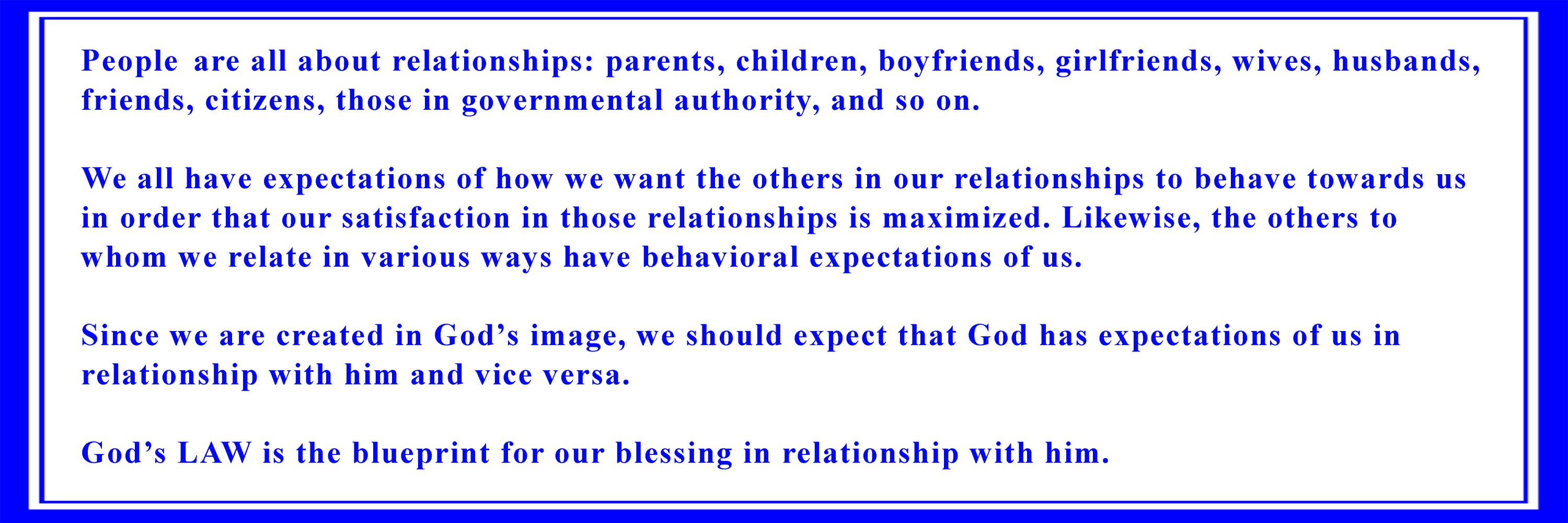
According to the Bible, God’s desire is to bless humankind.
ESV Genesis 1:28 And God blessed them. And God said to them, “Be fruitful and multiply…”
God blesses people with himself, since as God, he himself is the greatest possible blessing. To know God and to be in a good relationship with him is the greatest possible blessing a human being can ever have. God’s law, according to the scriptures quoted above and many like them, is the means to the greatest possible blessing of having a good relationship with God.

III. Tragedy Strikes
A. The Old Testament is the historical record of how humankind in general and one special, called people in particular, failed to follow God’s law and thereby failed to receive God’s blessing of an ongoing, fruitful relationship with himself.
B. In the Old Testament human will and raw obedience were the only means at people’s disposal for following God’s law. In spite of God’s gracious provision of a sacrificial system to make amends for people’s failures to follow the blueprint he gave them in order to build a blessed relationship with himself, they still failed.
The Old Testament can be summarized as: The Law and Humankind’s Failure to Follow It
IV. A New Way
The New Testament can be summarized as: The Law and Humankind’s Success in Following It
A. God didn’t quit: he gave people a new way to obey his principles and to come into a blessed relationship with himself.
B. He sent the perfect man who did follow his law, the blessed man of Psalm 1.
C. Jesus Christ fully obeyed God’s law and became the human sacrifice that opened the door to mankind’s restored relationship with God.
ESV 2 Corinthians 5:21 For our sake he made him to be sin who knew no sin, so that in him we might become the righteousness of God.
D. God provided that simply by believing in Christ–by saying yes to Christ–that Christ’s obedience to the Law would apply to everyone who accepts Christ as the solution to their lives.
E. God also gave his Holy Spirit to live on the inside of those who receive the solution of Christ. The Holy Spirit helps people to follow God’s law the way Christ did, which means pleasing God and being blessed in relationship with him.
ESV John 14:16 And I will ask the Father, and he will give you another Helper, to be with you forever,
ESV John 15:26 “But when the Helper comes, whom I will send to you from the Father, the Spirit of truth, who proceeds from the Father, he will bear witness about me.
NLT Romans 8:1 So now there is no condemnation for those who belong to Christ Jesus. 2 And because you belong to him, the power of the life-giving Spirit has freed you from the power of sin that leads to death. 3 The law of Moses was unable to save us because of the weakness of our sinful nature. So God did what the law could not do. He sent his own Son in a body like the bodies we sinners have. And in that body God declared an end to sin’s control over us by giving his Son as a sacrifice for our sins. 4 He did this so that the just requirement of the law would be fully satisfied for us, who no longer follow our sinful nature but instead follow the Spirit. 5 Those who are dominated by the sinful nature think about sinful things, but those who are controlled by the Holy Spirit think about things that please the Spirit. 6 So letting your sinful nature control your mind leads to death. But letting the Spirit control your mind leads to life and peace.
Psalms is where the life of Christ–his obedience to the Law, his prayers of praise and supplication for help, his sacrificial death, his resurrection and final victory–is played out in Hebrew poetic prophecy.
Previous in Psalms
Next in Psalms
Beauty Day 172
Find one beautiful thing every day and take a photo of it.
Philippians 4:8 Finally, brothers, whatever is true, whatever is honorable, whatever is just, whatever is pure, whatever is lovely, whatever is commendable, if there is any excellence, if there is anything worthy of praise, think about these things.
♦
Beauty Day 172 Backyard
My friends’ backyard
is the prettiest backyard
I have ever seen
Mike is a landscaper/gardener
and now that I mention it
how strange…
every time I visit
he is sitting back relaxing
yet he alone does all this labor
mostly folk art
no classes no lessons
just a natural love
for beauty and color
finding ceramics, dinnerware
broken pieces of tile
he smashes–creates anew
creatures and birds
architecture and seas
while growing plants and flowers
is his specialty
talking birds participate
from their safe house just beyond
Mike’s a wonder
as is Claudia my friend
who prepares a meal fit for royalty
from their garden just below
what makes these people most special
is their love
for everyone
for me
for you
♦

Beauty Day 171
Find one beautiful thing every day and take a photo of it.
Philippians 4:8 Finally, brothers, whatever is true, whatever is honorable, whatever is just, whatever is pure, whatever is lovely, whatever is commendable, if there is any excellence, if there is anything worthy of praise, think about these things.
♦
Beauty Day 171 Graduation!
Square dance graduation
excited for my friends
as though they were family
a great achievement
120 calls in 9 months
and it’s true
they are like babies
we Angels will have to hold their hands
at every dance for about a year
until these seedlings take root
♦

Beauty Day 170
Find one beautiful thing every day and take a photo of it.
Philippians 4:8 Finally, brothers, whatever is true, whatever is honorable, whatever is just, whatever is pure, whatever is lovely, whatever is commendable, if there is any excellence, if there is anything worthy of praise, think about these things.
♦
Beauty Day 170 Spring Breakup of the River Ice
Every year in the north country
comes a day when river ice breaks up
it’s a day of celebration dancing singing
flowing good cheer
and it should be
because life continues
moves on to fuller days ahead
little did I know
as I lay sick and motionless
for nearly two weeks
that the ice pack was melting
and fissures deep within
perhaps because of stillness
with little outward stimulation
I had time to hear and could hear
the deeps within me creaking groaning
and finally the ice began to break
and so it begins again
new life new commerce
good cheer and miles of new roads up ahead
in short
paralysis died
after so many years
the bathroom is on its way
to getting some fix
and who know where that will lead?
what pray tell comes next?
♦

6 What Do Authors Say About Christ in Psalms?
Bibliography
Outline of Series
Are the Psalms about Jesus Christ?
Some say yes, to a great extent, while others limit their yes to specific “Messianic” verses quoted in the New Testament and labeled as such.
Among those who limit their “yes” are those who say that the original verses most likely referred specifically to some king in Israel’s past and down through a line of succession became applied to Christ. They might say that Christ “quoted” a psalm, such as Psalm 22:1 while hanging on the cross. By saying “quoted,” they mean that Christ appropriated the psalm and made it apply to himself. In other words, Christ did not originate the psalmic words at the moment he spoke them. By whatever means they may have entered his mind at the moment, he repeated what had already been written about someone else on a different occasion and then applied those words to himself and his own situation. This is quite different than saying that the original psalm meant Christ all along, even from the beginning.
Among those authors who say “yes!” unreservedly are those who may feel that the original words as first written were always prophetic utterances by the psalmists, which from the beginning point forward to the life and prayers of the Son of God during his incarnation. I fall into this category.
Most of the authors who write academic books and have good academic reputations, no matter what their opinions on the matter, build good biblical cases to support their views. Therefore, this author–myself, has come to the conclusion that whether or not any given reader perceives Jesus Christ of Nazareth, Son of God, in the psalms as written is a personal, subjective matter representative of the faith of that reader and the activity of the Holy Spirit in that reader’s heart. In other words, one’s belief occurs first, and the academic rationale follows. This means that for the most part, academic arguments will convince very few to change their minds.
For example, reading many academic arguments against my own point of view on this topic has never changed my mind that Christ in his incarnation is why God willed the psalms to be written. Does this indicate that I am close minded? No, it simply means that I continue to believe that I correctly heard God speak into my heart through the Holy Spirit via certain psalms that these words are the voice of Christ prophetically spoken through the psalmist. Yet because I do have an academic awareness, I simply kept searching until I found some academic arguments that match my own presuppositions, or in my case, experiences. (I am not saying that those who think differently than I do not believe in God or do not have faith in Christ.)
Because faith comes by believing and by the Holy Spirit, academic arguments perhaps most often fall short of leading one to either salvation or devotion. And because my great interest in Psalms is devotional, this blog presentation will be for the most part devotional. I am not seeking to build an academic argument. I am seeking to share what I have discovered and to lead others who may be so disposed to seek God in prayer to ask him to reveal Christ to their hearts through the Old Testament, and in particular through Psalms. The Holy Spirit can open to eager heart what Jesus himself opened to his disciples shortly after his resurrection:
Luke 24:25 And he said to them, “O foolish ones, and slow of heart to believe all that the prophets have spoken! 26 Was it not necessary that the Christ should suffer these things and enter into his glory?” 27 And beginning with Moses and all the Prophets, he interpreted to them in all the Scriptures the things concerning himself.
Luke 14: 44 Then he said to them, “These are my words that I spoke to you while I was still with you, that everything written about me in the Law of Moses and the Prophets and the Psalms must be fulfilled.” 45 Then he opened their minds to understand the Scriptures, 46 and said to them, “Thus it is written, that the Christ should suffer and on the third day rise from the dead, 47 and that repentance and forgiveness of sins should be proclaimed in his name to all nations, beginning from Jerusalem. 48 You are witnesses of these things.
Quotations from Authors Who Find Christ in Psalms
According to the witness of the Bible, David is, as the anointed king of the chosen people of God, a prototype of Jesus Christ. … And he is not unaware of this, but “being therefore a prophet, and knowing that God had sworn with an oath to him that he would set one of his descendants upon his throne, he foresaw and spoke of the resurrection of the Christ” (Acts 2:30 f.). David was a witness to Christ in his office, in his life, and in his words. The New Testament says even more. In the Psalms of David the promised Christ himself already speaks (Hebrews 2:12; 10:5) or, as may also be indicated, the Holy Spirit (Hebrews 3:7). These same words which David spoke, therefore, the future Messiah spoke through him. The prayers of David were prayed also by Christ. Or better, Christ himself prayed them [the prayers of Psalms] through his forerunner David [emphasis added]. (Bonhoeffer, Psalms, 18-19.)
The emphasized portion of the above quotation perfectly expresses my own perception of very many of the psalms, a conclusion I arrived at independently of Bonhoeffer. He goes on to explain how we as believers can pray the same prayers because and only because Christ prayed them first.
Not just those psalms that directly mention the king or aspects of his reign and kingdom are Messianic psalms. The New Testament implies that all psalms have a relationship to Jesus Christ [emphasis added]. Thus Psalm 31, which in its Old Testament context does not seem to have a Messianic emphasis, is messianic in the sense that it refers to the person or work of Jesus Christ, as is clearly shown in its use in Luke 23:46. This does not mean we are dependent on the New Testament for which psalms are Messianic because a broader principle is at work, a principle rooted in Jesus’ statements in Luke 24:44-47…this principle, which is the basis for the view that all the psalms relate to the person and/or work of Jesus Christ. (Belcher, The Messiah and the Psalms, 30.)
The psalter is the book most often quoted in the New Testament, with the same status as the prophets. David is given there the role of a prophet (Acts 2.30; 4.2). For their part, the rabbinical writings recognize the prophetic inspiration of David and the psalmists. This is clear from the Targum on the psalms: Ps. 14.1, ‘To praise, in the spirit of prophecy, through the intervention of David’; (Tournay, Seeing and Hearing God with the Psalms, 31). [Tournay cites many more examples.]
The greatest evil people can suffer is loneliness. But God has taken the initiative in overcoming this: thanks to the psalms, we can directly see and hear God (Tournay, Seeing and Hearing God with the Psalms, 32).
Previous Lesson in Psalms
Next Lesson in Psalms
Psalm 1: Introduction to the Psalter
Bibliography
Outline of Series
ESV Psalm 1:1 Blessed is the man who walks not in the counsel of the wicked, nor stands in the way of sinners, nor sits in the seat of scoffers;
2 but his delight is in the law of the LORD, and on his law he meditates day and night.
3 He is like a tree planted by streams of water that yields its fruit in its season, and its leaf does not wither. In all that he does, he prospers.
4 The wicked are not so, but are like chaff that the wind drives away.
5 Therefore the wicked will not stand in the judgment, nor sinners in the congregation of the righteous;
6 for the LORD knows the way of the righteous, but the way of the wicked will perish.
I. Observations
- This psalm lends itself to study by phrases rather than individual words.
- Phrases indicate two contrasting categories.
- What are they?
II. Two Contrasting Categories
Psalm 1: the Righteous (Vs 6) – Positive |
|
Psalm 1: the Wicked – Negative |
|
blessed (1-2) |
[synonyms:] wicked, sinners, scoffers |
||
action: walks not |
in the counsel of the wicked |
||
action: stands not |
in the way of sinners |
||
action: sits not |
in the seat of scoffers |
||
action: delights |
in the law of the Lord |
||
action: meditates |
on the Lord’s law day and night |
||
the righteous is like (vs 3): |
wicked are not like the righteous |
||
a tree planted by streams of water |
wicked are like: chaff |
||
yields its fruit in season |
the wind drives the chaff away |
||
leaf does not wither |
[results stated negatively:]will not stand in the judgment |
||
[restatement:] in all that he does he prospers |
will not stand in the congregation of the righteous |
||
[conclusion:] (6) for the Lord knows the way of the righteous |
[results stated positively:]the way of the wicked will perish |
||
Paraphrase of final outcome for righteous:The righteous will prosper.They will live in the company of the Lordand in the company of the other righteous.Life, Inclusion |
Paraphrase of final outcome for the wicked:The wicked will not prosper.They will die.They will be excluded from the Lord’s presenceand from the collected gathering of the righteous.Death, Exclusion |
||
III. Questions and Response
1. Verse 6 says, “for the Lord knows the way of the righteous.” What does it mean for the Lord to “know the way of”? What is involved here?
a. to see, be aware of, be intimately acquainted with: ESV Psalm 31:7 I will rejoice and be glad in your steadfast love, because you have seen my affliction; you have known the distress of my soul,
b. to know something in its entirety from beginning to end; this includes the element of knowing the future: ESV Psalm 37:18 The LORD knows the days of the blameless, and their heritage will remain forever;
c. to know in the sense of receiving and treating someone as a friend, to approve: ESV Nahum 1:7 The LORD is good, a stronghold in the day of trouble; he knows those who take refuge in him.
d. Jesus uses the word in the sense of receiving, owning (as the shepherd a sheep), protecting, guarding, watching over carefully: ESV John 10:14 I am the good shepherd. I know my own and my own know me,
e. to be able to distinguish from among many others and to acknowledge this friendship publicly: ESV 2 Timothy 2:19 But God’s firm foundation stands, bearing this seal: “The Lord knows those who are his,” and, “Let everyone who names the name of the Lord depart from iniquity.” (quoted from NET Numbers 16:5)
f. “the way of”: “NET Notes: ‘way of the godly’ is not their behavior, but their course of life or destiny;”
g. “The Lord knows the way of the righteous,” could be paraphrased as, “The Lord is intimately acquainted with every detail of the heart and life of the righteous person from start to finish; he approves of this person, lays claim to him or her as his own, and promises to look after her in an all powerful, protective way, even up to and including eternity.”
2. What does “perish” mean in verse 6?
perish: to be ruined, broken, carried off, lost, destroyed, exterminated2. Do the categories seem black and white to you? How do you feel about that?
3. Does God’s word change because we don’t like it? What might be a wise course for us?
4. Do you think there might be a “fudge factor” within the categories? What might be a theological word to describe God’s “fudge factor?”
5. Reread verse 6: for the LORD knows the way of the righteous, but the way of the wicked will perish. Do you think this might be a good thematic summary of the entire Psalter? Why or why not? Do you think this one verse sums up the message of the entire Bible? Defend your position one way or the other.
IV. What other questions do you have? As we read more of Psalms, we will come to a better understanding of what the words “righteous” and “wicked” mean within the context of Psalms. In brief, these terms describe a person’s attitude (what is in a person’s heart, the person’s desires and motivations) toward the Lord God and his Word, rather than a person’s actions. Action follow attitude.
V. Christ in Psalm 1
While it cannot be “proven” academically that Christ is “the man” of Psalm 1, nothing prevents the Holy Spirit from revealing Christ as such in the hearts of believers.
ESV Psalm 1:1 Blessed is the man who walks not in the counsel of the wicked, nor stands in the way of sinners, nor sits in the seat of scoffers;
ESV Psalm 80:17 But let your hand be on the man of your right hand, the son of man whom you have made strong for yourself!
ESV Psalm 110:1 A Psalm of David. The LORD says to my Lord: “Sit at my right hand, until I make your enemies your footstool.”
ESV John 19:5 So Jesus came out, wearing the crown of thorns and the purple robe. Pilate said to them, “Behold the man!”
Previous in Psalms
Next in Psalms
What Are Psalms?
Link to Bibliography
Psalms are songs, prayers, meditations, prophecy, and a look into the deepest heart of Christ the Son during the period of time of his incarnation. Just as the Lord inhabits the praises of his people (Psalm 22:3), so the Holy Spirit brings to life the Psalms within the hearts of believers everywhere. This Bible study is a place intended to encourage us all to read, read, and read the Psalms so that contact with Christ, God, and the Holy Spirit will be made within their words.
Text:
I recommend the little book 31 Days of Wisdom and Praise (See Bibliography, Jones) for the reasons of its NIV translation and for the special numerical arrangement of the Psalms. While it is not necessary to buy this book, the little pocket paperback is highly attractive and convenient. The special numerical arrangement, however, can be followed from any Bible. In this arrangement, the psalms are presented according to the days of the month. On the 1st of each month, for example, the reader finds Psalms 1, 31, 61, 91, and 121. Then, continuing the example, on the 14th, the reader will find Psalms 14, 44, 74, 104, and 134. Everyone who follows this sequence will read the entire Psalter in one month.
When finished, begin reading it again, and again, and again. Sooner or later, God will sometimes and occasionally speak the words of the Psalter into your heart, as he meets you in your own particular life situation, Sitz im Leben. When he does this, you will have fellowship with God the Father and God the Son through the Holy Spirit within the words of Scripture.
Why Read the Psalms?
- To see Christ in his humanity.
- Of greatest value to me personally has been the realization that Jesus himself prayed most of these psalms during his sojourn of trial and suffering while a man on earth. Seeing and understanding this great Love leads me to worship Jesus the Son and God, the Father who loved the world so much that he gave his Son to suffer and to be crucified by the world.
- In addition to having fellowship with the Father and his Son through the Holy Spirit, reading the Psalms cyclically, repeatedly, and horizontally (as described in the preceding section) develops an awareness of the unity of the Psalms as a whole, the themes they develop, and the movement of content from one form to another, for example, from lament and petition to praise and thanksgiving.
- There is a Story contained in the Psalms as a whole.
- You will begin to recognize that God is love, that he loves his people unceasingly and without limits, and that he loves you in particular.
- Close familiarity with the vocabulary and language of the Psalms will also help you as you read other biblical books, especially books in the New Testament. You will begin to hear echoes of particular psalms in the speech and allusions of various New Testament writers and characters.
For example, after repeated reading of Psalm 1 from a literal translation, such as the English Standard Bible, when Pilot steps out from his private chamber, points at Christ, who has just been flogged and is about to be crucified, and says, “Behold, the man…” (John 19:5), by grace of the Holy Spirit, it becomes impossible not to hear in Pilot’s words an echo of the word “man” in the phrase “Blessed is the man…” in Psalm 1:1. Christ is “the man” who is blessed both in Psalm 1 and in the vast majority of the psalms. From Psalms, we learn about the physical and especially the internal suffering of God’s Son more than we do from any other biblical book. This awareness leads to a greater depth of worship and love for the Lord, as well as a deeper comprehension of the Bible’s proclamation, “God is love” (1 John 4: 8, 16). And we ask ourselves, how is it that flogging and crucifixion lead to a pronouncement of blessing? This is theology at a deep and fine level.
Topics of Consideration in this Bible Study of Psalms:
As the weeks progress, our study will lead us into consideration of:
- content, meaning
- categories of people and ideas
- theology
- forms, such as lament, praise, and thanksgiving
- rhetorical style, such as the presence of blocks of dialogue
- identification of speakers
- New Testament quotations and use of the Psalms
- poetical devices
- the five books within Psalms
- the place and importance of the Septuagint in reading and understanding the Psalms
In addition to being a written study published on this blog, there is a corresponding “live” Bible study for a small group of women who meet weekly. Clearly, we will not attempt to cover all of the topics listed above for each and every psalm we study, especially since the purpose of the study is to lead us into the presence of God, rather than into an academic understanding of an ancient Hebrew book. Rather, as various of the above topics become relevant for the psalm(s) under consideration that week, topics will be introduced as aids to appreciation.
Descriptive Summary:
My intent is to make this study a devotional study with just enough academic overtones to guide and encourage devotional use of the Psalms. May the Lord bless us all.
Ways to Increase Personal Engagement with a Devotional Reading of Psalms
- As mentioned above, read and reread again and again and again
- Read the Psalms out loud with only yourself present in the room
- Journal as you read in a simple statement/”my response ” format
- Try different translations, including a true to text paraphrase, such as the New Living Translation (NLT)
Link to Beginning of Series Link to Next in Series
 One Small Voice