Home » 2022 (Page 5)
Yearly Archives: 2022
Sion Complains: Journal 2.63
By Christina M Wilson
… chapter by chapter context clues continued. In this post, Sion complains, and Isaiah presents God’s response.
Recap: Descriptors of Faithful Israel
The purpose of the last several posts is to determine from previous context in Isaiah who the “barren” woman of Isaiah 54:1 might be.
1 Rejoice, you barren that bear not; break forth and cry, you that do not travail: for more are the children of the desolate than of her that has a husband: (Isaiah 54:1 Septuagint)
We have determined that this desolate one can be neither Gentiles (Devotional 2.56) nor apostate (faithless) Israel (Devotional 2.55). The thesis of these posts is that God in Isaiah distinguishes between the faithful and the unfaithful. His promises will be fulfilled in the faithful. Chapter 44 begins to indicate that the “barren” woman of 54:1 is faithful Jerusalem (Devotional 2.61). Chapter 48 (Devotional 2.62) develops the theme of God’s delivering Israel. He will rescue a remnant of all Israel. Nevertheless, the chapter divides into two sections. God speaks to rebellious hearts in the first, and to those whom he loves in the second.
Chapter Summaries
Chapter 49 opens with the Lord God announcing to Gentiles the arrival of God’s Servant. More and more as the book progresses, references to Gentile inclusion accompany Isaiah’s prophecies of the Servant’s arrival. The section concerning the Servant begins in 48:15, “I have spoken, I have called, I have brought him, and made his way prosperous” (Septuagint). “Him” refers to God’s special Servant. Readers can know this for three reasons.
1. Isaiah’s theme in the second portion of the book (chapter 40 forward) is the comfort God will bring Israel through his Servant.
2. The text refers frequently to the Servant throughout these chapters.
3. The Servant, so very blessed by God and so pleasing to him, becomes a major character in the second volume.
4. The Servant’s words in the very next verse, verse 16, indicate that he could not possibly be Cyrus the Persian.
48:16 Draw near to me, and hear you these words; I have not spoken in secret from the beginning: when it took place, there was I, and now the Lord, even the Lord, and his Spirit, has sent me (Septuagint–LXE).
Cyrus was not present with God “from the beginning.” (See Proverbs 8:22-31.) For those with ears to hear and receive, it also stands possible that the “he” of verse 21 also refers to the Servant (LXE).
THE SERVANT SPEAKS: GENTILE INCLUSION
The section of Isaiah 49:1-6 is popularly known as the Second Servant Song. God’s Servant speaks all of the words it contains. Interestingly, except for a brief pause in verses 4-5, the entirety of this passage is a call to Gentiles to come and be blessed along with “the tribes of Jacob and… the dispersion of Israel” (LXE). (See Isaiah Devotional 2.26.)
The “God of Israel” in verse 7 commands the people to sanctify (to set aside for God’s use and treat as holy) the Servant. The Servant is “him that despises his life” (Septuagint). As Paul explains to the Philippians, he (Christ) became nothing and willingly submitted to death on the cross (Philippians 2:6-8; see also Hebrews 12:2).
From verses 8-12, God explains to the Servant his mission to Gentiles. God’s words to his Servant in Isaiah are the forerunner of the Great Commission that Jesus the Christ the Servant passes on to his followers before he ascends into heaven at the end of his incarnation on earth (Matthew 28:18-20). The Servant shall speak to Gentiles and Israel. God the Lord tells his Servant to say “to them that are in bonds” to go forth, to leave the darkness and “be fed in all the ways.” The text mentions the word “pasture” twice in three verses. It uses “shepherd” language. Christ (the Servant) said, “I am the good Shepherd” (John 10:11, 14).
The entire shepherd passage in John 10:2-18 matches God’s intention in Isaiah 49 Septuagint perfectly. The “sheep that are not of this pen” (John 10:16) whom Christ says he must also bring, are the Gentile “nations” of Isaiah 49:1,6, and 8 Septuagint.
Verse 13 concludes the section that begins in Isaiah 48:16 with a very fitting command to rejoice.
13 Rejoice, you heavens; and let the earth be glad: let the mountains break forth with joy; for the Lord has had mercy on his people, and has comforted the lowly ones of his people. (LXE)
SION COMPLAINS
But just then, after this wonderful scenario of health and well-being that God will bring to the entire earth through his Shepherd, Sion complains. “Sion” here is a term of intimacy. The elder son’s moping response to the inclusion of his wayward younger brother into his father’s family once again (Jesus’s Parable of the Prodigal Son in Luke 15:25-32) resembles so much Sion’s response to the wonderful news of God’s magnificent provision, as explained in the previous paragraphs.
14 But Sion said, The Lord has forsaken me, and, The Lord has forgotten me. (LXE)
GOD REPLIES
God’s reply to the “moping” Sion makes two points. Together, these stretch into chapter 50.
I. “I will not forget you” (Septuagint Isaiah 49:15-26).
A. God proclaims that he loves Sion more than a mother loves her own child (49:15-16).
B. He does have plans for her. She will be rebuilt (49:17).
C. Sion’s own sons will return (49:18-21).
D. God will include Gentiles in the building up of Sion (49:22-23). The children of the nations will value the heritage of Israel and not let fall a speck of dust be lost or wasted.
E. The Lord will deliver Jacob from the Babylonians that afflicted them (49:24-26)
II. You Brought This on Yourselves (Septuagint Isaiah 50:1-3).
God replies with his second argument to Sion, paraphrased: You say that I abandoned you. What are the charges on your mother’s document of divorce? “Behold, you are sold for your sins, and for your iniquities have I put your mother away” (50:1). I did come, and there was no one to meet me. I called, and there was no one to listen (50:2). Don’t think that I have no power. I have plenty of power. And before this whole story is over, you will see me clothe the sky with darkness and make its covering as sackcloth (50:2-3).
RETURN TO THE SERVANT IN THE THIRD SERVANT SONG
God in chapter 49 has been presenting the glories of his Servant to his people and to the nations. Sion interrupts in 49:14 to complain by bringing false charges against God (see above). God answers their complaint in 49:15-50:3. Then immediately, in the very next verse, God returns to the topic at hand, which is his Servant. The Third Servant Song begins in Isaiah 50:4. There, the Servant speaks. (We will continue the Servant’s Song in a future post.) But first, what about the context of chapter 49 as it relates to the barren woman?
THE “BARREN” WOMAN OF 54:1
Chapter 49 builds a foundation for the barren woman of chapter 54.
1 Rejoice, you barren that bear not; break forth and cry, you that do not travail: for more are the children of the desolate than of her that has a husband: for the Lord has said, 2 Enlarge the place of your tent, and of your curtains: fix the pins, spare not, lengthen your cords, and strengthen your pins; 3 spread forth your tent yet to the right and the left: for your seed shall inherit the Gentiles, and you shall make the desolate cities to be inhabited.
… to be continued
Happy Easter!
IS CHRIST’S RESURRECTION HISTORICAL?
By Christina M Wilson
Sometimes Christians will hear a so-called “scholar” or nay-sayer proclaim that the resurrection of Jesus from the tomb is not “historical.” Yes, it is historical, and here’s why.
In 2004 I had the blessed experience to accompany the mother of a close friend back to her home on a commune near Haifa. Towards the end of my trip, I had a few days on my own. I visited Jerusalem.
When it was time to leave, I wandered around the streets just outside the old city walls looking for a bus stop. I happened upon a quiet sign that read, “Garden Tomb.” A short while later, I sat alone in a dug out portion of rock in the face of a small cliff.
I sat for some time waiting for a “spiritual message” as I read various Scriptures posted on the wall. One said, “He is not here; he has risen, just as he said. Come and see the place where he lay.” –Matthew 28:6. All else lay quiet, including my heart.
Eventually, the message broke through to me, “He is not here.” Indeed, except for myself, the tomb remained quite empty. So, I also left. What is the point?
What this “doubting Thomas” learned is that Jesus is not in his tomb. I saw it with my own eyes. And this whole experience has remained with me over the years. It is part of my “history” with the Lord—a personal interaction he and I experienced together. There are many, many more.
This Easter, ask your friends who claim to know the Lord what their history is with him. Everyone who claims to know the Lord has such a history. It’s called their testimony. Maybe someone might want to share theirs below.
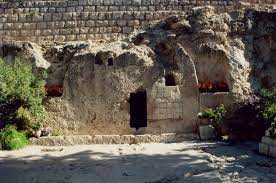
The first photo below is what the tomb looks like, a la Wikipedia. I lost the photo taken of me by some passersby. (But I was still wearing a long black jacket and carrying a black backpack purse–just like today!
The second photo is one I took inside the city walls. It reminds me that Jesus said, “I am the bread of life.”

Chapters 45-48: Journal 2.62
By Christina M Wilson
… chapter by chapter context clues continued
Recap: Descriptors of Faithful Israel
The purpose of the last several posts is to determine from previous context in Isaiah who the “barren” woman of Isaiah 54:1 might be.
1 Rejoice, you barren that bear not; break forth and cry, you that do not travail: for more are the children of the desolate than of her that has a husband: (Isaiah 54:1 Septuagint)
We have determined that this desolate one can be neither Gentiles (Devotional 2.56) nor apostate (faithless) Israel (Devotional 2.55). The thesis of these posts is that God in Isaiah distinguishes between the faithful and the unfaithful. His promises will be fulfilled in the faithful. Chapter 44 begins to indicate that the “barren” woman of 54:1 is faithful Jerusalem (Devotional 2.61).
Chapter Summaries
Isaiah chapter 45 declares the sovereignty and might of God. God defends himself very strongly as creator of all things. He even states that he creates darkness and evil (45:7). Devotional 2.21 develops this chapter with God as its subject. Chapter 45 anticipates the role of God’s Servant. It uses Cyrus the Persian as a type. In verses 20-22, God makes a special appeal to Gentiles to turn to him and “be saved” (verse 22). Chapter 45 does not appear to add to the theme of Jerusalem or Israel as the “barren” one of chapter 54:1.
In chapter 46 God turns from defending himself to describing the idol worship of Israel. The description God gives of idolatrous Israel does not use the word “barren.” Nevertheless, this short chapter describes an Israel that spiritually walks through deserted places away from God. God calls the unfaithful to repentance. He promises salvation and glory for Sion (verse 13).
God through Isaiah speaks directly to Babylon for the entirety of chapter 47. He refers to her as a “virgin daughter” (verse 1). He continues the motif of addressing the Babylonian kingdom as a female person throughout the chapter. God speaks nothing about Israel in chapter 47.
Chapter 48 presents a classic example of God’s “flip-flop” of attitude toward Israel. In the first eleven verses God addresses unfaithful Israel. See below some of the phrases he uses.
1 Hear these words, you house of Jacob, who are called by the name of Israel, and have come forth out of Juda, who swear by the name of the Lord God of Israel, making mention of it, but not with truth, nor with righteousness; 2 maintaining also the name of the holy city, and staying themselves on the God of Israel: the Lord of hosts is his name… [My comment: The text leaves no room for doubting that God addresses those who call themselves by the name of Israel.] … 4 I know that you are stubborn, and your neck is an iron sinew, and your forehead brazen. 5 And I told you of old… lest you should say, My idols have done it for me; and should say, My graven and molten images have commanded me… 8 You have neither known, nor understood, neither from the beginning have I opened your ears: for I knew that you would surely deal treacherously, and would be called a transgressor even from the womb. 9 For my own sake will I show you my wrath, and will bring before you my glorious acts, that I may not utterly destroy you. 10 Behold, I have sold you, but not for silver; but I have rescued you from the furnace of affliction. 11 For my own sake I will do this for you, because my name is profaned; and I will not give my glory to another. (LXE)
TO PARAPHRASE:
God in the previous passage addresses a people whom he identifies clearly. People know them by the name of Israel. They identify themselves with the holy city [Jerusalem]. But they do so falsely. They also pretend to rely upon God. In reality, they worship idols, stubbornly and boldly. God did not ever “open their ears” to understand him. He knew that they would “deal treacherously” and transgress from the time even before they were born (verse 8). God would have destroyed them, but this would not look good before the nations. Because they call themselves by Israel’s name, God rescued them. He did this for his own honor and glory, not for their sakes.
THE FLIP-FLOP
Immediately after this diatribe, God again addresses Jacob and Israel (verse 12). But the Septuagint presents a major difference between this address and the one immediately prior.
48:12a Hear me, O Jacob, and Israel whom I call… (LXE)
The Septuagint uses the word “call” in present tense. The various English translations of the Masoretic use past tense. The difference is subtle. Past tense indicates that the calling was done in the past (obviously). This leads a reader to assume that God addresses the same group of people in verse 12 whom he addresses in verses 1-11. But this is not necessarily so.
Two Groups
The Greek word “call” (καλέω, ka-le-oh) is the same word Paul uses in Romans 8:30 and Matthew in Matthew 2:15. Now, God in Isaiah 48:8 states that he did not open the ears of the Israel whom he addresses in that prior section. If their ears were not open to hear, then they would not hear God calling them. The second group of addressees, however, God does call. He calls in expectation that they will hear and obey.
Therefore, it seems highly likely that within the people known as “Israel” are two kinds of people. One type of person is what today we would label a “false believer.” This is someone who goes by the name of “believer” and perhaps behaves and speaks as though they were believers. But their profession is false. In reality, they are far from God. The other type of person is one whom God himself certifies that he himself called.
Today, we all recognize two types of “believers” in the Christian church. This is indeed why Matthew warns against wolves within the church who dress in sheep’s clothing (Matthew 7:15). If such different kinds of believers exist in the Christian church, why would they not be present in God’s Old Testament congregation of “Israel”?
GOD’S WORDS TO THOSE HE CALLS
48:12 Hear me, O Jacob, and Israel whom I call; I am the first, and I endure for ever. 13 My hand also has founded the earth, and my right hand has fixed the sky: I will call them, and they shall stand together. 14 And all shall be gathered, and shall hear: who has told them these things? Out of love to you I have fulfilled your desire on Babylon, to abolish the seed of the Chaldeans. 15 I have spoken, I have called, I have brought him, and made his way prosperous. 16 Draw near to me, and hear you these words; I have not spoken in secret from the beginning: when it took place, there was I, and now the Lord, even the Lord, and his Spirit, has sent me. 17 Thus says the Lord that delivered you, the Holy One of Israel; I am your God, I have shown you how you should find the way wherein you should walk. 18 And if you had listened to my commandments, then would your peace have been like a river, and your righteousness as a wave of the sea. 19 Your seed also would have been as the sand, and the offspring of your belly as the dust of the ground: neither now shall you by any means be utterly destroyed, neither shall your name perish before me. 20 Go forth of Babylon, you that flee from the Chaldeans: utter aloud a voice of joy, and let this be made known, proclaim it to the end of the earth; say you, The Lord has delivered his servant Jacob. 21 And if they shall thirst, he shall lead them through the desert; he shall bring forth water to them out of the rock: the rock shall be cloven, and the water shall flow forth, and my people shall drink. 22 There is no joy, says the Lord, to the ungodly. (LXE)
COMPARISONS AND CONTRASTS
1. Notice that God calls this second group “out of love” (verse 14). The first group he delivered for the sake of his own name and glory (verses 9, 11).
2. Although this group also sinned against God and suffered discipline at his hand, nevertheless, God spares a remnant, just as he does for the first group (verses 9, 18-19).
3. The tone of this address is completely different (verses 20-21 versus 8-11).
4. As if to ward off confusion, God states strongly that the “ungodly” will have no joy. Because the group God addresses in verses 1-11 are ungodly, readers can apply verse 22 to them.
THE SERVANT
Septuagint verses 15 and 16 appear to refer to God’s Servant.
15 I have spoken, I have called, I have brought him, and made his way prosperous. 16 Draw near to me, and hear you [plural] these words; I have not spoken in secret from the beginning: when it took place, there was I, and now the Lord, even the Lord, and his Spirit, has sent me.
Chapter 48 closes immediately prior to the Second Servant Song of Isaiah 49:1-6. Verses 15 and 16 in the Septuagint follow the First Servant Song of Isaiah 42:1-7. This passage, therefore, falls within the context of God’s Servant. God speaks verse 15, while the Servant speaks verse 16. Readers may conclude that God will pour his blessings on this second group of Israelites by means of his Servant. (LXE) (See also Devotional 2.24: Messiah Speaks.)
CHAPTER 48: CONCLUSION
While the text of chapter 48 makes no specific mention of the “barren” woman (Septuagint Isaiah 54:1), it does delineate two kinds of Israelite: the strongly disobedient and another group, those whom God calls. The alternative to this conclusion–that there is only one group whom God addresses in both portions of chapter 48–leads readers to conclude that God’s chastisements are ineffectual. Readers might also conclude that God’s will is weak or that he cannot make up his mind. If God bestows the blessings of chapter 48 upon all Israel regardless of the condition of their hearts, then readers might conclude that for an Israelite the state of their faith does not really matter. In other words, why should they worship God? Why not cling to their idols, since God’s blessings will fall upon them anyway? But I strongly believe that chapter 48 does not state this. Those whose hearts remain closed off to God will not receive his blessings of joy (Isaiah 48:22).
Faithful Israel: Journal 2.61
By Christina M Wilson
… chapter by chapter for context clues continued
Recap: Descriptors of Faithful Israel
The purpose of the last several posts is to determine from previous context in Isaiah who the “barren” woman of Isaiah 54:1 might be.
1 Rejoice, you barren that bear not; break forth and cry, you that do not travail: for more are the children of the desolate than of her that has a husband: (Isaiah 54:1 Septuagint)
We have determined that this desolate one can be neither Gentiles (Devotional 2.56) nor apostate (faithless) Israel (Devotional 2.55). The thesis of these posts is that God in Isaiah distinguishes between the faithful and the unfaithful. His promises will be fulfilled in the faithful.
Chapter Summaries
Septuagint Isaiah chapter 44 begins to pull various strands together. Recall that chapter 43 closed on a note of chastisement. Chapter 44 opens with comfort and encouragement. God in the middle portion of chapter 44 again condemns idolaters. Finally, the chapter closes with joy, encouragement, and specific mention of Cyrus. God will bless Cyrus with wisdom and use him to accomplish his plans.
DETAILS
I. Terms of Love
Chapter 44 abounds with declarations of God’s love for Jacob, Israel, and Jerusalem. There is no reason to think that these are not all one and the same entity. A few examples follow.
- … hear, Jacob my servant; and Israel, whom I have chosen. (verse 1, LXE)
- … fear not, my servant Jacob; and beloved Israel, whom I have chosen. (verse 2, LXE)
- … who says to Jerusalem, You shall be inhabited; and to the cities of Idumea, You shall be built (verse 26, LXE)
II. Promises of Blessing with Qualifiers
God promises amazing things to his servant Jacob, his beloved and chosen Israel, and to Jerusalem. In verse 2, God states that Jacob and Israel will “yet be helped.” But verse 3 appears to qualify with a specific statement those to whom the help will come.
3 For I will give water to the thirsty that walk in a dry land: I will put my Spirit upon your seed, and my blessings upon your children: (LXE)
In verse 3, God specifies that the water he gives will go “to the thirsty.” And he describes these as they who “walk in a dry land.” This language begins to resemble Isaiah 54:1, “the desolate.” Similar descriptive terms also appeared in the prior chapter in Isaiah 43:19.
19 Behold, I will do new things, which shall presently spring forth, and you shall know them: and I will make a way in the wilderness, and rivers in the dry land. (LXE)
The word “seed” in verse 3 is singular. In an ambiguous sense, this could perhaps refer to God’s Servant. Or, the word could simply apply to a group of Israel’s offspring. One cannot ignore the metaphorical overtones of the imagery. Spirit added to images of water and rivers of water anticipate Messiah’s use of these terms as metaphors for God’s pouring out his Holy Spirit (John 4:10, 14; 7:37-39).
III. A Further Qualifier
Verse 22 further describes the manner in which God will bestow his blessing upon Jacob and Israel. This verse contains three actions. God performs the first. He calls on Israel and Jacob to perform the second. And God performs the third.
22 For behold, I have blotted out as a cloud your transgressions, and your sin as darkness: turn to me, and I will redeem you. (LXE)
The three actions God specifies are these.
- God cancels Israel’s sin.
- He commands Israel, “Turn to me.“
- God will redeem them.
The word “redeem” means “to release on receipt of ransom” (Thayer). Those who read Isaiah, and especially Septuagint Isaiah, with open hearts begin to discover where much of New Testament theology has its origin. The Septuagint Scripture is the Scripture the disciples of Jesus and Paul the apostle read.
IV. Israel Is Israel
As mentioned previously, Septuagint Isaiah 44 breaks into three sections. In the first, God pronounces his blessing upon Israel and Jacob (verses 1-6). In the second, he denounces “all” idolaters without distinguishing where they live (verses 7-20). That is, these idolaters could go by the name of Israel, or they could be pagan (Septuagint Isaiah 44:9, 10, 11). In the third section, God again blesses Israel and Jacob (verses 21-24, 26-28). In verse 25, which falls in the middle of the section of blessing, God again reminds idolaters that he will frustrate their activities.
44:25 Who else will frustrate the tokens of those that have divining spirits, and prophecies from the heart of man? turning the wise back, and making their counsel foolishness; 26 and confirming the word of his servant, and verifying the counsel of his messengers: who says to Jerusalem, You shall be inhabited; and to the cities of Idumea, You shall be built, and her desert places shall spring forth. 27 Who says to the deep, You shall be dried up, and I will dry up the rivers. 28 Who bids Cyrus be wise, and he shall perform all my will: who says to Jerusalem, You shall be built, and I will lay the foundation of my holy house. (LXE)
Clearly, God does not include in his blessing those who practice false spiritism and prophesy falsely. Yet, even though some of these may be ethnic Israelites from Jerusalem and Judah, God does not forsake the names “Israel,” “Jerusalem,” and “Judah.” God distinguishes among different kinds of people, yes. But readers begin to see that God reserves the names of Jacob, Israel, Jerusalem, and Judah for the faithful. These are they who thirst (verse 3), repent (verse 22), and follow the words of God’s true messengers verse 26).
The Christian “church” presents a current parallel. Followers of Christ are called “the church.” Nevertheless, some who attend church and call themselves Christian are false teachers and even heretics. But the church does not cease being called the church for this reason. Likewise, God in chapter 44 calls his faithful followers Jacob, or Israel, or Jerusalem, or Judah. This does not mean that God blesses everyone who applies these names to themselves. Readers know this because over and over in this and previous chapters, God calls out and condemns those who walk disobediently away from him and his precepts.
V. God’s Promise to the Barren and Desolate
The vocabulary Isaiah uses in 44:23, 26, and 28 resembles the vocabulary of 54:1.
44:23 Rejoice, you heavens; for God has had mercy upon Israel: sound the trumpet, you foundations of the earth: you mountains, shout with joy, you hills, and all the trees therein: for God has redeemed Jacob, and Israel shall be glorified. (LXE)
44:26 … who says to Jerusalem, You shall be inhabited; and to the cities of Idumea, You shall be built, and her desert places shall spring forth… 28 Who bids Cyrus be wise, and he shall perform all my will: who says to Jerusalem, You shall be built, and I will lay the foundation of my holy house. (LXE)
54:1 Rejoice, you barren that bear not; break forth and cry, you that do not travail: for more are the children of the desolate than of her that has a husband… (LXE)
SIMILARITIES
The text of Isaiah 44 resembles the text of Isaiah 54:1 in several important ways.
1. Chapter 54 immediately follows the lengthy Fourth Servant Song of Septuagint Isaiah 52:13-53:12. And, chapter 44 closes with mention of Cyrus. Undoubtedly, verse 44:28 speaks to Israel’s local situation of exile in Babylonia. Additionally however, in Isaiah’s broader context, Cyrus becomes a type of God’s Servant. In both chapters 44 and 54, God’s Servant is he through whom God’s blessings flow.
2. Both texts contain commandments to “Rejoice!”
3. The proclamations in verses 44:26 and 28 that Jerusalem shall be “inhabited” and “built” imply that currently she is not inhabited and not built. Verse 28 indicates that God’s holy house does not even have a foundation. Likewise, the text of 54:1 describes the one whom the prophet commands to rejoice with the words, “barren,” who “bears not,” “you that do not travail,” and “desolate.”
4. The Greek phrase “children of the desolate” in 54:1 means literally “children of the desert.” This imagery corresponds with the earlier imagery of Isaiah 44:3-4.
44:3 For I will give water to the thirsty that walk in a dry land: I will put my Spirit upon your seed, and my blessings upon your children: 4 and they shall spring up as grass between brooks, and as willows on the banks of running water. (LXE)
54:1 … more are the children of the desolate [children of the desert] (LXE)
CONCLUSIONS
First, the context that Septuagint Isaiah 44 provides indicates that the barren, childless woman of Septuagint Isaiah 54:1 is faithful Jerusalem. God chose Jerusalem to house his temple. In chapter 44 he promises to rebuild the city and the temple. Definitely, chapter 44 speaks literally, to a physical city and a physical temple. Yet, 54:1 speaks with metaphor. The eyes of faith enable readers (both in Isaiah’s day and now) to perceive that chapter 44 also contains spiritual dimensions beyond the literal prophecy.
Second, the text amply demonstrates in chapter 44 and previous chapters that God does separate peoples. He distinguishes between those who receive the true words of his genuine prophets and those who follow the false narratives of their own hearts. In other words, God recognizes those who repent in truth (turn back to him, verse 22) against those who continue in their own ways with their backs turned away from God.
Finally, God calls his faithful by the names Israel and Jerusalem.
Israel Is One: Journal 2.60
By Christina M Wilson.
… continued from Devotional 2.59
Descriptors of Faithful Israel
At this point, we are moving through the very broad context of Isaiah 54:1 chapter by chapter in order to help us determine who the “barren” woman might be.
1 Rejoice, you barren that bear not; break forth and cry, you that do not travail: for more are the children of the desolate than of her that has a husband: (Isaiah 54:1 Septuagint)
We have determined that this desolate one can be neither Gentiles (Devotional 2.56) nor apostate (faithless) Israel (Devotional 2.55). The thesis of these posts is that God in Isaiah distinguishes between the faithful and the unfaithful. His promises will be fulfilled in the faithful.
Chapter Summaries
In Chapter 43 God appears to address Israel as a whole. He applies few direct labels, such as “those who hunger” (Isaiah 40:29-31). When he chastises, he chastises the whole of Israel. When he loves and forgives, he appears to love and forgive all of them. Israel is one. Nor does God choose a new or a different people. God keeps Israel.
43:2 … O Jacob… O Israel, Fear not: for I have redeemed you, I have called you by your name; you are mine. (LXE)
43:4 Since you became precious in my sight, you have become glorious, and I have loved you: (LXE)
Nevertheless, before the close of chapter 43, God again chastises Israel and Jacob. Chapter 43 exemplifies the problem God faces in the Old Testament: God loves his people, but his people reject him.
43:27 Your fathers first, and your princes have transgressed against me. (LXE)
43:28 And the princes have defiled my sanctuaries: so I gave Jacob to enemies to destroy, and Israel to reproach. (LXE)
“ISRAEL” LARGER THAN LOCAL
Isaiah chapter 43 also appears to indicate that God includes more people within the name “Israel” than the sum total of those sent to captivity, living in Babylon, or remaining on the land as a remnant.
43:5 Fear not; for I am with you: I will bring your seed from the east, and will gather you from the west. 6 I will say to the north, Bring; and to the south, Keep not back; bring my sons from the land afar off, and my daughters from the ends of the earth; 7 even all who are called by my name… (LXE)
SEPTUAGINT AMBIGUITY IN 43:7b-9a
Readers know that Isaiah introduces God’s Servant, Messiah (Isaiah 9:6-7; 42:1-7; 49:1-6; 50:4-9; 52:13-53:12). At this point in chapter 43, however, the prophet has not fully developed the Servant theme. Therefore, Septuagint Isaiah 43:7b and 43:15 appear to contain ambiguous foreshadows of God’s Servant.
43:7b for I have prepared him for my glory, and I have formed him, and have made him:
Who is “him”? This person could be a personification of Israel as a whole. In the largest context of Isaiah, however, “him” could mean God’s Servant. Isaiah 42:1-7 recently introduced him The verse immediately following the verse containing the reference to “him” describes God’s calling of the blind and deaf.
43:8 and I have brought forth the blind people; for their eyes are alike blind, and they that have ears are deaf. (LXE)
When Messiah came, he, of course, healed the physically blind and deaf (Matthew 11:5). He also called those who recognized and confessed their own spiritual blindness (John 9:40-41; Mark 2:16-17). This verse, then, does seem to distinguish a particular kind of people whom God brings forth. But, could this still be Israel as a whole? Yes, because all the people are “alike blind.”
NO PUNCTUATION
Greek text carries no punctuation. Moving on from mention of the blind and deaf, readers conceivably could connect Septuagint Isaiah 43:9a with the passage immediately prior (“I have prepared him for my glory” and “I have brought forth the blind people”) rather than what follows. That is, readers could place a strong semantic period after “shall be gathered out of them” (see below).
43:8-9a and I have brought forth the blind people; for their eyes are alike blind, and they that have ears are deaf. 9 All the nations are gathered together, and princes [rulers] shall be gathered out of them:
Verse 9a received fulfillment after the Servant’s death, resurrection, and ascension (1 Corinthians 6:2-3; 1 Peter 2:9).
CONCLUSION
The coming of God’s Servant, Messiah, solves God’s Old Testament difficulty.
- The Servant follows God’s law whole heartedly.
- The Servant calls the blind and deaf, who repent of their rebellion against God.
- God saves Israel.
- Septuagint Isaiah 43 demonstrates that God does not intend to abandon Israel. Further, Israel remains Israel. The chapter does indicate, however, that Israel’s tendency is to wander and rebel (verses 22-28). Verse 7 continues what Isaiah previously began in chapters 9 and 42–the introduction of a singular person who will glorify God, in other words, God’s Servant. He will gather the blind and deaf. In verse 8, God does not state that he will bring forth all the people of Israel. Rather, “I have brought forth the blind people.”
- The chapter’s prophecies extend beyond the strictly local.
- “bring my sons from the land afar off, and my daughters from the ends of the earth” (verse 6)
- “All the nations are gathered together” (verse 9)
BUT WHO IS THE “BARREN” WOMAN OF ISAIAH 54:1?
Unfortunately, the context of Chapter 43 does not appear to add information concerning her identity, at least not to this poor student.
Readers can find more on Septuagint Isaiah 43, at Septuagint Isaiah Devotional Journal 2.17.
Isaiah Labels Faithful Israel: Journal 2.59
By Christina M Wilson
… continued from Devotional 2.58
Descriptors of Faithful Israel
Chapter 40 indicates that God does not intend to bless “all Israel.” Rather, he chooses to bless those who hunger and wait on him. To “wait” in this sense, means to trust steadfastly in God alone. Often, as Christians, we pray to the Lord for our need. When a solution does not appear immediately, we may quit waiting for God and undertake ourselves. The matriarch Sarah abandoned her waiting upon God and convinced her husband Abraham to do so as well. Ishmael resulted from their impatience and lack of trusting God. Obedience to the Lord often involves quiet trust and waiting. (See also Isaiah 64:4.)
Chapter Summaries
God in chapter 41 does not at first glance seem to make distinctions among Israel. He appears mostly to speak to the people as a whole.
Examples:
- 14 Fear not, Jacob, and you Israel few in number; I have helped you, says your God, he that redeems you, O Israel.
- 27 I will give dominion to Sion, and will comfort Jerusalem by the way.
But then, a slow and careful reading reveals verses that may cause readers to pause and think that God does have a particular profile in mind.
Examples:
- 8 But you, Israel, are my servant Jacob, and he whom I have chosen, the seed of Abraam, whom I have loved: 9 whom I have taken hold of from the ends of the earth, and from the high places of it I have called you, and said to you, You are my servant; I have chosen you, and I have not forsaken you. 10 Fear not; for I am with you: wander not; for I am your God, who have strengthened you; and I have helped you, and have established you with my just right hand.
—Paul, as interpreter of Abraham and his seed, argues that “the seed of Abraham” includes those and only those who placed their faith in God. He explains this in Romans 4:16-18; 9:6-8; and Galatians 3:26-29. - 17 And the poor and the needy shall exult;
–The context of the statements in Isaiah 41:14-19 flows continuously from verse 8 above. Notice that God does single out the “poor and needy” for particular mention.
The first of four Servant Songs appears in Septuagint chapter 42:1-7. Verse 1 reads, “Jacob is my servant, I will help him: Israel is my chosen, my soul has accepted him; I have put my Spirit upon him; he shall bring forth judgment to the Gentiles.” This verse adds a new layer of meaning to Septuagint Isaiah 41:8, “But you, Israel, are my servant Jacob, and he whom I have chosen, the seed of Abraam, whom I have loved.” Matthew quotes 42:1-4, although he appears to do so from the Masoretic. The Masoretic writes, “Behold, my servant,” leaving out the label “Jacob,” which the Septuagint includes. (See Matthew 12:17-21 ESV.)
One of my principles of scriptural interpretation is that Christ taught his disciples to apply the light of his life, death, and resurrection upon Old Testament prophecy (Luke 24:27, 44-47). Therefore, Matthew’s application of the Isaiah passage is highly relevant. Now, Matthew didn’t merely apply the Isaiah passage to Christ, as though there were a different, original meaning. Rather, Jesus’s words in Luke indicate that the details the Old Testament prophets gave originally referred to himself. When he opens his disciples’ minds to “understand” and tells them that “it is written that the Christ should…,” he unequivocally means that these prophecies concerned himself in their original meanings and intent. The Septuagint bible brings these meanings forward to a greater extent than the Masoretic.
All this applies to our topic in a special way. God in Isaiah 41 and Isaiah 42 funnels his blessings to Israel through his Servant. The New Testament reveals the identity of God’s Servant as Jesus the Christ, Messiah.
A PARENTHESIS TO DISCUSS GENTILE INCLUSION IN CONTRAST TO A “MILLENNIAL” KINGDOM
My intention is to gather into a future post the many scriptures concerning God’s inclusion of Gentiles within the Servant’s flock. Here, however, I want to mention one point. If God intends special, exclusive blessings to “all Israel” as a nation (e.g., to rule the world in his name during a millennial kingdom), why would he consistently introduce the topic of Gentile inclusion in the multitude of prophecies concerning the Servant? Chapter 42 is filled with such references.
As a Christian, I read the verses below from Isaiah with the light Jesus supplies in Luke 24:45-47, “Then he opened their minds to understand the Scriptures… “Thus it is written, that the Christ should suffer… 47 and that repentance and forgiveness of sins should be proclaimed in his name to all nations, beginning from Jerusalem.” These words in Luke are among the very first which Christ spoke to his disciples after his resurrection. Minimally, a reasonable conclusion would be that God’s blessing of Gentiles weighed far more heavily on Christ’s resurrected heart than any supposed millennial kingdom. In fact, the resurrected Lord Jesus spoke so little, if at all, about a “millennial” kingdom that his disciples began to grow impatient. They asked him point blank just before his ascension when the kingdom would be restored to Israel (Acts 1:6). I believe it fair to say that he avoided replying directly (Acts 1:7).
DESCRIPTIVE LABELS IN CHAPTER 42
Here are some verses from Septuagint Isaiah 42 that indicate whom God will bless.
- 1 Jacob is my servant… Israel is my chosen… I have put my Spirit upon him; he shall bring forth judgment to the Gentiles.
- 4 … and in his name shall the Gentiles trust.
- 6 I the Lord God… have given you for the covenant of a race, for a light of the Gentiles:
- 7 to open the eyes of the blind, to bring the bound and them that sit in darkness out of bonds and the prison-house.
- 10 Sing a new hymn to the Lord: you who are his dominion, glorify his name from the end of the earth: you that go down to the sea, and sail upon it; the islands, and they that dwell in them. 11 Rejoice, you wilderness, and the villages thereof, the hamlets, and the dwellers in Kedar: the inhabitants of the rock shall rejoice, they shall shout from the top of the mountains. 12 They shall give glory to God, and shall proclaim his praises in the islands.
- 16 And I will bring the blind by a way that they knew not… I will turn darkness into light for them, and crooked things into straight… and will not forsake them.
And here is how God chastises those among his own people who refuse to see, hear, and obey.
17 … be you utterly ashamed that trust in graven images, who say to the molten images, You are our gods. 18 Hear, you deaf, and look up, you blind, to see. 19 And who is blind, but my servants? and deaf, but they that rule over them? yes, the servants of God have been made blind… 24 For what did he give to Jacob up to spoil, and Israel to them that plundered him? Did not God do it against whom they sinned? and they would not walk in his ways, nor listen to his law. 25 So he brought upon them the fury of his wrath; and the war, and those that burned round about them, prevailed against them; yet no one of them knew it, neither did they lay it to heart. (Isaiah 42:17-25)
… to be continued
Isaiah Labels Faithful Israel: Journal 2.58
By Christina M Wilson.
Volume Two: Verses Without “Remnant”
The text of Isaiah labels faithful Israel. The last devotional considered verses concerning faithful Israel that contain the Greek word “remnant.” All but one of these occur in Greek Septuagint Isaiah “Volume 1” (Link to prior post). Devotional 2.58 will move forward in examination of how Septuagint Isaiah labels faithful Israel without using the word “remnant.”
Overview
Volume Two of Septuagint Isaiah contains ample quantities of direct speech by God. Up to our present location in Isaiah 54:1 Septuagint, God directs a good portion of his speech to his people. Sometimes he chastises. He often warns. And, God’s words provide a great deal of comfort. Often, God alternates rapidly between words of chastisement and warning and words of comfort and blessing. As asked in previous posts (Isaiah Devotional 60, Isaiah Devotional 2.14), is God schizophrenic? Does he have multiple personalities? Do the frequent changes of tone in God’s speech and intention indicate a supreme being who waffles? Someone who cannot make up his mind? Do these frequent changes indicate uncertainty on God’s part? The thesis of this devotional blog on the Septuagint text of Isaiah is that God addresses differing groups of Israel’s people.
This is not to say that there are hard lines cast in cement between “this group and that group.” Rather, among the totality of ethnic Israel in Isaiah’s day, some people displayed hearts which in the long run sought to obey God, while others remained steadfastly rebellious and hard of heart in their behaviors concerning God. Perhaps one should call these different “kinds” of people, rather than groups of people.
The text of Isaiah labels, or tags, these different kinds of people within the ethnic body of Israel. Readers who observe carefully can distinguish to which sort of Israelite God speaks when he directly addresses his people. His message to each group is distinctly different.
Begin at the Beginning
Volume Two of Septuagint Isaiah speaks comfort to God’s people. The very first words announce this theme.
40:1 Comfort ye, comfort ye my people, saith God. 2 Speak, ye priests, to the heart of Jerusalem; comfort her, for her humiliation is accomplished, her sin is put away: for she has received of the Lord’s hand double the amount of her sins. (Brenton, Septuagint in English, LXE)
This text considers Israel as a whole. It appears to include everyone. Verse 9 adds the additional labels “Zion” and “cities of Juda.” Isaiah indicates no distinctions.
But then, verse 27 indicates a first hint of negativity on the part of God’s people. Not all is roses and sunshine.
40:27 For say not you, O Jacob, and why have you spoken, Israel, saying, My way is hid from God, and my God has taken away my judgement, and has departed? (Brenton, Septuagint in American English)
God then defends himself from these allegations in verse 28. The following three verses contain marvelous promises from God through the mouth of Isaiah his prophet. Note carefully, however, that God does specify with labels who exactly will receive these blessings. Further, he sets up contrasting categories of blessing versus non-blessing. The chart below the verse summarizes these.
40:29 He gives strength to the hungry, and sorrow to them that are not suffering. 30 For the young men shall hunger, and the youths shall be weary, and the choice men shall be powerless: 31 but they that wait on God shall renew their strength; they shall put forth new feathers like eagles; they shall run, and not be weary; they shall walk, and not hunger. (LXE)
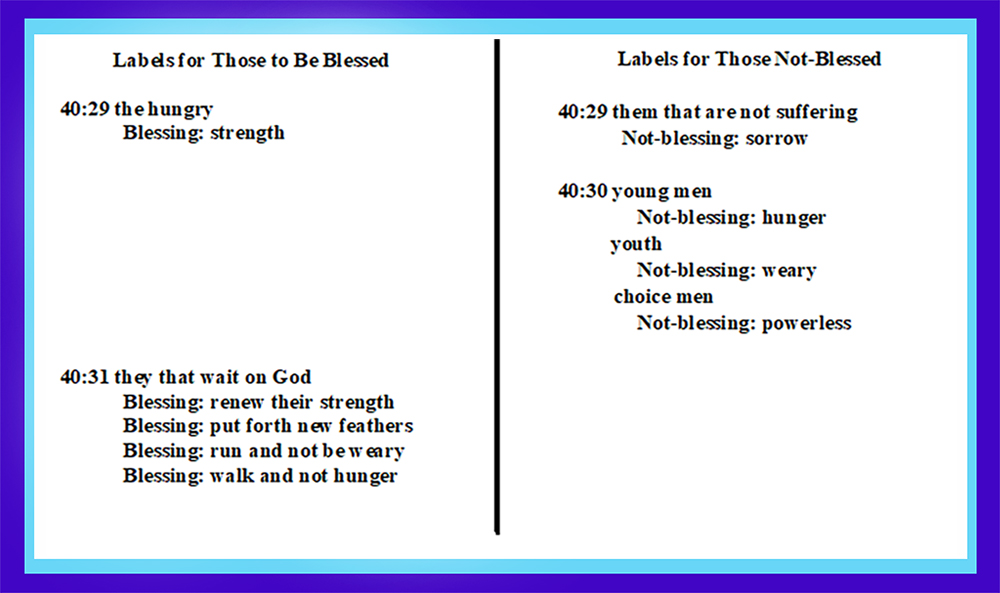
These verses demonstrate that God does make distinctions among those whom he chooses to bless or not-bless. Whatever else we may conclude about these categories, we clearly can see the profile of person, and in this case Israelite (verse 27), whom God chooses to bless.
… to be continued
The “Barren”–Faithful Israel: Journal 2.57
By Christina M Wilson.
The “Barren” Woman of Isaiah 54:1 Is Faithful Israel
Readers who have followed along this blog have discovered reasons why the “barren” woman of Isaiah 54:1 cannot be either Gentiles (Link to Devotional 2.56) or the unfaithful of Israel (Link to Devotional 2.55). God in the preceding chapters addresses two distinct audiences: 1) Israel’s hardened of heart, and 2) those whom God also chastises, but later calls and blesses. This post will further develop Isaiah’s recognition of different outcomes for those Israelites who rebel against God versus those whom God chooses to bless. The roadmap of this post is to demonstrate how Isaiah 54:1 lies on the path of those faithful Israelites whom God blesses.
Does Isaiah Distinguish Between the “Faithful” and “Unfaithful”?
Many would agree that the prophet Isaiah was not a “theologian” per se. Isaiah was not a theologian in the sense that the Apostle Paul was. And yet, when Paul received his knowledge of Christ by “revelation” (Galatians 1:11-12), part of that revelation surely included an enlightened understanding of the Old Testament (Luke 24:18-27). Paul relied heavily on the Old Testament (2 Timothy 4:13). He specifically quotes Isaiah six times, once in Acts (Acts 28:25-28) and five times in Romans. Four of those quotations occur in his discussion of what he calls the anguish in his heart concerning his kinsmen of Israel (Romans 9:27-33, 27, 29; Romans 10:16-21, 16, 20). Therefore, when considering the “Gospel of Isaiah” (Devotional 51), Paul remains highly relevant.
The gist of Romans 9-11 is that “not all who are descended from Israel belong to Israel” (Romans 9:6). Paul bases the argument of these chapters about Israel on the idea of the “remnant” of Israel (Romans 9:27-29). Paul’s thought, which he apparently garnered at least in part from Isaiah, is that the people of national Israel of the Old Testament will not all be saved. Only a remnant of ethnic Israelites, those who try in the long run to follow God, rather than rebel against him, receive God’s promise of salvation. The idea is that a necessary aspect of salvation includes belief in God (which means a faithful following of his way). God excludes the persistently disobedient from his promises of blessing, comfort, and salvation.
So, the question becomes, does Isaiah indeed distinguish among Israelites in this manner? And, what does this have to do with the barren woman of Isaiah 54:1? This post proposes that yes, Isaiah does distinguish between the faithful and unfaithful followers of God within Israel. Further, the barren woman represents the faithful only, not everyone.
Volume 1: The Remnant
Of the ten uses of the word “remnant” in Septuagint Isaiah with reference to Israel (not to other nations), nine of these occur in what we call Volume 1 (chapters 1 through 39). These are the ten occurrences, all from the Septuagint text: Isaiah 4:2; 4:3 twice; Isaiah 10:20, 21, 22; 11:11; 28:5; 37:32; and 46:3.
Here is the text of a few of the above examples, as they appear in the Septuagint.
4:2 And in that day God shall shine gloriously in counsel on the earth, to exalt and glorify the remnant of Israel. 3 And it shall be, that the remnant left in Sion, and the remnant left in Jerusalem, even all that are appointed to life [Greek, written for life, γραφέντες εἰς ζωὴν] in Jerusalem, shall be called holy. (1)
10:21 And the remnant of Jacob shall trust on the mighty God. 22 And though the people of Israel be as the sand of the sea, a remnant of them shall be saved. (Romans 9:27, 28)
28:5 In that day the Lord of hosts shall be the crown of hope, the woven crown of glory, to the remnant of the people.
Someone may object that in context the use of “remnant” simply indicates quantity, not character. I would reply that when Paul quotes Isaiah 10:21-22 Septuagint, he does so in the context of Israel’s having failed to reach the righteousness that is by faith (Romans 9:27-33). Even so, Isaiah does do more to develop the concept of faithfulness versus hardness of heart as the book progresses.
Volume 2: Israelites Hard of Heart
EXAMPLE ONE: ISAIAH 46
In Isaiah 46, two contrasting attitudes of God are displayed. Rather than perceive God as one who cannot make up his mind, as one who constantly flips back and forth in his resolve, it makes better sense to perceive by careful reading that God addresses two sets of people. One set he intends to save until the end. The other set receives stern words of warning. These words indicate that it is still not too late for them to change their ways and turn back to God. The Greek word “remnant” occurs in Isaiah for the last time in Septuagint Isaiah 46:3. Listen for the tone of forbearance and commitment to save which God expresses in these verses to his remnant.
3 Hear me, O house of Jacob, and all the remnant of Israel, who are borne by me from the womb, and taught by me from infancy, even to old age: 4 I am he; and until you shall have grown old, I am he: I bear you, I have made, and I will relieve, I will take up and save you.
A footnote in Brenton’s translation indicates that the English word “relieve” represents a Greek word that can mean “put up with.” We still use this phrase in exclamations of exasperation, “How do I put up with you?” Other translations emphasize the word’s connotation of child-training. Make note of God’s commitment to these people. He comforts them with promises of enduring help and salvation. The two verses say little or nothing about the character of these whom God bears.
Immediately afterward, however, God’s tone changes dramatically to displeasure and stern warning. His words also describe the character and actions of the addressees. In the Septuagint, God labels them, “You that go astray.”
5 To whom have you compared me? see, consider, you that go astray. 6 They… make idols, and bow down, and worship them… repent, you that have gone astray, return in your heart… 12 Listen to me, you senseless ones, that are far from righteousness: 13 I have brought near my righteousness, and I will not be slow with the salvation that is from me: I have given salvation in Sion to Israel for glory. (Isaiah 46:5-13 Septuagint)
In this example, God does not go so far as to say that he will withdraw his blessing from these people. However, his displeasure and warning to them is clear. There are two paths, God says in effect. Your path is far from me. You choose to make idols and then worship them. You rely upon these lifeless creations of your own hands to help you. But I am the source of righteousness. I will give my “salvation in Sion to Israel for glory.”
The question is, Does God address the same group of people as in the previous two verses? Does he tell the same people that he is committed to save them unconditionally, as it appears in the first two verses, and then in the very next breath warn the same people that they are far from his righteousness? At this point in Volume 2 it may be difficult to answer this question. As the book progresses, the indications that God addresses two entirely distinct audiences becomes stronger.
There is one thing, however, that we can notice here. The text does not say, “All Israel will be saved no matter what.” God does not moddy-coddle these disobedient people of ethnic Israel and say, “It’s okay, I will change your heart in the end. Don’t worry. My salvation for you is inevitable. The world will move over for you, and they will be happy to do so.” No. Rather, God warns these ones who turn their backs to him that they are far from the path of his righteous blessing and salvation. He places a burden upon his listeners to repent. The next post will provide, Lord willing, more examples from Isaiah for us to consider.
… to be continued
__________
1 Compare Isaiah 4:3 Septuagint with Revelation 13:8; 17:8; 20:12; and 21:27.
The “Barren”–Not Gentiles: Journal 2.56
By Christina M Wilson.
Recap
The prior post (Link) discusses why the “barren” or “barren woman” of Isaiah 54:1 is most likely not apostate Israel. This post discusses why the barren does not refer to Gentiles.
The Barren Woman–Negatives
2. GENTILES
Isaiah does not address Gentiles in his command to “you barren that bear not.”
1 Rejoice, you barren that bear not; break forth and cry, you that do not travail: for more are the children of the desolate than of her that has a husband: for the Lord has said, 2 Enlarge the place of your tent, and of your curtains: fix the pins, spare not, lengthen your cords, and strengthen your pins; 3 spread forth your tent yet to the right and the left: for your seed shall inherit the Gentiles, and you shall make the desolate cities to be inhabited. (Isaiah 54:1-3 LXE)
Are the Gentiles Barren?
Yes, they are. At this point in biblical history, Gentiles as a group have been excluded from God’s people. From time to time, God uses Gentiles for his purposes, both to do good and to do bad. God’s law had always provided for Gentile proselytes, or those who convert to Judaism. But overall, in the sense of their spiritual relationship with God, Gentiles have been barren up to this point in the biblical timeline.
Will the Gentiles Be Coming In?
Yes, the Gentiles will be joining the barren one’s tent. Isaiah 54:3 Septuagint specifically states, “your seed shall inherit the Gentiles.” God commands the barren one to expand her tent to make room for the newcomers. But, are these newcomers the “barren” whom God addresses? No, they are not.
WHY DOES THE “BARREN” NOT REFER TO GENTILES?
Background
The Septuagint grammar indicates that Isaiah speaks 54:1 and God begins speaking in 54:2. God continues speaking throughout the remainder of chapter 54. Neither does the addressee change throughout the chapter. The “you” of verse 1 is the same “you” of verse 17.
The Major Reason
The major reason the “barren” woman does not refer to Gentiles is that God does not address Gentiles directly up to this point in Isaiah. Consider the following examples from the Septuagint.
2 For in the last days the mountain of the Lord shall be glorious, and the house of God shall be on the top of the mountains, and it shall be exalted above the hills; and all nations shall come to it. 3 And many nations shall go and say, Come, and let us go up to the mountain of the Lord, and to the house of the God of Jacob; and he will tell us his way, and we will walk in it: for out of Sion shall go forth the law, and the word of the Lord out of Jerusalem. (Isaiah 2:2-3 LXE)
10 And in that day there shall be a root of Jesse, and he that shall arise to rule over the Gentiles; in him shall the Gentiles trust, and his rest shall be glorious. (Isaiah 11:10 LXE)
6 And the Lord of hosts shall make a feast for all the nations: on this mount they shall drink gladness, they shall drink wine: 7 they shall anoint themselves with ointment in this mountain. Impart you all these things to the nations; for this is God’s counsel upon all the nations. (Isaiah 25:6-7 LXE)
4 He shall shine out, and shall not be discouraged, until he have set judgment on the earth: and in his name shall the Gentiles trust. (Isaiah 42:4 LXE)
6 And he said to me, It is a great thing for you to be called my servant, to establish the tribes of Jacob, and to recover the dispersion of Israel: behold, I have given you for the covenant of a race, for a light of the Gentiles, that you should be for salvation to the end of the earth… 8 Thus says the Lord, In an acceptable time have I heard you, and in a day of salvation have I succored you: and I have formed you, and given you for a covenant of the nations, to establish the earth, and to cause to inherit the desert heritages: (Isaiah 49:6, 8 LXE)
4 Hear me, hear me, my people; and you kings, listen to me: for a law shall proceed from me, and my judgment shall be for a light of the nations. 5 My righteousness speedily draws near, and my salvation shall go forth as light, and on my arm shall the Gentiles trust: the isles shall wait for me, and on my arm shall they trust. (Isaiah 51:4-5 LXE)
All the previous examples contain text that speak about God’s plan of salvation for the Gentiles. Yet in none of these texts does God speak directly to the Gentiles.
AN OBVIOUS REASON
The content of the first three verses argues against the “barren” of verse 1 as addressee. What this means is that verse 3 labels the children of verse 1 as Gentiles.
1 Rejoice, you barren that bear not; break forth and cry, you that do not travail: for more are the children of the desolate than of her that has a husband… 3 … for your seed shall inherit the Gentiles (Isaiah 54:1, 3 LXE)
In plain, ordinary speech it does not make sense to say that someone inherits themselves. If the “barren” means Gentiles, then verse 3 indicates that the children (“seed”) of the Gentiles “shall inherit the Gentiles.”
EXTENDED CONTEXT
The extended context through chapter 55 provides strong support that God continues speaking to the same “you” that Isaiah addresses in 54:1. We find the following in 55:4-5.
4 Behold I have made him a testimony among the Gentiles, a prince and commander to the Gentiles. 5 Nations which know you not, shall call upon you, and peoples which are not acquainted with you, shall flee to you for refuge, for the sake of the Lord your God, the Holy One of Israel; for he has glorified you. (Isaiah 55:4-5 LXE)
As in the previous several examples, the speaker refers to the Gentiles in speech about them, but not to them.
Conclusion
Therefore, by using evidence that the book of Isaiah itself supplies, readers can feel confident that the “barren” woman of Isaiah 54:1 does not refer to Gentiles.
The next post, Lord willing, will consider positive evidence concerning who the “barren” woman most likely is.
Identity of the Barren Woman: Journal 2.55
By Christina M Wilson.
The Lord Addresses the “Barren [Woman]”
Who is the “barren woman?” The Lord begins addressing this person in Isaiah 54:1 and continues without a break through the end of the chapter in verse 17. There are few choices.
God himself speaks the bulk of the text of Isaiah from chapter 40 to the present chapter. Fortunately, throughout the entirety of this text, Isaiah announces with labels the person or group whom the Lord addresses. Consider, for example, the first verse. Clearly, there God directly addresses his own people.
Isaiah 40:1 Comfort ye, comfort ye my people, saith God. (Brenton, Septuagint)
But Isaiah 54:1 bears a metaphorical label for which there is no explanation apart from the context.
Rejoice, you barren that bear not; break forth and cry, you that do not travail: for more are the children of the desolate than of her that has a husband: for the Lord has said, (Isaiah 54:1 LXE)
The reader is on her own to determine who is the “barren that bear[s] not.” Isaiah also refers to this person as “the desolate.” We do know that the addressee is a woman. The noun inflections signify female. Also, women bear children, not men. But is the metaphorical woman a nation, a people group, an individual? These are questions the reader must ask.
How one answers these questions is important, because the answer may determine a reader’s eschatological viewpoint. Chapter 53 concerns the “passion” of God’s Servant in Isaiah’s gospel. It is a turning point, a crux, a very large occurrence in human and theological history. Many writers appear to have assumed that the text immediately following chapter 53 speaks of a far future millennial kingdom. Yet, this is nowhere in the text itself. Therefore, I have decided not to move on quickly, but to spend time on this verse until I am confident that I understand the identity of the barren woman.
Some Negatives
Whom can the reader be fairly certain that God does not address as “thou barren” (Brenton, Septuagint)?
1. APOSTATE ISRAEL
God is not addressing unfaithful Israel. He last spoke to “apostate” Israel, that is, to those who are unfaithful, in chapter 48.
48:1 Hear these words, you house of Jacob, who are called by the name of Israel, and have come forth out of Juda, who swear by the name of the Lord God of Israel, making mention of it, but not with truth, nor with righteousness; 2 maintaining also the name of the holy city, and staying themselves on the God of Israel… 4 I know that you are stubborn, and your neck is an iron sinew, and your forehead brazen. 5 And I told you of old what should be before it came upon you; I made it known to you, lest you should say, My idols have done it for me; and should say, My graven and molten images have commanded me… 8 You have neither known, nor understood, neither from the beginning have I opened your ears: for I knew that you would surely deal treacherously, and would be called a transgressor even from the womb. 9 For my own sake will I show you my wrath, and will bring before you my glorious acts, that I may not utterly destroy you… 11 For my own sake I will do this for you, because my name is profaned… (Septuagint)
Notice, immediately after this passage ends in verse 11, God speaks to a different group of people, whom he also labels. God addresses “Jacob and Israel whom I call” (Isaiah 48:12 Septuagint). God speaks differently to this group.
48:14… Out of love to you I have fulfilled your desire on Babylon, to abolish the seed of the Chaldeans. 15 I have spoken, I have called, I have brought him, and made his way prosperous. 16 Draw near to me, and hear you these words… 17 Thus says the Lord that delivered you, the Holy One of Israel; I am your God, I have shown you how you should find the way wherein you should walk. 18 And if you had listened to my commandments, then would your peace have been like a river, and your righteousness as a wave of the sea. 19 Your seed also would have been as the sand, and the offspring of your belly as the dust of the ground: neither now shall you by any means be utterly destroyed, neither shall your name perish before me. 20 Go forth of Babylon, you that flee from the Chaldeans: utter aloud a voice of joy, and let this be made known, proclaim it to the end of the earth; say you, The Lord has delivered his servant Jacob. 21 And if they shall thirst, he shall lead them through the desert; he shall bring forth water to them out of the rock: the rock shall be cloven, and the water shall flow forth, and my people shall drink. (Isaiah 48:12-21 Septuagint)
God uses a different tone with the second group, those whom he “calls.” He chastises them for disobedience (verse 18), yes, but he labels them His “servant” (verse 20). He declares himself to be their God (verse 17). He promises them water from the rock (verse 21). And finally, he names them “my people” (verse 21).
God’s words to the former group (48:1-11) are all chastisement. Importantly, God states that he will nonetheless save them, but not for their sake, but for the sake of his own name which is profaned on their account (verses 9 and 11). On the contrary, God rescues the second group from the Chaldeans “out of love to you” (verse 13).
Chapter 48 closes with contrasting pronouncements–one for each group. One group are the unfaithful and treacherous. The other group are those whom God chastises and heals.
GROUP 1: “There is no joy, says the Lord, to the ungodly” (Isaiah 48:22 Septuagint).
GROUP 2: “20… utter aloud a voice of joy, and let this be made known, proclaim it to the end of the earth; say you, The Lord has delivered his servant Jacob. 21 And if they shall thirst, he shall lead them through the desert; he shall bring forth water to them out of the rock: the rock shall be cloven, and the water shall flow forth, and my people shall drink” (Isaiah 48:20-21 Septuagint).
BACK TO CHAPTER 54
Within the text of Isaiah, God does not address apostate Israel again from 48:22 through the close of chapter 53. In chapter 53, the prophet/narrator confesses on behalf of the sins of the people. The people for whom he speaks would be the second group of chapter 48. The first group in that chapter (verses 1-11 and 22) display hard hearts that turn away from God.
Now, the tone of God’s voice in 54:1-6 and continuing for quite a way beyond is the same tone he uses with the second group, whom we have called the faithful group (Isaiah 48:12-21 Septuagint). They are the group that disobey God yet later receive his love and pardon. The tone God uses with that faithful group in chapter 48 matches the tone he uses with the people to whom he speaks in chapter 54, beginning with verse one.
CONCLUSION
Therefore, it seems safe to conclude that the “barren,” or “barren one,” or “barren woman” whom God addresses in Isaiah 54:1 is not apostate (unfaithful) Israel.
This is the first negative. The next post, Lord willing, will consider another negative, that is, who the identity of the “barren” is most likely not.
… to be continued
 One Small Voice