Home » A. Bible Studies » Colossians Bible Study (Page 3)
Category Archives: Colossians Bible Study

Christ Jesus: Son of His Father’s Love
Colossians 1:13 He has delivered us from the power of darkness and conveyed us into the kingdom of the Son of His love (NKJ)
Many children are born from the physical expression of love between their parents, often planned, and perhaps as often, not planned. The Bible teaches in Colossians 1:13 that Jesus Christ is the Son of his Father’s love. God in his love planned his Son from all eternity past, since they both co-exist eternally, along with the Holy Spirit:
John 1:1 In the beginning was the Word, and the Word was with God, and the Word was God.
Colossians 1:15-17 The Son is the image of the invisible God, the firstborn over all creation. 16 For in him all things were created: things in heaven and on earth, visible and invisible, whether thrones or powers or rulers or authorities; all things have been created through him and for him. 17 He is before all things, and in him all things hold together.

God’s love for Christ his Son and for the humanity he created in the world surrounds and lives within the incarnation of Christ. Both the Father’s love for his Son, his beloved Son, and his love for people are the fountainhead, the source, the driving motivation of the incarnation, the divine humanity of Christ on earth. Christ is the full expression of his Father’s love. The love of the Father birthed the Son, and Christ is “the Son of his [the Father’s] love,” both in eternity past and in the incarnation.
Scripture
First, Christ is the outspoken word which reveals the Father’s nature and character of love.
John 1:18 No one has ever seen God, but the one and only Son, who is himself God and is in closest relationship with the Father, has made him known.
John 3:16 For God so loved the world that he gave…
his one and only Son, that whoever believes in him shall not perish but have eternal life.
Romans 8:39 neither height nor depth, nor anything else in all creation, will be able to separate us from the love of God that is in Christ Jesus our Lord.
Hebrews 1:3a He is the radiance of the glory of God and the exact imprint of his nature,
Colossians 1:13 He has delivered us from the power of darkness and conveyed us into the kingdom of the Son of His love
Second, Christ is the beloved Son, the one whom his Father loves.
Matthew 3:17 And a voice from heaven said, “This is my Son, whom I love; with him I am well pleased.”
Mark 9:7 Then a cloud appeared and covered them, and a voice came from the cloud: “This is my Son, whom I love. Listen to him!”
Where Does This Leave Us?
Believers are in Christ, in the Beloved.
1 John 4:16 And so we know and rely on the love God has for us. God is love. Whoever lives in love lives in God, and God in them.
John 17:23 I in them and you in me– that they may be completely one, so that the world will know that you sent me, and you have loved them just as you have loved me.
Ephesians 1:4 For he chose us in Christ before the foundation of the world that we may be holy and unblemished in his sight in love.
Everything concerning us is motivated and dominated by God’s love.
Romans 5:5 and hope does not put us to shame, because God’s love has been poured into our hearts through the Holy Spirit who has been given to us.
Romans 8:38 For I am sure that neither death nor life, nor angels nor rulers, nor things present nor things to come, nor powers, 39 nor height nor depth, nor anything else in all creation, will be able to separate us from the love of God in Christ Jesus our Lord.
Ephesians 2:4 But God, being rich in mercy, because of the great love with which he loved us, 5 even when we were dead in our trespasses, made us alive together with Christ–by grace you have been saved– 6 and raised us up with him and seated us with him in the heavenly places in Christ Jesus,
Ephesians 3:19 and to know the love of Christ that surpasses knowledge, that you may be filled with all the fullness of God.
Colossians 1:13 He has delivered us from the power of darkness and conveyed us into the kingdom of the Son of His love,
What difference does this make?
The difference is that we once lived under the authority of the darkness, and God transferred us into a different kingdom, a different realm of reality, a kingdom of light in which Christ rules, that very Christ who is the Son of the Father’s love. Chains are broken, bondages are collapsed, the prisoners are free. We no longer owe allegiance to what causes our own destruction, and we have one fighting for us who is greater than death and darkness itself. God is love! And he is our God.
Love rules for us, within us, and through us. Love has become the new expression and protection of our being. We are safe at last. We no longer need to worry, nor to plan out our own futures. Jesus Christ reigns in our hearts and lives. Love rules our day. The one who is stronger than everything else in the universe claims us as his own. We are his. We can live our lives without fear. We can turn and face our enemies and in the name of Jesus Christ the King command them to leave. And at the end of the day, a great big no matter what, we are loved in Christ.

Week 8 Life Group: Colossians Bible Study
God the Father and God the Son: Colossians 1:12b-20–High Christology
Chapter 1 Overview
A. In this letter Paul addresses the Colossians as Believers in Christ
B. He recounts how they came to be saved (Col 1:6-7)
C. Paul recounts how he prays for these precious believers
1. He thanks God for their faith and love in Christ through the Holy Spirit (Col 1:3-8, especially 3-4)
2. He petitions God to give them clear understanding of his will and the power to do it with joy and thanksgiving (Col 1:9-12a)
D. Paul spells out the Father’s role in the Colossian believers’ salvation (Col 12b-14)
E. The Father’s role spills over into the Son’s role (Col 1:14)
F. Paul expands upon the unsurpassable excellences of Christ (Col 1:15-20)
Question: In this letter only, which of the three persons of the trinity does Paul present with least detail? second least? the most detail? (For Scripture concerning the Spirit’s role in believers’ salvation, see Galatians 3-6.)
G. The Colossian believers’ position in Christ (Col 1: 13-14, 21-23a)
H. Paul’s role among the Colossians and the kingdom of Christ (Col 1:23b-2:5)
Part 1: God the Father’s Role in Salvation (Col 1:12b-14)
Colossians 12b …[the Father] who has qualified you to share in the inheritance of his holy people in the kingdom of light. 13 For he has rescued us from the dominion of darkness and brought us into the kingdom of the Son he loves, 14 in whom we have redemption, the forgiveness of sins.
I. The Inheritance
A. How has God “qualified” the Colossian believers and us to share in the inheritance? (see :13)
For he has rescued us from the dominion of darkness and brought us into the kingdom of the Son he loves.
B. Describe some of the differences between the dominion of darkness and the Kingdom of light (the kingdom of the Son he loves)
C. What is the inheritance?
II. The Inheritors
A. Who are “his holy people in the kingdom of light?”
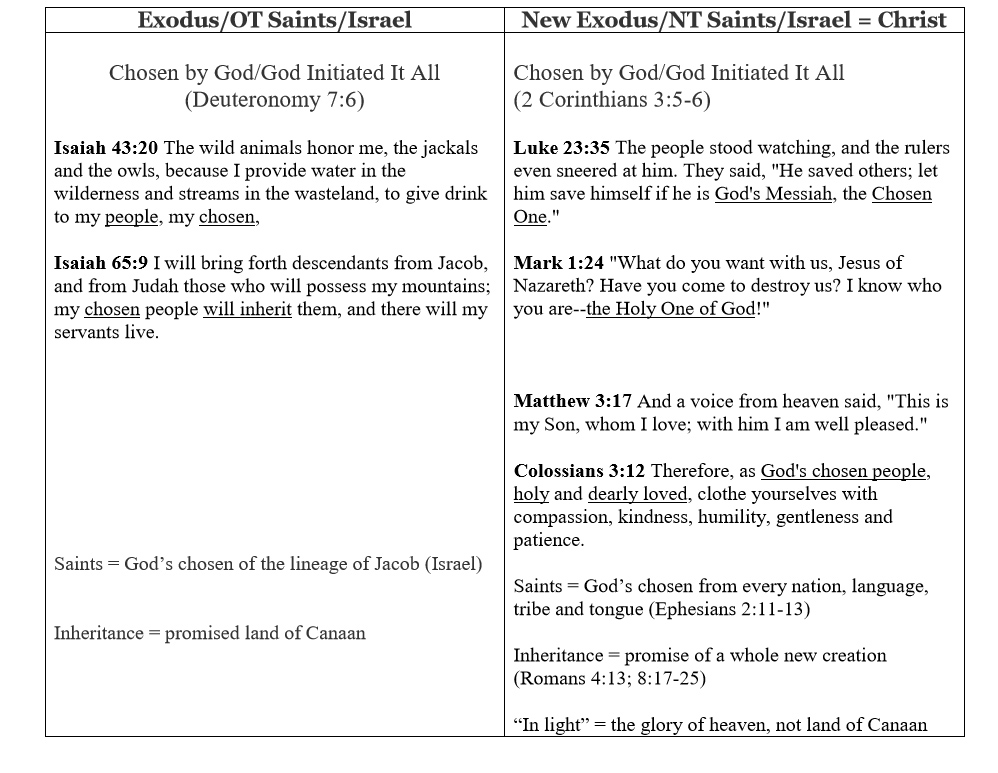
B. How are “redemption” and “forgiveness of sins” related? (vs 14)
Redemption = to loosen, to set free, to release
Forgiveness = to loosen, to set free, to release in exchange for an equivalent payment of some kind
III. Christ is the Mediator Between God and Man
A. OT Israel was God’s son
Exodus 4:22 Then say to Pharaoh, ‘This is what the LORD says: Israel is my firstborn son,
Hosea 11:1 “When Israel was a child, I loved him, and out of Egypt I called my son.
B. NT Israel is Christ, who is God’s Son
Matthew 2:15 where he stayed until the death of Herod. And so was fulfilled what the Lord had said through the prophet: “Out of Egypt I called my son.”
Mark 9:7 Then a cloud appeared and covered them, and a voice came from the cloud: “This is my Son, whom I love. Listen to him!”
C. The OT Exodus from Egypt
D. The NT Exodus from the dominion of darkness, enslavement to sin, curse of death, release from bondage to the ruler of this world (Satan)
Colossians 1:20 and through him to reconcile to himself all things, whether things on earth or things in heaven, by making peace through his blood, shed on the cross.
Other Great Verses:
Ephesians 5:8 For you were once darkness, but now you are light in the Lord. Live as children of light
Acts 26:18 to open their eyes and turn them from darkness to light, and from the power of Satan to God, so that they may receive forgiveness of sins and a place among those who are sanctified by faith in me.’
1 Peter 2:24 “He himself bore our sins” in his body on the cross, so that we might die to sins and live for righteousness; “by his wounds you have been healed.”
Ephesians 1:14 who is a deposit guaranteeing our inheritance until the redemption of those who are God’s possession–to the praise of his glory.
Ephesians 2:4 But because of his great love for us, God, who is rich in mercy, 5 made us alive with Christ even when we were dead in transgressions–it is by grace you have been saved. 6 And God raised us up with Christ and seated us with him in the heavenly realms in Christ Jesus, 7 in order that in the coming ages he might show the incomparable riches of his grace, expressed in his kindness to us in Christ Jesus.

Week 7 Life Group: Colossians Bible Study

Prayer: Part 2 Colossians 1:9-12a The Community of Believers
Colossians 1:9 For this reason, since the day we heard about you, we have not stopped praying for you. We continually ask God to fill you with the knowledge of his will through all the wisdom and understanding that the Spirit gives, 10 so that you may live a life worthy of the Lord and please him in every way: bearing fruit in every good work, growing in the knowledge of God, 11 being strengthened with all power according to his glorious might so that you may have great endurance and patience, 12 and giving joyful thanks to the Father…
I. Christians are a Spiritually Organic Community
A. Christ is the head from whom all else flows, the church is the body of Christ (Colossians 1:24; 2:19; Ephesians 4:16).
B. Christians are in Christ, and he is in them (Colossians 1:4, 1:28, John 17:23; Romans 8:9-11; 2 Corinthians 5:17).
C. It is therefore impossible for a Christian to be disconnected from the fellowship of believers (out of touch, out of fellowship–perhaps; spiritually disconnected–never!)
II. The Community of Believers as Exemplified in Colossians
A. How does faith come?
Romans 10:17 Consequently, faith comes from hearing the message, and the message is heard through the word about Christ.
Colossians 1:5 the faith and love that spring from the hope stored up for you in heaven and about which you have already heard in the true message of the gospel
Colossians 1:7 You learned
it from Epaphras, our dear fellow servant, who is a faithful minister of Christ on our behalf,

B. Epaphras most likely learned from Paul; Paul from Christ and then from Ananias and the other believers in Damascus.
1. Epaphras reported to Paul and Paul to his “team.”
2. This entire group prays regularly and frequently for the Colossian believers.
3. Christ himself and the Holy Spirit pray for all believers (Romans 8:26-27, 34).
C. This is the New Testament pattern and it remains so today:
1. As believers, we are never cut off nor alone, no matter how we may perceive our situation.
2. We are always connected both to Christ and to his body.
Paraphrase #1 verses 9-10:
Paul and Timothy continue to pray for the Colossians, asking God…
- to fill them with________________________________________________________________________________________________________________
____________________________________________________________________________________________________________________________
- through all (or, in all) ______________________________________________________________________________________________________________________________________________________________________________________________________________________________________________________
- in order that _____________________________________________________________________________________________________________________________________________________
Paraphrase # 2 verses 9-12a:
“Basically, his [Paul’s] petition is that his readers might know God’s will and have the power to do it.” (O’Brien, 86)
III. The Petition portion of Paul’s prayer flows naturally out of the Thanksgiving portion (Thanksgiving–Colossians Week 6).
c. Application: Are we remembering to incorporate thanksgiving into each intercessory prayer we make?
IV. Paul’s prayer of Petition summarizes the saint’s (believer’s) LIFE IN CHRIST
A. CHRIST IS THE MODEL of how we are to live in him.
“The student is not above the teacher, nor a servant above his master. 25 It is enough for students to be like their teachers, and servants like their masters…” –Matthew 10:24-25a
B. A life in Christ produces FRUIT, just as the gospel does:
the faith and love that spring from the hope stored up for you in heaven and about which you have already heard in the true message of the gospel 6 that has come to you. In the same way, the gospel is bearing fruit and growing throughout the whole world–just as it has been doing among you since the day you heard it and truly understood God’s grace. –Colossians 1:5-6
so that you may live a life worthy of the Lord and please him in every way: bearing fruit in every good work, growing in the knowledge of God, –Colossians 1:10
1. fruit carries two meanings
a. reproduction–sharing the gospel with others so that they may come to faith
a) the gospel bears fruit and grows throughout the whole world (v. 6)
b. Christ-like character within the life of every believer (v. 10)
i. walk in a manner pleasing to the Lord in every way
ii. engage in good works
iii. increasing in the knowledge of God
C. A life in Christ leads the believer to the CROSS, just as Christ’s path led him to the cross.
being strengthened with all power according to his glorious might so that you may have great endurance and patience, –Colossians 1:11
Then he said to them all: “Whoever wants to be my disciple must deny themselves and take up their cross daily and follow me. —Luke 9:23
1. endurance (ὑπομονὴ, hu-po-mon-ee) is bearing up for a long while under a weight of difficult circumstances without giving up or losing faith in Christ
2. patience (μακροθυμία, ma-cro-thee-me-a) is having mercy, patience, tolerance, and love towards people in our lives who are difficult to deal with, just as God has great patience with us
D. Paul prays for TWO ITEMS that are essential to the Colossians’ successful walk of faith in Christ
a. clear knowledge, understanding, and wisdom concerning the ways and will of God in Christ
i. Christ based his walk on exact knowledge and agreement with the will of God. Can you think of biblical examples that demonstrate this?
b. God’s mighty power acting in grace on behalf of and within each believer
V. All of the above is to be accomplished with JOY and THANKSGIVING to the Father, who qualifies believers to partake in his kingdom of light.
A. Grammatically the joy and thanksgiving can apply to everything involved in the situations that call forth endurance and patience. (1 Thessalonians 5:16-18; James 1:2)
B. Grammatically the joy and thanksgiving can apply to the overall walk of faith–to the entire package of blessing and responsibility that is the inheritance of every believer in Christ.
I consider that our present sufferings are not worth comparing with the glory that will be revealed in us. –the Apostle Paul in Romans 8:18


Good News!

What is the Gospel? It’s the Good News of God’s love for us in Jesus Christ.
1 John 4:14 And we have seen and testify that the Father has sent his Son to be the Savior of the world.
1 John 5:11 And this is the testimony: God has given us eternal life, and this life is in his Son. 12 Whoever has the Son has life; whoever does not have the Son of God does not have life.
That is the Gospel in a nutshell.
Also: “Thus it is written, that the Christ should suffer and on the third day rise from the dead, 47 and that repentance and forgiveness of sins should be proclaimed in his name to all nations, beginning from Jerusalem. 48 You are witnesses of these things.” from Luke 24:46-48
Here is the Gospel from Isaiah. Note how much the same it is! Isaiah 43:10 “You are my witnesses,” declares the LORD, “and my servant whom I have chosen, so that you may know and believe me and understand that I am he. Before me no god was formed, nor will there be one after me.
The phrase from Isaiah, “…so that you may know and believe me and understand that I am he,” is (mini-Colossians 1:5-6).
In 1 John 5:11 (see the 2nd verse Above) “testimony” is the same word as “witness” in Isaiah. A witness is one that gives testimony. John tells us that the testimony is that God has given us eternal life in Jesus the Son of God. Jesus Christ himself IS the basic Gospel message. Part and parcel of Christ is the fact that as Savior he died on the cross for our sins. When we receive the testimony of Christ, it is with the realization that we are sinners who need to be cleansed, and that cleansing Christ provides. No one else does this.
John 3:16 For God so loved the world that he gave his one and only Son, that whoever believes in him shall not perish but have eternal life.
John 3:16 is also the Gospel. God-giving-his-Son means that God gave him to incarnation and to death and resurrection on the cross as a sacrifice for our sins.
MY POINT: So often when we hear evangelists we hear a focus on ourselves and our sins. This (according to my reading of Scripture) is NOT the focus of the Gospel. The focus is Jesus Christ and who HE is. Presenting Christ–a God who loves us and is for us is tremendously joyful Good News! It is easy to present Christ this way: “Hey, did you know that God loves you?”
As it turns out, the only people who will receive this news are the lowly in heart, those who need a Savior, those who are aware of their sins. Christ IS Savior. What he did as Savior is die on the cross for our sins.
The Good News is that I have eternal life in Christ. That’s what I want to share, because our world is ruled and dominated by death in all its many forms. That my sins are forgiven, is also great news, because my sins are Death. Christ’s defeat of death is the Good News! His love for me is Good News! In order to make those things happen, Christ died on the cross and rose again. Christ and the cross are inseparable. And I do believe that many if not most sinners need to hear about the LOVE of God in Christ before any focus or attention is given to their own sins. It’s about Christ–it’s not mainly about my sin.
May God bless us all richly on Good Friday and on Easter.
Week 6 Life Group: Colossians Bible Study
Recap
I. From
II. To
III. Greeting
IV. Body
A. Introduction–Laying a Good Foundation
B. Issues
Expanded Outline
A. Introduction–Laying a Good Foundation
1. Paul’s Prayer for the Colossians (vv 1:3-12a)
a. Thanksgiving (1:3-8) THIS LESSON
b. Paul describes his Supplication for them (vv 1:9-12a)
Paul’s Prayer of Thanksgiving–Colossians 1:3-8
I Statement of the Prayer: We always thank God, the Father of our Lord Jesus Christ, when we pray for you, (v 3 NIV)
II Paraphrase: We always include you in our prayers, and when we do, we always thank God, who is the Father of our Lord Jesus Christ, for you.
III Paul’s Reason for his Thanksgiving: because we have heard of your faith in Christ Jesus and of the love you have for all God’s people— (v 4)
A. Their faith in Christ Jesus
B. The love they have for all God’s people
IV Explication of Faith and Love: 5 the faith and love that spring from the hope stored up for you in heaven and about which you have already heard in the true message of the gospel 6 that has come to you. In the same way, the gospel is bearing fruit and growing throughout the whole world—just as it has been doing among you since the day you heard it and truly understood God’s grace. (vv 5-6)
V The Means by which the Colossians Heard the Gospel: 7 You learned it from Epaphras, our dear fellow servant, who is a faithful minister of Christ on our behalf, 8 and who also told us of your love in the Spirit. (vv 7-8)
VI Chronological Order of the events leading up to and resulting in Paul’s prayer of thanksgiving for the Colossians (mostly working backwards through the text, vv 3-8)
- Epaphras learned the gospel from Paul and discipled with him, possibly while Paul was in Ephesus for two years (Acts 19:1-10, specifically vv 1 and 10)
- Epaphras was from Colosse (Colossians 4:12) and returned there to spread the true message of the gospel (v 5) in his own neighborhood
- The gospel grew and bore fruit among the Colossians, just as in the whole world (v 6)
- The Colossians realized the hope stored up for them [you] in heaven (v 5)
- This realization resulted in the Colossians’ faith in Christ Jesus and … love…for all God’s people (v 4)
- Paul heard about their faith and love from Epaphras (vv 4 and 8)
- Paul began regularly praying for them (v 3)
- Paul wrote his letter of thanksgiving, encouragement, and exhortation (encouragement and instruction) to them
VII Key Words: hope, faith, love, gospel, fruit
A. Hope
1. as a verb–an attitude and activity of heart and mind
2. as a noun–here in this verse–not mere wishing
a. the full Christ-centered assurance and yearning for the fulfillment of the promises of God
b. a “living and sanctifying force” (Hendriksen, 49) (1Peter 1:3)
c. the thing hoped for; the object of hoping, the inheritance all saints receive in Christ (Colossians 1:12)
i. Jesus himself (Colossians 1:27) 
ii. Jesus’s heavenly treasure, the kingdom of heaven (Matthew 5:20)
iii. the inheritance that is imperishable, undefiled, and that can never fade (1 Peter 1:4)
iv. the glory which shall be revealed to us (Colossians 1:27, Romans 8:18)
v. we see this hope from far away (the present) and greet it joyfully (Hebrews 11:13)
3. The living hope produces faith and love within the believer’s heart.
B. Faith — saving faith in Christ in response to hearing the Word preached, the Gospel of life in Christ
They replied, “Believe in the Lord Jesus, and you will be saved–you and your household.” -Acts 16:31
If you declare with your mouth, “Jesus is Lord,” and believe in your heart that God raised him from the dead, you will be saved. -Romans 10:9
For since in the wisdom of God the world through its wisdom did not know him, God was pleased through the foolishness of what was preached to save those who believe. -1 Corinthians 1:21
So faith comes from hearing, and hearing through the word of Christ. -Romans 10:17
C. Love — Christ-like actions, speech, motives towards others, inspired by the presence of the Holy Spirit within the hearts of believers (Colossians 1:8)
This is how we know who the children of God are and who the children of the devil are: Anyone who does not do what is right is not God’s child, nor is anyone who does not love their brother and sister. -1 John 3:10
For this is the message you heard from the beginning: We should love one another. -1 John 3:11
“A new command I give you: Love one another. As I have loved you, so you must love one another. 35 By this everyone will know that you are my disciples, if you love one another.” -John 13:34
Love the Lord your God with all your heart and with all your soul and with all your mind and with all your strength.’ 31 The second is this: ‘Love your neighbor as yourself.’ There is no commandment greater than these.” -Mark 12:30
D. Gospel — Can you state the gospel in no more than one or two sentences?
Paul, a servant of Christ Jesus, called to be an apostle and set apart for the gospel of God— 2 the gospel he promised beforehand through his prophets in the Holy Scriptures 3 regarding his Son, who as to his earthly life was a descendant of David, 4 and who through the Spirit of holiness was appointed the Son of God in power by his resurrection from the dead: Jesus Christ our Lord. 5 Through him we received grace and apostleship to call all the Gentiles to the obedience that comes from faith for his name’s sake. -Romans 1:1-5
For Christ did not send me to baptize, but to preach the gospel–not with wisdom and eloquence, lest the cross of Christ be emptied of its power. 18 For the message of the cross is foolishness to those who are perishing, but to us who are being saved it is the power of God. -1 Corinthians 1:17-18
God made him who had no sin to be sin for us, so that in him we might become the righteousness of God. -2 Corinthians 5:21
He has saved us and called us to a holy life–not because of anything we have done but because of his own purpose and grace. This grace was given us in Christ Jesus before the beginning of time, 10 but it has now been revealed through the appearing of our Savior, Christ Jesus, who has destroyed death and has brought life and immortality to light through the gospel. -2 Timothy 1:9
Remember Jesus Christ, raised from the dead, descended from David. This is my gospel, -2 Timothy 2:8
Jesus performed many other signs in the presence of his disciples, which are not recorded in this book. 31 But these are written that you may believe that Jesus is the Messiah, the Son of God, and that by believing you may have life in his name. – John 20:30-31
E. Fruit …the gospel is bearing fruit and growing throughout the whole world–just as it has been doing among you since the day you heard it and truly understood God’s grace. Colossians 1:6
1. within the lives of individual believers as they become more fully conformed to Christ’s nature and character through Scripture and the promptings of the Holy Spirit
2. within communities of believers (local churches) as they express the love of Christ in word and actions among themselves and to other communities of believers
3. to the unbelieving world at large through acts of love and through the preaching of the gospel
4. in this way, the quality of Christ-like character increases in believers throughout the world, and the numbers of believers increase throughout the world
VIII Key Points
A. How did the Colossians arrive at their belief? (Colossians 1:6-7)
1. hearing (So faith comes from hearing, and hearing through the word of Christ. -Romans 10:17 )
2. understanding – ἐπέγνωτε (e-peg-no-te) = full knowledge, no mysteries left untold
3. learning – ἐμάθετε (e-math-e-te) = discipleship, not a quick dip and I’m outta’ here, detailed lessons and practice and life application over time, what the disciples did in the years that they spent with Christ
B. Initial faith can be instantaneous and there is nothing simpler in the whole world: believe that Jesus Christ is Son of God, was born as man, died for our sins, rose again, and is preparing an eternal place by his side for all who believe.
For what I received I passed on to you as of first importance: that Christ died for our sins according to the Scriptures, 4 that he was buried, that he was raised on the third day according to the Scriptures, –1 Corinthians 15:3
My Father’s house has many rooms; if that were not so, would I have told you that I am going there to prepare a place for you? 3 And if I go and prepare a place for you, I will come back and take you to be with me that you also may be where I am. -John 14:2
Jesus said to her, “I am the resurrection and the life. The one who believes in me will live, even though they die; 26 and whoever lives by believing in me will never die. Do you believe this?” -John 11:25-26
C. Discipleship–fruitful increase in faith and love–is an ongoing process that lasts one’s entire life.
IX How does Paul in this portion of his letter, this prayer of thanksgiving, lay a good foundation for the key issues he brings up in Chapter 2 and beyond?
A. He establishes his approval of the Colossians
1. He commends the Colossians’ faith, love, and hope.
2. He commends the Colossians’ pastor, Epaphras, on whose gospel message and discipleship training their beliefs are based.
3. Paul approves of them so much that whenever he prays for them he gives thanks to God.
B. He lays out the main realities of Christian belief–grace, faith, hope, love, truth, the gospel, fruit, the Spirit, Christ—to be developed later.
C. He introduces the themes of learning and full understanding, which were themes used by the false teachers to entice the Colossians into compromise.
1. He states that the Colossians already have full knowledge.
2. They have this in Christ.
X Application
A. Take a dipstick test of my love for “all the saints.” Name specific ways – make a list – of how I regularly and frequently express this love in action. Where do I fall short? Where should my prayer focus be?
B. If not already doing so, begin incorporating statements of genuine thankfulness in my intercessory prayers for others, naming specific qualities or facts about them.
C. Am I doing my part to share the spoken-out-loud Gospel of Christ with others, so that they too may hear and believe?
D. Do I spend more time with my thoughts fixed on worry or on the hope that is stored up for me in heaven?
NEXT WEEK: We will be having a Fellowship Dinner, so no new lesson.
Link to (Colossians Bibliography)

Week 5 Life Group: Colossians Bible Study
B. Two Kinds of Biblical Peace for Humans: these are covenantal peace (think peace treaty) and subjective peace (think peace of mind)
1. Covenantal Peace–(legal peace, our standing with God, our position with God).
a. In Christ the paradox between God’s eternal, untouchable, unchanging peace and his being able to have fellow-feelings (emotions) with humans is resolved (see above.)
b. In Christ we not only have peace; he is our peace.
i. Jesus is the logos of God, the full expression and outward manifestation of the Triune Deity.
For in Christ all the fullness of the Deity lives in bodily form, (Colossians 2:9)
ii. As God incarnate, God in a human body, Christ is the intermediary between God eternal and man.
iii. Along with the attribute of peace, God also has attributes of perfect holiness and justice.
a) Humankind’s sinful nature and acts of sin (anything that contradicts the Ten Commandments) are incompatible with God’s nature.
b) Sin cannot live in God’s presence, and indeed, must be cast out. Such casting out is punishment, because God is light and in him is no darkness at all. (1 John 1:5)
Whoever is cast out from the presence of God abides in eternal darkness.
iv. Christ voluntarily died on the cross to save us from sin, from the inevitability of sin, and from the consequences of sin. (2 Corinthians 5:21) (Romans 5:8)
v. Apart from Christ, there is only enmity and wrath between us and God. (As concerns we humans, NOT everything we do is okay with the God who is peace–a paradox? If so, it lies with us, not within God.) (Isaiah 57:21) (Romans 5:9-10) (John 3:36)
vi. Christ’s death on the cross and resurrection into life fulfills the terms of the everlasting covenant between himself and God the Father.
a) Those who are in Christ (those who believe in him) are beneficiaries with Christ of his eternal reward, according to the terms of the everlasting covenant between Christ and God the Father.
b) This is LEGAL peace. (Hallelujia!!)
c) Scripture
1) Hebrews 13:20–the eternal covenant,
2) Titus 1:2 (verses 1-3 for context),
3) Mathew 26:28 (Christ’s blood of the covenant),
4) 1 Corinthians 11:25 (the blood of the covenant)
c. Why did God make an everlasting covenant with Christ that includes Christ’s people, “whomsoever wills” (everyone who wants to be included–see Harry Potter’s Sorting Hat)?
i. The only reason lies in God himself–it is his nature to be kind, loving, generous, spectacular, merciful, and good.
ii. God’s grace is displayed in his opening the means of peace–the doorway to peace–through Christ’s blood of the cross. This blood through the Holy Spirit regenerated our spirits, the part of us that died when our first parents rebelled against God.
iii. God’s grace is displayed by means of the Holy Spirit, who prepares our hearts to receive God’s gracious gift of reconciliation (making up after a H-U-G-E fight) in Christ.
iv. Without God’s grace, his own freewill gift to us, we would still be his enemies by our own choosing.
Before the sinner can be reconciled to God and enter into participation of the peace which Christ has made with Him, he must cease his rebellion, throw down the weapons of his warfare, and yield to God’s rightful authority. But, in order to do that, a miracle of grace must be wrought in the sinner by the Holy Spirit. As the Father ordained peace, as the incarnate Son made peace, so the Holy Spirit brings us into the same. He convicts us of our awful sins and makes us willing to forsake them. He communicates faith to the heart whereby we savingly believe in Christ. Then “being justified by faith, we have peace with God” (Romans 5:1) objectively. (Pink, 34)
2. Subjective peace
a. What is it? Subjective peace is how we feel inside when we are at rest with ourselves and with God–happy, secure, safe, joyful.
b. How do we get it? One result of covenantal peace, the legal peace described above, is the feeling of peace we receive.
c. Subjective peace is the feeling of contentment and well-being we have when we know that God is pleased with us and we know that we are in his company, his presence, in “fellowship” with him, in communication with him.
3. How do we maintain this feeling of subjective peace?
a. Obedience to God and his way (his precepts, principles, commandments)
i. Since humanity lost objective (external, formal, legal) peace with God as a result of their fall into rebellion (sin) when they chose to disobey God and believe Satan’s word above that of God, it makes sense that we would lose our subjective peace whenever we disobey God’s precepts, thinking and acting in ways not in agreement with his nature and sovereignty (sin).
ii. Therefore, obedience to God and his precepts is the best way to maintain subjective peace with God. Those who believe in Christ never lose their objective (covenantal) peace with God.
b. Forgiveness
i. When we sin, we need to confess our sin quickly and receive God’s forgiveness and restoration (see scripture below).
ii. When we fail to forgive another and harbor a grudge or bitterness, or when we nurse our wounds and live out from the broken places in our lives, we forfeit peace with God, ourselves, and others. Our physical health also suffers.
a) not forgiving others brings our spiritual growth to a standstill (Parable of the Unmerciful Servant)
b) forgiving others frees us up to move on in Christ and to experience joy and peace unspeakable
c. How do we restore subjective peace once lost?
i. Turning quickly to God in repentance to confess and receive forgiveness of our sins. “If we claim to be without sin, we deceive ourselves and the truth is not in us. 9 If we confess our sins, he is faithful and just and will forgive us our sins and purify us from all unrighteousness.” (1John 1:8-9)
ii. Keeping at prayer asking God by his grace to help us forgive so-and-so for such-and-such until that prayer is fully, 100% answered, which, if we fight on courageously, it will be!
iii. Spending time with God in Scripture, prayer, worship, and fellowship with other believers results in subjective peace with God.
“Now the God of peace be with you all” implies that the saints must conduct themselves in harmony, that amity and concord must prevail among them, so that there be no grievous failure on their part that would offend God and cause Him to withdraw His manifested presence from them. “Those things, which ye have both learned, and received, and heard, and seen in me, do: and the God of peace shall be with you” (Philippians 4:9). Individuals as well as a corporate company of believers must be in subjection to the divine authority and maintain scriptural discipline if they would enjoy the peace of God (see 2 Corinthians 13:11). Charles Hodge well said, ‘It is vain for us to pray for the presence of the God of love and peace unless we strive to free our hearts from all evil passions.’” (Pink, Gleanings from Paul, 34) (Bibliography).
Week 4 Life Group: Colossians Bible Study–Holiness, Grace, and Peace
Colossians 1:2 To God’s holy people in Colossae, the faithful brothers and sisters in Christ: Grace and peace to you from God our Father.
Outline
I. God’s Holy People: What does holiness mean in this verse? (See separate post on “Holiness”)
II. Grace
A. Popcorn: What is grace? What words or short phrases come to mind when you think about God’s grace?
1. God’s undeserved goodness
2.a wonderful, saving surprise against the flow
3. GRACE = God’s Riches At Christ’s Expense
4. Mercy when least expected
5. The giving of “slack”
6. Hospitable
7. Tender
8. Loving
9. Forgiven
10. Debts forgiven
III. Peace
A. What Is God’s Peace?
1. God is himself the “Fountain of peace.” (Pink, 30)
a. Peace is an attribute of God. Peace describes his nature.
b. God is impassible–he himself is never perturbed and he does not suffer.
c. God is immutable–he does not change.
d. Scripture
i. with God there are no surprises (Acts 15:18 (NKJ))
ii. with God there are no disappointments (Romans 11:36)
iii. with God there are no disturbances (James 1:17)
iv. with God there is no change (James 1:17)
2. How does this attribute of God and these verses reassure us?
a. Our salvation is not based on us nor upon our behavior but upon God’s own eternal decision within himself.
b. We can’t surprise God, nor disappoint him, nor cause him to change his mind about us. Once adopted into his family–always in his family, always loved.
c. Are we then robots, completely controlled by another? No. Modern example of “predestination” (think Calvinism) coexisting with “free choice” (think Arminianism): Harry Potter and the Sorting Hat. Although the hat made the ultimate decision, it never went entirely against the wishes of the student, but took his or her desires into strong consideration. (Decision of the Hat)
3. Is God then completely mechanical, cold, and unmoving towards us? No. Church Father Cyril of Alexandria always spoke of “qualified impassibility,” or, “God suffered without suffering.” The Council of Chalcedon (Council of Chalcedon 451) adopted his thought concerning the two natures of Christ in one person, one nature divine and one human, united yet distinguishable, which remained the norm in the Christian church for one thousand years. From Scripture, we see that both Yahweh of the Old Testament and Christ in the New suffered and experienced emotion. Yet, paradoxically, God in himself, God eternal and sovereign, remains always unperturbed, always at peace as the fountain of peace.
Think of planet Earth as viewed from space. How does it appear? Completely smooth, having a level and even surface. From earth, however, steeply elevated mountains and precipitous canyons abound. Earth is also home to severe earthquakes and tremendously destructive storms. Likewise, the eternal God, in and of himself, never changes and is always at peace, at rest, within himself. Yet in his interactions with us, when he relates to us at our own level, he often responds to our storms with storms of his own. (Psalm 18) (“Our Great God” by Fernando Ortega)
God in grace, mercy, and love accommodates our frailties and finiteness by using a translator to interpret and express himself to us. This translator is divine, God himself. He is Christ, the Word, the logos, the expression and outward manifestation of God. Christ became flesh and lived among us.
As noted above, God expresses and manifests himself as Yahweh, I Am That I Am, in the Old Testament, and as Christ in the New Testament. God-in-relation-to-human-beings suffers with us and responds to our repentance, prayers, and petitions. Nevertheless, in his eternality, He is always at peace. He is like a father who can fully comprehend, sympathize with, and have compassion for the suffering of his little child, without he himself in his being ever becoming “shaken to his core,” nor disturbed in any way.
The Good News of Jesus Christ, the Gospel message, is that God did indeed “come down” to us.
God in his infinite holiness, unchangeableness, and purity of peace did come down, all the way down, to Planet Earth in order to participate fully in the humanity of people, except for their sin.
For we do not have a high priest who is unable to empathize with our weaknesses, but we have one who has been tempted in every way, just as we are—yet he did not sin. (Hebrews 4:15)
But when the set time had fully come, God sent his Son, born of a woman, born under the law, 5 to redeem those under the law, that we might receive adoption to sonship. (Galatians 4:4-5)
Next Week: Two Kinds of biblical peace for humans–1) covenantal peace (think peace treaty) and subjective peace (think peace of mind)

Week 3 Life Group: Colossians Bible Study
Colossians as a First Century Letter
Formal Elements
I. From (1:1)
II. To (1:2a)
III. Greeting (1:2b)
IV. Prayer (1:3-12a)
V. Body (1:3-4:6)
VI. Closing and Farewell (4:7-18)
Functional Elements
I. Opening (From, To, and Greeting) (1:1-2b)
II. Introductory Remarks: Laying a Good Foundation for What Follows (1:3-2:5)
III. Issues, Exhortations, Concerns (2:6-4:6)
IV. Final Greetings and Farewell (4:7-18)
Zoom-In:
II. Introductory Remarks: Laying a Good Foundation for What Follows (1:3-2:5)
A. Prayer for the Colossians (1:3-12a)
B. The Father’s Role in the Colossians’ Salvation (1:12b-13)
C. The Son’s Role in the Universe and in Salvation (1:14-23a)
D. Paul’s Role (1:23b-2:5)
1. for the gospel (1:23b)
2. for the church (1:24-29)
3. for the growth of the Colossians and Laodiceans (2:1-5)
Detailed Presentation
I. From
A. Paul an apostle of the Lord Jesus Christ (1:1a)
1. What do we know about Paul? What is his character like? What are some main events in his life? What can we conclude about his motives and purpose in serving the gospel, Christ, and the church?
a. Stoning Stephen Acts 7:54-8:3
c. His Suffering Connected with Ministry 2 Corinthians 11:23-33
2. In what ways might Paul be compared and contrasted with Joshua?
B. Timothy our brother (1:1b)
1. What is Timothy’s role in the Letter to the Colossians?
2. Would you describe Timothy as being first generation or second generation Christian?
3. Questions for thought
a. How do we learn about Timothy throughout the New Testament?
b. That is, does he speak and act directly as a main character?
c. Or, do we mostly learn about him by reading references to him written by others?
d. Is he a main player in the biblical books that bear his name?
4. Thinking about the New Testament in light of Timothy, what do we learn about its overall content? (Who are the main players?)
5. Colossians 1:1, Acts 16:1-3, 1 Timothy 1-6, 2 Timothy 1-4
C. Who is Epaphras? How does Paul describe him?
1. Colossians 1:7 How would the Colossians feel about Paul, whom they had never met, when he commends their pastor? How would they feel about the gospel message Epaphras had given them?
2. Colossians 4:12 This may refer to physical imprisonment, or more likely, metaphorical servitude to Christ.
II. To
A. To God’s holy people in Colossae, the faithful brothers and sisters in Christ (1:2)
B. What do we know about the town of Colosse?
1. Where was it situated? Was it on or off the main trade thoroughfare?
2. How large or small was it?
3. What was its importance, if any?
C. Had Paul ever visited Colosse?
1. Did he know the people personally?
2. What effect might this have had on the tone of his letter to them?
3. Compare Paul’s tone in the Letter to the Galatians with his tone here and relate this to his personal history with each of these churches.
Next Week: Colossians 1:2 more on “To” and “Greeting” with a focus on the words “holy,” “grace,” and “peace.”
Mini Word Study: Hagios (‘Áγιος)
‘Áγιος pronounced ha-gui-os, or hagios.
Hagios occurs in Colossians 1:22 as the adjective “holy”: “…to present you holy in his sight…” and as a noun “saints” in Colossians 1:2, 4, 12, and 26.
Definition: set aside, consecrated, for a specific purpose for and/or by God; as the quality of persons or things that can be brought near or into God’s presence (Friberg). Example verse:
1Peter 2:5 you also, like living stones, are being built into a spiritual house to be a holy priesthood, offering spiritual sacrifices acceptable to God through Jesus Christ.
An Old Testament word that sums up this particular aspect of the word hagios, or “holy” in English, is the word “devoted,” or set aside, consecrated, as the definition above suggests.
Psalm 119:38 (KJV) Stablish thy word unto thy servant, who is devoted to thy fear.
The phrase “is devoted” is displayed with italics in the KJV to indicate that this specific phrase is not found in the original Hebrew text but has been added for clarity by the translators of the KJV. The meaning of the phrase, however, is embedded in the concept of “servant,” and brings out a certain characteristic of servanthood very well (think Downtown Abbey.)
In Scripture, when something was set aside as a tithe or offering for use by the Lord, this item merited the description “devoted.” Three biblical examples follow:
1. Leviticus 27:21 (NET) When it reverts in the jubilee, the field will be holy to the LORD like a permanently dedicated field; it will become the priest’s property.
2. Joshua 6:17-19 (ESV) And the city and all that is within it shall be devoted to the LORD for destruction. Only Rahab the prostitute and all who are with her in her house shall live, because she hid the messengers whom we sent. 18 But you, keep yourselves from the things devoted to destruction, lest when you have devoted them you take any of the devoted things and make the camp of Israel a thing for destruction and bring trouble upon it. 19 But all silver and gold, and every vessel of bronze and iron, are holy to the LORD; they shall go into the treasury of the LORD.”
Joshua 7:1 (ESV) But the people of Israel broke faith in regard to the devoted things, for Achan the son of Carmi, son of Zabdi, son of Zerah, of the tribe of Judah, took some of the devoted things. And the anger of the LORD burned against the people of Israel.
3. Mark 7:10-12 (NIV) For Moses said, ‘Honor your father and mother,’ and, ‘Anyone who curses their father or mother is to be put to death.’ 11 But you say that if anyone declares that what might have been used to help their father or mother is Corban (that is, devoted to God)– 12 then you no longer let them do anything for their father or mother.
We have examples of things “devoted” in our own lives: 1) Our tithes and firstfruit offerings to the Lord, 2) our “cookie jar” money that we save for that “special something,” or 3) a special, one-time-only income, such as an income tax refund or an unexpected inheritance, that we earmark, or set aside, for a special and specific purpose, such as a family vacation or college tuition fund for the kids.
So, getting back to the verse Psalm 119:38 (KJV), the Scripture is saying that the speaker of this psalm himself has been set aside, earmarked, for a special use by the Lord: to be his servant.
When we discover that we ourselves have been set aside by the Lord for his service (see 1Peter 2:9), this is at once an honor, a privilege (he’s the ruler of the universe, and he takes good care of what belongs to him), and a duty, or responsibility. Also, who does this make the BOSS in all we think, say, and do?
Prayer: Lord, thank-you for calling me to be “devoted,” or set aside, for you. Help me to be aware that this is why I am here and to step up to my role in Christ Jesus.
Week 2 Life Group: Colossians Bible Study
I. Finish General Introduction from first week.
A. First week: Why study the Bible? What to pray before each reading/study time?
1. To hear God Isaiah 55:3
2. Life Psalm 119:92-93, John 1:2
3. Stability, unchanging truth Matthew 7:24 
4. Helps us pray more effectively as we learn God’s will 1John 5:14-15
B. This week: Study and/or Reading?
1. What is the difference between studying the Bible and reading the Bible?
a. reading is once-through; relatively rapid; distance; overview; the forest
b. studying is in-depth; spend time on one section; details; the trees
c. some prefer reading with pray and dependence on the Holy Spirit
d. pastors and teachers must study in addition to reading, so that they can present God’s truth more fully and accurately
e study and reading are both necessary
f. nothing is as wonderful or takes the place of God opening Scripture to us directly as we pray and spend time with him in his Word
2. What activities of study can we be doing as we “spend time” on certain portions of Scripture? What can we be doing as we ask God to “open” his Word to us?
a. participate in a group study, as we are doing now. Example: Pastor Leaf’s study on Nehemiah which lasted over one year
b. read the passage, reread, reread, etc. (As we read and reread the same passage, the Holy Spirit will draw our attention to details of interest we had not noticed before. In the hiking world, this is like hiking the same trail over and over again.)
c. as we notice individual words, phrases, and thoughts, ask questions like a child—what’s this? what does this mean, really? I don’t understand this? is there another way these words could be understood? why this? why that?
d. have a set time and a set place—a structured routine
e. take notes, draw charts, make diagrams, write/journal our thoughts, look at a map, outline
f.
3. What are some resources we may at some point want to use as helpful aids in our study?
a. find a Bible with side, center, or bottom-of-the-page references to look up related passages and words. Let Scripture interpret Scripture.
b. What is a “study” Bible and should we use one?
c. access to more than one translation
4. “Head” knowledge and “heart” knowledge
a. what is head knowledge?
b. what is heart knowledge?
c. which is more important?
d. why might we need both?
i. all of Psalm 119 combines head and heart
Psalm 119 2 Blessed are those who keep his statutes and seek him with all their heart– 3 they do no wrong but follow his ways. 4 You have laid down precepts that are to be fully obeyed.
Psalm 119:11 I have stored up your word in my heart, that I might not sin against you.
ii. short answer: We will be judged for our actions, not for our knowledge. Actions proceed from the heart. The head can be a powerful ally of the heart when the head informs the heart and keeps the heart in check. Both need to be brought into submission to Christ.
II. Read the text
A. What is the letter’s tone?
1. friendly, conciliatory, filled with compliments and praise
2. corrective, especially beginning in Chapter 2
3. different than Paul’s tone to the Galatians
a. Paul had founded the church in Galatia; the Galatians were his spiritual children; his emotions were more tied up with them
b. There is no evidence that Paul himself had ever visited Colosse; he may have been writing to strangers
B. What is the letter’s purpose?
1. encouragement
2. correction and guidance
3. to protect the integrity of the church’s beliefs
III. Next Week: continue specifics of the Introduction to the Letter; begin studying the text–greeting
Example of SideBar S-O-A-P in Practice
 One Small Voice