Home » Academic/Biblical (Page 10)
Category Archives: Academic/Biblical
Paul Summarizes the Message of His Letter: Colossians 2:6-7
A Short Discussion Guide
Paul Summarizes the Message of His Letter: Colossians 2:6-7
ESV Colossians 2:6 Therefore, as you received Christ Jesus the Lord, so walk in him, 7 rooted and built up in him and established in the faith, just as you were taught, abounding in thanksgiving.
Paul’s message is “Christ Jesus the Lord.”
Philippians 1:21 For to me to live is Christ, and to die is gain.
- Verse 6: Therefore, as you received Christ Jesus the Lord, so walk in him,
For Discussion:
- What was the gospel that the Colossians received? (What does Christ’s Lordship include?) Look back in Chapter 1.
- Think about Paul’s command to “walk in him.” How does the image of someone walking describe our life of faith?
- Do we walk alone? Who is with us?
- Can you paraphrase (say in your own words) verse 6?
- Verse 7: rooted and built up in him and established in the faith, just as you were taught, abounding in thanksgiving.
For Discussion:
- What are the four images Paul uses in verse 7?
- ___________________________
- ___________________________
- ___________________________
- ___________________________
Think about these images one at a time. How does each image illustrate our relationship with Christ and our walk of faith?
A Fuller Leader’s Guide
ESV Colossians 2:6 Therefore, as you received Christ Jesus the Lord, so walk in him, 7 rooted and built up in him and established in the faith, just as you were taught, abounding in thanksgiving.
Paul’s message is “Christ Jesus the Lord.”
Philippians 1:21 For to me to live is Christ, and to die is gain.
I. Verse 6: Therefore, as you received Christ Jesus the Lord, so walk in him,
A. “as you received “
- Thayer: to receive something transmitted, such as a narrative or instruction by teachers (Thayer)
- Paraphrase: The teaching you received from Epaphras (Colossians 1:5-7) is good, true, and complete. Stick with that.
B. “Christ Jesus the Lord“
- Why do you think Paul added “the Lord” to “Christ Jesus”? What does Lord signify? What is the impact of this word?
- Christ IS Lord. He is the Lion of Judah (Psalm 29:9; Revelation 5:5)
- Order, rank, supremacy, deity above all else (Philippians 2:5-11)
- There is one Lord (1 Corinthians 8:6; Ephesians 4:4-5)
- Naming Christ Lord establishes our relationship to him as servant (slave) to master.
- This is not a bad thing–it is 1) reality, and 2) worshipful
- Paul, arguably one of the “greatest” Christians of all time, said this about his own relationship to Christ: (Romans 1:1; Titus 1:1)
- Being a servant to Christ does not exclude our being his 1) friend (John 15:14-15 How does v. 15 cast light on the apparent contradiction in v. 14?) and 2) sibling (Mark 3:34; John 20:17; Hebrews 2:11).
- When we receive Christ the Lord, we have an obligation as servant to obey him.
- Paul establishes Christ as superior to all other spiritual beings whom the false teachers might claim the Colossians need.
C. In this verse, what does Paul mean by saying “so walk in him”?
- Translation comparison: 1) MESSAGE You received Christ Jesus, the Master; now live him. 2) MOUNCE So then, just as you received · Christ Jesus as Lord, continue to live in him, 3) NET Therefore, just as you received Christ Jesus as Lord, continue to live your lives in him, 4) NIV So then, just as you received Christ Jesus as Lord, continue to live your lives in him,
- What connotations (associated meanings) does the word walk bring to our minds?
- movement
- movement forward
- progressive
- sustained
- orderly
- not running; not hurky-jerky, not sprinting
- implies a destination, a goal, a purpose, a definite period of time
- not meandering, nor wandering, nor strolling
- implies a steady speed over time
- good for a long distance
- Therefore, walk in him is a commandment
- implying that we have control over our movement, that we are making a choice, that living out our faith is neither passive nor forced;
- We are under our own volition.
- Yet, we are being commanded–so walking is something we need to do and should do.
- The commandment implies a leader–the one who gives the command–Paul, and behind Paul, Christ.
- The above is how we are to move in Christ, how we are to live out our lives in him.
Definition of walk: to move by foot by our own energy at a comfortable, sustainable pace in a directed or guided motion towards a destination or goal or for an established length of time.
- BTW: We are NOT alone!
- Hebrews 13:5c …for he has said, “I will never leave you nor forsake you.”
- ESV John 14:16 And I will ask the Father, and he will give you another Helper, to be with you forever,
- Helper in Greek is “paraclete” παρακλητος: “one called alongside to help; (1) as a legal technical term, as one who appears in another’s behalf advocate, defender, intercessor (1J 2.1); (2) as one who gives protection, help, and security helper, comforter, counselor ( JN 14.16) (Friberg).
So we have God with us–the Helper, the One who walks alongside us and in us, the Holy Spirit–to sustain, guide, and direct us in our walk in Christ.
D. Paraphrase (in other words): Keep on keeping on in Christ alone, just as you were taught from the beginning by Epaphras, your faithful pastor and teacher.
II. Verse 7: rooted and built up in him and established in the faith, just as you were taught, abounding in thanksgiving.
A. Paul mixes his metaphors! (Since we know that Paul was a highly educated man, we can conclude that literary style differed then from now.)
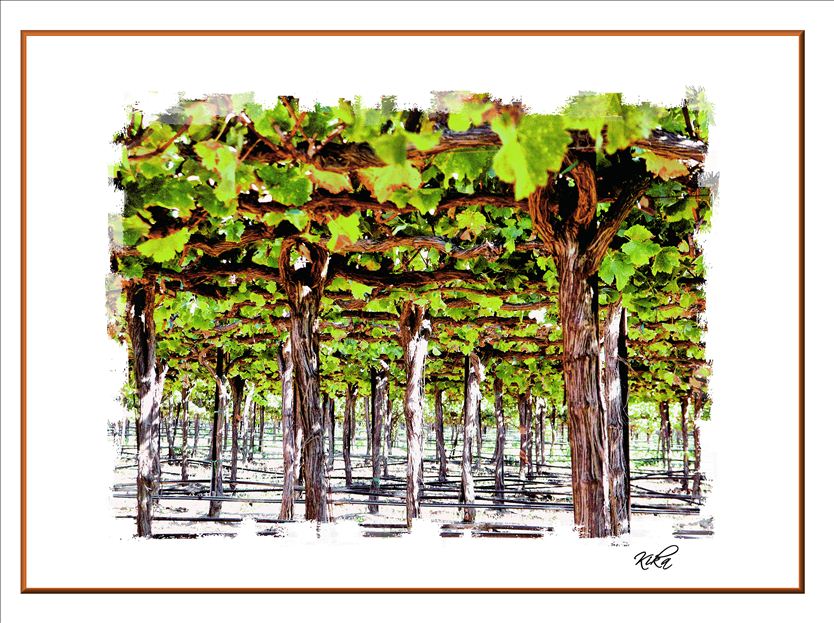
1. Rooted in Christ
onesmallvoice.net
- If we are like roots, then Christ is the soil.
- Roots are organic, alive, growing.
- Roots are the part of a plant that is beneath the ground; therefore, outwardly invisible. Christ nourishes and sustains us from within.
- Roots are the means by which a plant is nourished from the soil.
- Roots cling to the soil and are all but inseparable from it.
- Roots and soil, therefore, provide the nourishment, stability, support, and growth of a plant.
2. Built up in Christ
- “Built up” implies that we are like a structure whose foundation and framework is faith.
- The structure is increasing in size.
- A structure passively increases under the hands of a builder–God is ultimately in control of who we become in Christ–and we participate as living stones (1 Peter 2:5).
- A structure is that which is above the foundation–it is visible from the outside.
- A structure built in Christ is solid, strong.
3. Established in the Faith
- confirmed
- made sure
- strengthened
- established
- tested, tried, and proven, as a secure legal document (the building inspection is passed! and the building is now ready to be used for its intended purpose)
4. Abounding (overflowing) in Thanksgiving
- overflowing with thanksgiving like a full cup of wine (Wright, 104)
B. Why do you suppose thanksgiving is central to and characteristic of life in Christ?
- Continuing Paul’s metaphors, thanksgiving might be thought of as…
- the fertilizer and nutrients in the soil
- the rebar that runs through and strengthens a structure
- the official “seal of approval” on a legal document
- Functions of thanksgiving
- acknowledges that a blessing has been received
- opens a door for further blessings
- focuses our eyes on the giver of the blessings–Father God and the Lord Jesus Christ
- increases our awareness of blessings
- places us as debtors to the One who gives
- feeds joy
- places trials and hardships in perspective
- lightens our load
- completes the circle of grace
- unites us with the body of Christ–other believing Christians
- When and how did you learn about thanksgiving in your Christian walk?
III. Verse 6 is Paul’s commandment; Verse 7 provides a “floor plan” of verse 6.

Weekend Ministry in San Francisco
Mission Bridge and The Shepherd’s House Weekend Outreach to the Homeless and Impoverished of San Francisco’s Tenderloin District
May 20-22, 2016
Team: 12 persons—5 men and 7 women, two vans for long distance travel, one van for inter-city trips

Mission Activities:
Friday
- Visit, clean, and rededicate the Memorial Cross of 1894 in memory of the service held near Drake’s Bay about St. John’s Day on June 24, 1579, by Francis Fletcher, a priest of the Church of England and Chaplain to Sir Francis Drake; the site of the first Christian service in the English tongue on the coast of California, the first use of the Book of Common Prayer in what became the United States, and the first recorded missionary prayer on this continent. Our prayers included dedication of our trip to San Francisco and the city of San Francisco itself.

- An after dark excursion onto the sidewalks around the SF City Center International Hostel where we stayed the two nights of our weekend. We distributed our homemade hot chocolate to the homeless “street people,” served up from a thermos and with marshmallows and a sprinkling of cinnamon as an extra upon request. If a door to further interaction opened, we offered listening ears, heartfelt concern, joy as appropriate, Scripture, prayers, the Gospel, and testimonies to the love of Christ.
Saturday
- We broke into two teams. One team served breakfast through San Francisco City Impact by knocking on the doors of single room occupants at a local hotel, and the second team served breakfast to the homeless and many hotel single room occupants through St. Anthony’s Church Dining Room, which serves 2,500 free hot meals daily.
- Carrying two full lunches each from Subway, we ministered in Civic Center Plaza by offering one of the lunches to a homeless person and asking permission to sit with him or her as we ate the other lunch. (Variations to this format did occur.) Stories were heard, love and the gospel were shared, and prayers were given.
- In late afternoon/early evening our street band congregated at Ghirardelli Square to praise and worship God, offering public testimonty to his great goodness that causes us to sing with joy.
- During free time in the Square and on the Wharf, some ministered by engaging shop employees and passersby on the street in conversation and evangelistic blessing in Christ.
Sunday
- The entire team served hundreds of breakfasts to the poor of the city at GLIDE church within short walking distance of the hostel.
- Distribution of oranges and first aid kits in baggies opened doors of conversation with street residents on the walk both to and from the church.
- Some in the team were fortunate enough to receive a private tour of “Tenderloin National Forest,” an amazing botanical and artistic, forested masterpiece on Cohen Alley, created by the Tenderloin residents in cooperation with the nonprofit The Luggage Store/509 Cultural Center. This alley used to be known locally as “Crack Alley.” Our enthusiasm and interest tremendously blessed our street person tour guide, who played an instrumental role in construction of the park.

Personal Highlights of the Ministry Weekend
Best of Everything: By far and away, the best part of everything we did Friday-Sunday was meeting and greeting the beautiful, welcoming and responsive street people of the Tenderloin District near the International Hostel, many of whom were homeless. Their brokenness was tragic, yet light kept breaking through.
- Cici — I read the word “hope” like a banner across my mind as we talked with Cici, who had just received a devastating medical diagnosis that she needed to share with her wheelchair bound, dependent friend. As I prayed Christ’s hope into her, she responded with thanksgiving and hope! and her friend, who had mostly been nonresponsive up until then, lifted his head and broke into a big grin. I also prayed for healing.
- Charles — Charles gladly received two cups of hot chocolate from us, then began jumping up and down in excitement to show us what he does–he carves bars of soap into the forms of angels and sells them on the street. He has them carefully wrapped in a shoebox inside a brief case inside a cloth bag. He even has a neatly typed order form. They are beautiful, smell great, and are reasonably priced. He began his business while living on the street. I prayed for his success.
- Victoria — a small woman carefully dressed, Victoria became homeless when the client for whom she worked as a live-in caregiver recently died. I have two personal friends who also become homeless when their clients die. Victoria is a caregiver by nature. First, she introduced us to Samuel, a crippled man with an open wound on his ankle. She spoke with great compassion about how his soiling himself causes other street folk to tease and belittle him. Next, when a very tall man came from his “bedroom” on the sidewalk a short distance away to ask her if she had socks, she reached into what looked like her personal bag and pulled out a pair of ankle socks, which she gave him. She didn’t just give them, however; she stooped over twice and carefully placed and fitted one sock on each of his upraised feet. Happy, he ran back down the sidewalk.
In the meantime, Victoria began making a racket with the wooden handle of a broom, which she violently banged against the iron bars of a nearby gate. When another man yelled at her, she explained that she was simply trying to scare the mice away. When one ran out onto the sidewalk near her feet, she scampered and shuddered in fear. I kept asking myself, How is she ever going to sleep peacefully with all these mice running around? We encouraged Victoria to contact City Impact, where we pray she will get a referral for another caregiving placement.
- When we next passed the tall man who had received the socks, he was trying to fit his lanky body between a folded piece of cardboard serving as both bed and blanket, but he needed to keep his legs somewhat bent.
Most Memorable Quote: — from the street man on Sunday morning, who said, “It’s good to look back on the different stages of my life and to now have nothing, because when there is nothing to worry about, I realize how much I have.”
This same man described how the Ku Klux Klan had stolen his father’s inherited land, tortured his father, and killed him in front of his mother (I’ve edited out the graphic details of his story). Cuppng his hands and lifting his tightened arms in an upward arc that began near his stomach, he said, “There’s something in me that says I need to forgive them.” Then he told me what he saw in my eyes–and he was right on. I encouraged this man to be the light-bearer on his street, and I pray that God will use him to plant a street church right where he is in the Tenderloin.
Most heart-wrenching moment: — awakening in the deep middle of the night to the terrified screams of children in great pain, screams seeming to come from one of the nearby hotels, “Mommy, please don’t!” “Mommy, please stop!” Later, an adult male’s loud voice.
Most gentle moment: — the following morning, watching the young, single father spoon feed and care for his 1-1/2 year old son in GLIDE Church’s dining room, seeing him exert the same wisdom and tenderness my own son uses with my toddler granddaughter.
…equivalent fathers, nothing lacking, nothing different
…the young father’s comment, “I’m working very hard to keep him.”
…the way the pre-speech child, almost a toddler yet still an infant, kept his eyes trustingly and expectantly fixed on his father’s face
…the scene a portrait of love and “the way it’s ‘sposed to be” in the middle of tragic brokenness.
…I don’t know why it is that perfect goodness brought me to tears in the midst of heart-wrenching yet dry-eyed tragedy, but this is how it was for me. I saw a portrait of a Father’s love for his own children and how we as children should look to our Heavenly Father with patiently expectant love and confidence that all our needs will be gently and lovingly met, no matter how much the external circumstances and impossible surroundings say otherwise.
Take-away prayers:
- for the street’s own Christian ministry to itself, one homeless person to another
- for sidewalk Bible studies by street Christians, both men and women
- for revival among the homeless of the Tenderloin
Biggest Lesson:
- that Christ is everywhere
- to be repeatedly accepted and welcomed as the foreign missionary among people who gladly received what we offered and who purposefully gave back their own experiencing of Christ and God
- joy in giving and blessedness in receiving

Exodus 15:26–How Could a Loving God Put Disease on ANYONE?
NET Exodus 15:26 He said, “If you will diligently obey the LORD your God, and do what is right in his sight, and pay attention to his commandments, and keep all his statutes, then all the diseases that I brought on the Egyptians I will not bring on you, for I, the LORD, am your healer.”
At Bible study last evening, a young Christian asked the sincere question in the title of this blog. I, for my part, before I became a Christian, for many years nurtured anger against God because he killed the Egyptian babies.*

NET Exodus 12:29 It happened at midnight– the LORD attacked all the firstborn in the land of Egypt, from the firstborn of Pharaoh who sat on his throne to the firstborn of the captive who was in the prison, and all the firstborn of the cattle. 30 Pharaoh got up in the night, along with all his servants and all Egypt, and there was a great cry in Egypt, for there was no house in which there was not someone dead.
After I became a Christian, a better knowledge of God and his loving ways, especially as revealed in the Old Testament, brought me to peace with this difficult portion of Scripture. The key was to see the story of Israel’s deliverance from Egypt through God’s eyes, not through my own.
In beginning a small study to help my friend untangle her knot about God’s love and the Egyptian plagues of disease, I came across the following Bible study done by Robert L. (Bob)Deffinbaugh and published at Bible.org on May 13, 2004. I think it does a good and complete job of laying out the facts as presented in Scripture. The Holy Spirit needs to work it into a believer’s heart, as He did in mine, by resolving the underlying issues there. For me, it was a matter of accepting the fact and gravity of sin, especially my own. Indeed, before I became a Christian, I was one of these biblical “Egyptians.” Here is the link:
The Passover and the Plague of the Firstborn (Exodus 11:1-13:16)
* I was not a careful listener in those years. God actually killed all the firstborn; many of whom were undoubtedly adults at the time.
THE PNEUMA PROJECT: The Human Body and Healing
A lesson on the Bible and what it says about the Human Body & Healing, by Brent Eglitis
Given at The Shepherd’s House on May 10, 2016
The Human Body and Healing by Brent Eglitis



Resurrection Special
Here is a great link that examines a small portion of the massive evidence that the resurrection of Jesus Christ actually occurred in history: Evidence for the Resurrection





 One Small Voice