Home » Posts tagged 'Christianity' (Page 8)
Tag Archives: Christianity
A Living Polystrate Book
A most amazing thing about the Bible is how it remains unchanged and relevant through all the ages of worldview evolution–which is how people’s thinking about the world changes with the world itself.

The Bible sprang to life among the Ancient Near East cultures, when chaos and unpredictable gods governed people’s lives.
It flourished during the centuries when sophisticated Grecian philosophies dominated the thinking of the Mediterranean world.
It survived the Dark Ages when almost no one could read it nor had a copy of it even if they could.
It’s made it through the Enlightenment and is currently a best seller even in the multicultural, post-post modern world we live in.
Unchanged, unchanging, but changing the hearts of thousands and millions over the course of time.
What other book speaks so strongly?

Rivers of Living Water
ESV John 7:38 Whoever believes in me, as the Scripture has said,
‘Out of his heart will flow rivers of living water.’

He Is Our Peace

NIV Isaiah 9:6 For to us a child is born, to us a son is given, and the government will be on his shoulders. And he will be called Wonderful Counselor, Mighty God, Everlasting Father, Prince of Peace.

Harry Potter’s Sorting Hat: How Predestination and Free Will Coexist

Harry Potter’s Sorting Hat Illustrates How Predestination (Calvinism) and Free Will (Arminianism) Can Peacefully Coexist
Harry Potter’s Sorting Hat illustrates how predestination (Calvinism) and free will (Arminianism) can peacefully coexist.
His Great and Precious Promises
His Great and Precious Promises
Easter Dawn Begins to Glimmer
Disc or Cork?
The dawn of Easter is just gleaming above the horizon. While searching online concerning a different topic, I stumbled upon this question: Was the stone that sealed Jesus’s tomb a round disc or cork-shaped? Now those of you with Spirit fullness, just hush up please, and let me continue. In fact, you can tune out if you like–I don’t want you giving away my punch line.
Here is what the debate concerns: 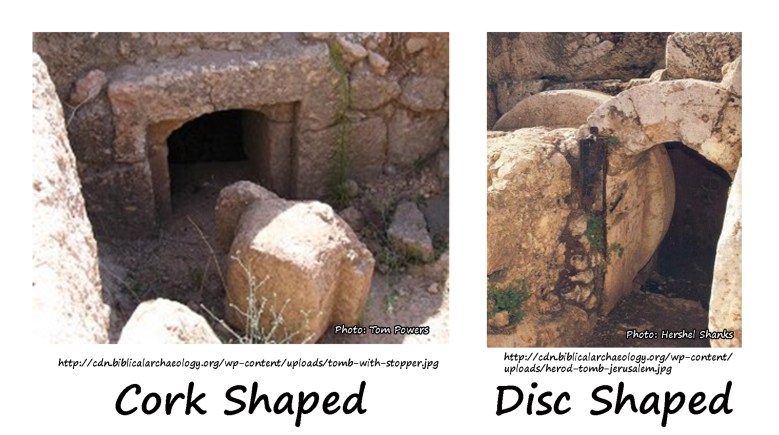
Some scholars say disc, and some say cork shaped.
I must confess that as a younger Christian, I always wondered about that stone that sealed Jesus’s tomb. In my mind, I imagined a great boulder shaped object, like an enormous marble, rolled against the opening of the tomb. It didn’t quite fit.
Once upon a day, the Lord arranged a visit for me to the Garden Tomb in Jerusalem (The Garden Tomb). Given the opportunity to stay with a dear friend at her long-time home on a kibbutz near Haifa, I noticed there a gigantic disc shaped stone, like an enormous round coin. This, my friend told me, is what some used to seal tombs carved into rock. A few days later, when I visited The Garden Tomb, I saw there a groove in front of the opening in which just such a disc could be placed.  Light flooded my brain.
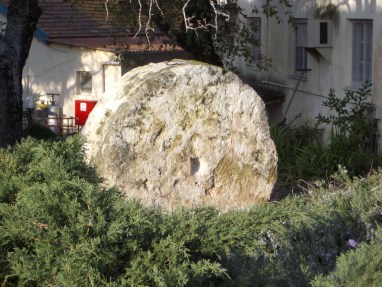
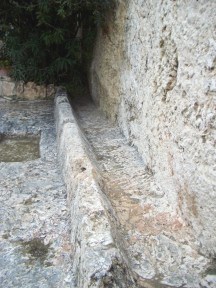
Now, I am by no means suggesting that this anecdotal experience weighs in with any scholarly importance whatsoever. It doesn’t. It’s just that being able to visualize how a rock could seal a flat, rectangular door actually helped my faith in Scripture. Yes, I realize that my faith must have been very small. Nevertheless, God is gracious.
Within the Tomb–Grace Upon Grace
The day I visited Christ’s tomb, I was virtually alone in the Garden. Some kind gentlemen took my picture, then they, too, left. Visitors in that era were permitted to enter the tomb, which is what I did. As I just said, I was virtually alone in the entire Garden, so I set my bag down, sat down, and remained awhile. Long enough to read the signs and Scripture two or three times and to be still. Then, like doubting Thomas when Jesus appeared to him and said, “Put your finger here, and see my hands; and put out your hand, and place it in my side. Do not disbelieve, but believe,” (John 20:27) I believed. Because, you see, the tomb was empty. Then I could get up and leave. No more thought was necessary. I had seen what the Lord in his grace had taken me half way around the world to see. Grace upon grace upon grace.
Now this is the truth that “those with Spirit fullness” (see first paragraph) already know. Jesus is Alive!! How do they know? By experience. How did I come to believe that the tomb was empty? By experience: I sat in an empty tomb.
John 20:29 Jesus said to him, “Have you believed because you have seen me? Blessed are those who have not seen and yet have believed.”
But God’s love is full of grace. For those who need to see in order to believe, God creates for them experiences of sight. We learn of God through his Word and through the hands-on activities of the Holy Spirit in our lives. So…
Believe and be blessed!

Week 3 Life Group: Colossians Bible Study
Colossians as a First Century Letter
Formal Elements
I. From (1:1)
II. To (1:2a)
III. Greeting (1:2b)
IV. Prayer (1:3-12a)
V. Body (1:3-4:6)
VI. Closing and Farewell (4:7-18)
Functional Elements
I. Opening (From, To, and Greeting) (1:1-2b)
II. Introductory Remarks: Laying a Good Foundation for What Follows (1:3-2:5)
III. Issues, Exhortations, Concerns (2:6-4:6)
IV. Final Greetings and Farewell (4:7-18)
Zoom-In:
II. Introductory Remarks: Laying a Good Foundation for What Follows (1:3-2:5)
A. Prayer for the Colossians (1:3-12a)
B. The Father’s Role in the Colossians’ Salvation (1:12b-13)
C. The Son’s Role in the Universe and in Salvation (1:14-23a)
D. Paul’s Role (1:23b-2:5)
1. for the gospel (1:23b)
2. for the church (1:24-29)
3. for the growth of the Colossians and Laodiceans (2:1-5)
Detailed Presentation
I. From
A. Paul an apostle of the Lord Jesus Christ (1:1a)
1. What do we know about Paul? What is his character like? What are some main events in his life? What can we conclude about his motives and purpose in serving the gospel, Christ, and the church?
a. Stoning Stephen Acts 7:54-8:3
c. His Suffering Connected with Ministry 2 Corinthians 11:23-33
2. In what ways might Paul be compared and contrasted with Joshua?
B. Timothy our brother (1:1b)
1. What is Timothy’s role in the Letter to the Colossians?
2. Would you describe Timothy as being first generation or second generation Christian?
3. Questions for thought
a. How do we learn about Timothy throughout the New Testament?
b. That is, does he speak and act directly as a main character?
c. Or, do we mostly learn about him by reading references to him written by others?
d. Is he a main player in the biblical books that bear his name?
4. Thinking about the New Testament in light of Timothy, what do we learn about its overall content? (Who are the main players?)
5. Colossians 1:1, Acts 16:1-3, 1 Timothy 1-6, 2 Timothy 1-4
C. Who is Epaphras? How does Paul describe him?
1. Colossians 1:7 How would the Colossians feel about Paul, whom they had never met, when he commends their pastor? How would they feel about the gospel message Epaphras had given them?
2. Colossians 4:12 This may refer to physical imprisonment, or more likely, metaphorical servitude to Christ.
II. To
A. To God’s holy people in Colossae, the faithful brothers and sisters in Christ (1:2)
B. What do we know about the town of Colosse?
1. Where was it situated? Was it on or off the main trade thoroughfare?
2. How large or small was it?
3. What was its importance, if any?
C. Had Paul ever visited Colosse?
1. Did he know the people personally?
2. What effect might this have had on the tone of his letter to them?
3. Compare Paul’s tone in the Letter to the Galatians with his tone here and relate this to his personal history with each of these churches.
Next Week: Colossians 1:2 more on “To” and “Greeting” with a focus on the words “holy,” “grace,” and “peace.”
 One Small Voice