Home » Posts tagged 'Scripture' (Page 4)
Tag Archives: Scripture
Weeping May Last for the Night, But…

There is so much
to weep about in our world recently. Bad things happen as surely as night follows day. (John 16:33) It seems as though our country–along with most other parts of the world–has been experiencing one very long night. Will the violence and human pain never end? Yet for those who find their eternal hope in our great God and Savior (Titus 2:13), Scripture carries the promise of a bright day to follow each and every dark night: “For his anger is but for a moment, and his favor is for a lifetime. Weeping may tarry for the night, but joy comes with the morning” — (Psalm 30:5).”
Christians know this biblical promise of God is true, because Christ has already deposited within them the fountain of life and joy–his Holy Spirit (John 7:38; Ephesians 1:13). And this fountain of joy and life is eternal; it can never be quenched no matter how much external circumstances say otherwise. And so we sing–
” “Spring up, O well! — Sing to it!”
Christians know and experience that God’s love and mercy arrive fresh and new every morning (Lamentations 3:22-23), and therefore unquenchable joy is their strength (Nehemiah 8:10).

Rain of Spirit in the Desert
What are the barren places in our heart? The Holy Spirit seeks to RAIN on those places.


S P E C K: Read and Question
How much do we get from Scripture when we read? Use these 5 questions as you read to help you better focus, understand, and absorb.
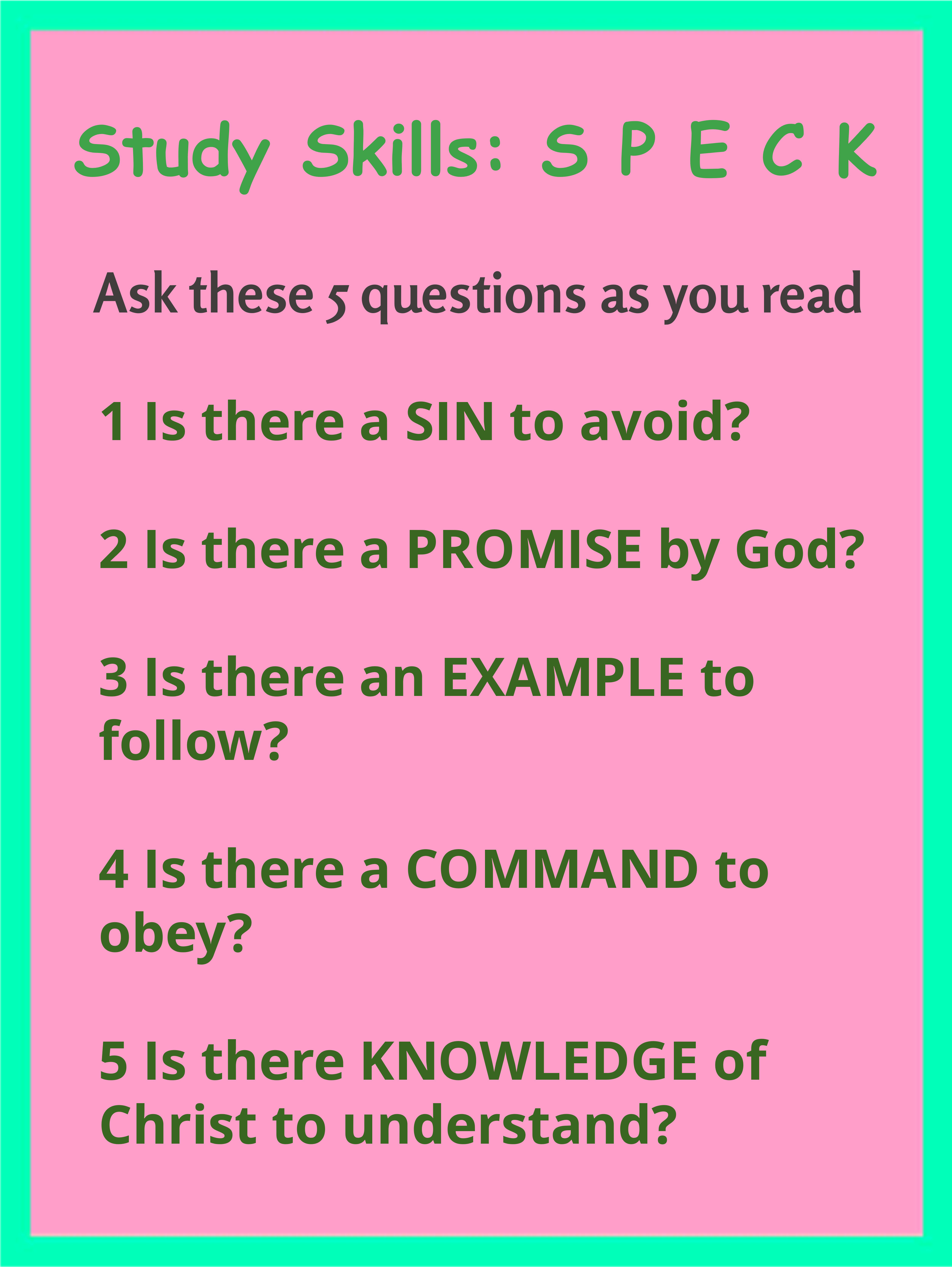
The Navigators. LifeChange Series: A life-changing encounter with God’s Word from the books of Colossians & Philemon. 2nd ed. Colorado Springs: NavPress, 2013, 77.
S P E C K: A Study Skills SideBar
As we read passages of Scripture, such as Colossians 3:1-18, we can ask ourselves questions such as those summed up by the acronym SPECK.


Does Paul Spiritualize the Concrete?: The Great Shift Exemplified in Colossians 2:8-3:4

Click for Text Here: Colossians 2:8-3:4
Gospel Precedents and Biblical Background of Spiritual Elements in Colossians 2
I. One of the great markers of the New Testament Gospels is the translation of concrete and historical Old Testament realities into spiritual and historical realities:
A. Jesus becomes the sacrificial lamb.
1. OT: Abraham begins to sacrifice Isaac (Genesis 22:1-14)
NT: John the Baptist of Jesus–“Behold, the Lamb of God.” (John 1:29, 36)
2. OT: Passover blood of the sacrificial lamb on the lintel (Exodus 12:7)
NT: Jesus sacrificed during Passover (Luke 22:7-8)
B. Jesus becomes the temple.
1. OT: (2 Chronicles 7:11-12)
NT: (John 2:19-22)
C. Concrete worship becomes spiritual.
1. OT: God commanded a certain location where he was to be worshiped (Deuteronomy 12:2-7)
NT: Jesus changed a specific, physical (concrete) location of worship into a spiritual locus of worship with no physical correspondence (John 4: 20-24)
2. OT: God gave the Israelites manna to keep them alive in the wilderness (Exodus 16)
NT: Jesus gives his followers spiritual blood and spiritual bread (spiritual representations of his own physical–i.e., concrete–body) to keep them spiritually alive (John 6:30-35, 49-58)
D. God called Israel his son  God calls Jesus his Son

OT: (Hosea 11:1)
NT: (Matthew 3:17; Luke 3:22)
E. The Old Covenant becomes the New Covenant
1. OT: The many OT covenants had physical (concrete) markers
a. the Noahic Covenant, marked by a rainbow, in which God promised not to physically destroy all living flesh by water (Genesis 9:12-17)
b. covenant with Abraham marked by the sacrifice of a physical ram (Genesis 22:9-18)
c. covenant with Israel through Moses (Exodus 24:3-8) marked by sacrificial blood (“This is the blood of the covenant which the LORD has made with you according to all these words.” Exodus 24:8) and the Ten Commandments (Exodus 24:8, 12; 25:16; 34:28)
d. covenant with David and his house (Psalm 89:3-4; 2 Samuel 7:13) marked by the establishment of his kingdom
2. NT: Jesus gives a New Covenant marked by the concrete (physical) sacrifice of his own body on a cross and the symbolic remembrance of that sacrificed blood in communion (“This cup that is poured out for you is the new covenant in my blood.” Luke 22:20
II. The New Testament epistles continue to replace concrete (physical) realities with spiritual realities sometimes marked by concrete symbols:
A. Continuation of Jesus’ blood as a symbolic marker of the New Covenant (1 Corinthians 11:25)
B. Continuation of the spiritual temple motif (Hebrews 10:19-20)
C. Continuation of spiritual worship (John 4:23-24; Philippians 3:3; Revelation 21:22)
D. Scripture continues to refer to Jesus as God’s son (Acts 8:37; Romans 1:1-4; 2Peter 1:17) and to his followers as sons (includes daughters) of God (Romans 8:14; Galatians 3:26; Hebrews 12:7)
E. The epistles continue to refer to the New Covenant as having replaced the Old (in prophecy Jeremiah 31:31-34; 2 Corinthians 3:6; Hebrews 8:8-13; Hebrews 9:15; Hebrews 12:24)
Paul’s Movement from Concrete (Physical) to Spiritual in Colossians
I. In matters of food, drink, festivals, new moon, a sabbath
Colossians 2:16 Therefore let no one pass judgment on you in questions of food and drink, or with regard to a festival or a new moon or a Sabbath. 17 These are a shadow of the things to come, but the substance belongs to Christ.
A. Paul’s list includes all concrete substances (food and drink) or practices (celebrating a festival, a new moon, or a Sabbath).
B. He calls these a “shadow,” but Christ is the “substance,” or the reality that casts the shadow. Not being physically present on Earth at this time, Christ is Spirit, present by means of the Holy Spirit, who lives in believers and among them.
C. Paul calls these concrete religious practices “elemental spirits” or “elementary principles” as in the NAU. (Gr: στοιχεῖον) (Colossians 2:20)
D. They fall within the category of what Paul labels “flesh” or “fleshly,” (Colossians 2:18; 3:22) what this post refers to as “concrete” or “physical.”
E. These practices concern concrete (physical) items, such as food and drink, which perish as they are used–i.e., they have no eternal value–and they are not useful in helping one to achieve the spiritual practices God desires (Colossians 3:23). The spiritual practices which God desires Paul begins to present in 3:5.
II. Paul moves circumcision from concrete to spiritual
Colossians 2:11 In him also you were circumcised with a circumcision made without hands, by putting off the body of the flesh, by the circumcision of Christ,
III. Baptism, itself a concrete action, signifies a spiritual correspondence to and spiritual identification with Christ’s death and resurrection
Colossians 2:12 having been buried with him in baptism, in which you were also raised with him through faith in the powerful working of God, who raised him from the dead.
IV. In a spiritual way, the record of debts owed under the Old (First) Covenant was nailed to the cross with Christ and thereby cancelled, forgiven (2:13)
Colossians 2:14 by canceling the record of debt that stood against us with its legal demands. This he set aside, nailing it to the cross.
V. Paul’s point is that the Colossians, as believers in Christ, have moved from the old, concrete form of worshipping God to the new, spiritual form of worship.
Colossians 2:20a If with Christ you died to the elemental spirits of the world,
They are therefore free of the old ways, having died with Christ to them, and having been raised with him into newness of life under the New Covenant of Spirit
and no longer need to follow these old, concrete (physical, fleshly) ways of worship and thinking and living
Colossians 2:20b why, as if you were still alive in the world, do you submit to regulations–
VI. Paul’s Alternative to the Old Ways 

A. His rationale
Colossians 3:1a Since, then, you have been raised with Christ
Colossians 3:3 For you have died, and your life is hidden with Christ in God.
B. His conclusion
Colossians 3:1b set your hearts on things above, where Christ is, seated at the right hand of God.
C. How should the Colossians’ thinking change?
Colossians 3:2 Set your minds on things that are above, not on things that are on earth.
D. What will the end result be?
Colossians 3:4 When Christ who is your life appears, then you also will appear with him in glory.
VII. Paul begins to answer the question, How then shall we live?
NIV Colossians 3:5a Put to death, therefore, whatever belongs to your earthly nature (your concrete, fleshly body)
[not in text: and begin to live to the spiritual in the following ways, which he begins to state in 3:5b]
Link: Concrete to Spiritual: How Jesus Changes the Old Testament to the New
Colossians Reference List
- A Greek-English Lexicon of the New Testament and Other Early Christian Literature, 2nd Edition, edited by William F. Arndt and F. Wilbur Gingrich. Chicago: The University of Chicago, 1979.
- BibleWorks 9 Software for Biblical Exegesis & Research. Norfolk, VA: BibleWorks, 2011.
- Community Bible Study. Engaging God’s Word: Colossians. Colorado Springs: Community Bible Study, 2013.
- Duffield, Guy P. and Nathaniel M. Van Cleave. Foundations of Pentecostal Theology. 4th ed. Los Angeles: Foursquare Media, 2008.
- Fee, Gordon D. and Douglas Stuart. How to Read the Bible for All Its Worth. 3rd ed. Grand Rapids: Zondervan, 2003.
- Friberg, Timothy, Barbara Friberg, and Neva F. Miller. Analytical Lexicon to the Greek New Testament. Baker’s Greek New Testament Library. Grand Rapids: Baker, 2000. BibleWorks, v.9.
- Hendriksen, William. New Testament Commentary: Exposition of Colossians and Philemon. Grand Rapids: Baker Book House, 1964.
- The Holy Bible: New International Version®. NIV®. Copyright © 1973, 1978, 1984, 2011 by Biblica. All rights reserved worldwide. (New International Version Bible Online). http://www.biblestudytools.com/colossians/.
- The Navigators. LifeChange Series: A life-changing encounter with God’s Word from the books of Colossians & Philemon. 2nd ed. Colorado Springs: NavPress, 2013.
- O’Brien, Peter T. Understanding the Basic Themes of Colossians, Philemon: Quick Reference Bible Topics. Edited by David A. Hubbard. Dallas: Word Publishing, 1991.
- Pink, Arthur W. Gleanings from Paul. Edited by Rev. Terry Kulakowski. Zeeland, MI: Reformed Church Publications, 2009. Accessed February 26, 2016. http://www.davidcox.com.mx/m/files/Pink-Gleanings_From_Paul(PPC).pdf.
- Shorter Lexicon of the Greek New Testament, 2nd Edition, edited by F. Wilbur Gingrich and Frederick William Danker. Copyright © 1965 by The University of Chicago Press.
- Thayer, Joseph. A Greek-English Lexicon of the New Testament (Abridged and Revised Thayer Lexicon). Ontario, Canada: Online Bible Foundation, 1997. BibleWorks, v.9.
- Wright, N. T. Tyndale New Testament Commentaries Vol. 12: Colossians and Philemon. Downer’s Grove: Intervarsity Press, 1986.

Paul: You Colossians Already Have It All
Tracing Out a Single Strand in Paul’s Letter

His Argument
I. The Colossians’ Position in Christ

- The Colossians have faith and love (1:4).
- They heard the gospel and fully understood and recognized (ἐπιγινώσκω) the grace of God in truth (1:6).
- They learned this true gospel from Epaphras, a faithful minister of Christ (1:7).
- They are no longer estranged (1:21) but are now reconciled and will be presented by God holy, blameless, and irreproachable before him (1:22),
- IF they continue in the faith, stable and steadfast, not shifting from the hope of the gospel they heard (1:23) (and again in 2:6).
- They currently have good order and firmness of faith in Christ (2:5).
THEREFORE: (2:6)
II. Exhortations
A. As you received Christ Jesus the Lord, so live (walk) in him (2:6) (Having come full circle–inclusio–this verse repeats 1:23).
- How? (2:7)
- rooted in Christ
- built up in Christ
- established in the faith (as you were taught in the gospel by Epaphras)
- overflowing with thanksgiving
B. Don’t do this:
- Don’t let others deceive and draw you astray into their cul-de-sac of false belief (2:8),
- Because you don’t need them:
C. Don’t let this happen:
- That anyone should pass judgment on you in regard to food, drink, festivals, new moons, or Sabbaths (2:16).
- Because
D. But do this:
- Seek the things that are above, where Christ is seated at the right hand of God (3:1).
- Set your minds on things that are above, not on things that are on earth (3:2).
- Because
III. Paul Continues Explaining in Detail How the Colossians Should Live (3:5-4:6)
Conclusion of Paul’s Introductory Foundation: Colossians 2:1-5
NIV Colossians 2:1 I want you to know how hard I am contending for you and for those at Laodicea, and for all who have not met me personally. 2 My goal is that they may be encouraged in heart and united in love, so that they may have the full riches of complete understanding, in order that they may know the mystery of God, namely, Christ, 3 in whom are hidden all the treasures of wisdom and knowledge. 4 I tell you this so that no one may deceive you by fine-sounding arguments. 5 For though I am absent from you in body, I am present with you in spirit and delight to see how disciplined you are and how firm your faith in Christ is.
NET Colossians 2:2 My goal is that their hearts, having been knit together in love, may be encouraged, and that they may have all the riches that assurance brings in their understanding of the knowledge of the mystery of God, namely, Christ,
How can Paul be agonizing and contending, fighting, for those in Colosse and Laodicea, if he is in prison and has never met many of them in person? (for the following list, please see Hendriksen, 94)
- striving in prayer (Colossians 4:12, 13; Romans 15:30)
- listening to God
- careful planning
- letter writing
- give direction to those in the mission field
- exhorting the resistance to Satan
- gospel proclamation wherever and however possible
- giving his personal witness and testimony
- living a model Christian life while undergoing pressure and affliction
Verse 2a Paraphrased (Wright, 98):
In other words, while the process of knitting together the church into a united body clearly includes the growth of love, it also includes the growth, on the part of the whole community, of that proper understanding of the gospel which leads to the rich blessings of a settled conviction and assurance. Living in a loving and forgiving community will assist growth in understanding, and vice versa, as truth is confirmed in practice and practice enables truth to be seen in action and so to be fully grasped (cf. 1:9-11). All of this promotes the encouragement, comfort and strengthening of the heart, regarded metaphorically then as now as the seat of affections and the mainspring of actions.
Verse 2–“in order that they may know the mystery of God, namely, Christ,” is central to the entire letter, is central to the entire New Testament, to the entire Bible. Everything is wrapped up in Christ, “namely, Christ.” To know Christ is the goal of Paul and God’s ministry here on earth. Christ is the answer to everything we might want to know about God and his purposes.
NIV 2 Peter 1:3 His divine power has given us everything we need for a godly life through our knowledge of him who called us by his own glory and goodness.John 17:3 Now this is eternal life: that they know you, the only true God, and Jesus Christ, whom you have sent.
NIV 1 Corinthians 8:6 yet for us there is but one God, the Father, from whom all things came and for whom we live; and there is but one Lord, Jesus Christ, through whom all things came and through whom we live.
NIV 1 John 5:20 We know also that the Son of God has come and has given us understanding, so that we may know him who is true. And we are in him who is true by being in his Son Jesus Christ. He is the true God and eternal life.
3 in whom are hidden all the treasures of wisdom and knowledge.
Verse 3 expands and reiterates verse 2. Christ is the “mystery of God” (v. 2) revealed. All that which was hidden and secret about God is fully made known by him to man in Jesus Christ.
NIV Colossians 2:9 For in Christ all the fullness of the Deity lives in bodily form,
Wisdom and knowledge are treasures, and those who are in Christ may begin to eternally plumb those treasures.
NIV John 17:21 that all of them may be one, Father, just as you are in me and I am in you. May they also be in us so that the world may believe that you have sent me.
NIV John 17:23 I in them and you in me–so that they may be brought to complete unity. Then the world will know that you sent me and have loved them even as you have loved me.
How is God’s wisdom different than human wisdom? How are wisdom and knowledge related?
In Christ knowledge is never separated from wisdom, as it often is among men. Now wisdom is the ability, in concrete situations, to apply knowledge to the best advantage. It uses the most effective means to achieve the highest goal. (Hendriksen, 105)
God’s wisdom is creative; it is the source of all that we as humans can only reflectively know and understand. We who are created in God’s image, create by using what he alone created from nothing, himself excepted.
4 I tell you this so that no one may deceive you by fine-sounding arguments.
Paul is almost but not quite telling them that they may be deceived or about to be deceived. This is a warning spoken from love and concern, because the true knowledge of Christ is far better than every deception. Paul will describe some of the deceptions as Chapter 2 continues to unfold.
5 For though I am absent from you in body, I am present with you in spirit…
Verse 5a speaks to the spiritual unity all believers share with one another in Christ (see John 17 quoted above). This unity is emphasized and made more real (conscious) as we pray for one another. Paul’s presence with the Colossians, though physically absent from them, was a reality to him, because he constantly agonized for them in prayer.
Colossians 1:9 For this reason, since the day we heard about you, we have not stopped praying for you.
Colossians 1:29 To this end I strenuously contend with all the energy Christ so powerfully works in me.
Colossians 2:1 I want you to know how hard I am contending for you and for those at Laodicea, and for all who have not met me personally.
…and delight to see how disciplined you are and how firm your faith in Christ is.
After warning the Colossians in the prior verse that they may be deceived or about to be deceived by false teachers, Paul builds them up and encourages them by naming strengths he knows they already have.
- This reassures them in their faith that they are doing well and are on the right path.
- Such reassurance is an encouragement to them to continue as they are doing, even though the path may be difficult.
- Paul’s words also reassure them of the high regard he has for them. (How does this help prepare them for the more difficult words he is to tell them further on in the letter?)
- Paul’s compliments to them speak into the characteristics he wants them to continue to practice and grow, that is their orderliness–discipline–and firmness–stability–in the faith and in their meeting together.
This conclusion to Paul’s lengthy introductory remarks ends on a happy and positive note. The next verse begins Paul’s exhortations.
Recap of the letter so far:
Introductory Remarks: Laying a Good Foundation for What Follows (1:3-2:5)
A. Prayer for the Colossians (1:3-12a)
B. The Father’s Role in the Colossians’ Salvation (1:12b-13)
C. The Son’s Role in the Universe and in Salvation (1:14-23a)
D. Paul’s Role (1:23b-2:5)
1. for the gospel (1:23b)
2. for the church (1:24-29)
3. for the growth of the Colossians and Laodiceans (2:1-5)
Application:
- In Paul’s entire introductory foundation, Colossians 1:1-2:5, what evidence do you find of his diplomacy? Do we apply Paul’s kind of diplomacy in our interactions with non-Christians and Christians alike?
- Does learning about the full “mystery of God, namely, Christ in whom are hidden all the treasures of wisdom and knowledge” cause me to want to say with Paul:
Philippians 3:10 I want to know Christ–yes, to know the power of his resurrection and participation in his sufferings, becoming like him in his death,…
Philippians 3:13 Brothers and sisters, I do not consider myself yet to have taken hold of it. But one thing I do: Forgetting what is behind and straining toward what is ahead, 14 I press on toward the goal to win the prize for which God has called me heavenward in Christ Jesus.
- What am I doing to achieve this goal? What “corners” am I cutting? Where am I being lazy? Where am I commendable?
…………………………………..
Our group will be taking a break at this point. I hope that these studies have in some way been helpful to someone. Blessings in Christ!

Exodus 15:26–How Could a Loving God Put Disease on ANYONE?
NET Exodus 15:26 He said, “If you will diligently obey the LORD your God, and do what is right in his sight, and pay attention to his commandments, and keep all his statutes, then all the diseases that I brought on the Egyptians I will not bring on you, for I, the LORD, am your healer.”
At Bible study last evening, a young Christian asked the sincere question in the title of this blog. I, for my part, before I became a Christian, for many years nurtured anger against God because he killed the Egyptian babies.*

NET Exodus 12:29 It happened at midnight– the LORD attacked all the firstborn in the land of Egypt, from the firstborn of Pharaoh who sat on his throne to the firstborn of the captive who was in the prison, and all the firstborn of the cattle. 30 Pharaoh got up in the night, along with all his servants and all Egypt, and there was a great cry in Egypt, for there was no house in which there was not someone dead.
After I became a Christian, a better knowledge of God and his loving ways, especially as revealed in the Old Testament, brought me to peace with this difficult portion of Scripture. The key was to see the story of Israel’s deliverance from Egypt through God’s eyes, not through my own.
In beginning a small study to help my friend untangle her knot about God’s love and the Egyptian plagues of disease, I came across the following Bible study done by Robert L. (Bob)Deffinbaugh and published at Bible.org on May 13, 2004. I think it does a good and complete job of laying out the facts as presented in Scripture. The Holy Spirit needs to work it into a believer’s heart, as He did in mine, by resolving the underlying issues there. For me, it was a matter of accepting the fact and gravity of sin, especially my own. Indeed, before I became a Christian, I was one of these biblical “Egyptians.” Here is the link:
The Passover and the Plague of the Firstborn (Exodus 11:1-13:16)
* I was not a careful listener in those years. God actually killed all the firstborn; many of whom were undoubtedly adults at the time.
 One Small Voice