Home » 2020 (Page 3)
Yearly Archives: 2020
Isaiah: A Personal Devotional Journal–2
RECAP: As mentioned previously, God in Isaiah addresses two groups of people. He is pleased with one group and blesses them. The other group receives his condemnation. Unless the reader understands that God constantly and abruptly switches back and forth between these two groups, she might form the opinion that God is “schizophrenic,”–now he is happy; now he is angry. The groups are usually not labeled per se. Most often, everyone is referred to as “they.” So how does the reader know when God has left off addressing one group and switches to the other? The answer lies in the content. Someone who knows God well might say, “God would never speak to his loved ones using words like these.”
The two groups, though usually not labeled, are labeled in Chapter 1. Verse 2 introduces the rebellious children. Verse 9 introduces the “few survivors,” (LXX seed) the Lord “left,” (LXX left surviving, Thayer Def. 2), that is, spared. He spared a remnant. The concept of remnant derives from a root meaning “forsake, abandon.” Most often, biblically, the word is not used in a good way. Israel “forsakes” or “abandons” God’s law. But when judgment comes, and God sweeps away the wicked, it is good to be part of the leftovers, the small group not taken, the ones left behind. The image of a seamstress cutting a pattern works well. The scraps left over after the usable portion has been removed are “left.” Seamstresses actually call this leftover portion the “remnant.”
Isaiah’s whole concept of a “remnant” spills over into Romans 9:6, “… For not all who are descended from Israel belong to Israel,” and 9:27, “And Isaiah cries out concerning Israel: ‘Though the number of the sons of Israel be as the sand of the sea, only a remnant of them will be saved.'” Understanding the concept that Isaiah flips between addressing two distinct groups of people is critical. Unless the reader grasps this and learns to identify the two groups, she might get whiplash. God in Isaiah 1:25-27 addresses the remnant, who will be cleansed by the removal of greater Israel, whose judgment is described in verses 28-31.
Chapter 2 opens, “The word that Isaiah the son of Amoz saw concerning Judah and Jerusalem,” (ESV, unless otherwise noted). Judah and Jerusalem formed the Southern Kingdom of Israel. Judah is the tribe that birthed Jesus, according to his flesh. Jerusalem was the center of Israel’s worship, location of the temple of God. Isaiah’s prophecies span four Judean kings (1:1), and the timing is just over 100 years before the Babylonian captivity. God sent Isaiah to call his people to repentance (1:16-20).
Verses 2-4 are positive words prophesying goodness and blessing. These are addressed to the remnant, the “seed,” (1:9). In verse 2, the words “mountain,” “mountains,” and “hills,” are symbolic. Isaiah is not speaking of literal elevations of literal landscape features, nor of a cataclysmic, literal lifting up (a seismic earthquake?) of a massive amount of earth and rock, even though it is true that Jerusalem was built on a high hill. The “mountain of the Lord” represents the dwelling place of God, the figurative seat of his power (see also Isaiah 30:29, Micah 4:1-2, and Zechariah 8:3). The hills in this verse represent other, smaller powers. “Zion” is first mentioned in 2 Samuel 5:7 and is a name for the City of David, the capital of that great king. David in turn becomes a New Testament type (a model New Testament writers claim from the Old Testament) of the Great King, Jesus Christ. Taken together, the words of verse 2 speak of the physical location of the center of the Lord’s kingdom, where he is to be worshiped.
Still in verse 2, what time period do “the latter days” refer to? The Septuagint (Old Greek translation) calls these “the last days.” We find this phrase again in Acts 2:17, 2 Timothy 3:1, Hebrews 1:2, and elsewhere in the New Testament. Hebrews 1:1-2 declares, “Long ago, at many times and in many ways, God spoke to our fathers by the prophets, 2 but in these last days he has spoken to us by his Son, whom he appointed the heir of all things, through whom also he created the world.” Based upon its New Testament usage, the “last days,” or “latter days,” refer to a time future to Isaiah, a time of Messiah’s reign, that is, after the resurrection and ascension. Yet, the question still remains, “latter days” of what? Taken as a whole, verses 2-3 speak of a time of restoration and righteousness in God’s kingdom, a time when his center of worship will be a beacon of light to the whole world.
Verse 4 is extremely well known among Christians. “He shall judge between the nations, and shall decide disputes for many peoples; and they shall beat their swords into plowshares, and their spears into pruning hooks; nation shall not lift up sword against nation, neither shall they learn war anymore.” It speaks of the peaceful, enlightened reign of the Lord, Christians would say of Messiah. Whether this age of spiritual peace and prosperity refers to the current church age in its entire extent, or to a still future reign, cannot be known. In either event, God’s intention, as expressed by Isaiah, is to bless his worship by many peoples, not just the Israelites.
Verse 5 transitions from Group 1, the blessed, to Group 2, the judged. It can be read with the previous section, or the following. It’s as though God is saying to his own people, the house of Jacob (paraphrasing), Look, I just showed you the future of my kingdom and my worship. Now won’t you come and be part of this? Verse 5, “And now, O house of Jacob, come, and let us walk in the light of the Lord.” Could the Apostle John have been thinking of this when he wrote in John 1:4-5, “In him was life, and the life was the light of men. 5 The light shines in the darkness, and the darkness has not overcome it,”? See also John 12:35-36 and Luke 1:79.
Verses 2:6-4:1 address in an unbroken stream the group God chastises (to be continued).
Isaiah: A Personal Devotional Journal–1
In Isaiah 1, God speaks as a man. By that I mean he speaks in the language we use. He uses our words, and his meaning is clear.
God’s tone (verses 1-8) is the tone of one who is grieving, as a father grieves his wayward children. He speaks not as an authoritarian–not as a lofty God of might who issues decrees with thunder and lightning. His tone is pleading, almost as though he has put himself down at our level.
Nevertheless, judgment is coming, but God’s call is ever for his people to repent. God’s first-ever recorded words to Cain urged him to repent:
… And the LORD had regard for Abel and his offering, 5 but for Cain and his offering he had no regard. So Cain was very angry, and his face fell. 6 The LORD said to Cain, “Why are you angry, and why has your face fallen?
7 If you do well, will you not be accepted? And if you do not do well, sin is crouching at the door. Its desire is for you, but you must rule over it.” 8 Cain spoke to Abel his brother. And when they were in the field, Cain rose up against his brother Abel and killed him. (Gen 4:4-8 ESV)
In response to God’s graphic description of the people’s sinfulness in verses 1-8, the first person plural voice of verse 9 acknowledges that they had sinned.
Isaiah 1:9 If the LORD of hosts had not left us a few survivors, we should have been like Sodom, and become like Gomorrah. (Isa 1:9 ESV)
Nevertheless, it is God who acts in verse 9. It is he who did not (note the past tense, as though the speaker is recording after-the-fact) completely wipe out his people, as he had done when he passed judgment on the wicked towns of Sodom and Gomorrah. Here is the FIRST mention in Isaiah of those whom God “left,” or spared. Here, so early in the book, Isaiah introduces this group of people whom God addresses throughout the full length of Isaiah: those who repent and remain under his wing. The other group comprises those who do not.
Still in verse 9, the verbal phrase, “had not left us,” in the Septuagint contains the root (lemma) of the Greek word for “remnant,” which Paul announces in Romans 9:27, where he quotes from Isaiah 10, a few chapters later. Then, in Romans 9:29, he quotes this verse from Isaiah. The “remnant” whom God spares from judgment play a critical role in Isaiah. The ESV calls them, “a few survivors,” again in verse 9. In the Septuagint, the Greek word for “survivors” is “seed,” which my analytical lexicon labels as singular. God left a remnant, a leftover seed, whom he did not destroy. From Paul again, we recall that Christ is Abraham’s “seed,” singular (Galatians 3:16). I surmise that here in Isaiah 1:9, the seed are the remnant of the faithful, from who Messiah comes. The other group of people, for want of a better word, I call the “bulk,” the bulk of the people. As Isaiah progresses* through the reigns of four kings, a very long time, we find that he alternately addresses each of these two groups. We will watch for that.
If we were not sure that God is angry, verse 10 makes that abundantly clear. The speaker of verse 9 says, “If…, we would have been like Sodom and Gomorrah.” But with God there is no “if.” We know that he is speaking to the “bulk” group now, because he directly addresses them as though they are Sodom and Gomorrah:
Hear the word of the LORD, you rulers of Sodom! Give ear to the teaching of our God, you people of Gomorrah! (Isa 1:10 ESV)
And then, in verses 11-15, God speaks in the most personal of terms about how he does not want their forms of hypocritical worship–their false obedience to his law. In 16-17, he lists what he does want: his heart seeks justice for the fatherless, the widow, and the oppressed. Sins against these are the ones God notices.
Verses 18-19 are a direct call to repentance, along with a description of the blessings which will ensue. Verse 18 speaks the FIRST promise of cleansing in the book. Verses 18-20 offer the two choices: repent and be blessed, or continue rebelling and be punished.
In tragic terms, God describes in verses 21-23 how low the once beautiful city has fallen, how mismanaged and corrupt it has become. But in verse 24, he, the “Lord” and “LORD of hosts, the Mighty One of Israel,” vows, “I will get relief from my enemies and avenge myself on my foes.” This also is tragic, because verse 25 reveals that these enemies and foes are his own people. We know this from the text because he names his foes and enemies as, “you” and refers to them with the word, “your.” There is no doubt of whom God is speaking–his own people.
24 Therefore the Lord declares, the LORD of hosts, the Mighty One of Israel: “Ah, I will get relief from my enemies and avenge myself on my foes. 25 I will turn my hand against you and will smelt away your dross as with lye and remove all your alloy. (Isa 1:24-25 ESV)
Verse 25 reveals, however, that his intention is to purify. He continues to describe the restoration of Zion by means of justice and righteousness in verses 26-27. But the closing verses switch back again to the “rebels and sinners,” and their end in verse 31 sounds a lot like hell. This causes the reader to go back and reread vs. 24-25, where the likelihood emerges that the group there who receives the cleansing are the remnant, while the rest of the chapter describes the bulk who will be destroyed.
RESPONSE
I was first struck by the love of God and how he makes himself so accessible. His heart is that his people should repent and receive his blessing. Nevertheless, he, as the Sovereign Lord, judges wickedness. He will have none of it. But the pleading for repentance is strong here, as throughout the rest of the book. It is not God’s desire that any should perish.
As I read the descriptions of those who displease God, I could not help but think of our own country, America, right now, especially as we travel through this election season. As I look around the dark landscape our country has become, it seems as though Isaiah’s words directly describe us as a nation. How tragic that is. And what about the church? Is God wholly pleased with us?
Personally, the sins of my life are scarlet. In meditation, I rehearse these sins before the Lord. My only hope is that I will be one of the ones who continuously turns to God in confession and repentance. I am assured that God has loved me in the past, and if I remain humble and dependent upon him for my cleansing, I am sure he will love me to the end. Lord, help me to do my part. Lord, may it be so.
__________
* It is true, this is not the first time I have read or studied Isaiah. I studied it many years ago, and discovered the concept of the remnant at that time. What is a surprise to me here, is that the remnant is named as early as v. 9 of chapter 1.
Isaiah: A Personal Devotional Journal–Introduction
Who “owns” the Bible? Scholars? Academics? the Church? a denomination?
My initial response tells me that God owns the Bible. It is his from start to finish. And he gave it as a gift to his people, the church: Israel in the Old Testament and the Bride of Christ in the New.
A common, ordinary person has access to the Bible and God encourages such to read it, to eat it, to devour it. There are many testimonies we often hear in which someone says they began reading the Bible and became a Christ-follower. God wants his children, all of them, to read his word.
Isaiah has always been one of my favorite biblical books. It speaks the gospel of Christ. As I was considering recently, What book shall I choose for my devotional reading, I detected an eagerness in my heart for Isaiah.
Quite frankly, I am too old to begin an academic study of Isaiah. The book is huge, and there are volumes and volumes of commentary that have been written about it over the centuries in which one writer contradicts another. There is no way I can wade through all that material.
Therefore, I have decided to read Isaiah as a small person taking her daily walk, enjoying and paying attention to the scenery and small details of the path. And, I love to write. So I decided to write a journal of my musings as a single voice. I pray, Lord, that you will lead and guide me along your way, give me your eyes, point out to me what you want me to see and hear, smell, taste and touch along the way. I pretend to have no authority, other than the Holy Spirit as my guide. Lord, I give this journal to you. Bless, please, according to your will. Hallelujia and praise your name, Love in Christ, Christina.
Comfort During Trials: Size Doesn’t Matter

Stock Image
The poster accompanying this post illustrates just the first portion of Isaiah 43:2. The second half complements the first and should not be eliminated from it. The entire verse reads:
When you pass through the waters, I will be with you; and when you pass through the rivers, they will not sweep over you. When you walk through the fire, you will not be burned; the flames will not set you ablaze (NIV).
This is a verse for all seasons and for all people. When I was still a child and not yet a Christian, I summed up my entire philosophical musings with the phrase, “All things are equal.” By this I meant that the experiences of a bird are bird-size, yet they fill that bird’s universe. The experiences of a mighty world leader are mighty-world-leader-size, yet they fill that leader’s universe. While small creatures may have what we might call small problems, yet they completely fill that small creature’s entire world. Large people have large problems, yet those problems can do no more than fill that large person’s entire world. In this sense, “All things are equal,” because everyone experiences their own lives to the maximum amount their lives can hold.
The point is that we should not compare our situations with the situations of others in a judgmental fashion. It makes no difference if we are judging ourselves or judging others. God does not do that. He judges each person according to their own size. “For he knows our frame; he remembers that we are dust” (Palm 103:14, ESV). In other words, God does not judge us according to his own godly size; he judges us according to our own size. And we are creatures made of dust. In a parable Jesus told, a master speaks the same words to two people. One had invested and doubled five talents of money, and the other had invested and doubled two talents. Both received the identical commendation, “Well done, good and faithful servant. You have been faithful over a little; I will set you over much. Enter into the joy of your master,” (Matthew 25). The master rewarded each according to their size. Yet for each, the reward was equally full, since no doubt it filled that person’s capacity.
Concerning difficulties, to a tiny ant, a trickle of rain water can present a formidable obstacle. To a long distance solo sailor, her obstacle might be a violent storm at sea. The ant should not think that her prayers and cries for help mean less to God than those of the brave sailor. And the brave sailor should not disdain the pleadings for mercy of the tiny ant. Jesus said, “Let the children come to me.” And in his very next breath, he told the crowd that we should all become like them (Luke 18:16-17).
No problem we will ever face is too big for God to handle, and no problem we will ever face is too small for God to care. God sees each of us for who we are. It does not matter to him if we are the Apostle Paul or if we are the poor widow who placed her last two cents into the synagogue offering. God loves all his children, and he will see us through it all.
Spirit and Word

Photo by Christina Wilson
Paul tells us in 2Corinthians 3:6, “For the letter kills, but the Spirit gives life.” Of course, he was talking about God’s law written in a believer’s heart. This is the New Covenant Jeremiah spoke of in 31:31. Jesus informed his listeners in John 6:63, “It is the Spirit who gives life; the flesh is no help at all. The words that I have spoken to you are spirit and life.” The Bible is certain that a new creation in Christ needs the Holy Spirit. And, Christ also was certain that the words he spoke “are spirit and life.” Christians need both the Spirit of God and the Word of God. Here is the Trinity–God the Father, the Holy Spirit, and God the Son, who is the Word.
Because there are false spirits and because our hearts are not always as discerning as they might be, sometimes Christians tend to hear who they think is the Holy Spirit but is not. Or they hear or interpret the Holy Spirit inaccurately. Even famous Christians sometimes do this. Therefore, God has also given us his Word. His Word is a correction against false spirits. But the Holy Spirit is a correction for the dead letter–words alone that carry no life. So, charismatic saints and lovers of Scripture all! Let us heed Paul’s admonition and do as he suggests, “Let my prayer be from the spirit, and equally from the mind. Let my song be from the spirit, and equally from the mind.” In this is life. God in his wisdom and love gave us both mind and Spirit, both his Spirit and his Word.
Peace and Rest in the Stability of God
Photo by Nevada
I grew up in a traditional Presbyterian church that boasted big stained glass windows and a multi-tiered organ. (I’m not saying that’s where I am now.) One of my favorite childhood hymns was, “This Is My Father’s World.”
This Is My Father’s World
Maltie D. Babcock, 1901, Public Domain
This is my Father’s world,
And to my list’ning ears
All nature sings, and round me rings
The music of the spheres.
This is my Father’s world:
I rest me in the thought
Of rocks and trees, of skies and seas—
His hand the wonders wrought.This is my Father’s world:
The birds their carols raise,
The morning light, the lily white,
Declare their Maker’s praise.
This is my Father’s world:
He shines in all that’s fair;
In the rustling grass I hear Him pass,
He speaks to me everywhere.This is my Father’s world:
Oh, let me ne’er forget
That though the wrong seems oft so strong,
God is the ruler yet.
This is my Father’s world,
The battle is not done:
Jesus who died shall be satisfied,
And earth and Heav’n be one.
Two lines which keep reverberating in my heart are, “That though the wrong seems oft so strong, God is the ruler yet.” Tell me, when has the world not seen trouble? Trouble is ubiquitous. All my recent ancestors knew seasons of peril and deprivation. Times of peace are the anomaly. Nevertheless, through it all, the light of God’s love shines. He hasn’t lost track of us, and he still intercedes to bless us where we are. During the hard times I say, “This, too, shall pass.” During the good times I say, “God is so good.” God’s love is everywhere, and he saves to the uttermost those whose heart is open to recognize and receive his Son.
Hebrews 7:25 Consequently, he is able to save to the uttermost those who draw near to God through him, since he always lives to make intercession for them. (ESV)
This morning, I invite everyone who may read this to draw near to God through Jesus his Son, so that the rest and peace we can find only in Christ may be ours in abundance.
How Do We Deal with Fear?

God is familiar with all our fears. He’s been there with us and for us. He knows how we respond to dangerous or challenging situations–with fear! Consider these verses:
- “Fear not, Abram, …” Genesis 15:1
- “Fear not, for I am with you…” Isaiah 41:7
- “Fear not, you worm Jacob, You men of Israel…” Isaiah 41:14
- “Fear not, O Jacob, my servant…” Jeremiah 46:28
- “Fear not, little flock…” Luke 12:32
But here’s the thing…God rejects NO ONE on account of their fears. Rather, God sees fear as an opportunity for his Holy Spirit to help us build our trust in him. He’s not going to pass us by simply because we are afraid. If God wants to use us, he will use us, no matter our fears. Get used to it. Grow your faith by trusting God and obeying his commands for you, especially when you are afraid. You will discover that God is always with you. He will never let you down. He will walk through those flames with you, and he will hold you close to himself. Yes, you may even die. But the Lord has you in himself. He will resurrect you and give you life eternal.
God is good. Jesus knew fear. Luke tells us that before the agony of the cross, Jesus’s “sweat became like great drops of blood falling down to the ground,” (Luke 22:44). Jesus did die, but just look at what his death accomplished. Because of his trust and obedience to God his Father–alongside his fear of the torturous cross–Jesus conquered death itself.
The important thing is always pray. Pray. Pray. Pray. Stay very close to the Holy Spirit in your heart and in God’s word of Scripture. Ask the Lord to help you hear him correctly. Check out your understanding of his commandment to you over and over and over again. When you are sure that you are hearing God correctly, then tell him your intentions to act. Ask him to overrule you if you are wrong, to let you know. Plead with him to reveal any mistakes in your heart. When you have done all this, and God is still telling you to go, then go. He will not fail you. He will be with you. We have his unbreakable promise on this. Our reward for allegiance to Jesus our King is eternal life–with him, forever. That is the best part.
Be strong and take heart, and have no fear, for it is the Lord your God who is going with you. He will not take away his help from you. —Deuteronomy 31:6
Be Fruitful and Multiply
God our Creator is our Father. His being is Trinity. When he incarnated, he chose a Father/Son relationship, that is, parent/child. Until Moses, God’s one commandment to humankind was to be fruitful and multiply. Clearly, God favors families. He wants us to favor family, as well. This begins with our parents. Today is grandparents day. If our grandparents taught their children well, then we will be honoring both parents and grandparents today. Some of us will likewise receive honor. When we honor our father and our mother, we also honor our Creator-Father, God. This is a good way to give him pleasure in us.
Joy in Being Tested
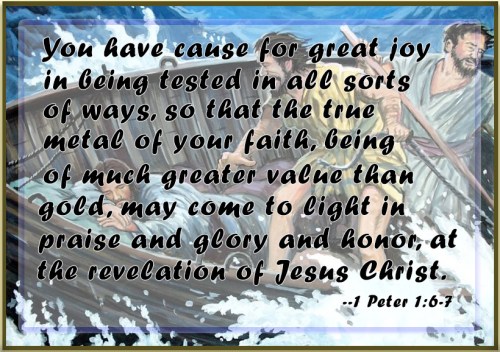
The season of suffering besetting the world right now offers ample opportunity for God to test our faith. Although we’re not all being tested the same way, it’s clear from Scripture that testing is spiritually “normal,” and actually good for our faith. Our confidence during trials is that the Holy Spirit will light the way (Christ’s way) in front of us. Christ will grow us and pull us through. As Christians, let’s rejoice together in faith that God is in charge, and he knows what he is doing in each of our lives.
Have You Asked the Lord About That?
 Part of me is impulsive and part of me mulls things over for years and years. Sometimes the impulsive part gets me into trouble. Other times, when I give myself space to be quiet and talk to the Lord in words, I ask his advice on certain issues in my heart. I ask him for wisdom. And when I do so, I admit to him that I’m willing to hear him call me out. When I say I ask him for advice and wisdom, I don’t mean the “super spiritual” items. I mean the practical things I am facing or a task I must perform.
But the results are amazing! So often, when I ask the Lord for his advice, he gives it to me. When I ask him for wisdom, he shows me the way. His Holy Spirit lights the path in front of me.
And your ears shall hear a word behind you, saying, “This is the way, walk in it,” when you turn to the right or when you turn to the left. (Isaiah 30:21 ESV)
And yes, he does call me out from time to time. I’m grateful for that, because his words are wise. I get to modify my behavior, so I don’t fall into the same traps that lead to bad consequences the next time. So, the verse for today is:
The Lord is good to those who are waiting for him, to the soul which is looking for him. –Lamentations 3:25
 One Small Voice