Home » Articles posted by Christina Wilson (Page 12)
Author Archives: Christina Wilson
Hezekiah’s Pride Part 1: Isaiah Journal 81
By Christina M Wilson. Previously published at https://justonesmallvoice.com/hezekiahs-pride-part-1-isaiah-devotional-journal-81/.
Isaiah 39 Septuagint Modernized NETS
Hezekiah-Part Seven: Hezekiah’s Virtue
Introduction
In general, pride tempts capable people. Pride is a danger for those who succeed in their plans. Spiritually, pride attacks those who demonstrate virtue and faithfulness to the Lord.
For example, the Holy Spirit, the very presence of God, descended upon Jesus as he came up from the waters of baptism. By this action, the Lord God anointed him for ministry. Immediately, the same Spirit led him into the wilderness, where Satan tempted him for forty days (Mark 1:9-13). Satan focused his temptation on causing Jesus to respond to him in a prideful way, to abandon his complete dependence upon the Lord his God and Father.
Jesus, being the Son of God, could have depended upon his own divine nature. But he didn’t. By submitting to the written Word of God in Scripture, Jesus withstood all attempts of Satan to cause him to respond in prideful ways.
As another example, Satan himself is an angelic being whose splendor originally was great, greater than all the other angels. His downfall occurred when he gave in to pride. Pride is one of the first and greatest of all sins. Pride leads people to depend upon themselves, rather than upon the Lord. It is important for Christians to understand the movements of pride, so that we can defend against it.
Scripture gives us much detail concerning King Hezekiah’s pride. But first, we must consider his virtue in order to understand why he succumbed to pride. As background for this and the following posts, it would be good to read through 2 Chronicles 29-31. I quote from the Septuagint below, but readers may feel free to choose their own preferred version of Scripture.
What Happened
The book of Isaiah concludes its history of good King Hezekiah in chapter 39. The portrait this chapter paints of Hezekiah’s pride and callousness toward his own progeny is not beautiful. It seems a poor ending to a wonderful life.
Hezekiah had recovered from a near fatal illness (Journal 80, Isaiah 38). Having heard about this, the son of the king of Babylon went to visit him, bringing gifts. This pleased Hezekiah very much. The king took him on a thorough tour of all the many treasures in his house. Hezekiah was a man of great wealth and delighted to show off in this fashion.
Afterwards, God sent Isaiah to announce to Hezekiah Babylon’s future devastation of everything in his own house and all the treasures accumulated by his ancestors over many generations. They would even carry off some of his own sons and make them eunuchs in Babylon (castrate them). But Hezekiah rejoiced, because the prophecy would not be fulfilled in his own days. He himself would be spared. He would rather that his children would be the ones to suffer for his pride.
Isaiah 39:7 They shall also take of your children whom you shall beget; and they shall make them eunuchs in the house of the king of the Babylonians. 8 And Hezekiah said to Isaiah, The word of the Lord is good, which He has spoken; let there be peace and righteousness in my days. (Complete Apostles’ Bible, Brenton’s Septuagint)
This chapter speaks very poorly of Hezekiah, right? Yes, it does. Therefore, the question is, how could such a good man be so selfish?
Hezekiah’s Immediate Ancestors
Hezekiah was very good. Scripture speaks more highly of him than of nearly any other king. Hezekiah took the throne at age twenty-five. His father Ahaz was very wicked. He imitated the kings of Israel, making molded images of idols, ignoring the temple, and burning incense everywhere. He even “burned his children in the fire,” an abominable cultic practice of the native peoples of the land (2 Chronicles 28:3).
Hezekiah’s grandfather, Jotham, did what was right in the sight of the Lord. But he did not inspire his people. They remained corrupt (2 Chronicles 27:1-2).
Uzziah, Hezekiah’s great-grandfather, reigned fifty-two years. At first he did right, following the laws of the Lord. The Lord blessed his building projects and his preparations for war (2 Chronicles 26:6-15). Unfortunately, Scripture records that he became proud. “His heart was lifted up to his destruction; he transgressed against the Lord his God” (2 Chronicles 26:16).
Uzziah’s pride led him to enter the temple of the Lord to burn incense (Numbers 16:16-17, 35). God permitted only priests to do this (Exodus 30:7-9). God’s rules concerning incense were very strict (Leviticus 10:1-5). Uzziah’s arrogance as king in performing this abominable deed was so great that eighty-one priests of the Lord went in to resist him. When he became furious with them, the Lord struck him with leprosy. He lived in isolation the rest of his days (2 Chronicles 26:16-23).
Just How Good Was Good King Hezekiah?
Hezekiah did better than all these ancestors. Hezekiah began to reign at age twenty-five. His model king was David, not his immediate forbears.
And he did that which was right in the sight of the Lord, according to all that his father David had done. (2Chronicles 29:2 LXE)
HEZEKIAH PURIFIES THE TEMPLE
- It’s wonderful to read 2 Chronicles 29 through 31. Hezekiah was a king like no other. He worked pointedly, quickly, thoroughly, and generously to do all that the law commanded concerning the cleansing of the temple and bringing sacrifices there.
2 Chronicles 29:10 Therefore it is now in my heart to make a covenant, a covenant with the Lord God of Israel, that He may turn away His fierce wrath from us. 11 And now be not wanting to your duty, for the Lord has chosen you to stand before Him to minister, and to be ministers and burners of incense to Him. (CAB, LXE)
- The apostate actions of the kings of prior generations had caused the hearts of nearly everyone to turn calloused, indifferent, and even scornful of the Lord and his ways. Hezekiah reversed this.
2 Chronicles 29:5 and said to them, Hear, you Levites: Now sanctify yourselves, and sanctify the house of the Lord God of your fathers, and cast out the impurity from the holy places. 6 For our fathers have revolted, and done that which was evil before the Lord our God, and have forsaken Him, and have turned away their face from the tabernacle of the Lord, and have turned their back. 7 And they have shut up the doors of the temple, and put out the lamps, and have not burned incense, and have not offered whole burnt offerings in the holy place to the God of Israel. (CAB, LXE)
- Hezekiah inspired others to follow his lead.
And they purified the house of the Lord in eight days [!]… 18 And they went in to King Hezekiah, and said, We have purified all … which King Ahaz polluted in his reign, in his apostasy, we have prepared and purified; behold, they are before the altar of the Lord. (2 Chronicles 29:15-19)
THE PEOPLE WORSHIP THEIR TRUE GOD AGAIN
2 Chronicles 29:33 And the consecrated calves were six hundred, and the sheep three thousand. 34 But the priests were few, and could not slay the whole burnt offering, so their brethren the Levites helped them, until the work was finished, and until the priests had purified themselves… 35 And the whole burnt offering was abundant, with the fat of the complete peace offering, and the drink offerings of the whole burnt sacrifice. So the service was established in the house of the Lord. 36 And Hezekiah and all the people rejoiced, because God had prepared the people: for the thing was done suddenly. (CAB, LXE) (“…since the events took place so suddenly” SAAS)
The King Prepares the Passover
Hezekiah led the people with a strong hand. Unlike his grandfather Jotham (2 Chronicles 27:2), his personal dedication extended downward to others. He motivated them to follow his lead.
THE KING AND THE ASSEMBLY
Hezekiah was never a loner. People were happy to join his team.
2 Chronicles 30:2 For the king, and the princes, and all the congregation in Jerusalem, designed to keep the Passover in the second month. (CAB, LXE)
But preparing to celebrate the Passover began as an uphill battle.
3 For they could not keep it at that time, because a sufficient number of priests had not purified themselves, and the people were not gathered to Jerusalem. (CAB, LXE)
BACKGROUND
These events occurred just a short while before the Assyrians carried off Israel into captivity. The time was ripe for God to discipline Israel for their faithless apostasy (2 Kings 17:5, 18:13). Nevertheless, Hezekiah included the northern kingdom in his invitation to celebrate the Passover in Jerusalem. In doing so, he remained faithful to the decree given Solomon, while the kingdom was still united (2 Chronicles 12:13; Deuteronomy 12:5, 11; 1 Kings 8:29).

2 Chronicles 30:5 And they [see verse 2 above] established a decree that a proclamation should go through all Israel, from Beersheba to Dan, that they should come and keep the Passover to the Lord God of Israel at Jerusalem; for the multitude had not done it lately according to the Scripture.
Remember that Jeroboam had torn the ten tribes of Israel away from the united kingdom of David, Solomon, and initially Rehoboam, Solomon’s son (1 Kings 11:43). As Jeroboam’s first action as king of the northern ten tribes, he placed two golden calves (1 Kings 12:27-30). He put one calf in Bethel on the southern border. The other he placed in Dan, near the northern border at that time. He placed these specifically so that the people of Israel would not go to Jerusalem to worship there, as the Lord had decreed.
THE INVITATION
And here is King Hezekiah of Judah, sending out a proclamation to the hostile north to invite them to celebrate the Lord’s Passover in Jerusalem.
2 Chronicles 30:6 And the posts went with the letters from the king and the princes to all Israel and Judah, according to the command of the king, saying, Children of Israel, return to the Lord God of Abraham, Isaac, and Israel, and bring back them that have escaped, even those that were left of the hand of the king of Assyria. 7 And be not as your fathers and your brethren, who revolted from the Lord God of their fathers, and He gave them up to desolation, as you see. 8 And now harden not your hearts, as your fathers did; give glory to the Lord God, and enter into His sanctuary, which He has sanctified forever, and serve the Lord your God, and He shall turn away His fierce anger from you. 9 For when you turn to the Lord, your brethren and your children shall be pitied before all that have carried them captives, and He will restore you to this land; for the Lord our God is merciful and gracious, and will not turn away His face from you, if we return to Him. (CAB, LXE)
ISRAEL’S RESPONSE TO THE INVITATION
How did the northern people of Israel respond?
and they laughed them to scorn, and mocked them. (2 Chronicles 30:10)
Nevertheless…
11 But the men of Asher, and some of Manasseh and of Zebulun, were ashamed, and came to Jerusalem and Judah.
THE LORD BLESSES THE FAITHFULNESS OF THE PEOPLE OF JUDAH
The actions of Hezekiah and all the people of Judah pleased the Lord. And he blessed them.
2 Chronicles 30:12 At the word of the Lord, the hand of God was on Judah to give them singleness of heart to obey the command of the king and the leaders.
Summary to This Point
1. I’ve gone into historical details more than usual in this post. Second Chronicles records a wonderfully rare coming together of all the people of Judah to faithfully worship the Lord. This happened completely because of one man’s leadership, good King Hezekiah. The story gets even better as Scripture progresses.
Hezekiah was young, still in his twenties, when all these events occurred. The reason I am building such a detailed background is so that we can see how easy it was for Hezekiah to give in to pride in his older years. His spiritual successes and leadership skills were enormous. Because in the end he gave in to pride, he provides a warning for all of us.
There is a popular verse that has been in circulation for a number of years. It has to do with beseeching the Lord in prayer. King Hezekiah is the very embodiment of this verse.
2 Chronicles 7:14 if my people who are called by my name humble themselves, and pray and seek my face and turn from their wicked ways, then I will hear from heaven and will forgive their sin and heal their land. (ESV)
2. Hezekiah was a great leader who inspired people of many backgrounds to follow him. Levites, priests, the assembly of elders, the people as a whole, and even a few people from hostile Israel to the north all united to follow his lead in turning back to worship the Lord.
There is still more for us to see. But because this post is already long enough, I will continue in Post #82.
To be continued…
Hezekiah Worships: Isaiah Journal 80
By Christina M Wilson. Previously published at https://justonesmallvoice.com/hezekiah-worships-isaiah-devotional-journal-80/.
Isaiah 38 Septuagint Modernized NETS
Hezekiah-Part Six: Hezekiah Worships
III. Isaiah 38:9-20
Only Isaiah records King Hezekiah’s prayer when he recovered from his illness. In this prayer, Hezekiah worships the living God who saved him.
9 The prayer of Hezekiah king of Judah, when he had been sick, and had recovered from his sickness:
10 I said in the end of my days, I shall go to the gates of the grave; I shall part with the remainder of my years.
11 I said, I shall no more see the salvation of God in the land of the living; I shall no more see the salvation of Israel on the earth; I shall no more see man.
12 My life has failed from among my kindred; I have parted with the remainder of my life; it has gone forth and departed from me, as one that has pitched a tent takes it down again; my breath was with me as a weaver’s web, when she that weaves draws near to cut off the thread.
13 In that day I was given up as to a lion until the morning; so has He broken all my bones; for I was so given up from day even to night.
14 As a swallow, so will I cry, and as a dove, so do I mourn; for my eyes have failed from looking to the height of heaven to the Lord, who has delivered me,
15 and removed the sorrow of my soul.
16 Yea, O Lord, for it was told You concerning this; and You have revived my breath; and I am comforted, and live.
17 For You have chosen my soul, that it should not perish; and You have cast all my sins behind me.
18 For they that are in the grave shall not praise You, neither shall the dead bless You, neither shall they that are in Hades hope for Your mercy.
19 The living shall bless You, as I also do; for from this day shall I beget children, who shall declare Your righteousness,
20 O God of my salvation; and I will not cease from blessing You with the psaltery all the days of my life before the house of God. (CAB, LXE) (1)
GENRE
Today’s news media loves crises. They love to interview folk who have passed through a crisis and come close to being destroyed. They show up with microphone in hand and say, “Tell us about your experience.” Then the survivor tells their tale. Such is this portion of Isaiah. Scripture gives King Hezekiah space to tell his harrowing experience of how he survived a deadly illness. We read his story in his prayer to God after he recovered (verse 9 forward).
Isaiah 38 is not the only place in Scripture that records a prayer after a near death experience. The Psalter contains several such prayers. King David’s enemies hounded him to death. He didn’t die, however. He lived to sing praises to the Lord who saved him. We find songs celebrating deliverance from near death in Psalm 18:4-19, 57:3-4, 116:3-8, and 118:5, 10-29. As pointed out in other posts on this site, these worshipful prayer songs of David prophetically represent the heart cries and life events of the Lord Jesus Christ during his incarnation (See A Triplet of Psalms on this site).
PARALLELS TO THE LIFE OF CHRIST
How awesome would it be to have one’s life run parallel to that of the Lord Jesus Christ? Many saints both dead and alive encounter persecutions and grievous circumstances similar to those in the life of Christ. The New Testament declares that Christians will and should experience such parallels. Is it possible that this portion of King Hezekiah’s life experience prophetically looks ahead to the death and resurrection of Christ?
- “sick and recovered” (verse 9)–See Psalm 18:4-8; Psalm 116:3, 6; 118:17-18.
- a near death experience near the gates of Hades (verses 10 and 18)–Psalm 88:3; Psalm 6:4-5; 30:3; 94:17.
- cut off from family and from life (verses 11-12)–Psalm 102:3-11; 88:8, 18.
- “given as to a lion” (verse 13)–Psalm 22:13, 21; 57:4;
- “so has He broken all my bones” (verse 13)–Psalm 34:20; 6:1-5; 22:14; 31:10; 42:10. (Note: Christ’s bones were not broken.)
- eyes fail from looking upward–Psalm 69:3.
- delivered! (verse 14)–Psalm 18:1; 30:3; 56:13; 57:4; 86:13; 116:6, 8.
- the Lord did it (verses 14, 16, 17)–Psalm 116:6, 8; 18:4-17; 118:21-23; 22:24-31; 57:3-5.
- Praise the Lord! (verses 19-20)–Psalm 18:46-50; 22:22-25; 57:3-11; 116:16-19; 118:18-29.
There may be other parallels to the Psalms and to the life of Christ within this simple, heartfelt prayer of King Hezekiah.
THE SIGN OF TWO KINGS
When have any of us ever seen the sun move backward in the sky? Isaiah gave Hezekiah a sign that the shadow cast by the setting sun would move backward (2). The text does not say that the sun would move backward, but that the shadow of its setting would (2 Kings 20:8-11). Nevertheless, the sign indicates a miracle. The shadow of death over Hezekiah would be withdrawn.
God performed an even bigger miracle when he resurrected King Jesus from the grave. When God gave victory over death to his Son, he also turned back death’s shadow from the entire world. The sunshine of life shines again. Both the resurrection of Christ the King and the “resurrection” of King Hezekiah indicate life for every believer who identifies with the death and resurrection of Jesus, the King of kings.
When we face difficulties from which we may not survive, let us call upon the name of the Lord. Our God saves. He delivers from death. God’s deliverance is sure, fixed in the heavenlies, whether in this life or by means of our passing to the next. Either way, Christians do experience and will experience resurrection from death. This is the prophetic promise of Isaiah 38.
__________
1 The Complete Apostles’ Bible (CAB). Translated by Sir Lancelot C.L. Brenton. Revised and Edited by Paul W. Esposito, and, The English Majority Text Version (EMTV) of the Holy Bible, New Testament. Copyright © 2002-2004 Paul W. Esposito. Available August 8, 2021, at Isaiah 38 – Complete Apostles’ Bible (bibliatodo.com).
2 Septuagint translations differ among themselves and from the Masoretic. The differences concern whether the shadow of the setting sun would move backward on the face of a sundial or backward upon the steps of a set of stairs in his father’s house. These differences don’t change the overall meaning of the text. Either way, the shadow cast by the setting sun moves backward.
Hezekiah Prays c’t’d: Isaiah Journal 79
By Christina M Wilson. Published previously at https://justonesmallvoice.com/hezekiah-prays-ctd-isaiah-devotional-journal-79/
Isaiah 38 Septuagint Modernized NETS
Hezekiah-Part Five: Hezekiah Prays c’t’d
III. Isaiah 38:1-22 (2 Kings 20:1-11; 2 Chronicles 32:24)
HISTORICAL FOOTNOTE
Three events in the life of Hezekiah dominate these chapters of Isaiah.
- Assyria threatens Jerusalem.
- Hezekiah becomes deathly ill.
- The Babylonians visit Hezekiah, who shows them all his treasures.
Establishing with certainty the chronological timeline of these three intertwined events is difficult. However, the lessons to be gleaned do not depend upon chronology.
About to Die, Hezekiah Prays
“In those days,” Hezekiah becomes sick unto death. The Lord sends Isaiah the prophet to tell Hezekiah that he is about to die (Isaiah 38:1). Hezekiah prays. He does his own praying. But Christian readers may take note of the large “elephant in the room” throughout these several chapters. Namely, King Hezekiah relates frequently with a prophet, Isaiah, who gives him detailed and exact messages from God.
Most of us don’t have prophets in our lives functioning as Isaiah did for Hezekiah. If someone says they do, well then, perhaps some of their kind friends might want to check that out carefully. But while most Christians don’t have a ministering prophet, all Christians have the Holy Spirit.
THE HOLY SPIRIT
Personal testimonies abound the world over of many varied ways in which God communicates directly to a believers’ conscious understanding. Some of these involve words impressed upon a believer’s mind. King Hezekiah did not have the ability to commune with God in the same manner as Isaiah. Nor did the king have the Holy Spirit living within him, as today’s believers do.
The sending of the Holy Spirit to rest and abide with every believer is one of the first actions of King Jesus upon his ascension to his heavenly throne. He prophesied his sending of the Spirit in advance.
John 15:26 “But when the Helper comes, whom I will send to you from the Father, the Spirit of truth, who proceeds from the Father, he will bear witness about me. (ESV)
When the Holy Spirit was given, tongues of fire rested upon each believer severally.
Acts 2:1 When the day of Pentecost arrived, they were all together in one place. 2 And suddenly there came from heaven a sound like a mighty rushing wind, and it filled the entire house where they were sitting. 3 And divided tongues as of fire appeared to them and rested on each one of them. 4 And they were all filled with the Holy Spirit and began to speak in other tongues as the Spirit gave them utterance. (ESV)
The Apostle Peter bore witness to this event.
Acts 2:33 Being therefore exalted at the right hand of God, and having received from the Father the promise of the Holy Spirit, he has poured out this that you yourselves are seeing and hearing. (ESV)
Finally, the writer of the letter to the Hebrews encourages believers to utilize the full benefits of Christ’s atoning blood by entering the presence of God. It is no longer necessary for prophets to intervene for us.
Hebrews 4:16 Let us then with confidence draw near to the throne of grace, that we may receive mercy and find grace to help in time of need. (ESV)
Hebrews 10:19 Therefore, brothers, since we have confidence to enter the holy places by the blood of Jesus, 20 by the new and living way that he opened for us through the curtain, that is, through his flesh, 21 and since we have a great priest over the house of God, 22 let us draw near with a true heart in full assurance of faith, with our hearts sprinkled clean from an evil conscience and our bodies washed with pure water. (ESV)
WEEPING BEFORE THE LORD
Scripture tells us how Hezekiah prays, and so much like we ourselves would like to do from time to time.
Isaiah 38:2 Then Hezekiah turned his face toward the wall, and prayed to the Lord, 3 and said, “Remember now, O Lord, I pray, how I have walked before You in truth and with a true heart, and did what is pleasing in Your sight.” So Hezekiah wept loudly.” (SAAS, St. Athanasius Academy Septuagint)
But do we actually pray as King Hezekiah did? It seems to me that many times Christians are afraid to weep loudly before the Lord. Haven’t we been taught to “Rejoice always”? We may perhaps want to weep and complain, but are we afraid this would display doubt or lack of faithfulness? May the Holy Spirit guide each one of us in our prayers.
Romans 8:26 Likewise the Spirit helps us in our weakness. For we do not know what to pray for as we ought, but the Spirit himself intercedes for us with groanings too deep for words. (ESV)
God Hears Hezekiah
God hears Hezekiah’s prayer. Even though Hezekiah needs Isaiah to tell him words from God, God hears Hezekiah directly. And wonder of wonders, God heals Hezekiah and grants him fifteen more years of life (Isaiah 38:5). Many of us may know cancer victims for whom God granted healing and many more years of healthful living.
THE CAKE OF FIGS
It is noteworthy that God asks Hezekiah to perform a physical action as a demonstration of his faith.
Isaiah 20:7 Then Isaiah said, “Let them take a cake of figs and rest it on the boil, and he will recover.” (SAAS)
Did the figs heal Hezekiah? Or, did God heal Hezekiah upon his obedience of faith? (See 2 Kings 5:1-14 concerning Namaan the leper. Recall also how Jesus commands the man born blind to do such and such in order to effect his healing, John 9:7.)
A PHYSICAL SIGN
Not only does God give Hezekiah the miracle of healing, he gives him a physical miracle as well.
2 Kings 20:8 And Hezekiah said to Isaiah, What is the sign that the Lord will heal me, and I shall go up to the house of the Lord on the third day? 9 And Isaiah said, This is the sign from the Lord, that the Lord will perform the word which He has spoken, the shadow of the dial shall advance ten degrees; or if it should go back ten degrees this would also be the sign. 10 And Hezekiah said, It is a light thing for the shadow to go down ten degrees; but let the shadow return ten degrees backward on the dial. 11 And Isaiah the prophet cried to the Lord, and the shadow returned back ten degrees on the dial.
Opinions may vary on the wisdom of asking God for a sign. Does asking for a sign display doubt, or faith? However one may feel about asking for signs today, signs are not uncommon in the Old Testament nor in the New (Genesis 9:12-17; Exodus 31:13; Judges 6:17, 36-40; Luke 2:12; Matthew 2:2; 12:39-40; 24:3, 30; 26:48; John 2:18-19; Revelation 1:1; and many more).
Hezekiah displays his faith by asking for a difficult sign. A difficult sign serves him well, because when Isaiah prays and the Lord performs the impossible (the shadow on the sundial moving backward), it gives Hezekiah certainty. I personally was desperate enough once to ask for a difficult sign, and when God granted this, the boost to my morale strengthened my faith to overcome my difficulties. Nevertheless, however useful a sign may prove to be, a Christian’s faith rests upon Christ, according to the Scriptures, and not upon signs.
GOD LOVES HEZEKIAH
Readers of Isaiah know that God loves Hezekiah.
- First, God devotes four entire chapters in the book of Isaiah to Hezekiah. Plus, he gives three chapters in 2 Kings to Hezekiah, as well as four chapters in 2 Chronicles to this same man.
- Second, God hears Hezekiah and answers his prayers. God answers Hezekiah’s personal prayers and his prayers for the deliverance of Jerusalem.
The Bible testifies of Hezekiah that he “did what was good and right before the Lord his God. And in every task he undertook in the service of the house of God, he sought his God in the law and in the commandment with all his heart” (2 Chronicles 31:20-21).
But was Hezekiah a “super saint”? Scripture reveals Hezekiah to be an emotional man with deep character flaws. He flings himself down, cries aloud, spreads his burdens before the Lord, weeps like a baby, becomes prideful in heart, and displays great selfishness with regard to others (Isaiah 39). I don’t know about you, dear readers, but I see strong resemblances (though I am female) between myself and this man. I relate to Hezekiah because of his earnestness toward the Lord and in the ridiculous, foolish ways of his heart.
HERE’S THE POINT
Because God loves Hezekiah, he loves those who are like him. That means, God loves me, and God loves you.
Be blessed as you travel down this path of faithfulness to the Lord.
……….
…To be continued: Hezekiah’s Prayer of Worship and Thanksgiving
King Hezekiah Prays: Isaiah Journal 78
By Christina M Wilson. Previously published at https://justonesmallvoice.com/king-hezekiah-prays-isaiah-devotional-journal-78/
Isaiah 37 Septuagint Modernized NETS
King Hezekiah-Part Four: Hezekiah Prays
The prophet Isaiah records three prayers of Hezekiah to God Almighty. In response to each of these, God answers with direct speech and action. Notably, God speaks his words not to Hezekiah but to the prophet Isaiah. The first two interactions concern the imminent siege and attack by the Assyrian army against Jerusalem. The third concerns Hezekiah’s mortal illness. In the first instance, Scripture does not record that Hezekiah prays. Rather, he asks the prophet Isaiah to pray. In the second and third instances, Scripture records the words that Hezekiah prays himself.
I. Isaiah 37:1-7
HEZEKIAH’S THREE RESPONSES
When the Rabshakeh came threatening annihilation to Jerusalem, Hezekiah responded in three ways.
- He tore his clothes and covered himself with sackcloth. These are outward signs of inner grief, mourning, humility, and repentance. More modern equivalents might be wearing black to a funeral, physically dropping to one’s knees to pray, and bowing the head in prayer.
- Hezekiah also “went up into” (NETS and Brenton) the house of the Lord. Only the Greek Septuagint includes two separate words for “went up” and “into.” Both are important. The Masoretic Hebrew writes “into” alone. Hezekiah did not move laterally to his own home or to the home of his friends. Nor did he go down to some other location. Rather, he made the effort to go up to where God is. He entered into the presence of the Lord. Spiritually speaking, supplicants must acknowledge the Lord, approach him, and enter into his presence in order to initiate speech with him.
- Finally, Hezekiah sent emissaries to Isaiah the prophet with exact words to tell him. It is not wrong to ask friends to pray for us. There are many fine reasons why a believer might want others to join them in prayer. If the Lord wills for us to be alone with him, he has power to make third parties unavailable. Hezekiah gave these words to Isaiah.
3 Today is a day of affliction, and reproach, and rebuke, and anger; for the pangs have come upon the travailing woman, but she has not the strength to bring forth. 4 May the Lord your God hear the words of Rabshakeh, which the king of the Assyrians has sent, to reproach the living God, even to reproach with the words which the Lord your God has heard; therefore you shall pray to your Lord for these that are left. (CAB, LXE)
Hezekiah’s prayer expresses two main thoughts. First, he appeals to the “living” God’s own honor, and second, he desires the preservation of the remnant, “these that are left.”
ISAIAH’S REPLY
Just as a first responder giving immediate first aid, the living Lord’s first response was, “Do not be afraid,” (verse 6). The enemy’s goal, as represented by the Rabshakeh, is to blind and confuse believers to make them give up in fear. The Lord’s goal is to comfort, “Do not be afraid…I will” do such and such (verse 7). He shifts the fearful person’s attention away from themselves and the situation and onto himself, his power, and his goodness. In this instance, Isaiah told Hezekiah that the Lord would take care of it all. He himself need not lift a finger.
II. Isaiah 37:8-38
Hezekiah prays a second time. This prayer is strikingly different from the first. No longer does the king tell Isaiah how to pray for them, but he himself prays directly. His prayer focuses on faith statements of God’s attributes and power. He sees the Assyrians minimized in comparison with God Almighty. He asks specifically for God to save them from the Assyrians so that “every kingdom of the earth may know that you alone are God,” (verse 20, NETS). In other words, his expressed concern is for the testimony and glory of God alone.
The king does one other thing that bears attention. Because God was already at work against the Assyrians, Rabshakeh did not speak in person this second time at Jerusalem’s wall. Rather, messengers sent from the Assyrian king had given Hezekiah a scroll (or scrolls). The NET translation expresses well the impact of Isaiah 37:14.
Hezekiah took the letter from the messengers and read it. Then Hezekiah went up to the LORD’s temple and spread it out before the LORD.
This verse presents a graphic image of the meaning of prayer (Isaiah 37:14). All the problems are reported in one place. Hezekiah takes these and spreads them out, possibly as he kneels upon the floor. As he opens them up before the Lord, he turns them over to him. By doing so, he asks God to carry the burden for him. Hezekiah also speaks out loud his faith and trust in God, his Lord.
THE RESULT
Scripture records no message from Hezekiah to Isaiah. Yet, Isaiah spoke God’s reply. This time, God’s first words confirm Hezekiah’s expressed faith. “I heard what you prayed to me,” (verse 21). I grant your request. This is what I’m going to do. And here is a sign, so that you will know I will do what I say.
God gives two reasons for his positive reply to Hezekiah’s prayer for help.
- First, he protects Jerusalem for his own sake. Jerusalem is where God’s temple resides. God protects his own glory.
- Second, he protects the city for “My servant David’s sake.” God had promised David that Messiah would come from his loins (2 Samuel 7:12-16; 2 Timothy 2:8; Revelation 22:16).
Verses 36-38 record the fulfillment of God’s promise to Hezekiah through Isaiah the prophet (Isaiah 37:36-38). It happened just as he said it would.
…Hezekiah’s third prayer to be continued
Hezekiah-Highlights: Isaiah Journal 77
By Christina M Wilson. Originally published at King Hezekiah-Highlights: Isaiah Devotional Journal 77 – justonesmallvoice.com.
Isaiah 36-37 Septuagint Modernized NETS
King Hezekiah-Part Two: Highlights
When reading the four Isaiah chapters concerning King Hezekiah, certain highlights, or themes, shine through.
- Hezekiah’s trust in God
- his vibrant prayer life
- his successful leadership of those under his authority
- God’s testing of him
- his pride
- his selfishness
- the fact that godly character is not inheritable
The crux of King Hezekiah’s history in the context of Israel’s history, however, is not Hezekiah’s character, but the character of God.
Will God Come Through for Jerusalem?
“Rabshakeh” is the title given the emissary/military general who represented the King of Assyria (36:2). The threat was real–very close, very imminent, right at Jerusalem’s front door.
Rabshakeh lied. He bluffed. His purpose in Isaiah 36 was to talk his way into victory. He pressed all the psychological buttons he could think of. His purpose was to get the people to forsake their king (Isaiah 36:14) and give up without a fight (Isaiah 36:16-17). He promised them peaceful prosperity until the day when he would take them away to the happy, happy land of captivity.
Rabshakeh exemplifies the tactics of our spiritual enemy, Satan. Satan attacks our faith in God by subtly twisting his character and lying to us about him. His goal is to make us fearful of possibilities and potential outcomes that have not yet occurred. He paints a very dour picture of the present and future, tempting us to give up without a fight.
These were the tactics of Rabshekah. His main argument was that Hezekiah’s God was no different than all the other “gods” whom Assyria had vanquished. Hezekiah realized that indeed these other “gods” were false idols, blocks of wood and stone (Isaiah 37:18-19). They failed the countries which clung to them. But Hezekiah knew that his God lived, had power, and would save them. And, in the end, God did. He came through for Jerusalem at this time, because of Hezekiah’s strong faith in him.

King Hezekiah-Overview: Isaiah Journal 76
By Christina M Wilson. Published simultaneously at King Hezekiah-Overview: Isaiah Devotional Journal 76 – justonesmallvoice.com.
Isaiah 36-37 Septuagint Modernized NETS
King Hezekiah-Part One: Overview
Four narrative chapters concerning King Hezekiah bring the first portion of the prophetic book of Isaiah to a close. At the same time, these chapters serve to introduce the latter half of Isaiah. Barry Webb calls them a “bridge” between the two major portions of the book (1).
Even casual readers will notice that the first portion of Isaiah differs from the latter portion in tone and content. Speaking in general terms, the first portion represents God speaking harshly to his people in terms of accusation and judgment. Historically, the first portion encompasses the permanent carrying off into captivity of the northern kingdom. It also prophesies the carrying off of Judah into exile more than a century later.
Isaiah also judges the nations in the harshest of terms, providing much end time material. Not all the end times, or eschatological, material is bad news, however. Interspersed throughout the judgment of the nations are passages of hope in a future Messiah. This Messiah will bless not just Judah and Jerusalem, but the whole world. This includes Gentiles.
The Lord speaks more fully in the second portion of the book. He develops in greater detail the nature of the coming Messiah. And, for the first time, he introduces the suffering which will characterize Messiah’s life. Overall, however, Isaiah’s message is one of comfort, hope, restitution, and glory.
Who Is King Hezekiah?
Four chapters of straight narrative in the prophetic book of Isaiah is unusual in itself. These chapters resemble a stand alone packet. Indeed, they are a packet, because they appear in 2 Kings 18:13, 17-20:21 in much the same form. This history appears in 2 Chronicles 32:9-26, as well, though shorter. 2 Chronicles devotes four entire chapters to Hezekiah’s complete reign, 2 Chronicles 29-32. Does a reader get the impression that there is something about King Hezekiah which God wants us to grasp?
2 Chronicles records this about King Hezekiah:
20 Thus Hezekiah did throughout all Judah, and he did what was good and right and faithful before the LORD his God. 21 And every work that he undertook in the service of the house of God and in accordance with the law and the commandments, seeking his God, he did with all his heart, and prospered. (2 Chronicles 31:20-21 ESV)
Scripture also reports this:
22 So the LORD saved Hezekiah and the inhabitants of Jerusalem from the hand of Sennacherib king of Assyria and from the hand of all his enemies, and he provided for them on every side. (2 Chronicles 32:22 ESV)
Christianity’s “Every Person”
Hezekiah (though he predates the incarnation) represents what it means to follow Christ and be “Christian.” Within the Christian world, he would be an “every person.” Scripture makes clear that Hezekiah, as an “every person,” was not perfect (Isaiah 38:3 and 39:6-8). Concerning his imperfections, he resembles King David. But also like David, Hezekiah’s heart of faith, expressed by his actions, remained loyal and steadfastly true to his God. I believe the Bible contains so many chapters devoted to Hezekiah’s life and actions because God holds him up as a model for us to imitate.
Facts of King Hezekiah’s Reign
Isaiah’s period of prophecy and King Hezekiah’s reign mostly overlap (Isaiah 1:1 and 39:8). Apparently, Isaiah ceased prophesying some time before Hezekiah died (Isaiah 1:1). This extensive overlap carried practical implications. Because of Isaiah’s physical proximity to Jerusalem and its king, the prophet and Hezekiah interacted on major occasions, such as the invasion by the Assyrians. Also, because of Isaiah’s importance as a prophet, he would naturally have much to say to and about Judah’s king.
Flashback
God himself excoriated the “apostate children” in Isaiah 30:1 forward (Septuagint). In the post for that chapter, I disagreed with many commentators by making the case that verses 1-18 applied not to Judah but to Israel. Given the Bible’s witness to the favor God granted King Hezekiah and his faithful heart, I stand by that assessment. God would never speak to his faithful children using the words he uses to chastise the hard hearted, distant, and disobedient children of chapter 30. Rather, when Scripture does portray the failings of Hezekiah’s character (Isaiah 39 and 2 Chronicles 32:24-31 Septuagint), it does so without the harsh, condemnatory words of Isaiah 30:1-17. The link to the prior post is here: ISAIAH 30 SEPTUAGINT-TWO KINGDOMS: JOURNAL 64.
__________
1 Webb, Barry. The Message of Isaiah: On eagles’ wings, part of the series, The Bible Speaks Today, Old Testament portion edited by J. A. Motyer. Published by Inter-Varsity Press, Downers Grove, Illinois, 1996, page 147.
The End of Time: Isaiah Journal 75
By Christina M Wilson. Published Simultaneously at https://justonesmallvoice.com/the-end-of-time-isaiah-devotional-journal-75/.
Isaiah 34-35 Septuagint Modernized NETS

Overview
Readers should consider Chapters 34 and 35 of Isaiah together. These two chapters together present the outcome of all human history, the end of time, in a manner similar to Psalm 1 (Psalm 1: LINK1 and LINK2).
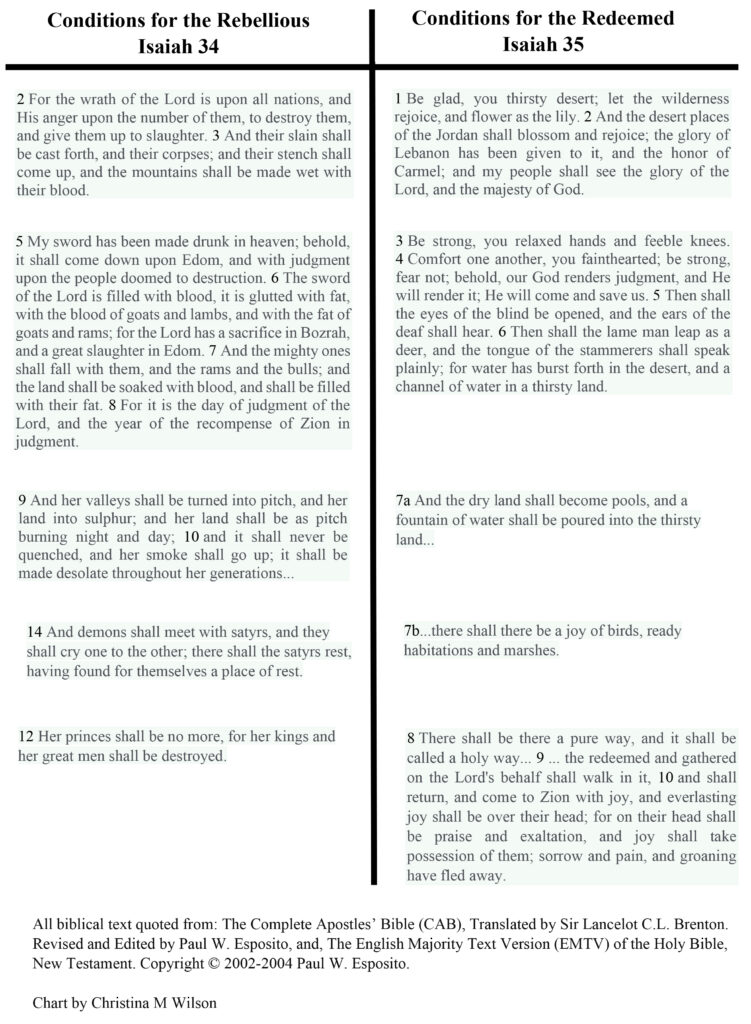
Chapter 34 gives the final outcome for the “damned”–those who persistently and willfully resist God and the goodness of his nature.
Chapter 35 gives the final outcome for those in the Kingdom of Messiah. Messiah is God’s Son who saves and redeems the poor in heart and spirit. These are people who look to him for their personal well-being and improvement of their condition. These are they who seek to obey their Savior/King. They believe in the goodness and holiness of God and give him their full allegiance.
Summary of Chapter 34
Most commentators conclude that in Chapter 34 God pronounces his final judgment against all nations (see verses 1 and 2, where the text contains the phrase “all nations.”) Further, in Isaiah 34 (Link to Various Commentaries) Edom represents all who oppose God and his people, who are represented by Zion (Isaiah 34:8).
That is, readers should not think that the chapter makes specific reference to Edom alone. The Jewish Study Bible points out that in “later Jewish history… the Edomites… converted to Judaism en masse during the late 2nd C. BCE, and were among the most zealous Jews during the conflict with Rome in the 1st C. CE,” (1). This is similar to other places in Scripture in which Babylon becomes a symbol for all that is unholy. See, for example, Isaiah 13 through 14 and Revelation 18:2-24.
One point of interest is that the text does not specify specific actions and attitudes in this section of final judgment. The Old Testament as a whole and Isaiah in particular catalog those elsewhere (See, for example, Isaiah 14:5-6). This chapter devotes itself to descriptions of God’s eternal punishment of the unrepentant wicked.
Summary of Chapter 35
Everyone agrees that Isaiah 35 speaks of Messiah. Chapter 35 is one of the most glorious chapters in Isaiah. It merits rereading (even out loud) two or three times, simply to capture the beauty of its words and images.
New Testament authors group Isaiah 35:5-6 with Isaiah 26:19; 42:18; and 61:1 (1). This occurred when Jesus provided John the Baptist a summary list of his ministry when he was in prison (Matthew 11:5 and Luke 7:22). Clearly, the time frame referred to is the first advent of Messiah.
Isaiah 35:5 Then shall the eyes of the blind be opened, and the ears of the deaf shall hear. 6 Then shall the lame man leap as a deer, and the tongue of the stammerers shall speak plainly; for water has burst forth in the desert, and a channel of water in a thirsty land. (CAB, LXE)
Luke 7:22 And he answered them, “Go and tell John what you have seen and heard: the blind receive their sight, the lame walk, lepers are cleansed, and the deaf hear, the dead are raised up, the poor have good news preached to them. (ESV)
Contrasts with Chapter 34
Chapter 35 contrasts with the previous chapter in many aspects.
Time Frame of Chapter 35
But what of the time frame of Chapter 35? When will Messiah appear and under what circumstances? At what point in Israel’s history will these events occur? Quite bluntly, does this chapter prophesy the first coming of Christ and the literal-spiritual realities of life in his kingdom? Or, is this chapter millennial/dispensational?
I. Jesus Applies Isaiah 35:5-6 to His First Advent
As stated above, Jesus sent his disciples to the imprisoned John the Baptist in Luke 7:22 and Matthew 15:30. He told them to tell John the highlights of his ministry. These highlights combined prophesies from various portions of Isaiah (Isaiah 26:19; 35:5-6; 42:18; 61:1). But clearly, the application made by Jesus in Luke and Matthew was to his then present, that is, his first advent.
II. The Chapter Gives No Hint of More Than One Advent
Isaiah himself in chapter 35 gives no hint of more than one advent. Verse 2 states in part, “My people shall see the glory of the Lord and the majesty of our God.” One of the strongest messages of the gospel writers is the glory of Christ, which they and countless multitudes of people witnessed in his incarnation.
III. The Dispersed (Septuagint) Shall Walk in the “Holy Way”
Verse 8 differs in the Septuagint from the Masoretic. While the Masoretic speaks of “fools,” the Septuagint speaks of the “dispersed.”
8 There shall be there a pure way, and it shall be called a holy way; and there shall not pass by there any unclean person, neither shall there be there an unclean way; but the dispersed shall walk on it, and they shall not go astray. (CAB, LXE)
In the so-called Millennium, will there be a dispersion? Yet, both before and after Rome destroyed Jerusalem (70 CE), shortly after Christ’s incarnation, the new believers dispersed from there and became missionaries around the known world.
IV. All Was Fulfilled by Christ’s Incarnation
Everything in Isaiah 35 was and is fulfilled in Christ’s current kingdom. This chapter prophesies the joy of the Lord, which Christians sing about as a present reality every Sunday.
9 … but the redeemed and gathered on the Lord’s behalf shall walk in it, 10 and shall return, and come to Zion with joy, and everlasting joy shall be over their head; for on their head shall be praise and exaltation, and joy shall take possession of them; sorrow and pain, and groaning have fled away. (CAB, LXE)
V. Jesus Described His Kingdom as Eternal Life
Chapter 34 is an end times chapter. It speaks the finality of the last judgment. If, then, Chapter 35 deals with Messiah’s present kingdom, how do these two time frames match?
Simply, Christ’s kingdom is eternal, now. When Christ sent his Holy Spirit, he sent eternity into believers’ hearts.
John 5:24 Truly, truly, I say to you, whoever hears my word and believes him who sent me has eternal life. He does not come into judgment, but has passed from death to life.
John 6:47 Truly, truly, I say to you, whoever believes has eternal life.
John 6:54 Whoever feeds on my flesh and drinks my blood has eternal life, and I will raise him up on the last day.
The final state of Christians has already begun in their hearts and spirits. Jesus Christ will raise believers up on the last day. There will be no judgment for those who believe in Messiah King. The beginning state of a believer’s heart is also the down payment of the final state (Ephesians 1:13-14). Eternal life in Christ begins now and will continue long past the final judgment of those who rebel against God’s goodness.
Conclusion
In conclusion, nowhere in all of Isaiah is the word “millennial” used. God kept Isaiah fairly busy describing Messiah’s incarnation, his identity as God’s Son, and his perfect, glorious, loving nature. It would seem odd in this most amazing chapter, for Isaiah to jump over the incarnation in favor of a bodily appearance at some unspecified time more than 2700 years afterward. I for one am perfectly content to enjoy the fullness of the Lord’s kingdom in the present moment, here and now. And when the final judgment of Chapter 34 occurs, the end of time, believers of Chapter 35 will be ushered into the Lord’s eternal presence.
__________
1 Archer, Gleason L. and Gregory Chirichigno. Old Testament Quotations in the New Testament. Eugene, Oregon: Wipf & Stock, 1983, pages 102-103 and 110.
__________
1 The Jewish Study Bible, Second Edition. Adele Berlin and Marc Zvi Brettler, Editors, Jewish Publication Society TANAKH Translation. Oxford University Press, New York, New York, 2014, page 833.
The Enemy Cast Out: Isaiah Journal 74
By Christina M Wilson. Published simultaneously at The Enemy Cast Out: Isaiah Devotional Journal 74 – justonesmallvoice.com.
Isaiah 33:14-24 Septuagint Modernized NETS
Where Is the Enemy?
The latter portion of Isaiah 33 contrasts the Zion that had been occupied by a foreign power with a Zion under the King’s rule.
The Enemy Has Been Cast Out
These Septuagint verses tell that the enemy no longer occupies Zion. (CAB, LXE)
- 14 The sinners in Zion have departed; trembling shall seize the ungodly.
- 18 Your soul shall meditate terror. Where are the scribes? Where are the counselors? Where is he that numbers them that are growing up, 19 both the small and great people? With whom he took not counsel, neither did he understand a people of deep speech, so that a despised people should not hear, and there is no understanding to him that hears.
- 23 Your cords are broken, for they had no strength; your food has given way, it shall not spread the sails, it shall not bear a signal, until it is given up for plunder; therefore shall many lame men take spoil.
Yes, the English text appears difficult to decipher. The NETS translation includes a footnote to that effect in verse 19. However, when comparing the various English translations of both the Septuagint and the Masoretic, the overall sense of the chapter unfolds.
Description of the New Kingdom
Isaiah describes the new kingdom after the enemy has departed (verse 14).
Characteristics of Its Inhabitants
- the righteous person (vs 15): walks in righteousness, speaks uprightly, hates lawlessness and wrongdoing, refuses bribes, is against capital punishment, shields his eyes from the enjoyment of evil
- he will live “in a high cave of a strong rock,” where he will be fed with bread and water (vs16), i.e., the basic food of life
- they will meditate on the past and the things and people who used to cause them fear, but are no longer present (vs 18)
- they revere the name of the Lord (v 21)
- not weary (v 24)
- their sins forgiven (v 24)
15 He that walks in righteousness, speaking rightly, hating transgression and iniquity, and shaking his hands from gifts, stopping his ears that he should not hear the judgment of blood, shutting his eyes that he should not see injustice. (CAB, LXE)
Characteristics of the Place
- foreign authorities will no longer be present (vs 19)
- a place of safety (vv 14, 16, 18-19, 20, 21, 22)
- a place of provision (vv 16, 20, 21)
- spacious, providing room for all (v 21)
- a place for the poor and injured (vv 23, 24)
- a place of permanence (v 20)
20 Behold the city of Zion, our refuge; your eyes shall behold Jerusalem, a rich city, tabernacles which shall not be shaken, neither shall the pins of her tabernacle be moved forever, neither shall her cords be at all broken; (CAB, LXE)
Characteristics of Its King
- glorious (v 17)
- he is Lord, God, judge, ruler, King (v 22)
22 For my God is great; the Lord our judge shall not pass me by; the Lord is our prince, the Lord is our king; the Lord, He shall save us. (CAB, LXE)
Concrete-Literal or Spiritual-Literal?
Why do I use hyphens in concrete-literal and spiritual-literal? Why use the words concrete in concrete-literal and literal in spiritual-literal? Why not just say literal and spiritual?
A Definition of Terms
In common, everyday language, “literal” tends to mean real, actual, concrete, and historical. And, in much theological jargon, spiritual tends to mean abstract, not historical, and not really happening in the “real” world, the concrete world. Theology tends to be divided between those who think every prophecy of the Old Testament needs to have a “literal” fulfillment and those who see spiritual fulfillment in many of the same prophecies. Some theologians might even be thinking “imaginary” when they use the term “spiritual.” When they accuse another theologian of “spiritualizing” a text, it’s as if they were accusing them of erasing the truth of that text and replacing it with abstract imagination.
Those using the term “literal” as a direct synonym of true and real usually mean that Old Testament prophecy needs to have a historical, three dimensional, physical fulfillment in the world we see, hear, and touch. In order for a biblical prophecy to be true, it must have a physical, three-dimensional fulfillment.
But, if “literal” means “true” and “real,” then spiritual realities are also real and true. They literally exist. God is Spirit. The Holy Spirit is Spirit. The Spirit of Jesus Christ occupies believers’ hearts. The rulers, authorities, cosmic powers, and forces of evil in the heavenly places that Paul describes in Ephesians 6 are real and true. They also happen to be spiritual beings, made of spirit rather than flesh and blood (Ephesians 6:12).
To cast the conversation about fulfillment of Old Testament prophecy with the terms literal vs spiritual is to introduce bias from the beginning. Therefore, I use the word “concrete” to mean that which can be physically seen with physical eyes, heard with physical ears, and touched with physical hands. The cities we live in, for example, are concrete. So, the term “concrete-literal” means a true reality within the physical world. And likewise, the term “spiritual-literal” means a true reality within the realm of spirit.
Repeating the Question
So, the question becomes, must every prophecy of the Old Testament have a physically concrete fulfillment? Or, did God intend that some of what appears to be physical description in Old Testament prophecy would have a spiritual-literal fulfillment rather than a concrete-literal fulfillment? Is Chapter 33 of Isaiah one of these times?
A Partial Concrete-Literal Fulfillment
I postulate that some portions of Isaiah 33 have already had a concrete-literal fulfillment. And further, when Isaiah spoke these words, God intended that these portions would be physically fulfilled relatively quickly in Isaiah’s lifetime. The context within chapter 33 and the context of its surrounding chapters speak of a concrete-literal fulfillment of the prophecies against Judah’s enemy Assyria.
For example, throughout Isaiah’s writing, a physical Israel had many physical enemies. In Isaiah’s lifetime, the greatest of these was Assyria. Isaiah repeatedly prophesies Assyria’s downfall (for example, see Isaiah 30:31). In terms of fulfillment, chapters 36 and 37 describe in detail how God miraculously defeated the Assyrians on behalf of Jerusalem and Judah. Chapter 33 contains strong indications that Isaiah refers to this time and event. It seems fair and likely that God through Isaiah intended the portions of Isaiah 33 dealing with the defeat of Assyria to have a concrete-literal fulfillment. Biblical history, as related in 2 Kings 18:17-19:37 and Isaiah 37, records such a fulfillment.
Obstacles to a Complete Concrete-Literal Fulfillment
But what about the portions of Isaiah 33:14-24 that speak of the new kingdom and the King who will rule there? Have these prophecies already found a concrete-literal fulfillment? Not really. Judah before and after its exile had some good kings (Hezekiah and Zerubbabel) who experienced some years of peaceful prosperity. But Israel’s independence ended. Not too long after the return from exile, the Old Testament ceased. God added no books to Scripture after Malachi. Throughout the entire Second Temple period various foreigners again ruled in Jerusalem, alongside the Jewish kings.
Then at the turn of the millennium, in New Testament times, Rome occupied Israel. Israel had no independent king seated on its throne. Further, within a few decades after Jesus’s ascension, Rome leveled Jerusalem (70 CE). Over the next century Rome oppressed the remainder of the Judean territory through bloody wars. Israel ceased to exist as an independent nation.
Currently, the physical Israel in today’s news does not match the description given by Isaiah in Chapter 33. It has no king, it is not entirely safe, and it is no more righteous than any other country on earth. It is not a Christian nation, nor do its citizens all necessarily believe in the God of their Scripture. It appears to be a secular country, rather than a country of faith.
Approximately 2,800 years have passed since Isaiah prophesied of a righteous Zion ruled by a glorious King. Have his prophecies not found fulfillment?
A Spiritual-Literal Fulfillment
I believe that Isaiah’s prophecies of a righteous Zion and a glorious, righteous King have received a spiritual-literal fulfillment in the kingdom of Jesus Christ. Jesus said, “My kingdom is not of this world,” John 18:36. By this he meant that his kingdom was not concrete-literal but spiritual-literal. Christians around the world have been living in and enjoying the benefits of Christ the King’s heavenly Zion for over 2,000 years.
Why does Isaiah use concrete words to describe a spiritual reality? The best answer I can give is to point the reader to the Apostle Paul in 2 Corinthians 2:1-16. Could Isaiah possibly have known these spiritual-literal realities? The heart of faith must surely answer, “Yes.” The Apostle John writes, “Isaiah said these things because he saw his glory and spoke of him,” (John 12:41). As we progress further in Isaiah’s book, we will find him more and more describing the spiritual-literal realities of Christ’s kingdom.
God Defeats the Enemy: Isaiah Journal 73
By Christina M Wilson. Simultaneously published at God Defeats the Enemy: Isaiah Devotional Journal 73 – justonesmallvoice.com.
Isaiah 33 Septuagint Modernized NETS
Overview
The majority of commentators assign the curse of “Woe…!” in verse 1 upon the Assyrians, led by Sennacherib. Assyria attacked Judah and Jerusalem in Isaiah’s lifetime. God turned them back before they completed the siege against Jerusalem (2 Kings 18:13-19:37). The other major enemy was Babylon. Led by Nebuchadnezzar, the Babylonians successfully overwhelmed Jerusalem approximately one hundred years later. Assigning this passage to the events surrounding Assyria’s unsuccessful siege of Jerusalem makes the most sense.
Verse two switches immediately to a prayer for mercy, made in the prophet’s own voice on behalf of the people. The prayer is very short–only two clauses. The concluding sentence of verse two, “The seed of the rebellious has gone to destruction, but our deliverance was in a time of affliction,” is a summary of historical events surrounding the siege of Jerusalem by Assyrian forces.
God replies affirmatively to the prayer in verses 10-13. The remainder of the chapter, through verse 24, speaks of a King and blessings for Zion. Once again readers will find a sharp contrast between final outcomes for those who oppose God and for those who trustfully turn to him for their safety.
Interpretation of Septuagint Verse 1
Verse 1 in the Septuagint at first, second, and even third glances appears nearly obscure in its language.
Woe to those that afflict you; but no one makes you miserable; and he that deals treacherously with you does not deal treacherously; those that deal treacherously shall be taken and given up, and like a moth on a garment, so shall they be spoiled. Isaiah 33:1 CAB, LXE
History reveals that God miraculously intervened on behalf of Jerusalem. He turned Sennacherib back at its walls (See the account at 2 Kings 18:13-19:37). For all Sennacherib’s loud bluster and threats, nothing came of them. The dramatic interchanges between Sennacherib and King Hezekiah will appear in Isaiah chapters 36 and 37. But for now, consider this verse from the New Testament.
Be sober-minded; be watchful. Your adversary the devil prowls around like a roaring lion, seeking someone to devour. (1Peter 5:8 ESV)
One of the lessons all Christians learn through experience is that the roaring of the devil Satan is not the same as being torn to pieces by him. When Sennacherib appeared at Jerusalem’s city walls, he roared and threatened, but did not immediately attack. King Hezekiah turned to the Lord and to the Lord’s prophet Isaiah. God replied by miraculously defeating the foe. Threats are not the same as actions. When Christians cave to the enemy in the face of threats, it is they themselves causing their own misery, not the enemy. Christians must learn to trust the Lord, just like King Hezekiah. Although he was afraid, he did not give ground. Let the enemy roar in their faces, God will protect his own at break of day.
A Play Unfolds
Assuming that the enemy in this particular chapter is Assyria, then how shall we parse these verses?
THE CHARACTERS
First, there are five characters: 1) The prophet and his people, 2) God, 3) the enemy Assyria, 4) the outlying regions of Judah, and 5) unnamed plunderers.
SYNOPSIS OF THE ACTION
Second, Isaiah fairly jumps back and forth among these characters, as though recording a play. Using a different analogy, he puts into a static painting action which occurs over a span of time. But, Isaiah jumbles the chronology. According to 2 Kings 18:13-19:37, Assyria attacked and overcame the outlying regions of Judah. These are Lebanon, Sharon, Galilee and Carmel (verse 9). Assyria’s general, Sennacherib, stopped at the walls of Jerusalem and taunted King Hezekiah and his soldiers there. Hezekiah prayed to the Lord. Isaiah prophesied exactly what would happen. Then the Lord killed the Assyrians overnight in a miraculous delivery for Judah. Sennacherib returned to his home. And the people of Jerusalem went out and gathered a great spoil from the camp.
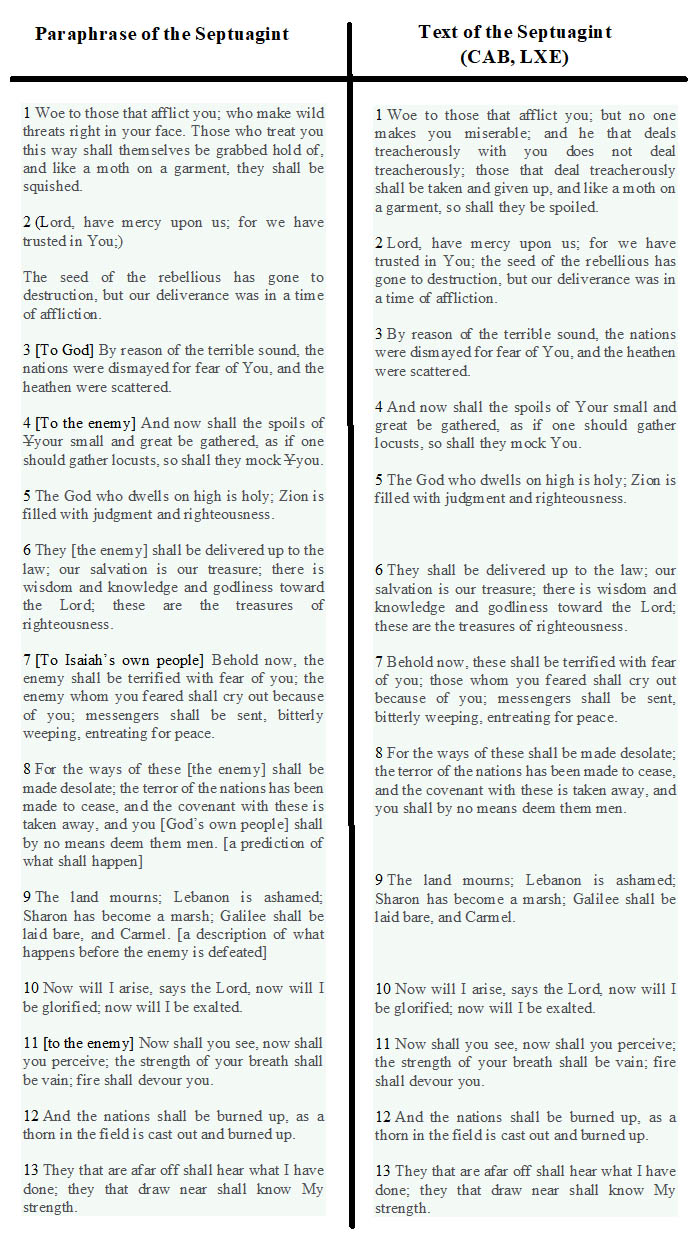
Note: Because the original Greek text contains no capitalization, it is fair to remove capitals from the Brenton translation in verse 4. (All translations interpret the original.) These capitals (verse 4) indicate the speaker addresses God. But this does not make sense in the context of verses surrounding verse 4. Therefore, without changing any words at all, using lower case “y” clarifies the meaning of the text. By removing the capitals, the object changes. The plunderers gather from the fallen enemy, making fun of this enemy as they do so. This narrative corresponds to the history given in 2 Kings. In support of this interpretive change, the NETS translation, by Moises Silva, uses no capitals in verse 4.
VERSE 14A
14a The sinners in Zion have departed; 14b trembling shall seize the ungodly. Who will tell you that a fire is kindled? Who will tell you of the eternal place?
The first clause of verse 14 belongs with the prior section. It concludes the previous action with a historical summary. Sennacherib and what few remained of his army left. Verse 14b should begin a new paragraph. It seems to belong best with the next section, a description of Messiah and his kingdom. Messiah, of course, arrives on the scene far into Isaiah’s future. Isaiah, however, always returns to him, inserting mention of him more and more frequently as the book progresses.
Chapter 33 to be continued…
Septuagint Variation: Isaiah Journal 72
By Christina M Wilson. Simultaneously published at Septuagint Variation: Isaiah Devotional Journal 72 – justonesmallvoice.com.
Isaiah 32:9-20 Septuagint Modernized NETS
Before leaving Chapter 32, there is one more Septuagint variation that sheds light on the chapter as a whole.
Recap
The prior Journal entry, Isaiah Devotional Journal 71, shows how Chapter 32 alternates between desolation for the then-existing nation of Israel and blessing for those in the future kingdom of the righteous King. These sections alternate in large chunks, rather than single verses:
- The blessings of Messiah: verses 1-4
- Contrast between the foolish wicked and the godly wise: verses 5-8
- Warning of the desolation to come: verses 9-14
- Messianic blessings: verses 15-20
Verse 19 in the Masoretic
Verse 19, in the ESV, protrudes like a thorn in the middle of a wedding bed. Then verse 20 returns to blessing.
ESV Isaiah 32:15 until the Spirit is poured upon us from on high, and the wilderness becomes a fruitful field, … 16 Then justice … righteousness … fruitful field. 17 … righteousness … peace … righteousness, quietness and trust forever. 18 … peaceful habitation, … secure dwellings, … quiet resting places. 19 And it will hail when the forest falls down, and the city will be utterly laid low. 20 Happy are you who sow beside all waters, who let the feet of the ox and the donkey range free.
A Difficult Text
Deciphering what the biblical text reads for this verse must be difficult, since other translations in the Masoretic tradition vary widely.
- For example, the Bible of the Jewish Publication Society (JPS) reads, “Isaiah 32:19 And it shall hail, in the downfall of the forest; but the city shall descend into the valley.“
- NRS “The forest will disappear completely, and the city will be utterly laid low.“
- KJV “When it shall hail, coming down on the forest; and the city shall be low in a low place.“
- Amplified Bible “But it [the wrath of the Lord] shall hail, coming down overpoweringly on the forest [the army of the Assyrians], and the capital [2] city shall be utterly humbled and laid prostrate.”
- NASB “And it will hail when the forest comes down, And the city will be utterly laid low.“
NIV and NET
The NIV, NET, and a few other dynamic translations (paraphrased) come closer to the text in the Septuagint. These translations combine verses 19 and 20. The outcome is a combination of blessing and trial.
- NIV “19 Though hail flattens the forest and the city is leveled completely, 20 how blessed you will be, sowing your seed by every stream, and letting your cattle and donkeys range free.“
- NET “19 Even if the forest is destroyed and the city is annihilated, 20 you will be blessed, you who plant seed by all the banks of the streams, you who let your ox and donkey graze.“
The blessing in the texts above is qualified. It appears to be due to a difference in geographic location. The forest and city suffer extreme damage. However, those living by the banks of the streams will be blessed, as they continue to farm and graze their animals.
The Septuagint Text Is Plain and Simple
15 until the Spirit shall come upon you from on high, and Carmel shall be desert, and Carmel shall be counted for a forest. 16 Then judgment shall abide in the wilderness, and righteousness shall dwell in Carmel. 17 And the works of righteousness shall be peace; and righteousness shall ensure rest, and the righteous shall be confident forever. 18 And His people shall inhabit a city of peace, and dwell in it in confidence, and they shall rest with wealth. 19 And if the hail should come down, it shall not come upon you; and they that dwell in the forests shall be in confidence, as those in the plain country. 20 Blessed are they that sow by every water, where the ox and the donkey tread.
Contrasts Between the Septuagint and the Masoretic
1. Verse 19 in the Septuagint brings no contextual contradictions that must be explained. The verse smoothly follows the theme of blessing found throughout the passage.
2. All geographic areas are blessed. There is no distinction among them. The city will be blessed, the forest blessed, the plains blessed, and the waterways blessed.
3. Unlike the Masoretic, verse 18 of the Septuagint specifically states that “His people shall inhabit a city of peace.” Then, verse 19 brings no calamity upon that city. In contrast, verse 18 of the Masoretic makes no mention of a city. However, in verse 19 various calamities fall upon “the city,” depending upon the version.
- JPS: the city shall descend into the valley
- NRS: the city will be utterly laid low.
- KJV: the city shall be low in a low place
- Amplified: the capital [2] city shall be utterly humbled and laid prostrate.
- NASB: the city will be utterly laid low.
- NET: Even if … the city is annihilated,
- NIV: Though … the city is leveled completely,
4. In both textual traditions, the occurrence of hail appears either certain or likely. But only in the Septuagint does the hail harm no one.
Concrete-Literal or Spiritual-Literal
The Septuagint text of Isaiah 32:19 states, “And if the hail should come down, it shall not come upon you.” When does falling hail not harm objects or people it may hit? The Masoretic translations present a catastrophic hailstorm that flattens forests and cities. But the hail that falls in the Septuagint does not harm the people who inhabit every corner of the righteous King’s kingdom.
In the prior post, Isaiah Devotional Journal 71, I presented the argument that in Chapter 32 Isaiah writes using concrete terms for spiritual realities (1). Verse 19 adds evidence to this hermeneutic. Although it speaks to us by means of concrete (physical) language, the realities this verse describes are spiritual. See, for example, John Calvin’s description of this passage.
While Isaiah thus prophesies concerning the reign of Hezekiah, all this is declared by him to relate to the kingdom of Christ as its end and accomplishment; and therefore, when we come to Christ, we must explain all this spiritually, so as to understand that we are renewed as soon as the Lord has sent down the Spirit from heaven, that we who were “wildernesses” may become cultivated and fertile fields. Ere the Spirit of God has breathed into us, we are justly compared to wildernesses or a dry soil; for we produce nothing but “thorns and briers,” and are by nature unfit for yielding fruits. Accordingly, they who were barren and unfruitful, when they have been renewed by the Spirit of God, begin to yield plentiful fruits; and they whose natural dispositions had some appearance of goodness, being renewed by the same Spirit, will afterwards be so fruitful, that they will appear as if they had formerly been a “wilderness;” for all that men possess is but a wild forest, till they have been renewed by Christ. Whenever, therefore, the Church is afflicted, and when her condition appears to be desperate, let us raise our eyes to heaven, and depend fully on these promises. (2)
In the life of the Spirit in a believer’s heart, the “hail” of real-life difficulties and circumstances shall not harm the believer’s faith or persistent peace, security, and well-being in Christ. Is this Isaiah’s intended meaning? Rather one should ask, Is this God’s intended meaning for this text? Within the context of the Septuagint Gospel of Isaiah, yes, I believe that God intends us to find the Spirit of Christ in this passage.
Right or Wrong?
When trying to answer the question, “Which text is right and which text wrong?” there is no exact answer. The truth is that two completely different textual traditions have been handed down to us. A “textual tradition” encompasses many hundreds, or even thousands, of years. The Septuagint began as a translation of Hebrew approximately three centuries before the birth of Christ. Readers should not hold this fact of birth against it (3). Later scholars and religious persons have edited both the Greek and Hebrew texts within their own tradition. The Masoretic Bible we hold today did not reach its final form until centuries after Christ.
One thing is clear, however. Jesus of Nazareth and his followers accessed the Septuagint. Greek was the “lingua franca” of Christ’s day. And, the New Testament writers often quoted from the Septuagint. I am fully satisfied to use the Septuagint translation as my devotional Bible for the book of Isaiah. I like it because there is so much of Christ in it.
__________
1 “Because the time markers fail to represent accurately the concrete-literal history of Israel, it is good biblical hermeneutics to interpret the language of this chapter spiritually. Using concrete-literal language, Isaiah prophesies the spiritual demise of one kingdom and the arrival of a new King. The new kingdom will be eternal.” Isaiah Devotional Journal 71
2 Calvin, John. “Commentary on Isaiah 32:15”. “Calvin’s Commentary on the Bible”. https://www.studylight.org/commentaries/cal/isaiah-32.html. 1840-57. These files are public domain.
3 For readers who would like to learn more about the Septuagint translation of the Bible, the following post might be a good place to start: Psalm 28: Why the Septuagint? Part 1-Background – justonesmallvoice.com.
 One Small Voice