Home » Academic/Biblical (Page 7)
Category Archives: Academic/Biblical
Psalm 132: Intercession and Divine Speech
Introduction
This week I begin a new section: Specific Psalms.
Why begin with Psalm 132?
- I’ve been reading through the Psalter, and this is where I was when I needed to choose the first psalm to write about: plain and simple.
- As I was reading, the Lord sparked my interest in this psalm. Is it a coincidence that the last post of my previous series on the Psalter ended with Psalms 132? Perhaps the Lord is saying that he wasn’t finished yet.
- This is a Lenten psalm, according to The Orthodox Study Bible (Bibliography), and we are currently in the season of Lent.
- This psalms brings together in one place several aspects, or threads of interest, in the Psalter generally. It combines in one psalm: Messiah, reported direct divine speech, a view of the relationship between Father and Son, enemies, intercessors, the Ark, and specific prophecy. This post will not cover all these topics.
- Psalm 132 displays similarity with The Lord’s Prayer.
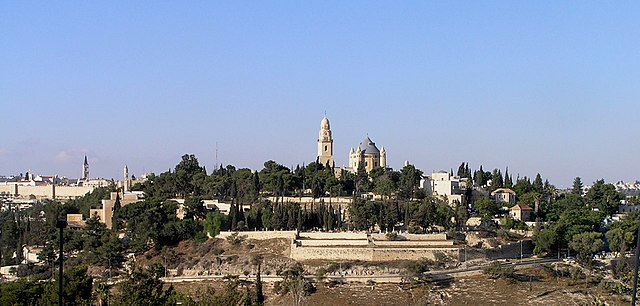
Temple Mount Today. https://upload.wikimedia.org/wikipedia/commons/thumb/9/9f/MtZion_from_Abu_Tor.jpg/640px-MtZion_from_Abu_Tor.jpg
General Description
With eighteen verses, Psalm 132 is of medium length. It was not written by David. It is not an intimate psalm. Other than the reported speech of God himself, no use is made of singular first person, meaning that this is a group, or corporate, psalm.
1 Remember, O Lord, in David’s favor,
all the hardships he endured,
2 how he swore to the Lord
and vowed to the Mighty One of Jacob,
3 “I will not enter my house
or get into my bed,
4 I will not give sleep to my eyes
or slumber to my eyelids,
5 until I find a place for the Lord,
a dwelling place for the Mighty One of Jacob.”
6 Behold, we heard of it in Ephrathah;
we found it in the fields of Jaar.
7 “Let us go to his dwelling place;
let us worship at his footstool!”
8 Arise, O Lord, and go to your resting place,
you and the ark of your might.
9 Let your priests be clothed with righteousness,
and let your saints shout for joy.
10 For the sake of your servant David,
do not turn away the face of your anointed one.
11 The Lord swore to David a sure oath
from which he will not turn back:
“One of the sons of your body
I will set on your throne.
12 If your sons keep my covenant
and my testimonies that I shall teach them,
their sons also forever
shall sit on your throne.”
13 For the Lord has chosen Zion;
he has desired it for his dwelling place:
14 “This is my resting place forever;
here I will dwell, for I have desired it.
15 I will abundantly bless her provisions;
I will satisfy her poor with bread.
16 Her priests I will clothe with salvation,
and her saints will shout for joy.
17 There I will make a horn to sprout for David;
I have prepared a lamp for my anointed.
18 His enemies I will clothe with shame,
but on him his crown will shine.”
(English Standard Version (ESV) The Holy Bible, English Standard Version. ESV® Text Edition: 2016. Copyright © 2001 by Crossway Bibles.)
Vocabulary
Three proper names need explanation:
1. Ephrathah (6 Behold, we heard of it in Ephrathah;) refers to a place name, whose exact location is not agreed upon by scholars. Some say a small town outside of Bethlehem or even Bethlehem itself (Ruth 4:11; Micah 5:2; Genesis 35:19); some say Bethel; and others say a district of Ephraim, location of Shiloh, where the Ark first rested (Bonar, 402).
2. Jaar is also a place name. (6 … we found it in the fields of Jaar). A reasonable explanation is that this term meaning field or wood, stands in for Kiriath-jearim (1 Samuel 7:1), where the Ark rested in the house of Abinadab for twenty years after the Philistines released it and David rescued it. The reader can easily imagine Abinadab’s allotment containing both fields and woods, or forests.
3. Zion. Zion is a very large and meaningful word in the Psalter. It can signify a particular mountain on which Jerusalem is built (Psalm 78:68; 135:21; 68:16), the early City of David, the temple mount, the city of Jerusalem, God’s chosen Israel (Easton, Psalm 51:18; 87:5), and in Christian times, the Church (Easton, Hebrews 12:22), the Heavenly City of Jerusalem (Hebrews 12:22; Revelation 14:1), and Christ himself (John 2:19-22). Verses 13-16 of this psalm, referencing Zion, have been set to music and are currently sung in worship settings (YouTube lyrics and music).
4. The Ark was a “holy box” (International Children’s Bible) located in a fabulous tent the Israelites had constructed during their exodus from Egypt through the wilderness. God would meet with Moses inside the tent above the Ark, which was also called “the mercy seat,” because this is where God revealed his mercy and compassion for his people (Exodus 40:20; Hebrews 9:3-5). During the period of judges, the Ark had been lost in a battle with the Philistines (1 Samuel 4). The Philistines could not keep it very long, because God was cursing them for having it in their possession (1 Samuel 5-6:1). They mounted the Ark on a cart and sent it back to Israel (1 Samuel 6), where it remained with Abinadab (see number 2 above), who lived in the fields or the woods, perhaps both. After twenty years (2 Samuel 7:2), David, who had become king, reclaimed the Ark (2 Samuel 6) and eventually made all the preparations for a glorious temple to house it. Solomon, his son, built the temple using all the resources of talent and substance his father had collected (1 Kings 6:1-8:66).
Setting
Psalm 132 is located and labeled in the Psalter with other songs of ascent. Jerusalem was built on hills, the southeastern bearing the name Mount Zion. Pilgrims from all over the kingdom would travel yearly to the temple in Jerusalem to worship there. Because the first person plural “we” is not identified, the reader can assume the pilgrims are speaking. This is one of the psalms they most likely sang as the temple in all its splendor came into view (Mark 13:1 And as he came out of the temple, one of his disciples said to him, “Look, Teacher, what wonderful stones and what wonderful buildings!” ESV).
Plot Line
The excitement of the pilgrims for their journey expresses itself as intercessory prayer for Messiah (in Hebrew), who is God’s “anointed,” (Christos in Greek) (vss. 10, 11, 17-18).
The Prayer
1) The prayer begins with the pilgrims asking God to “remember” (vs 1). Remember, Lord, your servant David who pleased you so much because of the zeal and humility he expressed in his desire to build you a house, a permanent dwelling place for the Ark of your presence (see 4 above, The Ark). Verses 2-5 give details of David’s humility and zeal in placing the Lord above himself.
2) David’s zeal was contagious. It spread to all the people. They recount their excitement to worship God at the location of the Ark (verses 6-9).
3) God’s anointed, the Messiah, the descendant of David, becomes the new subject of intercession in verse 10, which repeats the intercession of verse 1, with that difference now in view. The pilgrims rehearse God’s promise in regard to Messiah in verses 11-12. Verse 13 gives the reason why God made the promise: he desires Zion to be his habitation forever. The thought is implied that if God is going to inhabit Zion, there must be a King there who is faithful to him. God’s relationship to his King is described in verses 17-18. God has many great blessings planned for his King.
Psalm 132 A Model for Prayer
1. This intercessory psalm teaches us to pray Scripture. Our requests should be based upon the clearly expressed will of God. The pilgrims’ understanding of God’s will is stated throughout their prayer. They recount God’s will by quoting his past statements. God speaks his will in first person in verses 11-12 and 14-18, and his statements in these verses concur with other portions of Scripture. When we pray God’s will as revealed through Scripture, as the pilgrims did in Psalm 132, we can be certain that we perceive his will correctly. The following two verses reinforce the importance of praying God’s will:
Psalm 37:4 Delight yourself in the LORD, and he will give you the desires of your heart.
1 John 5:14 And this is the confidence that we have toward him, that if we ask anything according to his will he hears us.
2. This psalm teaches us to pray out from our personal history with God. These pilgrims knew their history, and they knew how that history agreed with the will of God. They remind God of this history and his promises to them in the first portion of the psalm. Then, in the second portion of the psalm, God replies that his will towards them has not changed.
3. So, as the pilgrims walk up the hill in the long ascent to Jerusalem, their place of worshipping God, they prepare their hearts by means of song and prayer to meet him there.
Similarities with the Lord’s Prayer
Jesus taught his disciples to pray by means of giving them a model prayer commonly known as the Lord’s prayer. In it, he taught them to pray, “Your kingdom come, your will be done…” (Matthew 6:10). This is exactly what Psalm 132 demonstrates. In Psalm 132, the pilgrims pray for God’s kingdom to come and for his will to be done.
Psalm 132 as Poetic Literature
Psalm 132 is a remarkable piece of poetic literature:
1. Speech
Psalm 132 makes liberal use of quotation. Thirteen of its eighteen verses contain direct or reported speech. The psalm’s speech panels give a dramatic immediacy to the poem. There is reported speech by David (verses 3-5), reported speech by God (verses 11-12), recollected first person plural speech (the worshipers in verses 7-9), and a second block of reported or direct speech by God (verses 14-18).
Adding to the sense of dramatic immediacy is the first person recollection of the people’s excited response to historical events (verses 6-7).
2. Remarkable Compactness and Brevity
In eighteen verses, this psalm sums up nearly the entire history of the Old Testament, moving from the inception of God’s dwelling with his people to its eschatological, or end times, conclusion. The centerpiece of Old Testament history is the temple of God, his dwelling place among his chosen ones, Israel. The centerpiece of the New Testament is the temple of God, which is Christ and his church, God’s eternal dwelling place among his chosen of all humankind.
3. Poetic Devices Reinforce Spiritual Content
The image of the pilgrims ascending the mountain corresponds poetically with the Bible’s progression through history, a metaphorical rising of thought and purpose from the strictly concrete-literal of the Old Testament to the spiritual-literal of the New. The poem itself is like a pilgrim’s journey. Temporally, the poem is set mid-way in the stream of God’s realities. The speakers in the poem look back upon God’s promises at the beginning of the Ark’s history, while at the same time praying forward to their fulfillment. We as readers look back upon the beginning of the fulfillment, which took place with Christ’s incarnation, death, resurrection, and ascension. And even while we look back upon Christ’s first coming, we, like the pilgrims in the psalm, look forward and pray for the final fulfillment of God’s promise (the often repeated already/not yet of prophecy and faith). The prayer of Psalm 132 will ultimately be fulfilled with Christ’s second coming. We who pray this psalm today are united with those pilgrims of Israel’s past who prayed it yesterday. The unity is centered in the person of Messiah, God’s anointed, Jesus Christ.
Link to Psalm 132 in a former series
Link to next post in this series
Link to prior post in this series
Link to Contents for this series
Next Post in Psalms–Second Series

Pixabay
Stay Tuned–The Author Is Taking a Summer Break, But Will Be Back Next Fall, Lord Willing!
Link to Christ in the Psalms: Contents
Christ in the Psalms: Bibliography
- 31 Days of Wisdom and Praise: Daily Readings from the Books of Psalms and Proverbs, New International Version. Arranged by R. Dean Jones. Grand Rapids: Zondervan, 1990, by International Bible Society.
- Academic Community of St. Athanasius Academy of Orthodox Theology, Elk Grove, California. The Orthodox Study Bible. Nashville: Thomas Nelson, 2008.
- Aland, Barbara, Kurt Aland, Johannes Karavidopoulos, Carlo M. Martini, and Bruce Metzger, Editors. The Greek New Testament, Fifth Revised Edition with Greek Text of Nestle-Aland Novum Testamentum Graece, 28th Edition. Stuttgart: Deutsche Bibelgesellschaft, 2014.
- Allen, Leslie C. Word Biblical Themes: Psalms. Waco: Word Books, 1987.
- The Ancient Faith Psalter. Translated by © 2016 Ancient Faith Publishing. Chesterton: Ancient Faith Publishing, 2016.
- Anderson, Bernhard W. with Steven Bishop. Out of the Depths: The Psalms Speak for Us Today, 3rd Edition, Revised and Expanded. Louisville: Westminster John Know Press, 2000.
- Archer, Gleason L. and Gregory Chirichigno. Old Testament Quotations in the New Testament. Eugene, Oregon: Wipf & Stock, 1983.
- Arndt, William F. and F. Wilbur Gingrich, Editors. A Greek-English Lexicon of the New Testament and Other Early Christian Literature, 2nd Edition. Revised and Augmented by F. Wilbur Gingrich and Frederick W. Danker from Walter Bauer’s Fifth Edition, 1958. Chicago: The University of Chicago Press, 1979.
- Augustine, St. Aurelius. Expositions on the Psalms. Digital Psalms version 2007 (public domain), compiled by Ted Hildebrandt. Available at https://faculty.gordon.edu/hu/bi/ted_hildebrandt/otesources/19-psalms/text/books/augustine-psalms/augustine-psalms.pdf. Accessed April 11, 2019.
- Barclay, John. The Psalms of David, and the Paraphrases and Hymns: With a Dissertation on the Book of Psalms, and Explanatory Introductions to Each. Edinburgh: James Gall, 1826. Reprinted Digitally by Forgotten Books, registered trademark of FB &c Ltd., London, 2017. Available at http://www.ForgottenBooks.com, 2017. A better quality copy is available at https://babel.hathitrust.org/cgi/pt?id=nyp.33433068259260;view=1up;seq=205;size=75. Accessed April 11, 2019.
- Bates, Matthew W. The Birth of the Trinity: Jesus, God, and Spirit in New Testament & Early Christian Interpretations of the Old Testament. Oxford University Press: Oxford, United Kingdom, 2015 and Paperback Edition 2016.
- Bates, Matthew W. The Hermeneutics of the Apostolic Proclamation: The Center of Paul’s Method of Scriptural Interpretation. Baylor University Press: Wayco, Texas, 2012.
- Bates, Matthew W. Salvation by Allegiance Alone: Rethinking Faith, Works, and the Gospel of Jesus the King. Baker Academic: Grand Rapids, Michigan, 2017.
- Belcher, Richard P. Jr. The Messiah and the Psalms: Preaching Christ from All the Psalms. Scotland: Christian Focus Publications, Ltd., 2006.
- BibleWorks. BibleWorks 9 Software for Biblical Exegesis & Research. Norfolk, VA: BibleWorks, 2011.
- Bonar, Andrew A. Christ and His Church in the Book of Psalms: 150 Inspirational Studies. Grand Rapids: Kregel Publications, 1978.
- Bonhoeffer, Dietrich. Psalms: The Prayer Book of the Bible. Minneapolis: Augsburg, 1974 in paperback.
- Brenton, Sir Lancelot C. L. The Septuagint Version: Greek and English. Grand Rapids: Zondervan Publishing House, 1970.
- Broyles, Craig C. Understanding the Bible Commentary Series: Psalms. Grand Rapids: Baker Books, 1999.
- Brueggemann, Walter. The Message of the Psalms: A Theological Commentary. Minneapolis: Augsburg, 1984.
- Bullock, C. Hassell. Encountering the Book of Psalms. Grand Rapids: Baker Academic, 2001.
- Cameron, Michael. Christ Meets Me Everywhere: Augustine’s Early Figurative Exegesis. New York: Oxford University Press, 2012.
- Childs, Brevard S. Biblical Theology in Crisis. Philadelphia: Westminster Press, 1970.
- Clowney, Edmund P. Preaching Christ in All of Scripture. Wheaton: Crossway, 2003.
- Costley, Clare L. 2004. “David, Bathsheba, and the Penitential Psalms*.” Renaissance Quarterly 57, no. 4: 1235-1277
- Crossway. The Holy Bible, English Standard Version. Copyright © 2001,2007 by Crossway Bibles, a division of Good News Publishers. All rights reserved. This publication contains The Holy Bible, English Standard Version, copyright © 2007 by Crossway Bibles, a division of Good News Publishers. It includes the January 2008 Update. See also English Standard Version Bible Online: http://www.biblestudytools.com/esv/psalms/ .
- Darby, John, John Darby’s Synopsis, Whole Bible, Psalm 102, Available at Christianity.com, “Psalm 102 Bible Commentary: John Darby’s Synopsis,” https://www.christianity.com/bible/commentary.php?com=drby&b=19&c=102#%5B1%5D, Accessed on November 17, 2017.
- Dines, Jennifer M. The Septuagint. London and New York: T&T Clark, 2004.
- ESV. The Holy Bible, English Standard Version. Copyright © 2001, 2007, 2011 by Crossway Bibles, a division of Good News Publishers. (ESV)
- Feinberg, John S. and Paul D. Feinberg, Editors. Tradition and Testament: Essays in Honor of Charles Lee Feinberg. Chicago: Moody Press, 1981.
- Friberg, Timothy, Barbara Friberg, and Neva F. Miller. Analytical Lexicon to the Greek New Testament. Baker’s Greek New Testament Library. Grand Rapids: Baker, 2000. BibleWorks, v.9.
- Futato, Mark D. Edited by Howard, David M. Jr. Interpreting the Psalms: An Exegetical Handbook. Grand Rapids: Kregel Academic, 2007.
- Gingrich, F. Wilbur and Frederick William Danker, Editors. Shorter Lexicon of the Greek New Testament, 2nd Edition. Copyright © 1965 by The University of Chicago Press.
- Hawker, Robert S. The Poor Man’s Old Testament Commentary: The Book of Psalms, public domain. Available at http://grace-ebooks.com/library/Robert%20Hawker/RH_Poor%20Man%27s%20Old%20Testament%20Commentary%20Vol%204.pdf, published by Grace Baptist Church of Danville, Kentucky. Accessed May 3, 2018.
- Hays, Richard B. Echoes of Scripture in the Letters of Paul. New Haven & London: Yale University Press, 1989.
- The Holy Bible: New International Version®. NIV®. Copyright © 1973, 1978, 1984, 2011 by Biblica. All rights reserved worldwide. See also (New International Version Bible Online): http://www.biblestudytools.com/colossians/. See also http://www.biblestudytools.com/esv/psalms/.
- Horne, George, Lord Bishop of Norwich. A Commentary on the Book of Psalms: In Which Their Literal and Historical Sense, as They Relate to King David and the People of Israel, Is Illustrated; and Their Application to Messiah, to the Church, and to Individuals as Members Thereof, Is Pointed Out; With a view to render the Use of the Psalter pleasing and profitable to all orders and degrees of Christians. Philadelphia: Alexander Towar, 1822.
- Horsley, Samuel Lord Bishop. The Book of Psalms; Translated from the Hebrew: With Notes, Explanatory and Critical. London: 1815.
- Jobes, Karen H. and Moises Silva. Invitation to the Septuagint. Grand Rapids: Baker Academic, 2000.
- Jones, R. Dean, Arranger. 31 Days of Wisdom and Praise. International Bible Society. Grand Rapids: Zondervan, 1990.
- King’OO, Clare Costley. Miserere Mei: The Penitential Psalms in Late Medieval and Early Modern England. Notre Dame, IA: University of Notre Dame Press, 2012.
- Law, Timothy Michael. When God Spoke Greek: The Septuagint and the Making of the Christian Bible. New York: Oxford University Press, 2013.
- Lewis, C. S. Reflections on the Psalms: The Celebrated Musings on One of the Most Intriguing Books of the Bible. Boston and New York: Mariner Books, a division of Houghton Mifflin Harcourt, 1958, 1986 and 2012.
- Lynch, David K. “The San Andreus Fault.” Geology.com: Geoscience News and Information. https://geology.com/articles/san-andreas-fault.shtml. Accessed 4/7/2018.
- Marcos, Natalio Fernandez Marcos. The Septuagint in Context: Introduction to the Greek Version of the Bible. Translated by Wilfred G. E. Watson. Netherlands: Society of Biblical Literature, 2000.
- Nestle-Aland, Editors. Novum Testamentum Graece, 26th Edition. Stuttgart: Deutsche Bibelgesellschaft, 1979, 1987.
- NIV. The Holy Bible: New International Version®. NIV®. Copyright © 1973, 1978, 1984, 2011 by Biblica. All rights reserved worldwide. (New International Version Bible Online): http://www.biblestudytools.com/colossians/.
- Pietersma, Albert, ed. A New English Translation of the Septuagint: The Psalms. Translated by Albert Pietersma. New York: Oxford University Press, 2007. Available online at http://ccat.sas.upenn.edu/nets/edition/24-ps-nets.pdf. Accessed April 27, 2018.
- Pink, Arthur. An Exposition of Hebrews. Baker Book House: Grand Rapids, 1954.
- Rahlfs, Alfred, Editor. LXT – LXX Septuaginta (LXT) (Old Greek Jewish Scriptures), Copyright © 1935 by the Württembergische Bibelanstalt / Deutsche Bibelgesellschaft (German Bible Society), Stuttgart.
- Rahlfs-Hanhart. Septuaginta: Editio altera. Stuttgart: Deutsche Bibelgesellschaft, 2006.
- Reardon, Patrick Henry. Christ in the Psalms, 2nd edition. Chesterton: Ancient Faith Publishing, 2011.
- Saphir, Adolph. The Divine Unity of Scripture. London: Hodder and Stoughton, 1896. Public Domain.
- Saphir, Adolph and Cortesi, Lawrence. “Chapter 4. Christ Above the Angels (Hebrews 1:5-2:4)” in The Epistle to the Hebrews: An Exposition. Public Domain. Available at http://juchre.org/saphir/heb2.htm Accessed 7/30/2017.
- Spurgeon, Charles. The Treasury of David: Containing an Original Exposition of the Book of Psalms; A Collection of Illustrative Extracts from the Whole Range of Literature; A Series of Homiletical Hints upon Almost Every Verse; And Lists of Writers upon Each Psalm in Three Volumes. Peabody: Henrickson Publishers, No Date.
- Thayer, Joseph. A Greek-English Lexicon of the New Testament (Abridged and Revised Thayer Lexicon). Ontario, Canada: Online Bible Foundation, 1997. BibleWorks, v.9.
- Tigay, Jeffrey H. “Psalm 7:5 and Ancient Near Eastern Treaties.” Journal of Biblical Literature 89, no. 2 (1970): 178-86. doi: 10.2307/3263047.
- Tournay, Raymond Jacques. Seeing and Hearing God with the Psalms: The Prophetic Liturgy of the Second Temple in Jerusalem. Translated by J. Edward Crowley. Sheffield, England: Journal for the Study of the Old Testament (JSOT) Supplement Series 118, 1991.
- Waltke, Bruce K. and James M. Houston with Erika Moore. The Psalms as Christian Lament: A Historical Commentary. Grand Rapids: William B. Eerdmans Publishing Company, 2014.
- Waltke, Bruce K. and James M. Houston with Erika Moore. The Psalms as Christian Worship: A Historical Commentary. Grand Rapids: William B. Eerdmans Publishing Company, 2010.
Link to Contents Page
Link to Annotated Bibliography
Christ in the Psalms: An Annotated Bibliography Part 2
The content of this post has moved: Christ in the Psalms: Annotated Bibliography
Christ in the Psalms: An Annotated Bibliography Part 1
The content of this post has moved: Christ in the Psalms: Annotated Bibliography
Psalms as Prayers of Christ
The Thesis: Many psalms record Jesus Christ praying to God and in them God replies, sometimes with speech, often with action.
Have you ever prayed a prayer to God, wishing he would reply, and he actually does? Do you remember how that feels? If God speaks to us, why wouldn’t he speak to his Son? Well, in Scripture he does!
There are two main biblical sources for the prayers of Christ to his Father God.
I. the Gospels
II. the Psalms

By Charlotte on Pixabay: https://pixabay.com/en/bible-holy-spirit-scripture-2989431/
I. Three gospel accounts come to mind that record actual prayers of Christ. There are many more:
John 11:41 So they took away the stone. And Jesus lifted up his eyes and said, “Father, I thank you that you have heard me. 42 I knew that you always hear me, but I said this on account of the people standing around, that they may believe that you sent me.”
After the above address to his Father, Jesus commanded his friend Lazarus, who had been dead in the tomb for four days, to come out, and he did. Jesus had thanked his Father in advance, and the answered prayer was in fact the miracle.
Mark 15:34 And at the ninth hour Jesus cried with a loud voice, “Eloi, Eloi, lema sabachthani?” which means, “My God, my God, why have you forsaken me?”
The above cry to his Father, Jesus made from the cross. God’s reply was to resurrect his Son.
John 12:27 “Now is my soul troubled. And what shall I say? ‘Father, save me from this hour’? But for this purpose I have come to this hour. 28 Father, glorify your name.” Then a voice came from heaven: “I have glorified it, and I will glorify it again.” 29 The crowd that stood there and heard it said that it had thundered. Others said, “An angel has spoken to him.” 30 Jesus answered, “This voice has come for your sake, not mine.
Here again, Jesus cried out to his Father, and this time, God answered him with actual, audible words. This is not the first time that God the Father spoke to his Son with audible words. He also spoke audibly at Jesus’ baptism (Matthew 3:16-17; Mark 1:9-12) and at his transfiguration (Luke 9:34-35). Later in Scripture, after his ascension, Jesus in turn spoke down to Saul, who became Paul, in audible words.
II. The second place we hear the voice of the Lord in prayer is in the book of Psalms. Prophetically spoken, Psalms are filled with prayers of Christ to God his Father, prayers to be realized by Christ during his incarnation. In some of the psalms, God himself speaks; in others, only Jesus speaks. In many psalms, Christ, the one praying, reports that God has heard and replied. Most often, the replies are not words the reader can hear, but replies of action. The action can be of different kinds: some is simply reported by the one praying, who is Christ; other actions are described in detail for the reader to see and hear, such as in Psalm 18. Sometimes the reply can be found in the same psalm as the prayed request. Other times the reply can be located across the book in other psalms. All the psalmist’s prayers are answered somewhere within the book of Psalms. As mentioned, when Jesus prays in the Psalms, it is prophetically, by the Holy Spirit, through the prophet/writer, such as David. Much more will be said on this in future posts.
Psalm 22:1 To the choirmaster: according to The Doe of the Dawn. A Psalm of David. My God, my God, why have you forsaken me? Why are you so far from saving me, from the words of my groaning? (See Mark 15:34 above and Matthew 27:35.)
God responded to the above cry with action. The psalmist reports the action in verse 21b and praises God throughout the rest of the psalm:
21b You have rescued me from the horns of the wild oxen!
22 I will tell of your name to my brothers; in the midst of the congregation I will praise you:
23 You who fear the LORD, praise him! All you offspring of Jacob, glorify him, and stand in awe of him, all you offspring of Israel! [and forward]
Example 2:
Psalm 5:1 To the choirmaster: for the flutes. A Psalm of David. Give ear to my words, O LORD; consider my groaning. 2 Give attention to the sound of my cry, my King and my God, for to you do I pray.
While this psalm has no specific answer given within the psalm itself, other places in the psalter speak loudly of its answered prayer. One place might be Psalm 103:
2 Bless the LORD, O my soul, and forget not all his benefits,
3 who forgives all your iniquity, who heals all your diseases,
4 who redeems your life from the pit, who crowns you with steadfast love and mercy,
5 who satisfies you with good so that your youth is renewed like the eagle’s.
Example 3.
Psalm 138:1 Of David. I give you thanks, O LORD, with my whole heart; before the gods I sing your praise;
2 I bow down toward your holy temple and give thanks to your name for your steadfast love and your faithfulness, for you have exalted above all things your name and your word.
3 On the day I called, you answered me; my strength of soul you increased.
Verse 3 above is a reported answer to prayer. The entire psalm is one of praise and thanksgiving.
Conclusion:
I look forward to delving into actual psalms in detail. Before we do that, however, I feel it would be practical and useful to describe a few of the books I have discovered that bear witness to my approach of hearing the voice of Christ in prayer to his Father within the book of Psalms. So, Lord willing, my next post will present other authors who read Psalms with this ear.
Link to next post in this series
Link to prior post in this series
Link to Contents for this series
Which Bible Should I Use?
Which Bible Should I Use? 
A quick, short answer is that you should use a Bible that you like, one that you are most likely to pick up and read. Actually reading the Bible is more important than which translation you use, especially since the Holy Spirit is the one who will be opening the Scripture to you (See The Holy Spirit in the Reader.)
Every English language Bible is a translation, since for the most part, the Old Testament was written in Hebrew and the New Testament was written in Greek. The modern versions of these languages are not identical with the older languages used during the years the Bible was written. All Bibles in languages other than the original Hebrew and Greek are translations. Therefore, there will be differences among them—this is unavoidable! English translations I have regularly used and recommend include the ESV and the NIV, especially the older, 1985 version. The New King James Version and the King James Version are also good.
Translations Matter
Good translations stick very closely to the wording of the original language, even including word for word reproductions of what some might call idioms. A good translation also preserves gender specific pronouns when the meaning might be thought either to support a specific person of a certain gender or a reference to humanity in general. The best rule of thumb is to let the language of Scripture speak for itself, and a good translation does just that.
For studying Scripture, paraphrased translations are poor starting points. A paraphrase is a translation in which words have been added, others dropped, and exact words of the original languages have been substituted by other words that the translators consider to be more palatable or understandable to modern tastes or sensibilities. The NIV sticks to the original intent of the biblical authors without use of word for word translation (dynamic equivalence), while the KJV, the NKJV, the NASB, and more recently the ESV stick to a close translation of both the intent and the actual words of the original languages (formal equivalence). The Message Bible is an example of a translation that is extremely paraphrased, and the NET Bible paraphrases freely as occasions suit the translators’ or the editors’ tastes.
For hearing Christ’s voice in the Psalms, a translation which sticks as closely to the original language as possible is preferable over a paraphrase.
One translation that is ancient is the Septuagint. The Septuagint is an early Greek translation of the Hebrew Old Testament (including Daniel, which was written in Aramaic.) While the Septuagint (LXX for short) often departs from the Hebrew in significant ways, this is the translation that the authors of the New Testament used, since many, if not most people in New Testament biblical times no longer spoke or wrote Hebrew. Greek was the international language of common exchange when the New Testament was written, and the New Testament was written in Greek with the Septuagint largely used for quotations from the Old Testament. For Jesus and his early followers, “Scripture” meant the Septuagint.
While not all scholars would be in agreement, I believe that God chose the Septuagint as the Old Testament to be used by authors of the New Testament for good reason. One reason is that the voice of Christ in Psalms is more readily apparent when reading from the Septuagint than from the Masoretic (Hebrew), and for Christians, Christ is the point of the entire Bible (3).
Since the Septuagint is a Greek translation, most readers must read a translation of it, just as most readers must read a translation of the New Testament itself, rather than the original Greek. Lancelot Brenton’s English translation of the Septuagint is the best translation I have found, even though there are some newer translations. I often use Brenton’s Septuagint, abbreviated LXE, the Septuagint in English.
Reference Bibles
I recommend choosing what is commonly called a Reference Bible. The references may appear on the left or right margins of the page, down a center column of the page, or in horizontal rows across the foot of the page. For my own ease of reading, I prefer either the center or side column references.
Most of what the reference columns contain are references to other portions of Scripture. In some cases, there might be a note that refers to a different possible translation or to a different manuscript tradition (1).
Some of the references refer to single words that appear elsewhere in Scripture. These are useful in doing word studies. Others refer to phrases or concepts that appear elsewhere in Scripture. Still others refer to entire verses that appear or are quoted elsewhere in Scripture. Often this last kind of reference has a back and forth movement between the Old and New Testaments. Exact repetitions of verbiage elsewhere in Scripture are called citations, and I find these the most useful form of reference.
A forward citation is a reference at a particular verse in the Old Testament which notes the occurrence of the words in that verse at a certain point or points in the New Testament. A backward citation is a reference at a verse in the New Testament that has its counterpart in the Old Testament. Both of these citation types are useful and necessary for the reader. Not all reference Bibles give both forward and backward citations for all verses. Some do a better job than others. Some give backward citations but largely ignore the forward. A good reference Bible is the ESV, since it gives fairly complete citations in both forward and backward directions. On the other side, I find that the NET Bible lacks a fair number of forward citations for the book of Psalms. This means that verses of some psalms are found in the New Testament that the NET Bible fails to point out in the Old Testament (2).
Reference Bibles Yes, Study Bibles No
While a good study Bible should contain an excellent set of forward and backward references, not all do (2), and study Bibles contain lots more than simple references. More than one study Bible contains commentary that can only be regarded as biased to favor one form of biblical interpretation over another. For new Christians and for anyone seeking to hear directly from the Holy Spirit through Scripture, it is best not to consult a study Bible for Psalms. Even a reference Bible is not necessary for anyone familiar with the facts of Christ’s life as presented primarily in the Gospels and Acts, and also in the New Testament letters, since the Holy Spirit is able to ring the internal bells of recollection to connect the psalms with the actual events of Christ’s life.
Unfortunately, most academic scholars and editors in today’s chilly climate reject the idea that the book of Psalms was written by God, through human psalmists, with the Lord Jesus, God’s Son, as God’s intended primary speaker of those prayers. In other words, God always intended Psalms to be the prophetic prayers of Jesus Christ pointing towards his incarnation. Then, during his incarnation, he lived out those same prayers. The notes of some study Bibles reflect disbelief in a tight unity of Scripture and provide a purposefully negative influence upon readers who are seeking to hear the prophetic voice of Jesus Christ within the psalms of Scripture. These study Bibles should be avoided if your purpose is to hear the voice of Jesus Christ praying the psalms.
In a later post, Lord willing, I will write about authors who are favorable to the view of Christ in the Psalms.
__________
(1) The original Bible was written in pieces, not all at the same time and not all at the same place. Each piece was carefully copied again and again by hand. No one has the original of any Scripture. Some of the existing copies are very, very old, while others are simply old. Some of the existing copies are copied from a copy which was copied from a copy and so on. Over time, the existing copies came to contain small differences. When these differences persist over time, they become known as “manuscript traditions.”
(2) One such example is found in Psalm 2:1-2, “Why do the nations rage and the peoples plot in vain? 2 The kings of the earth set themselves, and the rulers take counsel together, against the LORD and against his Anointed, saying,…” (ESV). Everyone familiar with the lyrics of Handel’s Messiah should recognize that for centuries these time-honored words from Psalm 2 have been commonly considered to be about Jesus Christ.
In a good use of references, the ESV at the very beginning of the first verse of this set of two verses in Psalms points out a citation in Acts 4:25-26, in which Psalm 2:1-2 is quoted exactly. The NET Bible, however, makes no mention anywhere in their voluminous notes for these two verses in Psalms that they are directly quoted in Acts. When the reader turns to Acts 4:25-26, the ESV cites Psalm 2:1-2 at the very outset of those verses, while the NET Bible places the reference to Psalms in the very last of eight long, arduous notes.
Further, the biblical speakers in Acts 4:24-25, just before the quotation from psalms, describe the quotation with these words, “Sovereign Lord, who made the heaven and the earth and the sea and everything in them, who through the mouth of our father David, your servant, said by the Holy Spirit,” (ESV). This is a very clear, scriptural, God-inspired statement (2 Timothy 3:16) that attributes the original verses in Psalms to God as author. A reader can safely assume that God knew what he meant and meant what he said when he inspired David as the go-between mouthpiece for his words. The aggregate of the NET notes, however, seems to suggest that the meaning of what God said through David as it concerns Christ was a human development through time in Israel’s long history, was only finalized by the Apostle Paul (who is not a Christian in Acts 4), and that it was not the direct intention of God from the very beginning. But the short text in Acts makes clear that those original Christians understood and quoted God’s original intention. It often seems that the editorial/translation stance of NET Bible, as just exemplified, is that the Old Testament should be read according to the assumed or academically reconstructed “theological context” of the human authors and listeners of the biblical era in which it was written, rather than the eternal theological context of God. This translation and notes should be avoided by readers who are desirous of hearing Jesus Christ’s voice praying the psalms.
(3) I extend my apologies to any reading this blog who might not see Christ as the point of the entire Bible. However, this blog is openly devoted to Christ. Christ is this blog’s only reason for existence.
Link to next post in this series
Link to prior post in this series
Link to Contents for this series
Hebrew Couplet in John 3 and 4: Jesus Evangelizes a Rabbi Section 2

John the Gospel writer wrote chapters 3 and 4 like a poetic couplet written in Hebrew. We miss a great deal of meaning if we read about Nicodemus without considering the woman at the well, and we miss a great deal of meaning if we read about the woman at the well without considering Nicodemus. Each of these narratives is like one line of a single couplet of Hebrew poetry.
This Blog Has Two Sections
-
Woman at the Well–Shorter, fewer details, general comments: Link
-
Nicodemus–Longer, more details, specific comparisons
Hebrew poetry of the Old Testament, especially in Psalms, features couplets. A Hebrew couplet consists of two lines of poetry that are independent, yet connected. The second line commonly repeats the first line by using a slightly different image, by adding a detail or example, by extending the meaning of the first line, or by particularizing the first line in some way. Examples abound.
1. Let your steadfast love come to me, O LORD,
your salvation according to your promise; (Psalm 119:41)
2. How precious is your steadfast love, O God!
The children of mankind take refuge in the shadow of your wings. (Psalm 36:7)
3. My God in his steadfast love will meet me;
God will let me look in triumph on my enemies. (Psalm 59:10)
John 3:16 itself is like two couplets of Hebrew poetry:
1. For this is the way God loved the world:
He gave his one and only Son,
2. so that everyone who believes in him will not perish
but have eternal life. (John 3:16 NET)
In John 3:16 above, Jesus says that God gives “everyone” who believes in the Son eternal life. To illustrate this statement, John gives two examples of “everyone”: first, Nicodemus in John 3, and then the woman at the well in John 4. These are two very different people, yet identical. While the differences are external, the points of identification are essential. The two taken together form a continuum of humanity with Nicodemus at one extreme and the woman at the well at the other. The two examples together are like a Hebrew couplet of poetry that illustrate the couplets in John 3:16 above:
Nicodemus’s great learning and righteousness are not enough to earn him everlasting life;
God’s love, working through faith, grants him life.
The woman at the well’s lack of education and sin are not enough to deny her everlasting life;
God’s love, working through faith, grants her life.
The two sets of couplets just above can be shortened into one couplet, then expanded with another in order to tell the full gospel account of Nicodemus and the woman at the well recorded in John 3 and 4.
Learning and righteousness will not bring you in;
Ignorance and sin will not keep you out.
God’s love, working through faith, are necessary and sufficient for all.
God alone in his love gives eternal life through belief in his Son.
Expansion
Differences between the two:
Nicodemus–a man, Jewish, a rabbi, well known, well-respected, educated, a teacher, close follower of the law.
Woman at the well–a woman, a Samaritan (pagan), anonymous, not respected, not educated, an adulteress.
Identification of the two:
Nicodemus–unable to enter God’s kingdom without the Spirit of Life (Christ).
Woman at the well–unable to enter God’s kingdom without the Water of Life (Christ).
Identification:
Nicodemus–welcomed by Christ.
Woman at the Well–welcomed by Christ.
Differences:
Nicodemus–slow to believe and receive.
Woman at the well–quick to believe, to receive, and to go share with others.
We can see the relationship between the two chapters if we align the verses in a table format:
John 3 |
|
John 4 |
2 “Rabbi, we know that you are a teacher come from God,” |
|
19 “Sir, I perceive that you are a prophet. |
3 Jesus answered … “unless one is born again he cannot see the kingdom of God.” |
|
23 …true worshipers will worship the Father in spirit and truth… |
6 That which is born of the flesh is flesh,and that which is born of the Spirit is spirit. |
|
24 God is spirit,and those who worship him must worship in spirit and truth.” |
Progress towards Faith Breaks Down |
|
Progress towards Faith Continues |
9 Nicodemus said to him, “How can these things be?” |
|
25 The woman said to him, “I know that Messiah is coming (he who is called Christ). When he comes, he will tell us all things.” |
|
|
|
|
10 Jesus answered him, “Are you the teacher of Israeland yet you do not understand these things? |
|
26 Jesus said to her, “I who speak to you am he.” |
|
|
|
|
|
|
|
28 So the woman left her water jar and went away into town and said to the people,29 “Come, see a man who told me all that I ever did. Can this be the Christ?” |
John the writer devotes great detail to demonstrate his point about Jesus’ teaching concerning the Kingdom of God. We can summarize Jesus’ teaching like this:
In order to enter the Kingdom of God…
1. No one is so rich that Jesus is not necessary (Nicodemus);
No one is so poor that Jesus is not sufficient (the woman at the well).
2. Jesus is necessary for everyone to enter the Kingdom of God;
Jesus is sufficient for everyone to enter the Kingdom of God.
3. Jesus is necessary and sufficient for all to enter the Kingdom of God.
John 3:16 For this is the way God loved the world: He gave his one and only Son, so that everyone who believes in him will not perish but have eternal life. (NET)
The Gospel of John shows us that everyone who is born again receives the Spirit of God. Everyone who believes in Christ God’s Son receives the Spirit of God. God is a living God who speaks with everyone who receives his Spirit. The Spirit of God is Christ, God’s Son. If you believe, then God gives his Spirit to you, and God’s Spirit will talk with you.
This is what Jesus accomplished on the cross. The cross of Christ wiped out the sin that separates all humankind from Holy God. With sin gone and Christ in its place, there is no longer need for Holy God to maintain his distance from human hearts. Every believer in Jesus Christ God’s Son reunites with God through Christ and the Holy Spirit.
This is why Scripture is alive to all who believe. This is why as you faithfully and persistently read the Psalms, you will begin to hear God speaking to your heart through them. You will begin to hear the prayers of Christ within the Psalms as the Holy Spirit interprets them to your heart.
All humankind is somewhere on the continuum between Nicodemus and the woman at the well. Everyone needs Christ. Jesus God’s Son makes himself available to all.
Link to next post in this series
Link to prior post in this series
Link to Contents for this series
Outline of Psalms Revisited
I. Introduction
A. Overview: A Second Go Round
B. Expect God to Speak to You—Yes, You!
2. God Is Willing to Talk to You
3. Jesus Evangelizes a Sinful Woman: Section I
4. Jesus Evangelizes a Rabbi: Section II
5. The Holy Spirit in the Reader
Pursue Your Hunger
God loves to communicate. He is in the business of communication. He created by speaking all things into existence (Genesis 1), and His Son is called the Word (John 1:1-5). After Christ’s atoning death, resurrection, and ascension, God sent the Holy Spirit to take the place of Christ on earth, and the Holy Spirit will be with us until Christ comes again (Matthew 28:8, 20). The Holy Spirit reminded the disciples of everything that Jesus ever said to them (John 14:26, 16:12-13). He is still with us today to act in our lives, reveal Christ to our hearts, and to open and explain Scripture to our understanding.
God does not keep secrets (Matthew 28:20; Luke 11:9). Nor does he have favorites (Romans 2:11). He loves a humble, broken, repentant spirit, and to everyone who is hungry to learn of him, he eagerly gives his spiritual food (Luke 11:11-13). This means that you don’t need to be well-educated to understand the Bible. God wrote it for everyone to understand and use (Proverbs 1:20; 2:4-5).
But you must be hungry for his Word. If you are not so very hungry, pray that the Holy Spirit will make you hungrier. And if you are already hungry, then you are blessed (Matthew 5:6). Pursue your hunger and pray that God will give you the answers that your heart desires. Ask him to open Scripture to you, especially those specific parts of Scripture that you want to know more about (Luke 24:27). God’s Word promises that he will answer your prayer. So keep on praying until he does, because he will (John 15:16; 16:23).

 One Small Voice
