Home » Posts tagged 'John 10'
Tag Archives: John 10
“I and the Father Are One”
Week 10 John 10:1-21 The Good Shepherd and John 10:22-42 I and the Father Are One
(Link to Outline of John)
John’s Theme: John 20:31 … these are written so that you may believe that Jesus is the Christ, the Son of God, and that by believing you may have life in his name.
Setting
The text of John 7:10 places Jesus in Jerusalem at the Feast of Tabernacles. Hendriksen locates this event in what he terms the “later Judean Ministry” (Hendriksen, Vol 1., 36). Jesus remains in this location from 7:10 through 10:39. Much of what John records in these chapters are Jesus’ ongoing conversations with the religious leaders, the “religerati,” who eventually instigate his crucifixion.
The conversations of John 9:40 through 10:21 appear to occur in a single location outside the Jewish temple within a continuous period of time; they connect one with another and involve the same people, the Pharisees (John 9:13).
Between verse 10:21 and 10:22, a period of time passes of which John records nothing. Verse 22 opens a new section, made apparent by the word “then,” or “at that time,” signifying a new time than the verses prior. This is how John breaks up his sections by using time markers. The reader also knows that the material beginning in verse 22 is a new section because John says it was the Feast of Dedication and winter, while the prior section had occurred in connection with the Feast of Tabernacles.
22 At that time the Feast of Dedication took place at Jerusalem. It was winter, 23 and Jesus was walking in the temple, in the colonnade of Solomon.

Jesus walks in the Portico of Solomon https://upload.wikimedia.org/wikipedia/commons/8/8e/Brooklyn_Museum_-_Jesus_Walks_in_the_Portico_of_Solomon_(J%C3%A9sus_se_prom%C3%A8ne_dans_le_portique_de_Salomon)_-_James_Tissot.jpg
The Feast of Dedication, known today as Hanukkah, occurs in winter. The colonnade of Solomon was a large covered porch, or portico, constructed as part of the original temple, along the temple’s east wall.
The Dialogue
24 So the Jews gathered around him and said to him, “How long will you keep us in suspense? If you are the Christ, tell us plainly.”
“The Jews” here refers to the religerati, the self-appointed censors of Jewish law and tradition, who throughout John’s gospel are those who demonstrate great hostility to Jesus. This is made apparent in the ensuing context by the dialogue between Jesus and these religious leaders, including their ultimate action in vs 31 of picking up stones to throw at him.
Given the history of these religious leaders and the dialogue which follows, the reader can discern that their question, “How long will you keep us in suspense? If you are the Christ, tell us plainly,” was not spoken in eager anticipation, but as a trap to lure him to speak something for which they might accuse him and arrest him.
25 Jesus answered them, “I told you, and you do not believe…
Jesus had already answered their question both directly and indirectly (Jn 5:17-47; 6:29, 35, 51-65; 7:37-39; 8:12-20, 28, 29, 42, 56-58; and 10:7-18).
25 …The works that I do in my Father’s name bear witness about me,
Jesus does not base his argument on words but in power. The works (miracles) he had already done could only have been done by one whom the Father had approved and was helping. The prime example occurred in chapter 9, where Jesus gave sight to a man who had been born blind. The Apostle Paul uses the same argument in his letter to the Corinthians–
1 Corinthians 2:4 and my speech and my message were not in plausible words of wisdom, but in demonstration of the Spirit and of power,
The Cause of Their Unbelief
26 but you do not believe because you are not among my sheep.
Which came first–the chicken or the egg? In the case in vs 26, the answer is clear–the religious leaders do not believe in Christ, because they are not among his sheep. In other words, being a sheep of Christ precedes belief.
John 6:44 No one can come to me unless the Father who sent me draws him…
Do all the sheep come to Christ in belief? Yes.
27 My sheep hear my voice, and I know them, and they follow me.
First a sheep, then a believer. So how does one get to be a sheep? Ask the Father for this blessing. As it turns out, only a sheep would want to be a sheep. Those who are not sheep prove that this is so by never coming to Christ. But if you are in doubt, pray and ask God, and he will make you a sheep, because he never turns anyone away who calls on him.
Acts 2:21 And it shall come to pass that everyone who calls upon the name of the Lord shall be saved.’
Eternal Life and Assurance of Salvation (Final Perseverance of the Saints)
28 I give them eternal life, and they will never perish, and no one will snatch them out of my hand. 29 My Father, who has given them to me, is greater than all, and no one is able to snatch them out of the Father’s hand. 30 I and the Father are one.”
Jesus makes it clear through repetition that “eternal life” means eternal, forever.
- “I give them eternal life,”
- “and they will never perish,”
- “and no one will snatch them out of my hand.”
- “…no one is able to snatch them out of the Father’s hand.”
- “I and the Father are one.” I.e., “We are together in full agreement on this.”
The very concept “eternal life” implies assurance of salvation, also known as final perseverance of the saints. If a sheep could by any means at all–through actions by someone else against her or by her own actions against herself–lose the eternal life that Jesus gives, i.e., fall out of salvation, lose her salvation, then the “eternal life” would not be eternal. This is clearly impossible. Eternal life means eternal, forever.
Pause (Selah): Rejoice! If any child of God reading this has sinned grievously and is fearful of having lost God’s favor, then take heart! These words of Jesus teach us that the end has not arrived. Allow your heart to grieve and mourn and sorrow over your sin and the displeasure you know it caused your Father, then lift your eyes and look into the eyes of Christ your Savior, the Lamb of God, and know that for this very moment he died. All your sins are forgiven. Truly sorrow and truly mourn and truly repent and run back into the arms of your Father and your Savior Christ for protection and restoration. One of the biggest lies the enemy tells is that a child of God, one of the lambs of Christ, could sin beyond repair. If you still have doubts, read and reread vss 28-30 and let them permeate your heart. They speak of eternal life in Christ that cannot be broken. Eternal life means eternal, forever, a life that cannot be lost.
Jesus One Substance with the Father
28 I give them eternal life…
30 I and the Father are one.
- Only God can give eternal life to another.
- Jesus clearly and openly states that he and the Father are one.
Jesus in vs 30 does not claim to be the Father, and clearly, the Father is in heaven (Matthew 6:9 Pray then like this: “Our Father in heaven, hallowed be your name), while Christ is on earth incarnated into a human body. He also states, “I and the Father…”, clearly implying two persons. What Jesus means is that he and the Father are one substance and of one will. Jesus here claims deity and equality with God the Father.
The Religious Leaders Understand Jesus’ Claim to Deity
31 The Jews picked up stones again to stone him.
Stoning was the punishment decreed for blasphemy in Old Testament Israel.
“Again” refers to John 8:59: So they picked up stones to throw at him, but Jesus hid himself and went out of the temple.
Jesus Defends Himself from Their Charge of Blasphemy
32 Jesus answered them, “I have shown you many good works from the Father; for which of them are you going to stone me?”
Again, Jesus appeals to the tangible and provable evidence of his “many good works” to corroborate his claim to deity (see also verse 25, “…The works that I do in my Father’s name bear witness about me”). In saying this, Jesus adds a touch of irony to the Pharisees’ action of attempting to stone him.
33 The Jews answered him, “It is not for a good work that we are going to stone you but for blasphemy, because you, being a man, make yourself God.”
The religious leaders hostile to Christ place far greater emphasis upon the words of Jesus than upon his actions. They discount Jesus’ claim that his good miracles attest his identity. However, if all Jesus ever did was speak and make verbal claims, while performing no miracles, then their accusations might be valid. But the fact is that Jesus did many good miracles that only one sent from God could perform, and this fact should have caused these leaders to stop, pause, consider, and inquire further into the identity of Jesus and who he claimed to be.
Then Jesus appeals to what should be their knowledge of scripture:
34 Jesus answered them, “Is it not written in your Law, ‘I said, you are gods’? 35 If he called them gods to whom the word of God came—and Scripture cannot be broken— 36 do you say of him whom the Father consecrated and sent into the world, ‘You are blaspheming,’ because I said, ‘I am the Son of God’?
Below is a paraphrase of the three verses above and the two that follow:
John 10:34-38The Message (MSG)
34-38 Jesus said, “I’m only quoting your inspired Scriptures, where God said, ‘I tell you—you are gods.’ If God called your ancestors ‘gods’—and Scripture doesn’t lie—why do you yell, ‘Blasphemer! Blasphemer!’ at the unique One the Father consecrated and sent into the world, just because I said, ‘I am the Son of God’? If I don’t do the things my Father does, well and good; don’t believe me. But if I am doing them, put aside for a moment what you hear me say about myself and just take the evidence of the actions that are right before your eyes. Then perhaps things will come together for you, and you’ll see that not only are we doing the same thing, we are the same—Father and Son. He is in me; I am in him.”–The Message (MSG) Copyright © 1993, 1994, 1995, 1996, 2000, 2001, 2002 by Eugene H. Peterson
Jesus in verses 34 through 36 employs a “lesser to greater” form of argument:
- Scripture cannot lie.
- Scripture itself calls human judges “gods” as they perform their duties of carrying out the justice of God.
- The “good works” that Jesus has already performed demonstrate that he is one “whom the Father consecrated and sent into the world.”
- Christ’s commission and deeds are greater than that of the human judges whom Scripture calls “gods.”
- Therefore, Jesus’ enemies should not be accusing him of blaspheming for saying, “I am the Son of God.”
Jesus then makes one final appeal to the evidence of his good works. Jesus makes this appeal in order to give these spiritually blind leaders a pathway to belief, the result of which would be eternal life for them:
37 If I am not doing the works of my Father, then do not believe me; 38 but if I do them, even though you do not believe me, believe the works, that you may know and understand that the Father is in me and I am in the Father.”
Nevertheless, the leaders persist in their stubborn unbelief–
39 Again they sought to arrest him…
And Jesus once again eludes them, because his time had not yet come.
but he escaped from their hands.
Jesus Ends His Later Judean Ministry
40 He went away again across the Jordan to the place where John had been baptizing at first, and there he remained.
With his escape from the hands of his enemies, Jesus wrapped up his later Judean Ministry, which he had begun in John 7:10, returned again to the other side of the Jordan, to the place where John had first been baptizing, and remained there.
And there he begins what is known as the Perean Ministry, which continues through John 12:11.
41 And many came to him. And they said, “John did no sign, but everything that John said about this man was true.” 42 And many believed in him there.
The “many” of these two verses refers to the people who lived in that region, as opposed to the Judeans, among whom were the hostile religious leaders who had rejected Christ so thoroughly. These “many” remembered the ministry of John the Baptist and the words that this forerunner had said concerning Christ. They believed John’s testimony, though it had not been accompanied by signs and wonders, and “many believed” in Jesus there.
The return to Perea (Joshua 13:8 With the other half of the tribe of Manasseh the Reubenites and the Gadites received their inheritance, which Moses gave them, beyond the Jordan eastward, as Moses the servant of the LORD gave them) marked the end of the Judean Ministry, as well as Jesus’ public ministry. While much of what Jesus spoke and did in Judea was for the purpose of formally presenting his messianic credentials to the nation of Israel and to its religious leaders, the same words and actions expressed the Savior’s evangelistic heart of concern for those who hated him so rismuch.
Jesus will not return to Judea again until the moment that “his time” comes, Passover, the year of his death.
Theological Importance of John 10
Both John and Jesus are master theologians. With simple linguistic images of sheep, shepherds, thieves, robbers, and wolves, four of the most important Christian theological principles are painlessly presented in words easy enough for all to understand.
-
Election
- Christ called out “his own” sheep by name (vs 3, 4, 14)
- He did not make a general call to all the sheep in the pen
- He had “other sheep” also, not of Israel’s fold, for whom the general scenario of shepherd calling his own remained unchanged (16)
- The shepherd calls and chooses the sheep; the sheep do not seek out and choose the shepherd (3-5, 14)
- Those who are not among Christ’s sheep do not believe (26)
-
Assurance of Salvation (Final Perseverance) (28-30)
-
One Substance (30)
- Jesus and his Father share the same qualities and characteristics of deity
- They both are of one essence
- Jesus’ statement in vs 30, “I and the Father are one,” refutes the heresy of Arianism, which later denied the claim that Jesus and the Father shared the same essence (both are equal; both are deity)
-
Two Persons (30)
- Jesus’ same statement in vs 30, “I and the Father are one,” refutes the heresy of Sabellianism, which later denied that Jesus and his Father were two separate persons.
- Sabellians claim that while God was on earth as the incarnate Son, he was not also and simultaneously in heaven as Father. They further claim that while God is Holy Spirit, he is not simultaneously Son and Father. This is somewhat like a glass of water, in which the same water cannot be liquid, solid ice, and vapor at the same time. It must be one of the three at any given moment and not either of the other two.
- Sabellians deny the Trinity, claiming that God is one person, much like one of Dr. Who’s shape shifters. This, is, of course, not true–Jesus said, “I and the Father,” which signifies two distinct beings.
Final Comment: and let us never forget that Jesus is the Good Shepherd who gives his life for the sheep.
John 10:15 just as the Father knows me and I know the Father; and I lay down my life for the sheep.
John 10:17 For this reason the Father loves me, because I lay down my life that I may take it up again.

Jesus the Good Shepherd
Week 10 John 10:1-21 The Good Shepherd and John 10:22-42 I and the Father Are One
(Link to Outline of John)
John’s Theme: John 20:31 … these are written so that you may believe that Jesus is the Christ, the Son of God, and that by believing you may have life in his name.

John 10 breaks into two sections:
• Section 1 (John 10:1-21) continues the discourse with the Pharisees after Jesus gave sight to the man with congenital blindness.
• In Section 2 (John 10:22-42) Jesus claims to be co-substantive (same substance) as God the Father; therefore, equal with God.
Section 1: The Good Shepherd
John 10:7 So Jesus again said to them, “Truly, truly, I say to you, I am the door of the sheep. 8 All who came before me are thieves and robbers, but the sheep did not listen to them. 9 I am the door. If anyone enters by me, he will be saved and will go in and out and find pasture. 10 The thief comes only to steal and kill and destroy. I came that they may have life and have it abundantly. 11 I am the good shepherd. The good shepherd lays down his life for the sheep. 12 He who is a hired hand and not a shepherd, who does not own the sheep, sees the wolf coming and leaves the sheep and flees, and the wolf snatches them and scatters them. 13 He flees because he is a hired hand and cares nothing for the sheep. 14 I am the good shepherd. I know my own and my own know me, 15 just as the Father knows me and I know the Father; and I lay down my life for the sheep. 16 And I have other sheep that are not of this fold. I must bring them also, and they will listen to my voice. So there will be one flock, one shepherd.
Jesus presents himself as the Good Shepherd, in contrast with the Pharisees, who are false shepherds–thieves and robbers, i.e., “bad shepherds.”
ESV Zechariah 11:17 “Woe to my worthless shepherd, who deserts the flock! May the sword strike his arm and his right eye! Let his arm be wholly withered, his right eye utterly blinded!”
Ezekiel 34:1 The word of the LORD came to me: 2 “Son of man, prophesy against the shepherds of Israel; prophesy, and say to them, even to the shepherds, Thus says the Lord GOD: Ah, shepherds of Israel who have been feeding yourselves! Should not shepherds feed the sheep? 3 You eat the fat, you clothe yourselves with the wool, you slaughter the fat ones, but you do not feed the sheep. 4 The weak you have not strengthened, the sick you have not healed, the injured you have not bound up, the strayed you have not brought back, the lost you have not sought, and with force and harshness you have ruled them. 5 So they were scattered, because there was no shepherd, and they became food for all the wild beasts.
Allegorical Interpretation John 10:7-16:
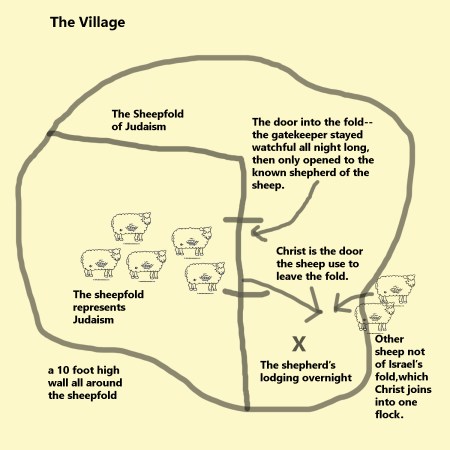
- Door into the sheepfold, guarded and operated by the gatekeeper (vss 1 and 2)
- Door of salvation for all people, Jewish, Gentile, and all future believers. This door leads out of the sheepfold of national Israel into Christ.
The Door into the Sheepfold
ESV John 10:1 “Truly, truly, I say to you, he who does not enter the sheepfold by the door but climbs in by another way, that man is a thief and a robber. 2 But he who enters by the door is the shepherd of the sheep. 3 To him the gatekeeper opens. The sheep hear his voice, and he calls his own sheep by name and leads them out.
The above verses speak of the shepherd of the sheep entering into the sheepfold through the door, which the gatekeeper opens. Clearly, the gatekeeper would not open the gate for a thief, a robber, or a stranger.
“…Christ presented Himself to Israel in a lawful manner, that is, in strict accord with the Holy Scriptures.” (Pink, 555)
Rephrasing the above quotation, Jesus entered the fold of Israel by the door.
“…the ‘door’ was the legitimate and appointed entrance into the fold, and this figure meant that the Messiah came by the road which Old Testament prophecy had marked out beforehand.” (Pink, 512-13)
This helps a great deal to explain why Jesus said, “Truly, truly, I say to you, the Son can do nothing of his own accord, but only what he sees the Father doing. For whatever the Father does, that the Son does likewise.” (John 5:19)
See also (Deuteronomy 18:18), “I will raise up for them a prophet like you from among their brothers. And I will put my words in his mouth, and he shall speak to them all that I command him.”
Christ did not deviate from either the prescribed words or actions the Father had preordained in Scripture, but did everything upfront and legal, according to all the terms of the Old Testament prophecies of the future Messiah.
Jesus entered the fold of Israel by the door, while all who went before him, namely the Pharisees to whom he was speaking, were thieves and robbers trying to climb over the wall.
• The Greek word for “thief” indicates stealth, while the Greek word for “robber” indicates violence.
The Pharisees were self-appointed rule makers and monitors who did not have credentials from the God of Israel–neither their positions, nor their words nor their actions were God’s. They performed no miracles, and they verbally rebuked and severely punished the weak and needy of God’s flock, even casting them out, as they had done to the man born blind.
NIV Matthew 23:4 They tie up heavy, cumbersome loads and put them on other people’s shoulders, but they themselves are not willing to lift a finger to move them.
Christ, on the other hand, met all the requirements for Messiah preordained by God through centuries’ worth of Old Testament scripture. God certified Christ as true and genuine both by the words that Christ spoke and by the miracles Christ performed. (Remember the faultless logic of the blind man in chapter 9, when he demonstrated that, “Never since the world began has it been heard that anyone opened the eyes of a man born blind. 33 If this man were not from God, he could do nothing.” (John 9:32-33)
The Door into Salvation
When exiting the sheepfold, the sheep exit through the door of Christ into salvation. [Yes, the figure changes, and the meaning of the symbols shifts somewhat. I guess that Jesus is allowed to mix his metaphors a bit.]
ESV John 10:9 I am the door. If anyone enters by me, he will be saved and will go in and out and find pasture.
The “entering” spoken of here concerns salvation. The sheep exit the door of the sheepfold of Judaism and national Israel, through which Christ had properly entered. They don’t just exit, however. They simultaneously enter into Christ and the eternal life of salvation which he is.
Jesus is not saying that people go in and out of salvation. The going in and out and finding pasture represent the freedom in Christ of salvation. He explains further the eternal assurance of salvation for believers in the next section of chapter 10.
Jesus’ sheep from Judaism form a new flock with believing Gentiles and other believers (for example, those who lived before Israel became a nation) of all times, peoples, tribes, and languages. This flock is one flock, no longer enclosed by the sheepfold of national Israel and Judaism.
John 10:16 And I have other sheep that are not of this fold. I must bring them also, and they will listen to my voice. So there will be one flock, one shepherd.
What Makes Jesus a Good Shepherd?

 One Small Voice
_-_James_Tissot.jpg)