Home » Academic/Biblical (Page 3)
Category Archives: Academic/Biblical
Psalm 25: Change of Person and Multiple Speakers

One thing is true about the Psalter: it is not to be skimmed, or read quickly. The psalms are meant to be mulled and chewed in a quiet atmosphere in which the alarm clock has been turned off. When read in such a manner, the psalms reveal details of form which add to reader comprehension. Scholarly tradition holds that the Psalter was performed in temple liturgies, that is, out loud where worshipers gathered. Many psalms lend themselves to a readers theater approach that would help to clarify their meaning to physically present listeners (see “Psalms 9 and 10: A Readers Theater”). Psalm 25 can be included in this grouping.
If I were the director, or worship leader, in charge of setting up Psalm 25 for dramatic presentation, I would assign parts in the following way:
- Speaker 1: the individual lifting his prayer to God
- Speaker 2: the chorus
Who are the speakers?
Concerning the identities of the speakers, the individual, Speaker 1, could be you or I. In a deeper sense and in alignment with the basic premise of this blog, the speaker is Jesus Christ. Psalm 25 uses this prosopological approach (speaking in-character as though using a dramatic mask, or costume) to prophesy of the coming Messiah in his human and mediatorial role. Speaker 2 could reasonably be any of the following: 1) an actual chorus of speakers who stand above and beyond the action as an interpretive narrator, 2) the voice of Scripture, as though personified, or 3) the voice of the Holy Spirit. Verse 22, “Redeem Israel, O God, from all their troubles!” favors an actual chorus (#1 above) or the voice of the Holy Spirit in intercession ((#3 above; see Romans 8:27).
Psalm 25 (NIV) in text blocks, or panels
- Panel 1
- Speaker 1, verses 1-2:
1 In you, Lord my God, I put my trust. I trust in you; 2 Do not let me be put to shame, nor let my enemies triumph over me.
-
- Speaker 2, verse 3:
No one who hopes in you will ever be put to shame, but shame will come on those who are treacherous without cause.
- Panel 2
- Speaker 1, verses 4-7:
4 Show me your ways, O Lord, teach me your paths; 5 guide me in your truth and teach me, for you are God my Savior, and my hope is in you all day long.
6 Remember, O Lord, your great mercy and love, for they are from of old. 7 Remember not the sins of my youth and my rebellious ways; according to your love remember me, for you are good, O Lord.
-
- Speaker 2, verses 8-10:
8 Good and upright is the Lord; therefore he instructs sinners in his ways. 9 He guides the humble in what is right and teaches them his way. 10 All the ways of the Lord are loving and faithful for those who keep the demands of his covenant.
- Panel 3
- Speaker 1, verse 11:
11 For the sake of your name, O Lord, forgive my iniquity, though it is great.
-
- Speaker 2, verses 12-14:
12 Who, then, is the man that fears the Lord? He will instruct him in the way chosen for him, 13 He will spend his days in prosperity, and his descendants will inherit the land. 14 The Lord confides in those who fear him; he makes his covenant known to them.
- Panel 4
- Speaker 1, verses 15-21:
15 My eyes are ever on the Lord, for only he will release my feet from the snare. 16 Turn to me and be gracious to me, for I am lonely and afflicted. 17 The troubles of my heart have multiplied; free me from my anguish, 18 Look upon my affliction and my distress and take away all my sins. 19 See how my enemies have increased and how fiercely they hate me! 20 Guard my life and rescue me; let me not be put to shame, for I take refuge in you. 21 May integrity and uprightness protect me, because my hope is in you.
-
- Speaker 2, verse 22:
22 Redeem Israel, O God, from all their troubles!
What are the advantages of viewing Psalm 25 this way?
The main advantage of reading Psalm 25 in this statement/response format is that the interplay between God and petitioner becomes apparent. In Panel 1, the individual addresses God, acknowledging his trust in him. He asks God that he would not be put to shame and that God would rescue him from his enemies. Then, the chorus, which could be the Holy Spirit, also addresses God directly. This speech differs from the former in that it states general, biblical principles about the nature and actions of God. It answers the needs of the first speaker with reassurance. “God, no one who puts their faith in you is ever put to shame. As for the enemies, they will be the ones put to shame, since they act treacherously without provocation. Speaker 1 is vindicated and reassured by these statements. Notice that the second person direct address to the Lord made by Speaker 2 in verse 3 is joined by third person statements of general principles. This contrasts with the second person direct address and first person statements of a personal nature in verses 1 and 2. The grammar supports the perception of two distinct speakers, and this becomes more apparent as the poem progresses.
In Panel 2, Speaker 1 asks the Lord to teach and guide him, because God is the one he looks to as Savior. All his hope is in the Lord constantly; there is no one else this individual relies upon. He reminds the Lord and asks the Lord to remember his great mercy and love which stretch back to the beginning. He also brings up the sin issue, asking the Lord to forgive him. He cites two reasons: 1) he is older now and knows better, and 2) he is counting on God’s love and goodness.
In response to this speech, Speaker 2, still in Panel 2, indicates in third person that the Lord is indeed good and upright. He does instruct sinners in how to improve their walk. Speaker 2 specifically mentions “the humble,” thereby implying that Speaker 1, as one of the humble, will be guided in what is right and that the Lord will answer his request positively by teaching him. In other words, “Don’t worry. The Lord hears and will answer your prayer by forgiving you and giving you the guidance you seek.”
In Panel 3, the first person individual speaker very simply repeats his request for forgiveness (verse 11), including the elaboration that his iniquity is very great. Speaker 2 responds in much the same fashion as the first time. This speaker never states, “The Lord does forgive you.” Rather, speaking in third person about the sinner and about the Lord, Speaker 2 implies the Lord’s forgiveness through descriptions of ongoing relationship. First, he describes the kind of person the Lord forgives. This person(s) is one who “fears” the Lord (verses 12 and 14). We learn contextually, by reading many psalms, that “to fear the Lord” means to be humble toward him, both in acknowledgment of his rights as the one and only sovereign creator and in acquiescence, or submission, to those rights. The Lord chooses a path, or “way,” for that person who fears him and will instruct him on how to live his life, or to walk in that “way.” Speaker 2 continues in verse 13 to pronounce a blessing from the Lord to such a person and his descendants. Verse 14 goes deeply into the blessing in store for the persons who fear the Lord, “14 The Lord confides in those who fear him; he makes his covenant known to them.” The teaching is remarkable, that to be forgiven means to be drawn in to close and intimate relationship with the Lord Almighty. And so the reader sees by example and illustration what it means when the Lord forgives the great iniquity of those who confess and repent.
Panel 4 contains the longest speech by the first person individual supplicant. It is like a final fireworks, as the end of the prayer-poem approaches. It causes the reader to question whether Speaker 1 has heard the responses given by Speaker 2 earlier in the prayer. Certainly the conditions have not yet changed. Descriptions of these become more personal and detailed, “I am lonely and afflicted” (vs 16) and in “anguish” (vs 17). The hatred of his enemies toward him is described as being fierce (vs 19). Verse 18 includes a request that the speaker’s sins be not just “forgiven,” as in verse 11, but more than that, taken away.
Verse 21 adds a new element to the prayer. Even though the supplicant perceives himself as a sinner, he requests that integrity and uprightness would protect him. The English translation does not indicate whose integrity and uprightness are being specified. Are they abstract, stand-alone qualities, are they characteristics of God, or are they indicative of the supplicant, in spite of his confessed sins? The Septuagint translation interprets the underlying Hebrew text (vorlage) differently, “The harmless and upright joined themselves to me: for I waited for thee, O Lord.” This is very interesting. First, such a statement supports well the interpretation that Christ in this psalm speaks in a mediatorial capacity. Secondly, in his incarnation, the poor and afflicted, the harmless (disenfranchised) ones, did attach themselves to Christ. Their very belief in him as God’s Son indicates their “uprightness” before the Lord (metaphorically their truth, “straightness,” sincerity according to Thayer). On the other hand, if Speaker 1 is making reference to his own integrity and uprightness, this would support the underlying premise of the righteous one confessing mediatorially the sins of others throughout the psalm.
Speaker 2 closes both this panel and the psalm with a prayer that Israel that would be redeemed, or saved, from all their troubles. Both the Hebrew and Greek use a masculine singular for “his troubles,” a grammar supported by the NET. If the Holy Spirit is Speaker 2, “Israel” could be the kingdom or it could be a special name for Christ in his mediatorial capacity (confer Hosea 11:1 and Matthew 2:15). This summary prayer in verse 22 accords well with the interpretation that the individual supplicant, Speaker 1, has spoken throughout the psalm in a mediatorial capacity.
Why does a grammatical shift of person indicate a change of speaker?
Verbs in many languages express “person,” the English word used to describe who the subject of the verb is speaking about. Some languages also use pronouns to help clarify meaning. For example, a sentence may say, “I run,” or “We run,” “You run,” or “He runs,” etc. Why is it important to notice person in speech?
Let’s set up an imaginary scenario. Let’s pretend that I am talking to you and that you and I are alone together. Let’s further assume that no one is listening in. I may make statements such as, “I am hungry,” or, “I want you to help me.” I may say, “You are doing a good job.” The common practices of ordinary language are such that grammatical person remains consistent during a speech segment. So let’s say I am talking to you, and your name is Viva. I might say something like, “Viva, I’m hungry. I want you to help me get some lunch ready.” However, I wouldn’t say, “Viva, I’m hungry. I want you to help me get some lunch ready. Viva is a good and kind person who always helps whoever asks her,” if the situation hadn’t changed and I was still talking directly to you, Viva. If I did speak like that, a hypothetical reader (who is now listening in) might think that 1) I was speaking to a very young child, 2) that Viva had a learning difficulty of some sort, 3) perhaps I was trying to brainwash Viva, or 4) that I was making a dramatic aside to an outside party listening in. Number 4 might occur if I were on a reality TV show and I suddenly turned to speak in third person about Viva to the assumed audience. These possibilities serve to demonstrate that in normal direct address to someone labeled, “you,” when the two persons are alone together, the speaker continues to use second person throughout a consecutive speech segment. They do not grammatically shift to third person and speak about the person whom they previously had been addressing, if nothing in the setup has changed. Such a shift would normally imply the presence of a third party to the conversation.
In the example given above, a reader might see on the printed page, “Viva, I’m hungry. I want you to help me get some lunch ready. Viva is a good and kind person who always helps whoever asks her.” Rules of ordinary, common speech would cause the reader to assume the presence of a third person, who either 1) speaks the final sentence or 2) to whom the final sentence is being spoken. The type of written material would influence the reader’s conclusions concerning which of those two possibilities is correct. For example, if the reader is reading a novel, she might assume the narrator spoke that last line to the reading audience.
The above example illustrates the principle that in ordinary, plain speech an individual who directly addresses another individual does so continuously throughout the speech event. The speaker does not switch second person “you,” to third person “he,” if continually addressing the same individual. If I am speaking directly to you, I would not suddenly begin referring to you in third person, not while I am still talking to you directly.
Therefore, when we as readers encounter grammatical changes of person in a single speech event, such as second person switches to third person and back again, we normally assume another individual to be present, either as speaker or as listener. As demonstrated above, Psalm 25 continuously switches from reference to the Lord in second person to reference about the Lord in third person, and back again. For example, consider verses 7b-8, “7b According to your love remember me, for you are good, O Lord [second person]. 8 Good and upright is the Lord; therefore he instructs sinners in his ways [third person].” Verse 7b addresses the Lord directly in second person, you. Verse 8 without warning switches to describing the Lord in third person, he and his. As readers daily schooled in the norms of plain, ordinary speech, we would naturally begin looking for explanations to explain the shift.
What possibilities might explain the shift of person in Psalm 25?
In Psalm 25, there are various possibilities that might explain the shift in person.
- The first person speaker turns from addressing the Lord in second person to addressing himself about the Lord in third person.
- The first person speaker turns from addressing the Lord in second person to addressing an assumed audience about the Lord in third person.
- A third party privy to the prayer makes narrative statements to the Lord (verses 3 and 22) or about the Lord (verses 8-10 and 12-14). In this scenario, the first person speaker either may or may not be aware of the third party who functions as a narrator.
Let’s discuss each of these possibilities one at a time.
- The first person speaker addresses himself about the Lord. In this scenario, the supplicant, that is, the first person speaker, begins by addressing the Lord directly using first and second person, “In you, Lord my God, I put my trust,” (verse 1). Then, even though his prayer hasn’t ended, he breaks off addressing the Lord and begins talking about the Lord in third person, “Good and upright is the LORD; therefore he instructs sinners in his ways (verse 8). Is he now talking to himself about the Lord?
- If number one is the case, then the entire prayer becomes a kind of metacognitive debate. If he is talking to himself, it would appear to be an attempt to convince himself that the Lord will answer his prayer because that is the Lord’s nature. This would preclude (leave out) his waiting on the Lord in order to receive the Lord’s reply. The psalmist does indeed state in verse 5 LXX that he has waited on the Lord all day long; the NIV uses the word “hoped” rather than “waited.” Trying to convince oneself about the reliability of the Lord is not the same as waiting on the Lord to answer one’s prayer. Possibility one, therefore, must be rejected.
- The first person speaker turns from addressing the Lord in second person to addressing an assumed audience about the Lord in third person.
- If number two is the case, that the supplicant turns to address an audience, as in a liturgical setting, then the intimacy of the personal confessions and appeals would be broken. This scenario seems unlikely in that the passion and intimacy of the prayer directed to the Lord lead one to believe that the prayer is genuine and earnest, as prayed by a real person in a real situation. If the prayer was originally conceived for a liturgical setting, then its basic premise would be false. An honest reader must reject this notion.
- A third party privy to the prayer makes narrative statements to the Lord (verses 3 and 22) or about the Lord (verses 8-10 and 12-14).
- Verse 3 is problematic in that the statements are second person addressed to the Lord and third person about those who are treacherous without provocation. It may be spoken by a narrator (a dramatic chorus viewing the prayer from the outside or the Holy Spirit), or it may be spoken by the supplicant. I feel it is the Holy Spirit, due to its content and tone, which differ from the statements in first person of personal need. Verse 3 aside, the remaining verses fit well with assignment to a third party.
- Is the first person speaker aware that third party proclamations about the nature and character of the Lord are being inserted into his prayer from time to time? It appears not. While it seems as though the Speaker 2 statements are spoken in reply to and with regard to the contents of the statements by Speaker 1, the reverse does not seem to be the case. Statements by Speaker 1 remain consistent throughout the psalm. His thoughts do not seem to have responded to the words of reassurance consistently spoken by Speaker 2. Therefore, I believe that we the reader can hear these inserted statements, but Speaker 1 does not.
- Of the three possibilities set forth to explain the grammatical shift in person within the prayer that is Psalm 25, I believe that the third possibility appears most probable in that it best explains the normal rules of speech under which we all function.
Summary
- There are changes of grammatical person throughout Psalm 25.
- These indicate a change of speaker.
- Speaker 1 is an individual supplicant confessing his suffering and sin to the Lord, asking forgiveness, and asking the Lord for his intervention in overcoming his enemies.
- Speaker 2 is an outside voice apparent to the reader of the psalm, but not apparent to the supplicant.
- The content of the statements by the two speakers vary considerably.
- Statements by Speaker 1 are all spoken in first and second person. They express anxiety, urgency, stress, emotional pain, confession of sin, and a beseeching attitude of trust and hope in the Lord. These are consistent throughout the psalm.
- Statements by Speaker 2 are all spoken in second and third person. They express strong confidence in the Lord’s consistent love, goodness, and faithfulness toward those who fear him by keeping the demands of his covenant. They express no anxiety.
- Psalm 25 is consistent with other psalms that clearly and directly indicate Christ as King, mediator, and persecuted supplicant.
- Most likely Speaker 1 in Psalm 25 is the prophetic, in-character (prosopological) voice of Christ during the trials of his incarnation.
- Most likely Speaker 2 is the voice of the Holy Spirit having heard the prayers of Christ and also praying to the Lord God on behalf of Christ and Israel.
- All of the above is consistent with Scripture considered as a whole and in parts, both Old and New Testaments.
How do these conclusions, based upon consideration of the grammatical changes of person in Psalm 25, help the reader’s faith?
First, two speakers are better than one. Two speakers implies the supernatural presence of deity listening to the words of the psalmist’s prayer. The supplications of this prayer will be answered. This informs the reader that her prayers will also be heard, understood, accepted, and answered. Our Lord is Spirit, but he is God who sees, hears, and speaks.
Psalm 145:19 NIV He fulfils the desires of those who fear him; he hears their cry and saves them.
Second, the presence of two speakers implies the presence of the Trinity within the words of Psalm 25: The Lord God to whom the supplications are directed, Christ the mediator making supplication for himself and the people he represents, and the Holy Spirit, the Helper, who helps the supplicant in his prayer.
Finally, the words and prayers of Speaker 2 are highly reassuring and certainly speak to people of faith of all times and places. By reading Psalm 25 with the understanding that Christ our mediator is praying for his mission and for the forgiveness of our sins and that the Holy Spirit is in full agreement with the words of his prayer, our faith is helped.
Penitential Psalms: Psalm 130–Praying from the Grave

1 [A Song of Degrees.] Out of the depths have I cried to thee, O Lord. 2 O Lord, hearken to my voice; let thine ears be attentive to the voice of my supplication. 3 If thou, O Lord, shouldest mark iniquities, O Lord, who shall stand? 4 For with thee is forgiveness: 5 for thy name’s sake have I waited for thee, O Lord, my soul has waited for thy word. 6 My soul has hoped in the Lord; from the morning watch till night. 7 Let Israel hope in the Lord: for with the Lord is mercy, and with him is plenteous redemption. 8 And he shall redeem Israel from all his iniquities. (Psalm 129(130) LXE, Brenton)
Prophecy, if prophecy, must tell a story. A large function of the Psalter is to prophesy. The seven penitential psalms (6, 32, 38, 51, 102, 130, and 143) prophesy of Christ: his innocence, the sacrificial nature of his atoning death, his human suffering, his resurrection, and the victory of his people. These portions of the life of Christ are not necessarily presented in chronological order within the penitential psalms. While other psalms speak of Christ’s suffering (Psalms 6, 32, 38, 102, and 143), Psalm 130 speaks from the grave (the depths) without making direct statements of suffering. Rather, the unique element of Psalm 130 is an extreme period of waiting, “For thy name’s sake have I waited for thee, O Lord, my soul has waited for thy word. My soul has hoped in the Lord; from the morning watch till night,” (Psalm 130:5-6 LXE). It is not difficult for faith to hear within these verses the voice of Christ as he waits within the grave for his resurrection.
Further, Psalm 130 contains no direct statements of personal sin or guilt, as do Psalms 38 and 51. Rather, Psalm 130 is a penitential psalm of atonement, due to its discussion of sin and forgiveness without personal confession of any sort. The word forgiveness in verse 4, which is ἱλασμός (il-as-mohss) in Greek, is a relatively rare word in Scripture, although it plays an enormous role in Christian evangelism and doctrine. Arndt and Gingrich (1) define it with two meanings: 1) propitiation or expiation, and 2) a sin-offering. While the major English translations (they are translating from Hebrew, not Greek) have “forgiveness” in verse 4, they use words such as “Day of Atonement” in Leviticus 25:9, “ram of atonement” in Numbers 5:8, “sin-offering” in Ezekiel 44:27, “propitiation” or “atoning sacrifice” in 1 John 2:2, and the same for 1 John 4:10. All of these occurrences in the Greek Septuagint are represented by the word ἱλασμός (il-as-mohss), which is translated as forgiveness in Psalm 130:4 (LXE Brenton) or atonement (NETS, Pietersma). (See footnotes 2 and 3.) Important to our discussion of the seven penitential psalms, this is the only occurrence of this word anywhere in the entire Psalter.
Who will receive the atoning forgiveness of verse 4? Verses 7 and 8 each name Israel. Israel, in the New Testament sense of the word (Romans 11:26), includes all believers, both saints of the Old Testament and saints of the New. What at first glance might seem to be a psalm of personal lament, therefore, is an intercessory prayer for the beneficiaries of Christ’s death. When God answers the Lord’s prayer for resurrection from the grave (verses 1-2 and 5-6 above), then his “unfailing love” (verse 7) and “full redemption” (verse 7) will be magnificently realized, for “He himself will redeem Israel from all their sins” (verse 8).
Comments: For those readers who consult commentaries, you might find that the point of view I present above, namely, that Christ is the subject of this prayer/poem–he is the one who is praying to God his Father from the grave–is underrepresented (4). The thesis of my approach is simple: the Psalter in its first person singular prayers speaks the voice of Christ.
I want to repeat what I wrote in the first post of this series on penitential psalms, “My purpose here is to hold up a road sign to you that says, “Have you tried this pathway through Psalms?” The pathway we will consider is Christ and his cross. Even in the so-called grouping of seven Penitential Psalms, we find Christ ever present and revealed. These psalms are not primarily about experiencing emotions of penitence designed to lead us to repentance. Rather, they are primarily about the life of Jesus Christ during his incarnation. My premise is that Psalms reveal Christ. He is their primary focus. As we see Christ revealed, we also learn about God’s love for us, and that is what makes them important” (The Penitential Psalms: A Fresh Look–New Series).
Premising Christ as speaker in all the penitential psalms at first appears to provide obstacles, the most difficult being what to do with a psalm of pure confession, such as Psalm 51. However, when we consider the seven psalms as a unified whole with the understanding that Christ is speaker throughout (except of course in those places which imply or directly state that God is addressing Christ, Psalm 102), we see that a clear picture of the several elements of the complete gospel emerges:
- Christ’s passion of human suffering (Psalms 6, 32, 38, 102, and 143)
- Christ’s innocence (Psalms 6, 102, and 130)
- the wrath of God upon Christ, the wrath that achieved propitiation (Psalms 6, 32, 38, 102, and 143)
- the persecution of Christ by his enemies (Psalms 6, 38, 102, and 143)
- Christ’s identity as both God and man (Psalm 102)
- Christ’s resurrection (Psalm 102:13)
- Christ’s prayer for his resurrection (Psalm 130)
- end results for Israel (or Zion) and the Church won by Christ in his victory through the cross (51, 102, and 130)
When the reader perceives Christ in their center, the penitential psalms (and the Psalter as a whole) gain a cohesion and sense of meaning that a consideration of each psalm separately does not provide. Also, this viewpoint provides deeper and more certain theological meanings than the isolated concepts of confession and repentance might individually supply. These psalms offer a great hope for the one who reads, a hope placed on the solid ground of the actions of the Son of God, rather than upon the alternative actions of an unnamed sinner with whom the reader must strain to identify. Once again, my purpose here is to hold up a road sign that says, “Have you tried this pathway through Psalms?” My prayer is that as you spend time with the Lord, asking him to reveal his presence to you within the words of Christ as expressed in these seven psalms, that God through his Holy Spirit will answer your heart to the fullest extent.
__________
1 Arndt, William F. and F. Wilbur Gingrich, Editors. A Greek-English Lexicon of the New Testament and Other Early Christian Literature, 2nd Edition. Revised and Augmented by F. Wilbur Gingrich and Frederick W. Danker from Walter Bauer’s Fifth Edition, 1958. Chicago: The University of Chicago Press, 1979.
2 Brenton, Sir Lancelot C. L. The Septuagint Version: Greek and English. Grand Rapids: Zondervan Publishing House, 1970.
3 Pietersma, Albert, ed. A New English Translation of the Septuagint: The Psalms. Translated by Albert Pietersma. New York: Oxford University Press, 2007. Available online at http://ccat.sas.upenn.edu/nets/edition/24-ps-nets.pdf. Accessed April 27, 2018.
4 John Barclay hears only the voice of Christ in Psalm 130. See Barclay, John. The Psalms of David, and the Paraphrases and Hymns: With a Dissertation on the Book of Psalms, and Explanatory Introductions to Each. Edinburgh: James Gall, 1826. Reprinted Digitally by Forgotten Books, registered trademark of FB &c Ltd., London, 2017. Available at http://www.ForgottenBooks.com, 2017. A better quality copy is available at https://babel.hathitrust.org/cgi/pt?id=nyp.33433068259260;view=1up;seq=205;size=75. Accessed April 11, 2019.
Penitential Psalms: Psalm 102–Summary of Its Dialogic Structure
In the “theodramatic” (1) setting of Psalm 102, the Holy Author creates a divine conversation between Father and Son. Scripture supplies confirmation of dialogue when the New Testament writer of the Letter to the Hebrews quotes in Hebrews 1:10-12 a portion of the entire exchange, verses 25-27, writing as a matter of fact that in these verses God addresses the Son. Though not directly stated, God the Father is implied.
Where else can the reader find evidence of this dramatic, readers theater style interpretation?
First, reading through the text of Psalm 102, the entire sense of the psalm inevitably reveals a conversation. Minimally, the main speaker addresses God directly in verses 1, 2, 10, and 24. Further direct addresses that carry a different content and tone are found in verses 12-22 and again in verses 25-28. The change in content and tone correspond to a change in speaker.
Second, as stated above, the Letter to the Hebrews explicitly identifies a second speaker, God, for verses 25-27. Finally, the Septuagint text leads the way in the Hebrews’ interpretation by plainly labelling in common, everyday language the presence of two speakers, “He [speaker one] answered him [speaker two] in the way of his strength: tell me the fewness of my days” (Psalm 101:23 LXE, verse 24 in modern language versions).
With the presence of two speakers acknowledged, the reader can discern the boundaries of the several speech parts. A reasonable assignment is the following:
- Speaker One (the Son): Verses 1-11 (12 LXX).
- Speaker Two (God the Father): Verses 12-22 (13-23 LXX).
- Speaker One (the Son): Verses 23-24a (24-25a LXX).
- Speaker Two (God the Father): Verses 24b-28 (25b-29 LXX).
When perceived as a divine dialogue between Father and Son, the devotional aspects of this amazing psalm expand greatly.
__________
Bates, Matthew W. The Birth of the Trinity: Jesus, God, and Spirit in New Testament & Early Christian Interpretations of the Old Testament. Oxford University Press: Oxford, United Kingdom, 2015 and Paperback Edition 2016, p 170.
Penitential Psalms: Psalm 102–God’s Son Speaks: Technical Background
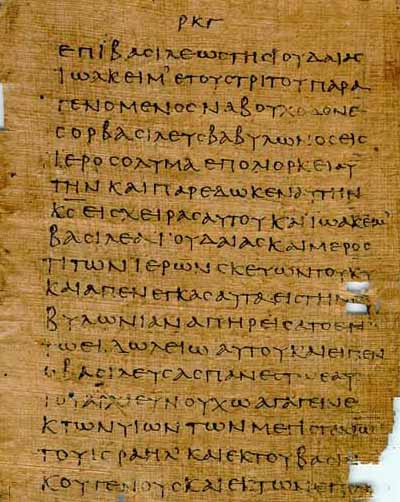
P 967 Rahlfs Daniel 1.1 (ca. 200 p. Chr. n., Papyrus-Sammlung Köln).
Accessed at http://www.hsaugsburg.de/~harsch/graeca/Chronologia/S_ante03/VT/vte_pd00.html#p967
Tragically, not many commentators hear the voice of Christ in Psalm 102. Spurgeon (1) does not. Generally, those who don’t hear the voice of Christ fail to hear the divine dialogue within this amazing psalm. Because two or more witnesses biblically establish a valid testimony (Deuteronomy 17:6; Matthew 18:16; John 8:18), I’m going to take time at the outset to provide these additional witnesses to my own. First, here is a link to the text itself, where the reader can find the entirety of Septuagint Psalm 101(102), and below that is an excerpt that contains the portion quoted in Hebrews 1:10-12.
Reader Resource: Bilingual Text LXX (Septuagint in Greek) and LXE (Brenton’s English Translation). Notice that in the Greek Septuagint and in Brenton’s translation, Psalm 102 in our English Bibles is numbered as Psalm 101. Also, verse numbers may differ, depending upon which Septuagint edition is being used. The numbers to the left follow the Masoretic tradition while those in parenthesis follow the numbering used by the link given.
23(24) He answered him in the way of his strength: tell me the fewness of my days.
24a(25a) Take me not away in the midst of my days: 24b(25b) thy years [are] through all generations.
25(26) In the beginning thou, O Lord, didst lay the foundation of the earth; and the heavens are the works of thine hands.
26(27) They shall perish, but thou remainest: and [they all] shall wax old as a garment; and as a vesture shalt thou fold them, and they shall be changed.
27(28) But thou art the same, and thy years shall not fail.
28(29) The children of thy servants shall dwell [securely], and their seed shall prosper for ever.
Here is the same text as presented in the ESV with the Septuagint English in brackets alongside: Psalm 102:23-28.
23 He has broken my strength in midcourse; [LXX: He answered him in the way of his strength:]
he has shortened my days. [LXX: tell me the fewness of my days.]
24 “O my God,” I say, “take me not away in the midst of my days— [LXX: Take me not away in the midst of my days:]
you whose years endure throughout all generations!” [LXX: thy years [are] through all generations.]
25 Of old you laid the foundation of the earth,
and the heavens are the work of your hands.
26 They will perish, but you will remain;
they will all wear out like a garment.
You will change them like a robe, and they will pass away,
27 but you are the same, and your years have no end.
28 The children of your servants shall dwell secure;
their offspring shall be established before you.
Finally, here is the portion (ESV) which the author of Hebrews quotes from the Septuagint:
10 And, “You, Lord, laid the foundation of the earth in the beginning,
and the heavens are the work of your hands;
11 they will perish, but you remain;
they will all wear out like a garment,
12 like a robe you will roll them up,
like a garment they will be changed.
But you are the same,
and your years will have no end.”
Second, as witness #1, here is how I perceive the dialogue in Psalm 101(102). Note that verse numbers differ and are dependent upon the edition being used. For reader convenience I am using the Masoretic numbers and referencing in brackets the numbers found in the “Bilingual Text” link in the “Reader Resource” paragraph at the top of this article.
- Verses 1 – 11 [1-12 in the bilingual link given above]. God’s Son speaks to his Father in the days of his incarnation and Passion.
- Verses 12 – 22 [13-23] God the Father replies through the Holy Spirit to his Son.
- Verses 23 – 24a [24-25a] God the Son answers God the Father. (23 “He answered him in the way of his strength: tell me the fewness of my days. 24a Take me not away in the midst of may days:)
- Verses 24b – 28 [25b-29] God the Father answers the Son. (24b “thy years are through all generations. 25 In the beginning thou, O Lord …]
Witness #2: John Barclay (2).
[Barclay uses the Masoretic numbering] In this Psalm we behold the sufferings of Christ, as expressed in his own person, by the Holy Ghost, from the beginning to verse 12, contrasted with the following glory, as declared by the same Spirit in the person of the Father, from verse 12 to 23. Then from the 23d to the middle of verse 24, the dialogue is again renewed, as at the beginning of the Psalm, in the person of the Son–to whom, from the middle of verse 24, to the end of the Psalm, the Father is again represented, as replying according to the former manner, mentioned from ver. 12 to 23: for so this Psalm, ver. 25, &c. is expressly applied and interpreted by the Holy Ghost, Heb. I. ‘Unto the Son he saith, Thy throne, O God, is for ever and ever–And thou, Lord, in the beginning, hast laid the foundation of the earth; and the heavens are the works of think hands,’ &c.–‘And they shall be changed: but thou are the same, and thy years shall not fail.’
My Comment: Very few biblical commentators will ascribe verses 12-24a to God the Father or God the Holy Spirit, even among those who readily find the Father replying to Christ in the final speech, verses 24b-28. Most gladly I recognize the kindred spirit that exists between John Barclay and myself.
In contrast to Barclay, the third witness, below, Robert Hawker, is one who readily hears the voice of Christ in his Passion in verses 1-11, yet who does not recognize the words of comfort found in verses 12-22 as proceeding from God the Father. He does, however, hear Christ speaking in verses 23-24a and the Father directly answering him in verses 25 to the end.
Witness #3: Robert Hawker (3).
After verse 28: From the apostle Paul’s quotation of this glorious passage, Heb. I. 10, &c. and his illustration of it, as there explained, it should seem very evident that these verses contain God the Father’s answer to Christ’s prayer, and form a blessed summary of all redemption mercies ensured to the church in Him…Reader, I know not what soul exercises or afflictions your heart may be wounded with; but I venture to believe, that the truest relief under all, is to view Christ in his unequalled sorrows. Poring over ourselves, or over our own sorrows, and magnifying them, will never bring comfort. But if I see Jesus with the eye of faith, in the tribulated path; if I mark his footsteps, and he calls to me, and leads me by the way of the footsteps of his flock, where he feeds his kids, beside the shepherds’ tents; I shall feel comfort.
My Comment: Very often, those commentators who do not perceive the voice of Christ in Psalm 102, but that of an unnamed human suppliant–these authors tend to focus on Christ as Creator, and that portion of Hebrews as a Creation passage. The reasoning is that the author of Hebrews merely “applies” the words of Psalm 102:25-28 to Christ as object. They consider verses 25-28 to be spoken by the unnamed single human speaker who speaks throughout the entire psalm. They argue that though this human poet addresses God throughout the entirety of the psalm, this particular portion is applied by the author of Hebrews as making reference to Christ as Creator. In other words, they see a human speaking to God throughout the psalm, complaining to God for a longer life, reasoning that because God has such a long life and such power to create, why can’t he give some of that to the suffering poet? They fail to grasp the nearly sacrilegious arrogance of such a supplication. These commentators claim that the author of Hebrews by inexplicable “divine” inspiration, wrenched these words in particular from the whole psalm, and applied them in reference to Christ as object (Creator). Not only does this do disservice to the entire concept of the Bible’s having been written in “plain, ordinary speech,” but it completely destroys the comfort Hawker and others preeminently find in this psalm, as they consider the sufferings of Christ and the comfort afforded both him and us, who are in him, by God the Father.
Witness #4: Arthur Pink (4)
Arthur Pink lines up with Hawker as perceiving Christ as speaker up until the Father’s reply quoted in Hebrews (verses 25-28). Myself and Barclay, the reader might recall, saw two sections in which God the Father spoke directly to the Son (verses 12-22 and 24b-28.) Pink sees only the latter. He adds to the discussion, however, by combining the author of Hebrews’ rhetorical (logical, argumentative) use of Christ as Creator with the devotional comfort found in Psalm 102 of Christ as suffering Savior. Pink writes:
“And Thou, Lord, in the beginning, hast laid the foundation of the earth.” The Psalm from which this is quoted is a truly wondrous one … It lays bare before us the Saviour’s very soul. Few, if any, of us would have thought of applying it to Christ, or even dared to, had not the Spirit of God done so here in Heb. 1. This Psalm brings before us the true and perfect humanity of Christ, and depicts Him as the despised and rejected One (p 69, see note 4).
After the above, Pink quotes the entire psalm (an indication of how very impressed he is with it) up through verse 22. He labels verses 23-24a as the “strong crying,” quoted in Hebrews 5:7, “of Him who was ‘acquainted with grief.'” Then Pink writes:
And what was Heaven’s response to this anguished cry of the Saviour? The remainder of the Psalm records God’s answer: “Thy years are throughout all generations. Of old hast Thou laid the foundation of the earth. And the heavens are the work of Thy hands. They shall perish, but Thou shalt endure, yea, all of them shall wax old like a garment; as a vesture shalt Thou change them, and they shall be changed: But Thou art the same, and Thy years shall have no end” (vv. 24-27).
Conclusion: In what I hope has not been a manner too arduous to read, I’ve presented four witnesses who agree that through the use of dialogue, Psalm 102 represents both the voice of the Son crying out to his Father in anguish during the days of his incarnation and Passion and the comforting voice of his Father in reply. I have been greatly encouraged recently to have discovered current academic writers who perceive divine dialogue between Father and Son in the book of Psalms (5). I’m sure up to date devotional material, such as this one seeks to be, will also follow.
I have presented these four witnesses so that the reader may have confidence to explore this pathway in a meditatively devotional session of his or her own. For those who follow this blog, I promise that a devotional interpretation of Psalm 102 will be written next.
For now, in consideration of Christian history’s regarding of Psalm 102 as one of the seven so-called penitential psalms, I just want the reader to notice how exactly the Holy Spirit wrote Scripture. We have seen that not all of the so-called “penitential” psalms are penitential in a sense that requires confession and repentance over sin. In this sense of the word, Psalm 51 is the most “penitential,” and Psalm 102 not at all. Note carefully that Psalm 51, which confesses and mourns over sin, does not represent Christ in any way as speaking from the divinity of his being. Rather, he speaks as mediator, a participant in humanity, a sacrificial lamb who took upon himself the sins of the world. Then, just as carefully, note that Psalm 102, which is highly “penitential” in the second meaning of the word, that of poverty and suffering of spirit, presents Christ both in his divinity and his human nature, but quite apart from sin. The reader can conclude that Christ God’s Son, as 2 Corinthians 5:21 states, “knew no sin,” as Psalm 102 demonstrates, and yet God “made him to be sin” “for our sake,” Psalm 51. Praise God.
__________
1 Spurgeon, Charles. The Treasury of David: Containing an Original Exposition of the Book of Psalms; A Collection of Illustrative Extracts from the Whole Range of Literature; A Series of Homiletical Hints upon Almost Every Verse; And Lists of Writers upon Each Psalm in Three Volumes. Peabody: Henrickson Publishers, No Date.
2 Barclay, John. The Psalms of David, and the Paraphrases and Hymns: With a Dissertation on the Book of Psalms, and Explanatory Introductions to Each. Edinburgh: James Gall, 1826. Reprinted Digitally by Forgotten Books, registered trademark of FB &c Ltd., London, 2017. Available at http://www.ForgottenBooks.com, 2017. A better quality copy is available at https://babel.hathitrust.org/cgi/pt?id=nyp.33433068259260;view=1up;seq=205;size=75.
3 Hawker, Robert S. The Poor Man’s Old Testament Commentary: The Book of Psalms, public domain. Available at http://grace-ebooks.com/library/Robert%20Hawker/RH_Poor%20Man%27s%20Old%20Testament%20Commentary%20Vol%204.pdf, published by Grace Baptist Church of Danville, Kentucky. Accessed May 3, 2018.
4 Pink, Arthur. An Exposition of Hebrews. Baker Book House: Grand Rapids, 1954, pages 68-74.
5 See Bates, Matthew W. The Birth of the Trinity: Jesus, God, and Spirit in New Testament & Early Christian Interpretations of the Old Testament. Oxford University Press: Oxford, United Kingdom, 2015 and Paperback Edition 2016. See also Bates, Matthew W. The Hermeneutics of the Apostolic Proclamation: The Center of Paul’s Method of Scriptural Interpretation. Baylor University Press: Wayco, Texas, 2012.
Penitential Psalms: Psalm 102–Who Is Speaking?
The Old Testament was originally written mostly in Hebrew. About three centuries before Christ, translations of the Hebraic Scriptures into Greek became common. These translations collectively are called the Septuagint. The word “septuagint” means seventy, and unverified tradition holds that seventy scholars sequestered themselves while making the translation at the request of King Ptolemy II for the national library in Alexandria. Extant Greek manuscripts, translated from Hebrew, are older than the oldest extant Hebrew manuscripts by one to two centuries (1). The New Testament, on the other hand, was originally written in Greek, and its authors regularly read and quoted from the Old Testament Septuagint. Knowing this information helps to clarify why the author of the New Testament’s Letter to the Hebrews included Psalm 102:25-27 in his list of Old Testament texts that demonstrate God’s calling Jesus Christ his “Son” (2).
In the first chapter of Hebrews, the biblical author quotes several passages from the Old Testament in which God speaks directly to his Son. The three occurrences of God speaking directly to his Son are found in verse 5, quoting Psalm 2:7; verses 10-12, quoting Psalm 102:25-27; and verse 13, quoting Psalm 110:1. In the first and third of these quotations, the reader readily discerns the voice of God speaking to a second person. The text clearly states that this is so. However, when reading the quotation from Psalm 102, as written in most English translations, the reader may wonder how it is that these particular verses refer to the Son? How did the writer of the Letter to the Hebrews arrive at his conclusion? Many commentators simply skip past the confusion by stating that the Hebrews’ author, divinely inspired, applied these verses to Christ. But this begs the question, for if so, then why so? Why these verses in particular?
Knowing that the author of Hebrews was quoting from a Greek text helps tremendously. In fact, it solves the puzzle. The complete context in the Septuagint clearly indicates a dialogue between two speakers. That is, the Septuagint text tags the verses immediately preceding the quotation found in Hebrews with clear transitional phrases of dialogue,
“23 He answered him in the way of his strength: tell me the fewness of my days. 24a Take me not away in the midst of my days: 24b [the reply from the second speaker immediately follows here without an identifying tag, but it is clear from the context that a second speaker answers the requests of the first speaker] thy years are through all generations. 25 In the beginning thou, O Lord, didst lay the foundation of the earth…” (3).
The Septuagint from which the author of Hebrews quotes (scholars overall agree that the writer is quoting from the Greek text) clearly distinguishes with speech labels the presence of two speakers in dialogue with each other. But the English translations of Psalm 102, which are based upon the Masoretic text (Hebrew), fail to include the tag words, “He answered him…”, found in verse 23a. And the author of the Letter to the Hebrews begins his quotation of Psalm 102 with verse 25, which occurs after the second speaker, God, has already begun speaking. The quotation in Hebrews does not contain the dialogue tags, or labels, but the author implicitly acknowledges their occurrence and assumes that his readers also know this fact. The assumption of dialogue is central to the logic and force of the author’s argument. He presents the Old Testament text as an example of God speaking directly to his Son.
Conclusion: While English versions translated from the Hebrew Masoretic text of Psalm 102:23 do not include the three words, “He answered him…”, the author of Hebrews implicitly acknowledges the prior occurrence of these three words as he begins his quotation in verse 25, which falls after their occurrence in the Septuagint from which he quotes. That the author implicitly acknowledges dialogue in the passage is clear from the entire context of Hebrews 1. The writer of the Letter to the Hebrews is demonstrating how Old Testament scripture accords Christ the status of Son. Among his proof texts are several verses that indicate direct speech by God to his Son. Among these is Psalm 102:25-27, quoted in Hebrews 1:10-12. It is clear that the Hebrews’ author is attributing the quotation as a speech statement by God to his Son. Again, the Son is the one to whom God is speaking, both in Hebrews 1:10-12 and in that passage’s source, Psalm 102:25-27. The Son is he to whom God replies. This fact, in turn, forces the reader to conclude that the “poor” man who pours out his supplication to the Lord, whose voice we hear so plaintively in the first eleven verses of this “penitential” psalm, is none other than the Son whom God addresses directly as such in verses 24-28 LXX (Septuagint).
Significance: What is the answer to the big question, “So what?” The following blog in this series will, Lord willing, provide answers to that question.
__________
1 Reference works concerning the textual history of the Septuagint include 1) Karen H. Jobes & Moisés Silva. Invitation to the Septuagint. Grand Rapids: Baker Book House, 2000. 2) H.B. Swete, An Introduction to the Old Testament in Greek, Cambridge: University Press, 1900. 3) Timothy Michael Law. When God Spoke Greek: The Septuagint and the Making of the Christian Bible. New York: Oxford University Press, 2013.
2 Although Hebrews begins speaking of God’s Son in verse 2 of chapter 1, the author specifically names Christ as the Son in Hebrews 3:6, “But Christ is faithful over God’s house as a son…”
3 Brenton, Sir Lancelot C. L. The Septuagint Version: Greek and English. Grand Rapids: Zondervan Publishing House, 1970. Notice that the verse numbering differs from most English versions.
The NETS Bible (Pietersma, Albert, ed. A New English Translation of the Septuagint: The Psalms. Translated by Albert Pietersma. New York: Oxford University Press, 2007. Available online at http://ccat.sas.upenn.edu/nets/edition/24-ps-nets.pdf. Accessed April 27, 2018) reads, “24(23) He answered him in the way of my strength, ‘Tell me the paucity of my days. 25(24) Do not take me away at the mid-point of my days,…”
In further confirmation of the Septuagint text, the Latin Vulgate, which translates the Greek, includes the words from Psalm 102:23, “He answered him…”
Penitential Psalms–Psalm 102: Why Penitential?

WE LEARNED what a truly penitential/repentant psalm looks like when we studied Psalm 51. This kind of psalm is rare in the Psalter. Psalm 102(101 LXX) immediately follows Psalm 51 in the list of seven traditional penitential psalms (6, 32, 38, 51, 102, 130, 143). It bears little resemblance to Psalm 51. Why does the list include Psalm 102?
First, a careful line by line search of Psalm 102 (ESV) (Greek and Brenton English) (English NETS) reveals not a single syllable concerning sin or repentance. Words and phrases present in Psalm 51, such as “blot out my transgressions” (v 1) and “wash me thoroughly from my iniquity and cleanse me thoroughly from my sin!” (v 2) simply do not occur anywhere in Psalm 102.
Second, what Psalm 102 does contain is a poetic expression of great suffering on the part of the speaker. His suffering is summed up well in the superscription given the psalm before the first verse begins, “A Prayer for the Poor; when he is deeply afflicted, and pours out his supplication before the Lord,” (Psalm 102:1 LXE). While of course this title is not part of the biblical text itself but an ancient editorial addition, the Greek word for “Poor” (πτωχός, ptoe-koes) is a word often used by Jesus in the New Testament. We find one example in the first beatitude, “Blessed are the poor in spirit, for theirs is the kingdom of heaven,” (Matthew 5:3). Thayer describes the meaning of this word “poor” as, “destitute of wealth, influence, position, honors; lowly, afflicted,” (Thayer, A Greek-English Lexicon of the New Testament). As explained in greater depth in a previous chapter (Penitential Psalms: A Big Mix-Up?) one possible explanation of the origin of both the word “penitential” and the list of seven psalms is the Greek “pen” word family. One of these “pen” stem words is πένητος (pen-ee-tohss). A “penitose” person is a poor person. Note the similarity to English “penitent.” “Penitose” is a synonym of “Ptoe-koes,” “poor,” which we just saw in the title above Psalm 102.
So, Psalm 102 is the speech of a poor, afflicted person who pours his heart out to the Lord. What else do we find in Psalm 102? Thirdly, we find the psalmist’s direct claim that he has enemies (v 8) who cause him pain, and further, that God himself (v 10) in “anger” and “wrath,” or “raging fury” (NET) has “lifted me up, and dashed me down,” (LXE, Septuagint in English). These last two features, both enemies causing pain and God’s wrath causing pain, are most strongly present in penitential Psalms 6, 38, and 102. Of these three, only Psalm 38 expresses sorrow for sin. Psalm 102, as mentioned in point one above, expresses neither confession nor remorse for anything.
Conclusion: Psalm 102 is “penitential” in the sense that it is the speech of a poor and needy person crying out to the Lord for help. The speaker’s suffering originates in persecution by both enemies and the Lord. There is neither acknowledgement of sin (confession) nor contrition (repentance) of any kind. The more we examine the seven so-called penitential psalms, the one item we find common to all of them is a deep humility of spirit as the psalmist addresses the Lord. To this author, it seems likely that, were we beginning fresh today, we would not begin to think of grouping these seven psalms in a cluster as our church forefathers did.
A Peek Ahead: There is much more to say about Psalm 102, such as, Who is speaking? This topic will form the content of a future post.
Penitential Psalms: Psalm 51–A Personal God of Love

It happens to be Maundy Thursday and tomorrow is Good Friday. Psalm 51 is an Easter Song if there ever was one. Psalm 51 is difficult for me and for everyone who strongly feels that Christ is the primary speaker in David’s psalms. The speaker in this psalm unquestionably confesses his personal guilt and sin. And Christ is sinless and holy. How can the speaker be Christ? And yet, that is my position.
Craig C. Broyles writes that of the seven penitential psalms (Pss. 6, 32, 38, 51, 102, 130, and 143), Psalm 51 is unique in its exclusive focus on sin (Broyles, p226). He also writes that among the psalms as a whole, it is “unrivaled … for its interest in inner transformation” (Ibid.). While Broyles in no way claims Christ as speaker, he states that within the psalm itself there is no reason to see David as speaker (Ibid., p 226-227). The superscripts were written by an ancient editor after the fact. None of the superscriptions above the psalms is to be considered Scripture.
Why is it so difficult to receive Christ as speaker in Psalm 51? Consider these words:
Have mercy on me, O God, according to your steadfast love; according to your abundant mercy blot out my transgressions. 2 Wash me thoroughly from my iniquity, and cleanse me from my sin! 3 For I know my transgressions, and my sin is ever before me. 4 Against you, you only, have I sinned and done what is evil in your sight, so that you may be justified in your words and blameless in your judgment. 5 Behold, I was brought forth in iniquity, and in sin did my mother conceive me. (Psalm 51:1 ESV)
Turn away thy face from my sins, and blot out all mine iniquities. (Psalm 51:9 LXE)
I must speak personally here, but I think I speak for many. To attribute the above words to Christ stirs up uncomfortable feelings of shame that are difficult to deal with. If Christ the sacrificial lamb speaks these words upon the painful cross, then that means that he the sinless one is speaking these words for me. It’s extremely humbling to go before the throne of grace knowing that He knows. It’s humbling to agree with him that yes, I did do these things. But what is most humbling is to see the big problem for God that my sin caused and to watch, childlike, as he himself pays the cost to fix the damage my sinful actions brought about. Yes, it’s very childlike. Come on, folks, admit it. God went to a lot of trouble to fix the problem humanity’s sin caused and it cost him a great deal. Because he is who he is, we in our puniness will never be able to possibly imagine what it was like for God’s Son, God himself, our creator, the all-powerful one, to become one of us and to take upon himself our sin.
Psalm 51 can be a great blessing for everyone whose sin is great. So often we hear about those who feel that God could never forgive their sin because of its excessive nature. “God can forgive others,” they may think, “but he could never forgive me.” Yes, he could! And he did! The actual words of the psalm itself don’t say what the sin was. When Israel’s high priest used to lay his hands upon the head of the scapegoat, he wasn’t just symbolically giving up the low-level sins of the people, but all their sins (Leviticus 16:7-10). God knows. Jesus on the cross knew what the sins were. He confessed them as his own.
What might the following words mean when translated into the actual experience of the One hanging on the cross? 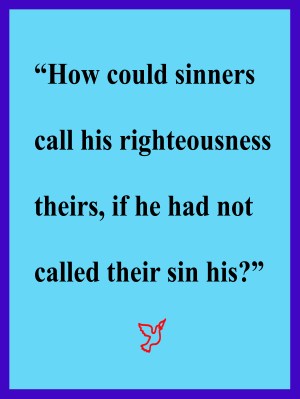
For our sake he made him to be sin who knew no sin, so that in him we might become the righteousness of God. (2Corinthians 5:21 ESV)
Might such a person, who has himself become sin, be able to confess the words of Psalm 51? For the sake of all who might ever believe in him, I say yes (1).
__________
1 Because Scripture calls for a witness of at least two, “Where two or more are gathered in my name…” “…take one or two others along…,” I’d like to bring along with me John Barclay. He writes:
… there is no blasphemy (as many have most blasphemously alleged there is) in this manner of interpretation [Christ as the sole speaker in all of Psalm 51]; which must either be admitted, or the New Testament made void! (Barclay, page 218)
While Barclay in his preface has multitudes of arguments to support his attributing all of Psalm 51 to Christ as speaker, one of his main arguments is the existence of parallel passages: Psalm 51:16-17 is parallel to Psalm 40:6. Psalm 40:6-8 is quoted in Hebrews 10:5-7. There the words are attributed directly to the mouth of Christ, “Therefore, when Christ came into the world, he said…” (Ibid.). Barclays’s logic is mathematical: If A = B and C = B, then A = C. Since the New Testament in Hebrews attributes Psalm 40:6 to Christ as speaker, then a parallel passage in another psalm (Psalm 51:16) must also be attributed to Christ (Barclay, page 47). It also follows that since there is one speaker throughout all of Psalm 51, if one portion is spoken by Christ, then the whole psalm, by the rules of plain English, must also be spoken by Christ (Ibid., page 42-43).
While I agree with this “head” explanation, I also fully agree with Barclay elsewhere, when he states that seeing Christ as our intercessor and mediator in Psalm 51 is mostly a matter of heart. Christ fully and consciously washed our sins away in his own blood. Why would anyone want to maintain that Christ our mediator did not stand in for us and acknowledge our sin as his own? If this were not so, Barclay asks, then how can we have confidence that the righteousness of Christ is ours? In other words, “How could sinners call his righteousness theirs, if he had not called their sin his?” (Ibid., page 71). And if our theology permits Christ to call our sin his, then in honesty, we cannot forbid him from confessing it. Yes, to see Christ as the speaker of Psalm 51 is to see what substitutionary atonement meant for the Lamb of God.
Many blessings upon you all; may this Easter be among the happiest you have ever known.
Penitential Psalms: Psalm 38–Christ’s Passion Speaks Loudly

Link to Psalm 38(37) English Septuagint Translation
Psalm 38 screams at the reader and begs her to ask, “Why is such a self-declared righteous man being punished so extremely by God? What were his self-declared sins against God, that he receives such wrath?” And finally, “Doesn’t it seem odd that someone who knows he is being oppressed by God for his sins would so mightily press upon God in prayerful request for salvation from his enemies?”
Psalm 38 is nowhere quoted in the New Testament, yet it bears a striking resemblance to Psalm 22, which is one of the Old Testament passages most often quoted in the New (1). The Gospel quotations of Psalm 22 make explicit reference to Christ in his Passion, while the author of Hebrews sees Christ as speaker within the context of Psalm 22:22. If readers perceive Christ as speaker in Psalm 22, wouldn’t the same principles of interpretation allow them to perceive Christ as speaker in Psalm 38? The answer is yes.
 Augustine in the 4th century perceived Christ as the speaker of Psalm 22 in its entirety from first to last (3). Making an appeal to consistency, he argues that if Psalm 38:3 is not spoken by Christ, then neither is Psalm 22:1, whose words in verse 1a Christ spoke from the cross, “O God, my God, attend to me: why hast thou forsaken me?” Augustine equates, “The words of mine offences are far from my health,” (Psalm 22:1b, Septuagint) with, “There is no peace to my bones because of my sins,” (Psalm 38:3b, Septuagint). Augustine answers questions 1 and 2 above by his claim that as Christ is the head of the body, when he speaks, he speaks for both himself as head and for the body. The sins he confesses are the sins of the body–i.e., the sins of humankind. God metes out on the cross the just consequences of sin that fell upon Adam when he first sinned in the garden. There God said to Adam, “You shall surely die,” (Genesis 2:16-17).
While many other commentators have many other opinions of who is speaking in Psalm 38, I will jump forward to John Barclay (1795-1826, Scotland), with whom I share a kindred spirit. He writes,
This Psalm also is all spoken in one person, and breathes forth the heaviest pressure and anguish of spirit, supported by the most consummate meekness, patience, and resignation to the will of God: the language is borrowed from the most pungent feelings of one suffering all manner of distress in body, min, character, and estate. That Messiah is the person, is demonstrable from the very face of the whole Psalm, compared with all its parallels cited on the margin with others [Note: The ESV version has many links to Psalm 38 throughout the Old and New Testaments], and read in the light of the four Evangelists: so that nothing more particular needs be said in this place; only the reader may especially consult Psalms vi. xl. lxix. and lxxxviii. with their illustrations (Barclay, pages 186-187).
Robert Hawker (1753-1827) writes upon Psalm 38:1,
And how truly interesting is it to behold Christ with an eye of faith thus praying; and to hear him with the ear of faith thus pleading; when enduring that curse which the law denounced against the sinner, and thus redeeming us from the curse by becoming both sin and a curse for us, that we might be made the righteousness of God in him. Gal. iii. 13. 2 Cor. v. 21. (Hawker, page 284)
And again, concerning verses 2-10:
Let any man read these verses, and then turn to the gospel, and his mind must be led out to remark the striking similarity between what is here said by the spirit of prophecy, and the history of the sorrows and sufferings of Jesus. Reader, turn to some few passages, and then pause over both, in comparing spiritual things with spiritual, and say whether David spake these things of himself, or of some other man? Luke, xxii. 41-44; Mark, xiv. 32-34: (Ibid.)
Concerning verses 11-14:
Who that ever read the prophet’s account of Him, that as a sheep before her shearers was dumb, so he opened not his mouth; or who that ever read the relation of Jesus standing before Pilate, when, amidst all the blasphemy poured upon him, he remained silent, until the unjust judge himself marveled; or who that ever attended to what the apostle hath said of Jesus, that when he was reviled, he reviled not again; who, I say, that ever attended to these things, could hesitate for a moment to behold the Lord Christ in this prophetic description of him? Surely no one that knows any thing of David’s history, will give him credit for this dumbness and insensibility to the reproaches of his enemies. (Ibid.)
For those who may feel uncomfortable attributing the confession of sin to the lips of Christ, Hawker writes this of verse 18:
Let not these words stagger the faith of the believer in considering them as spoken by Christ. As the sinner’s Surety, he was truly made sin for his people, so the scripture declares, yea, also a curse for them. Hence, in the eye of the law, Christ and his seed are one. Gal. iii. 13. 2 Cor. v. 21. (Ibid.)
Samuel Horsley (1733-1806) is bold in proclaiming,
Many parts of the psalm, however, have so striking a reference to the case of our Lord in the days of his flesh, that I cannot but think the whole belongs to him, and that he (the humanity of Christ) is the sick persecuted suppliant. If the sickness may typify generally his humiliation, as I think it may, and the heat which rages in the sick man’s loins, the fiery trial of wrath which he endured in the garden of Gethsemane, when his distress, though principally mental, discovered itself in dreadful symptoms in his body; if this interpretation of the sickness be admitted, there is not a sentence nor a word in the whole of this extraordinary composition which is not applicable to our Lord as man, with more strictness and propriety than to any other person. (Bishop Horsley, page 95, published posthumously in 1815 by the author’s son.)
Again, Andrew A. Bonar (1810-1892) addresses the incongruity of confessed sin by one whom Scripture declares righteous, when he writes:
The difficulty in the way of supposing it used by the Lord Jesus, as descriptive of his feelings and state, when he took on our guilt by imputation, is not at all greater than in some passages of Psalms xl. and lxix., which almost no one doubts to be his utterances. (Bonar, 129)
Finally, the editors of The Orthodox Study Bible (2008) write that Psalm 38 (37 LXX),
“reveals the great love of Christ for mankind in His sufferings and death on the cross, especially v. 18: For I am ready for wounds, and my pain is continually with me. And although He was ‘separate from sinners’ (Heb 7:26) and ‘knew no sin’ (2Co 5:21), yet out of His great compassion for sinners, He prays this prayer in a relative sense as though He were one of them. Thus, He takes the place of sinners as one of them, and intercedes to the Father for their salvation in the midst of His sufferings and death on the cross.”
The fact that I’ve included so few current references to the voice of Christ praying Psalm 38 is a sad reflection on the distance today’s evangelical churches and biblical academicians generally have moved away from the centrality of hearing Christ pray the Psalter. The third question stated in the opening paragraph above is, “Doesn’t it seem odd that someone who knows he is being oppressed by God for his sins wo0uld so mightily press upon God in prayerful request for salvation rom his enemies?” The answer is simple once we identify the speaker as Christ who prays this prayer. We are not at all surprised to hear the substitutionary Lamb of God asking his Father that his enemies not triumph over him.
What about the Penitential Nature of Psalm 38?
Psalm 38 is third in the series of seven traditional penitential psalms (4). The first verses of Psalms 38 and 6 are identical in the Septuagint (Greek). Even though the speaker in Psalm 38 attributes his suffering to his sin, he does not repent in the strict form of asking for forgiveness (5). Bruce Waltke, James Houston, and Erika Moore write:
Psalm 38 is truly a great piece of literature. The psalmist enables his reader to feel his eventual numbness from his unremitting pain by his unrelenting verbal depictions of them. No psalm depicts sickness in such an extended, numbing way. As the psalmist can endure no further suffering, neither can his audience endure further reading about them. (Waltke, page 134)
Psalm 38 is complex, however, because in the center of this prayer to God the psalmist shifts his focus from describing his pain to describing his enemies. The psalmist’s concern over his enemies continues nearly to the end of the poem. While Craig C. Broyles writes that the actions of his enemies, like those of his friends, are a reaction to his sickness (Broyles, 186), verse 20 (LXE) states otherwise, “They that reward evil for good slandered me; because I followed righteousness.” As indicated in the opening paragraph above, the self-proclaimed righteousness and goodness of the psalmist adds further complexity to this “penitential” psalm.
For those who explore the Septuagint, verse 17(18 LXX) provides an eye-catching difference from the Masoretic text within the context of the New Testament narrative:
Mark 15:15: and having scourged Jesus, he delivered him to be crucified. (ESV)
Septuagint (Greek): Because I am ready for scourges, and my pain is ever with me. (NETS, Albert Pietersma, ed.)
Septuagint: For I am ready for plagues (footnote in text: scourges), and my grief is continually before me. (Brenton)
Septuagint: For I am ready for wounds, And my pain is continually with me. (Original translation of St. Athanasius Academy in The Orthodox Study Bible.)
Masoretic (Hebrew): For I am about to stumble, and I am in constant pain. (NET)
Greek for “scourges”: μάστιγας
Definition: μάστιξ, μαστιχος, ἡ, a whip, scourge ) [Hebrew שזט Strong’s 07752] 1 Kings 12:11,14; Prov. 26:3): Acts 22:21; Heb. 11:36; metaphorically, a scourge, plague, i. e. a calamity, misfortune, especially as sent by God to discipline or punish (Ps. 88:33 (Ps. 89:33) (Thayer, Lexicon)
When placed in the context of the entire psalm, verse 17 (18 LXX) adds an important detail to the Passion of Christ.
Summary
Psalm 38 is much more than a “penitential” psalm. In it, we as readers find a strikingly complete first person narrative of the Passion of Jesus Christ. As the surrogate for the human race, Christ confessed the sins of his people, even while maintaining his own righteousness. We see his physical sufferings, his friends and family standing passive and aloof, the attacks of his enemies, and his utter reliance and trust toward God his Father.
As we the readers immerse ourselves in this psalm, we come to experience with the psalmist the great, great love which the triune God bears for his children–us. God is a personal God in an extreme sense of that word. He himself, by becoming one of us and dying a sacrificial death on the cross for us, bears the full weight of the burden each one of us owns. “See what sort of love the Father has given to us: that we should be called God’s children– and indeed we are!” (1John 3:1 NET)
A Personal Plea
If anyone who is reading this has not in your whole life turned to God and said something like, “Hi. Here I am, and this is who I am. Would you be my friend?” then I ask you, won’t you stop reading and thinking right now, turn to God, introduce yourself to him, and ask him for his presence with you? He’ll do all the rest. Jesus Christ will be the best friend you will ever have in your whole life.
__________
1 Psalm 32:1-2 is quoted in Romans 4:7-8, Psalm 22:1 is quoted Matthew 27:46 and Mark 15:34; Psalm 22:18 in John 19:24, Matthew 27:35, Mark 15:24, and Luke 23:24; and Psalm 22:22 in Hebrews 2:12.
2 Compare Psalm 32:3 (LXE) and Psalm 38:13-14 (LXE); Psalm 32:4 (LXE): “For day and night thy hand was heavy upon me: I became thoroughly miserable while a thorn was fastened in me. Pause.” and Psalm 38:2 (LXE): “For thy weapons are fixed in me, and thou hast pressed thy hand heavily upon me.” In this verse the verbs “fastened” and “fixed” are translations of the same Greek word, ἐμπήγνυμι–to stick in.
3 Augustine, Expositions of the Psalms, page 191.
4 The seven penitential psalms are: 6, 32, 38, 51, 102, 130, and 143.
5 Waltke, Houston, and Moore, The Psalms as Christian Lament: A Historical Commentary, page 133.
Penitential Psalms: Psalm 32–Grace

There is one thing about Psalm 32 (31 LXX) upon which everyone agrees: it is a psalm about grace. The Apostle Paul quotes Psalm 32:1-2 in Romans 4:7-8.
1 Blessed are they whose transgressions are forgiven, and who sins are covered.
2 Blessed is the man to whom the Lord will not impute sin, and in whose mouth there is no guile. (Psalm 32:1-2 LXE, Septuagint in English, Brenton)7 “Blessed are those whose lawless deeds are forgiven, and whose sins are covered;
8 blessed is the man against whom the Lord will not count his sin.” (Rom 4:7-8 ESV)
Paul in Romans pronounces grace–pardon for sin apart from works. He uses the example of Abraham, who received God’s blessing of righteousness on the basis of his faith. Paul extends the promise which God gave Abraham to all believers who follow his example of placing their faith in God. For Paul, placing one’s faith in God means placing faith in the God who raised the Lord Jesus from the dead.
22 That is why his faith was “counted to him as righteousness.”
23 But the words “it was counted to him” were not written for his sake alone,
24 but for ours also. It will be counted to us who believe in him who raised from the dead Jesus our Lord,
25 who was delivered up for our trespasses and raised for our justification. (Rom 4:22-25 ESV)
Paul argues in all of Romans 4 that God extends the grace of righteousness to Gentile believers on account of their faith in his Son, rather than on account of their racial birth. And who cannot hear the roar of joy surging like a great wave that encompasses all people around our globe? Besides being penitential, Psalm 32 is well known as a psalm of thanksgiving. The Greek Orthodox Church reads this psalm to new believers as they emerge from the waters of baptism. (See The Orthodox Study Bible.)
Let’s take a look at Psalm 32 (31 LXX).
LXE Psalm 32:1 <<A Psalm of instruction by David.>> Blessed are they whose transgressions are forgiven, and whose sins are covered.
2 Blessed is the man to whom the Lord will not impute sin, and in whose mouth there is no guile.
3 Because I kept silence, my bones waxed old, from my crying all the day.
4 For day and night thy hand was heavy upon me: I became thoroughly miserable while a thorn was fastened in me. Pause.
5 I acknowledged my sin, and hid not mine iniquity: I said, I will confess mine iniquity to the Lord against myself; and thou forgavest the ungodliness of my heart. Pause.
6 Therefore shall every holy one pray to thee in a fit time: only in the deluge of many waters they shall not come nigh to him.
7 Thou art my refuge from the affliction that encompasses me; my joy, to deliver me from them that have compassed me. Pause.
8 I will instruct thee and guide thee in this way wherein thou shalt go: I will fix mine eyes upon thee.
9 Be ye not as horse and mule, which have no understanding; [but thou] must constrain their jaws with bit and curb, lest they should come nigh to thee.
10 Many are the scourges of the sinner: but him that hopes in the Lord mercy shall compass about.
11 Be glad in the Lord, and exult, ye righteous: and glory, all ye that are upright in heart. (Psa 32:1-11 LXE)
A second point of agreement concerning Psalm 32 among commentators is its use of dialogue. After multiple readings, many readers will be able to recognize that more than one person speaks within its lines. Changes of tone, subject, and shifts between singular and plural help delineate the various speech boundaries within the psalm.
Identifying speakers in a psalm can be tricky. The reader must be alert, noticing large and small cues. She must draw upon her knowledge of God and his ways, based upon her reading of all of Scripture. Not surprisingly, while nearly everyone recognizes dialogue and change of speakers in Psalm 32 (31 LXX), there is not consensus concerning who speaks which lines.
Here is how I break it out:
Psalm 32 (31 LXE): A Readers Theater Interpretation
Chorus of the Congregation: … 1 Blessed are they whose transgressions are forgiven, and whose sins are covered.
2 Blessed is the man to whom the Lord will not impute sin, and in whose mouth there is no guile.
Christ to God: 3 Because I kept silence, my bones waxed old, from my crying all the day.
4 For day and night thy hand was heavy upon me: I became thoroughly miserable while a thorn was fastened in me. Pause.
5 I acknowledged my sin, and hid not mine iniquity: I said, I will confess mine iniquity to the Lord against myself; and thou forgavest the ungodliness of my heart. Pause.
Chorus of the Congregation: 6 Therefore shall every holy one pray to thee in a fit time: only in the deluge of many waters they shall not come nigh to him.
Christ to God: 7 Thou art my refuge from the affliction that encompasses me; my joy, to deliver me from them that have compassed me. Pause.
God to his Christ: 8 I will instruct thee [singular in LXX] and guide thee [singular in LXX] in this way wherein thou [singular in LXX] shalt go: I will fix mine eyes upon thee [singular in LXX].
God to the Congregation: 9 Be ye [plural] not as horse and mule, which have no understanding; but thou [added by translator] must constrain their jaws with bit and curb, lest they should come nigh to thee [singular].
[My Interpretation: Be ye [plural] not as horse and mule, which have no understanding. It is necessary to constrain their jaws with bit and curb, or they won’t come near you [singular impersonal required by context of a single person managing the horse.]
Chorus of the Congregation: 10 Many are the scourges of the sinner: but him that hopes in the Lord mercy shall compass about.
11 Be glad in the Lord, and exult, ye righteous: and glory, all ye that are upright in heart.
What makes Psalm 32 a psalm about the substitutionary atonement of Christ?
The key is found in verse 6, “Therefore shall every holy one pray to thee in a fit time…” What is the logic behind this statement, specifically the conclusion, introduced by the word “therefore,” that “every holy one” should pray to God while he may be found? What warrant is there to jump from the example of one sinner (verses 3-5) to an entire group? And what is the warrant to move from the example of a sinner to “every holy one?”
The latter difficulty can be explained by the NET translation. Where the Septuagint uses “every holy one,” (πᾶς ὅσιος), NET translates the Masoretic text as “faithful follower.” I believe that within the context of the Psalter this is a fair translation. Verse six states that “holy ones,” or “faithful followers,” i.e., those who have been forgiven (vs 1), should now call upon the Lord for protection whenever trouble comes upon them as a flood.
But why? Why does the text say, “therefore”? I see two possibilities. In the first, the logic of the psalm may be stating that because one sinner has been forgiven, God will likewise forgive all sinners. A second possibility states that because God has forgiven this particular sinner, therefore, all believing sinners (faithful followers now made holy) will be forgiven and have access to the help of God through prayer.
The answer to the question of which possibility is the correct one depends upon the identity of the speaker of verses 3-5, who also speaks in 7. This speaker would likewise be the singular “man,” a singular male in the Septuagint, referred to in verse 2. Verse 1 is plural; verse 2 is singular. Verse 6 encapsulates these two verses. The many are blessed because of God’s forgiveness to the one. “Therefore…” But who is this one?
First, “Blessed is the man …” of verse two is identical to the opening words of the Psalter in Psalm 1:1 (μακάριος ἀνήρ). The singular male of Psalm 1:1 is considered by this author and by many others to be Christ. Pilate said of him, “Behold, the man…” In that case, Pilate says, “Behold the human being.” Christ was crucified as the head of the human race. (See the prior post, “Penitential Psalms: 32–How Could Christ Pray the Words of a Sinner?”) In the Psalter, however, Christ is not a generic human being, as some translations would have it. He is a particular male, a single person, a real flesh and blood man who prays to God. Psalm 32:1-2 in the Septuagint distinguishes between the many (32:1) and the one male (32:2). This one male is the speaker of verses 3-5, which are closed off with a break, Selah. Verse 6 is the result (“therefore”) of verses 3-5.
Second, verses 3-4 in the Septuagint have some most remarkable words, which if taken literally, provide clues to the identity of the speaker.
3 Because I kept silence, my bones waxed old, from my crying all the day.
4 For day and night thy hand was heavy upon me: I became thoroughly miserable while a thorn was fastened in me. Pause.
Others have pointed out the similarity of these words to those of Psalm 38, which is a veritable portrait of Christ’s crucifixion. The Greek verb (LXX) for “fastened,” Psalm 32:4, “a thorn was fastened in me,” is identical to the Greek verb (LXX) for “fixed” in Psalm 38:2, “For thy weapons are fixed in me, and thou hast pressed thy hand heavily upon me.” Further, Psalm 32:3 states, “Because I kept silence,…” All four gospels make a point of the silence of Christ during his trial.
Once we know that Christ is the speaker of the personal prayer portion of Psalm 32 in verses 3-5 and 7, then the rest of the psalm begins to fall into place. For example, we know that verse 9 cannot be God addressing the speaker of the prayer, because God would never address his Son that way. Verse 8, on the other hand, beautifully illustrates God’s love for his Son.
What turns this psalm from penitential to joyful thanksgiving is the presence of the chorus, made up of believers. Because one man died confessing the sins of others, because God did not impute, or count that sin against him as an individual, then all those for whom Christ died now have free access to God through him. We know that God did not impute sin against Christ (or count it against him, reckon it against him), because God raised him from the dead. If Christ had been guilty, he would have merited his punishment and remained dead. But Christ himself was righteous. We know from his resurrection that God was pleased with him. Because of Christ’s victory, believers are blessed to have their transgressions forgiven, their sins covered. God’s mercy is a cause for thankfulness and rejoicing, which is what the congregation does in the final verse. The psalm opens and closes with God’s mercy for the sinner in view.
Conclusion
Craig C. Broyles writes that Psalm 32 “forms a combination of features unlike any other psalm,” (Broyles, 161). I don’t know about you who are reading this blog, but often, when I first read a psalm, I am left flat, almost without response. I think to myself, “I have nothing to say about this psalm.” But God has blessed me with persistence. God rewarded Jacob with a new name after he wrestled with him all night. Reading the Psalter is often like this biblical story. Many times it is only after wrestling with a psalm, seeking to understand, asking God, delving into the details, reading again and again, that I come to a deeper appreciation of the wisdom of God in how he connects Scripture with Scripture. It is true that these are ancient words and that we as today’s readers must seek to translate them into our own experience. But the treasure of meeting with God through the words of a psalm is so worth the effort. I pray that you will be encouraged to do some digging of your own.
Penitential Psalms: Psalm 32–How Could Christ Pray the Words of a Sinner?

Distant Shores Media/ Sweet Publishing
All our Christian lives, we are told that Christ died for our sins and that he himself knew no sin. We know that his own disciples did not spot references to his crucifixion and resurrection in their own Scripture (Luke 24). Nearly every Easter we hear Psalm 22, “My God, my God, why have you forsaken me?” And yet, when we read the words of confession in Psalm 32:5: I acknowledged my sin to you, and I did not cover my iniquity; I said, “I will confess my transgressions to the LORD,” and you forgave the iniquity of my sin (ESV), we balk at applying these words to the innocent Christ, and we become uncomfortable.
During the time I have studied the Psalter, more and more I become aware that the incarnated Christ is indeed human, a person, a man. The Psalter presents Christ’s humanity in a way that is “down to earth” relatable. Our shared human perceptions of experience were his shared human perceptions also. What hurts us hurt him.
Hebrews 12:2 teaches the shame of the cross–if I were hanging on a cross, I would find it extraordinarily shameful. I can relate to that. Galatians 3:13 tells us that Christ became a curse for us. Deuteronomy 21:23 explains that everyone hung to death upon a tree is cursed of God and a source of defilement for the land. Paul tells us that Christ has been sacrificed as our Passover lamb (1 Corinthians 5:7). John says, “He [Christ] is the propitiation for our sins, and not for ours only but also for the sins of the whole world,” (1 John 2:2 ESV). For “propitiation” in the Old Testament to happen, a lamb was slain and its blood sprinkled on the ark’s mercy seat, so that God’s anger against sinful believers would end. We also read about the scapegoat, upon which the priest would symbolically place “all the iniquities of the people of Israel, and all their transgressions, all their sins,” and “send him … into the wilderness” (Leviticus 16:21 ESV). Christ was also our scapegoat. Isaiah writes, “Surely he has borne our griefs and carried our sorrows; yet we esteemed him stricken, smitten by God, and afflicted,” (Isaiah 53:4 ESV).
Scripture shows us holy people of God who interceded in prayer as though they themselves were the sinful ones. Daniel prayed, “While I was speaking and praying, confessing my sin and the sin of my people Israel, … ” (Daniel 9:20 ESV). The godly Nehemiah prayed, ” … I now pray before you day and night for the people of Israel your servants, confessing the sins of the people of Israel, which we have sinned against you. Even I and my father’s house have sinned,” (Nehemiah 1:6 ESV). Paul in the New Testament wrote strongly, “For I could wish that I myself were accursed and cut off from Christ for the sake of my brothers, my kinsmen according to the flesh,” (Romans 9:3 ESV). So I ask, where in Scripture, if not in the first person voice of the psalmist, would God teach us how thoroughly Christ identified with and became humanity to the point of interceding for us as though one of our very own? 
I believe we should receive Christ’s penitent prayer as our representative in Psalm 32 for the same reason that John the Baptist allowed himself to be persuaded to baptize Jesus, because “it is right for us to fulfill all righteousness,” (Matthew 3:14 NET). I believe many have difficulty receiving Christ’s words of confession in Psalm 32 because of the difficulty we all experience in realizing just how very much one of us Christ became. Adam’s sin brought all his progeny into death and separation from God. One person, Adam, represented everyone. In the same way, Christ represents everyone (1 Corinthians 15:21-22). As our representative, Jesus personally confessed and was punished for each one of us.
As we meditate on these things, may the Holy Spirit open to our hearts this greatest of all loves with which our Creator Father loves us. May the words of John 3:16 take on a deeper texture of meaning as we consider the shame of the holy Son of God confessing our sin as though it were his own. And yet, “he endured the cross, despising the shame,” (Hebrews 12:2) because “… he who makes holy and those being made holy all have the same origin,” (Hebrews 2:11 NET). Jesus is not ashamed to call us brothers and sisters. I can only say, “Hallelujia! Thank you, Lord.” And that is just what the psalmist goes on to say in Psalm 32. We will look at that next time.
 One Small Voice