Home » Posts tagged 'Gospel of John' (Page 2)
Tag Archives: Gospel of John


Culture Wars–Jesus vs the Pharisees
Week 9 John 9 Focus–A Blindness Jesus Could Not Heal
(Link to Outline of John)
John’s Theme: John 20:31 … these are written so that you may believe that Jesus is the Christ, the Son of God, and that by believing you may have life in his name.

John 9:1 As He passed by, He saw a man blind from birth. 2 And His disciples asked Him, “Rabbi, who sinned, this man or his parents, that he would be born blind?”
The prevailing assumption in Jesus’ day was that physical ailments were a direct result of sin.
- Jesus’ own disciples (read: the good guys) thought that.
- The Pharisees (read: the bad guys) thought that: “You were born entirely in sins, and are you teaching us?”–vs 34.
The difficulty the disciples were having was trying to understand how a baby in the womb could sin sufficiently in order to be born blind. That is why they thought that perhaps it was the parents’ sin the child suffered for–therefore, their question to Christ–“Rabbi, who sinned, this man or his parents, that he would be born blind?”
There was some Old Testament evidence perhaps partly responsible for the strong assumption that physical afflictions (“defects, hardships, suffering, accidents, sickness, death”) were the direct result of sin. (Hendriksen, Vol. 2, 72)
1. Adam’s sin
Genesis 3:17 And to Adam he said, “Because you have listened to the voice of your wife and have eaten of the tree of which I commanded you, ‘You shall not eat of it,’ cursed is the ground because of you; in pain you shall eat of it all the days of your life; 18 thorns and thistles it shall bring forth for you; and you shall eat the plants of the field. 19 By the sweat of your face you shall eat bread, till you return to the ground, for out of it you were taken; for you are dust, and to dust you shall return.”
Romans 5:12 Therefore, just as sin came into the world through one man, and death through sin, and so death spread to all men because all sinned–
2. Sins of Parents
Exodus 20:5 You shall not bow down to them or serve them, for I the LORD your God am a jealous God, visiting the iniquity of the fathers on the children to the third and the fourth generation of those who hate me,
Jeremiah 31:29 In those days they shall no longer say: “‘The fathers have eaten sour grapes, and the children’s teeth are set on edge.’
3. A Person’s Own Sins
Deuteronomy 28:15 “But if you will not obey the voice of the LORD your God or be careful to do all his commandments and his statutes that I command you today, then all these curses shall come upon you and overtake you. (See also vss 16-68)
Jeremiah 31:30 But everyone shall die for his own sin. Each man who eats sour grapes, his teeth shall be set on edge.
Jesus himself did not think this way.
John 9:3 Jesus answered, “It was not that this man sinned, or his parents, but that the works of God might be displayed in him.
Luke 13:2 And he answered them, “Do you think that these Galileans were worse sinners than all the other Galileans, because they suffered in this way? 3 No, I tell you; but unless you repent, you will all likewise perish. 4 Or those eighteen on whom the tower in Siloam fell and killed them: do you think that they were worse offenders than all the others who lived in Jerusalem? 5 No, I tell you; but unless you repent, you will all likewise perish.”
Jesus said, “We must work the works of him who sent me while it is day; night is coming, when no one can work. 5 As long as I am in the world, I am the light of the world.” (John 9:4-5)
How Do We Respond When Someone Crosses Our Path? (Think: Trump and his followers vs Clinton and her followers–Do these two groups in the end both behave very much like the Pharisees in this account?)
Possible Behaviors
1. We can attempt to malign and annihilate the one who is different–the one who arouses our envy or fear.
2. We can examine them intellectually and endlessly–never offering a hand to help.
3. We can love and help them, interacting with them, giving of ourselves to them.
Jesus Is About to Perform His Sixth Sign
- The text will show that Jesus fell into category 3 above–loving, helping, interacting, giving of himself–towards BOTH the man born blind and the Pharisees. The Pharisees fell into categories 1 and 2 above.

Prejudice Blinds
Who was blind in the passage covering all of John 9?
- the man born blind (physical blindness)
- the Pharisees (spiritual blindness)
Jesus loved them both
- he healed the physical blindness of the one (John 9:6-7)
- he performed spiritual follow-up for this outcast (John 9:34-38)
- as ambassador for Christ, the healed man tried his best to open the eyes of the Pharisees (John 9:8-34)
- Jesus pointed out the error of the Pharisees (John 9:39-41)
The Pharisees’ Blindness
The Pharisees were certain that Jesus was a sinner, because Jesus was so unlike themselves.
John 9:22 (His parents said these things because they feared the Jews, for the Jews had already agreed that if anyone should confess Jesus to be Christ, he was to be put out of the synagogue.)
1. They could not accept Jesus’ parentage, as it was so different from what they expected.
John 7:27 But we know where this man comes from, [Mary and Joseph in Nazareth] and when the Christ appears, no one will know where he comes from.”
John 9:29 We know that God has spoken to Moses, but as for this man, we do not know where he comes from.” [God sent Moses; we do not believe that God sent “this man”]
2. Jesus had not gone through the normal channels of being educated among themselves, within the “establishment”–he was an outsider.
John 7:15 The Jews therefore marveled, saying, “How is it that this man has learning, when he has never studied?”
Matthew 13:54 and coming to his hometown he taught them in their synagogue, so that they were astonished, and said, “Where did this man get this wisdom and these mighty works? 55 Is not this the carpenter’s son? Is not his mother called Mary? And are not his brothers James and Joseph and Simon and Judas? 56 And are not all his sisters with us? Where then did this man get all these things?” 57 And they took offense at him. But Jesus said to them, “A prophet is not without honor except in his hometown and in his own household.”
3. Jesus continually broke one of their most important customs–the keeping of the Sabbath according to their own traditions.
John 5:9 And at once the man was healed, and he took up his bed and walked. Now that day was the Sabbath. 10 So the Jews said to the man who had been healed, “It is the Sabbath, and it is not lawful for you to take up your bed.”
John 5:16 And this was why the Jews were persecuting Jesus, because he was doing these things on the Sabbath.
John 5:18 This was why the Jews were seeking all the more to kill him, because not only was he breaking the Sabbath, but he was even calling God his own Father, making himself equal with God.
John 7:23 If on the Sabbath a man receives circumcision, so that the law of Moses may not be broken, are you angry with me because on the Sabbath I made a man’s whole body well?
4. Jesus hung out with those the Pharisees regarded as sinners.
NET John 7:48 None of the rulers or the Pharisees have believed in him, have they? 49 But this rabble who do not know the law are accursed!”
The Pharisees’ Prejudice Prevents Them from Considering as Valid the Amazing Miracle Christ Accomplished
1. The Pharisees’ beginning assumption is that Jesus is a sinner, because he healed on the Sabbath (see prior section).
ESV John 9:13 They brought to the Pharisees the man who had formerly been blind. 14 Now it was a Sabbath day when Jesus made the mud and opened his eyes.
2. They therefore steadfastly refuse to believe that he could perform a miracle as amazing as giving sight to a man born blind.
3. They cross examine the man, his parents, and the man again, trying to demonstrate that this miracle had not in fact occurred.
• the man
John 9:15 So the Pharisees again asked him how he had received his sight. And he said to them, “He put mud on my eyes, and I washed, and I see.” 16 Some of the Pharisees said, “This man is not from God, for he does not keep the Sabbath.” But others said, “How can a man who is a sinner do such signs?” And there was a division among them. 17 So they said again to the blind man, “What do you say about him, since he has opened your eyes?” He said, “He is a prophet.” 18 The Jews did not believe that he had been blind and had received his sight, until they called the parents of the man who had received his sight.
• the man’s parents
John 9:19 and asked them, “Is this your son, who you say was born blind? How then does he now see?” 20 His parents answered, “We know that this is our son and that he was born blind. 21 But how he now sees we do not know, nor do we know who opened his eyes. Ask him; he is of age. He will speak for himself.” 22 (His parents said these things because they feared the Jews, for the Jews had already agreed that if anyone should confess Jesus to be Christ, he was to be put out of the synagogue.) 23 Therefore his parents said, “He is of age; ask him.”
• the man again
John 9:24 So for the second time they called the man who had been blind and said to him, “Give glory to God. We know that this man is a sinner.”
25 He answered, “Whether he is a sinner I do not know. One thing I do know, that though I was blind, now I see.”
26 They said to him, “What did he do to you? How did he open your eyes?”
27 He answered them, “I have told you already, and you would not listen. Why do you want to hear it again? Do you also want to become his disciples?”
28 And they reviled him, saying, “You are his disciple, but we are disciples of Moses. 29 We know that God has spoken to Moses, but as for this man, we do not know where he comes from.”
30 The man answered, “Why, this is an amazing thing! You do not know where he comes from, and yet he opened my eyes. 31 We know that God does not listen to sinners, but if anyone is a worshiper of God and does his will, God listens to him. 32 Never since the world began has it been heard that anyone opened the eyes of a man born blind. 33 If this man were not from God, he could do nothing.” b
34 They answered him, “You were born in utter sin, and would you teach us?” And they cast him out.
4. Unable to disprove that the miracle had really occurred, they attack the man from their prejudice — “You were born in utter sin” — and cast him out, most likely with complete excommunication.
5. Being so completely stubborn in their prejudices, the Pharisees refuse to even acknowledge the possibility that a man might be from God who performed a miracle so great that no one had ever laid claim to it before in the whole history of the human race. Only someone connected with the power of God could have performed such a mighty miracle. They choose to allow the fact of the miracle to remain as evidence sitting abandoned right in front of them–rather than choosing to abandon for even a second their prejudice against the one who had performed the miracle.
6. Nor do they consider the possibility that their own Sabbath traditions may be at fault, since objectively God had indeed appeared to work an astounding miracle through a man, Jesus, even on the Sabbath day.
7. There was this spiritual blindness in them that even the light of Christ himself was not able to penetrate. It was the blindness of sheer, willful, stubborn, angry pride that led this group of holier-than-thou religious people to crucify the Lord of glory in the end.
John 6:44 No one can come to me unless the Father who sent me draws him. And I will raise him up on the last day.
John 6:65 And he said, “This is why I told you that no one can come to me unless it is granted him by the Father.”
Application Questions: How Could the Pharisees Have Gotten It So Wrong?
1. If a godly miracle occurs in a way that contradicts my own “holy rules,” what should be my response?
For example, many living Christians in the world give firsthand testimony of amazing miracles that they have either witnessed or that have occurred to them, yet other Christians condemn these folk as deluded, or even stronger, as emissaries of Satan. If I myself have never witnessed or experienced an amazing miracle, how might I respond to the testimony of others in a way that would save me from the condemnation of judgment Jesus himself pours out upon the religious leaders in this account?
John 9:39 Jesus said, “For judgment I came into this world, that those who do not see may see, and those who see may become blind.” 40 Some of the Pharisees near him heard these things, and said to him, “Are we also blind?” 41 Jesus said to them, “If you were blind, you would have no guilt; but now that you say, ‘We see,’ your guilt remains.
2. The religious leaders of Jesus’ day failed to recognize the arrival of the Son of God, mostly because he did not match up with their prior expectations of what their Messiah should look like. Their prejudices blinded their judgment.
In those days, the expectations of Messiah were mixed–the entire religious culture was composed of many strands which emphasized different aspects of Scripture or religion. There was no uniformity across the various factions of 1st century Jewish culture of that day. There was no single, clear picture of what or who Messiah would be when he came. Nevertheless, it appears that the religious leaders expected a messiah who would bring back the glories of King David–the military victories and the independence from foreign rulers that King David had achieved. Jesus severely disappointed these expectations, so much so that these same religious leaders asked the Roman government (represented by Pilot) to crucify him.
Is our Christian religious culture making similar errors today?
For example, one issue that divides is the expected Second Coming of Christ. What are some of the different views concerning how this will happen?
Given the account in John 9, how certain should a Christian be that their own viewpoint is correct?
Based upon the occurrences in John 9, as a Christian, do I allow my own views to sway me too heavily in my attitudes and responses towards those who hold a different view?
Do I allow my own views to influence my political expectations of those who are not even of the Christian faith?
3. The formerly blind man’s parents were so afraid of the leaders’ power to expel them from the synagogue that they failed to really rejoice and glorify God over the miraculous and amazing gift of vision for their son.
What are the metaphorical “synagogues” in my life from which I fear expulsion if I testify too strongly of Christ? (social groups? peer groups? family groups? work groups?)
Who are the metaphorical Pharisees before whom I hide my testimony of Christ in fear?
How real/deep/genuine is my faith if I let these fears dominate me?
4. Are there “religerati” in my life of whom I am afraid? (Are there factions or people in the church I attend whom I allow to dominate the expression of my beliefs in my own church?)
5. The Pharisees approached this amazing miracle of Jesus with a ferocious and predetermined bias against him that affected their judgment in every way.
What are my predetermined biases and against whom are they aimed?
6. With which character(s) in this story do I mostly identify?
7. Why does this blog’s author think that the scriptural account in John 9 has anything at all to do with the most recent presidential election?
In this presidential election of 2016, is it likely that either of the two sides is completely, or even mostly, correct?
What aspects of the “other group’s” lives, fears, hurts, and needs am I failing to see in an understanding way?
What really makes them tick?
What exactly were they voting for, rather than against?
What about them am I missing?
Where are my blind spots?
Where are my prejudices?
Can I pray and ask God to help me clear away my blind prejudices in order to create solutions to problems that that will allow pathways that don’t transgress the differences as much as the currently proposed pathways do? (In other words, can God help me create pathways of peace to accomplish my goals, pathways that walk around the other’s sore spots rather than tromping right through them?)
Am I the Pharisee in this story, completely loveless and blind to the needs of the life that Jesus came to save–that is, am I loveless and blind to the needs of the blind man for whom Jesus gave his life?
Am I one of the Pharisees, blind to my own blindness towards others?
Hey! What’s Your Problem?
Reader Challenge: As you read through this portion of Scripture, John chapters 7 and 8 (see link just below), try to answer the question found in the title of this blog–What is the problem that the enemies of Jesus have that prevents them from seeing Christ for who he actually is?
Week 8 Part 2 John 7:1-8:59 Focus–Jesus Confronts His Enemies
(Link to Outline of John)
John’s Theme: John 20:31 … these are written so that you may believe that Jesus is the Christ, the Son of God, and that by believing you may have life in his name.
Summary of Chapter 7 (based upon Hendriksen, Vol. 2, 30-31)
The Galilean Ministry has ended. Jesus has retired to the northern regions of the country. After six months, he returns again to Judea for the Later Judean Ministry and the feast of Tabernacles.
1. John 7:1-13 His blood brothers, not yet believers, (see Acts 1:14 for their later belief) attempt sarcastically to entice him to go to the feast with them. Jesus refuses, but later goes up “not publicly, but in secret” (vs 10). In the meantime, at the feast, the “Jews” are murmuring about where “that man” might be, while the crowds call him a “good man” They are all afraid to say anything openly, for fear of the religerati©.
2. John 7:14 Halfway through the feast, Jesus goes up to the temple and begins to teach. He causes a stir.
ESV John 7:37 On the last day of the feast, the great day, Jesus stood up and cried out, “If anyone thirsts, let him come to me and drink. 38 Whoever believes in me, as the Scripture has said, ‘Out of his heart will flow rivers of living water.'”
3. John 7:15-52 The people react.
a. The “Jews” are generally skeptical and oppositional (15, 20, 35-36).
b. The crowd is divided–some derisive and some more or less open (vss 12, 20, 25-27, 31, 40-44).
c. The Pharisees sent guards to arrest him (32, 45-52).
d. The guards sent to arrest him are dumfounded with awe-filled amazement at the manner in which Jesus spoke while teaching (32, 45-46).
e. Nicodemus, one of the Pharisees who had personally gone to inquire of Jesus (John 3:1-12), speaks up in defense of the law, a fairly safe and noncommittal way to defend Jesus himself (50, 51).
Summary of Chapter 8 (based on Hendriksen, Vol. 2, 68-69)
1. John 7:53-8:11 Discussion among experts is inconclusively split concerning whether or not this section should be included in Scripture.
This is the highly popular and famous scene in which Jesus loves unto salvation a woman caught “in the act of adultery.” The great contrast is between the non-judgmental (yet highly aware) love of Jesus versus the callous condemnation and deceitfulness of the “teachers of the laws and the Pharisees.”
2. John 8:12-59 The confrontation between Jesus and the religerati© continues (see Hendriksen, Vol. 2, 68-69).
Scene: the temple courts the following day (1-2)

Jesus: [Theme 1–the light] “I am the light of the world. He who follows Me shall not walk in darkness, but have the light of life.” (12) [JESUS’ SECOND GREAT “I AM” IN JOHN] (Light of the World: 1:4,5,7,8-9; 3:19, 20, 21; 8:12; 9:5; 11:9, 10; 12:35, 36; 12:46)
Pharisees: “You bear witness of Yourself; Your witness is not true.” (13)
Jesus: [Theme 2–Sent by God] The [my] Father sent me (7:28; 8:14b, 15, 16, 17, 18, 26, 49-50; 5:31, 5:38)
Pharisees: They don’t get it–they remain literalistic and concrete; their scope is narrowly focused on the physical, carnal world only.
• “Where is your father?” (8:19) [slanderous insinuation]
• “You, who are you?” (8:25) [scornful disdain]
• “They did not recognize that he spoke to them of the Father.” (8:27) [ignorance born of prejudice]
The Crowd of Religious People: “While he was saying these things, many believed in him.” (8:30) [mental agreement only, quickly changing to disdain–8:31, 33, 39, 41, 44, 48, 52, 53, 57, 59] [see also The Parable of the Sower, especially vss 5-6 and 20-21]
Jesus: [Theme 3–The Son of Man to be lifted up] “When you will have lifted up the Son of man, then you will know that I am he.” (3:14-16; 8:28; 12:32-33) [Also, Theme 6–I AM]
Jesus: [Theme 4–Truth] “If you remain [abide] in my word, you are truly my disciples, and you will know the truth, and the truth will set you free.” (8:31-32; 1:9, 14, 17; 3:21, 33; 4:18, 23, 24, 37; 5:31, 32, 33, 45; 6:32; 7:18, 28; 8:13, 14, 16, 17, 26, 32, 40, 44, 45, 46)
The [Supposedly] Believing Crowd of Religious People: “We are Abraham’s descendants, and have never been in bondage to anyone. How can you say, ‘You will be made free’?” (8:33)
Jesus: [Theme 5–My Father, your father] “I speak what I have seen with My Father, and you do what you have seen with your father.” (8:38) “If you are Abraham’s children, you are doing the works of Abraham. But now you are seeking to kill, me, a man who has been telling you the truth which I heard from God. This Abraham did not do. You are doing the works of your father.” (8:39-40)
The [by now] Non-believing Crowd of Religious People: “Abraham is our father.” (8:39) “We were not born of sexual immorality. We have one Father–even God.” (8:41)
Jesus: [Theme 5–My Father God, your father the devil] “If God were your Father, you would love me, for I came from God and I am here. I came not of my own accord, but he sent me (8:42) [Also Theme 2–Sent by God]. Why do you not understand what I say? It is because you cannot bear to hear my word. You are of your father the devil, and your will is to do your father’s desires. He was a murderer from the beginning, and has nothing to do with the truth, because there is no truth in him. When he lies, he speaks out of his own character, for he is a liar and the father of lies.” (8:44) “Whoever is of God hears the words of God. The reason why you do not hear them is that you are not of God.” (8:47)
The [now] Hostile Crowd of Religious People: “Are you greater than our father Abraham, who died? And the prophets died! Who do you make yourself out to be?” (8:53)
Jesus: [Theme 2–Sent by God] “If I glorify myself, my glory is nothing. It is my Father who glorifies me, of whom you say, ‘He is our God.’ 55 But you have not known him. I know him. If I were to say that I do not know him, I would be a liar like you, but I do know him and I keep his word.” (8:54-55)
Jesus: [Theme 5–My Father, your father] “Your father Abraham [according to the flesh] rejoiced that he would see my day. He saw it and was glad.” (8:56)
The Hostile Crowd of Religious People: “You are not yet fifty years old, and have you seen Abraham?” (8:57)
Jesus: [Theme 6–I AM] “Truly, truly, I say to you, before Abraham was, I am.” (8:58)
The Hostile Crowd of Religious People: [Theme 7–Jesus’ Enemies want to kill him] So they picked up stones to throw at him, but Jesus hid himself and went out of the temple. (8:59; 5:18; 7:1, 19, 20, 25; 8:37, 40)
So how did we do in the Reader Challenge? (see top of post)
Hint: What is the one thing that Jesus had that none of his enemies had? L-O-V-E.
1. See Jesus’ many miracles:
• water to wine demonstrates compassion for a groom, his bride, and the parents (2:1-11)
• healing the nobleman’s son demonstrates love for a social class not his own (4:46-54)
• healing the paralyzed man demonstrates Jesus’ love for the outwardly weak and defeated, the unattractive and unlovely (5:1-9)
• healing the paralyzed man on a Sabbath demonstrates Jesus’ (and God’s) love for people above an overly zealous and ungodly love for human religious tradition
• feeding the 5,000 people demonstrates love for people’s physical needs 6:1-15
2. Jesus’ actions demonstrate love:
• cleansing the temple demonstrates love for God and for God’s house of prayer (2:13-22)
• Jesus’ conversation with Nicodemus demonstrates love for potentially hostile people (3:1-21)
• Jesus’ conversation with the Samaritan woman at the well and his long visit in her village demonstrates his love for ethnic and religious classes not his own (Jesus was Jewish by human birth) (4:4-43)
• Jesus’ long discourses with his enemies in chapters 6, 7, and 8 demonstrate his love for those who hate them
• These same discourses demonstrate Jesus’ love for God in his willingness that none should go without hearing the gospel of salvation, even those whom he knows will use this gospel against him in order to kill him
3. Lack of love prevented Jesus’ enemies for recognizing that Jesus was a good man.
Yet, even without LOVE, two other attributes would have worked to help these blind enemies of Christ: KNOWLEDGE and OBEDIENCE
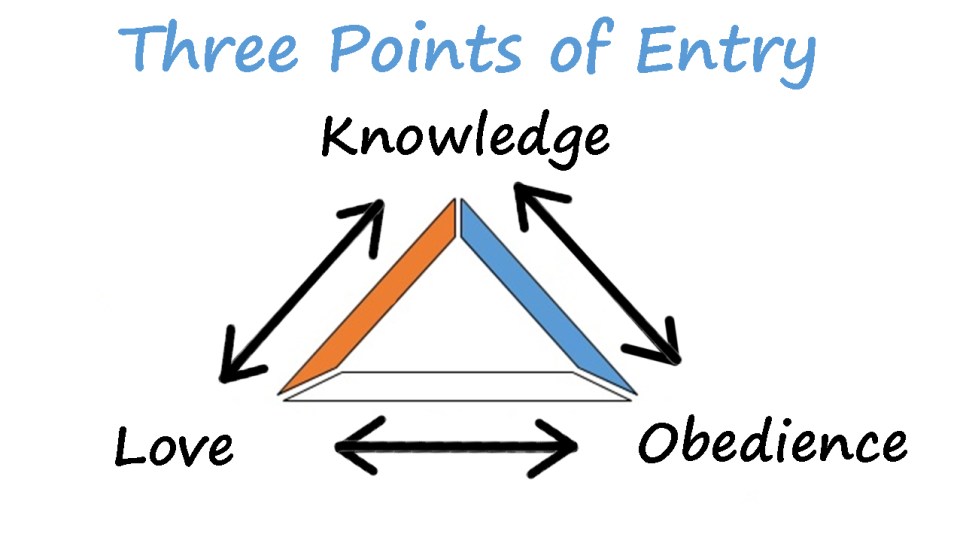
1. Obedience
2. Knowledge
John 7:17 If anyone’s will is to do God’s will, he will know whether the teaching is from God or whether I am speaking on my own authority.
obedience–if anyone’s will is to do God’s will
knowledge–he will know
Obedience–John 7:19 Has not Moses given you the law? Yet none of you keeps the law. Why do you seek to kill me?”
John 7:23 If on the Sabbath a man receives circumcision, so that the law of Moses may not be broken, are you angry with me because on the Sabbath I made a man’s whole body well?
Knowledge–John 7:27 But we know where this man comes from, and when the Christ appears, no one will know where he comes from.” 28 So Jesus proclaimed, as he taught in the temple, “You know me, and you know where I come from? But I have not come of my own accord. He who sent me is true, and him you do not know. 29 I know him, for I come from him, and he sent me.”
Obedience and Knowledge–John 7:49 But this crowd that does not know the law is accursed.” 50 Nicodemus, who had gone to him before, and who was one of them, said to them, 51 “Does our law judge a man without first giving him a hearing and learning what he does?” [The chief priests and Pharisees do not obey the law that they claim to know.]
Knowledge and Obedience–John 8:4 they said to him, “Teacher, this woman has been caught in the act of adultery. 5 Now in the Law Moses commanded us to stone such women. So what do you say?” … John 8:7 And as they continued to ask him, he stood up and said to them, “Let him who is without sin among you be the first to throw a stone at her.” 8 And once more he bent down and wrote on the ground. 9 But when they heard it, they went away one by one, beginning with the older ones, and Jesus was left alone with the woman standing before him. [In their claimed knowledge of the Law, the Pharisees test Jesus to see if he will deny the love for common folk, which he often displays, or deny his obedience to the Law of Moses. Jesus’ outwits them by causing them to recognize their own guilt of disobedience.
Knowledge and Obedience–John 8:49 Jesus answered, “I do not have a demon, but I honor my Father, and you dishonor me. [The religious leaders did not know God, nor did they obey him. They dishonored God by dishonoring his Sent One–Christ.]
Summary: If they had known God and wanted to obey him, they would have investigated Jesus’ claim of being God’s Son with an open mind and an open heart, given that God backed up Jesus’ claims with astounding miracles, and that Jesus taught with astounding teaching. If these Pharisees had sought to honor God (to know, obey, and love him), they would have fairly investigated Jesus’ claims, as Nicodemus, who was one of them, apparently did. Seeking to do God’s will (obedience), they would have discovered (knowledge) that Jesus truly was who he claimed to be. Knowledge of God and his Son leads to love for both. So, in love, they would have honored God by honoring the Son. They did none of these, thereby showing that they had neither knowledge of God, nor a heart of obedience towards him, nor did they have the love of God in their hearts. Jesus told them flat out that they had none of these because they were not “of God” but of their father, the devil (8:44).



Spiritual Versus Concrete Continues in John 6
Week 7 Part 4 John 6:22-71: Focus–Concrete (Concrete Literal) vs Spiritual (Spiritual Reality)
(Link to Outline of John)
John’s Theme: John 20:31 … these are written so that you may believe that Jesus is the Christ, the Son of God, and that by believing you may have life in his name.
In chapter 6 John continues the steady development of his presentation of the great salvation theme of his letter, and he continues to contrast the concrete-only understanding of the religious pundits of his day with the spiritual realities of eternal life.
I. John 3: Nicodemus and the necessity of being born again of the Spirit
John 3:3 Jesus answered him, “Truly, truly, I say to you, unless one is born again he cannot see the kingdom of God.” 4 Nicodemus said to him, “How can a man be born when he is old? Can he enter a second time into his mother’s womb and be born?” 5 Jesus answered, “Truly, truly, I say to you, unless one is born of water and the Spirit, he cannot enter the kingdom of God. 6 That which is born of the flesh is flesh, and that which is born of the Spirit is spirit.
II. John 4: The Woman at the Well and Christ the giver of living water that springs up in believers to a fountain of eternal life
John 4:10 Jesus answered her, “If you knew the gift of God, and who it is that is saying to you, ‘Give me a drink,’ you would have asked him, and he would have given you living water.” 11 The woman said to him, “Sir, you have nothing to draw water with, and the well is deep. Where do you get that living water? 12 Are you greater than our father Jacob? He gave us the well and drank from it himself, as did his sons and his livestock.” 13 Jesus said to her, “Everyone who drinks of this water will be thirsty again, 14 but whoever drinks of the water that I will give him will never be thirsty again. The water that I will give him will become in him a spring of water welling up to eternal life.” 15 The woman said to him, “Sir, give me this water, so that I will not be thirsty or have to come here to draw water.”
John 4:24 God is spirit, and those who worship him must worship in spirit and truth.” 25 The woman said to him, “I know that Messiah is coming (he who is called Christ). When he comes, he will tell us all things.” 26 Jesus said to her, “I who speak to you am he.”
III. John 6: Christ the bread of life and the necessity of eating his flesh and drinking his blood
John 6:31 Our fathers ate the manna in the wilderness; as it is written, ‘He gave them bread from heaven to eat.'” 32 Jesus then said to them, “Truly, truly, I say to you, it was not Moses who gave you the bread from heaven, but my Father gives you the true bread from heaven. 33 For the bread of God is he who comes down from heaven and gives life to the world.” 34 They said to him, “Sir, give us this bread always.” 35 Jesus said to them, “I am the bread of life; whoever comes to me shall not hunger, and whoever believes in me shall never thirst.
John 6:41 So the Jews grumbled about him, because he said, “I am the bread that came down from heaven.” 42 They said, “Is not this Jesus, the son of Joseph, whose father and mother we know? How does he now say, ‘I have come down from heaven’?“
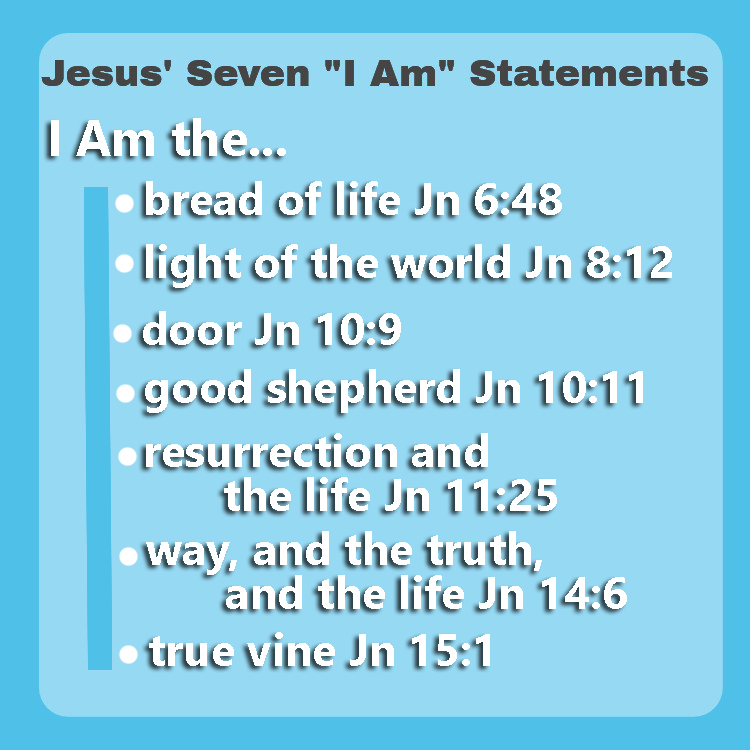
John 6:48 I am the bread of life.
John 6:51 I am the living bread that came down from heaven. If anyone eats of this bread, he will live forever. And the bread that I will give for the life of the world is my flesh.” 52 The Jews then disputed among themselves, saying, “How can this man give us his flesh to eat?” 53 So Jesus said to them, “Truly, truly, I say to you, unless you eat the flesh of the Son of Man and drink his blood, you have no life in you. 54 Whoever feeds on my flesh and drinks my blood has eternal life, and I will raise him up on the last day. 55 For my flesh is true food, and my blood is true drink. 56 Whoever feeds on my flesh and drinks my blood abides in me, and I in him. 57 As the living Father sent me, and I live because of the Father, so whoever feeds on me, he also will live because of me.
Recap:
- To Nicodemus Jesus said, You must be born again. Nicodemus responded concretely–asking whether he needed to crawl back into his mother’s womb as an old man.
- To the Woman at the Well Jesus said, I will give you Living Water. The woman initially responded concretely by asking for the water so as not to have to go to the well to fill her bucket every day.
- To all the listeners in John 6 (the religious pundits, his larger circle of disciples, and his own group of 12 disciples) Jesus reveals that he himself is the living water, and that those who want the fountain of water springing up to eternal life must eat his flesh and drink his blood. He was not speaking of cannibalism, but of the spiritual necessity of fully embracing himself in deepest communion–also known as believing in him. Many who heard him interpreted his words as though he were speaking of cannibalism, and they were repulsed.
This one verse sums up Jesus’ teaching well–
John 6:63 It is the Spirit who gives life; the flesh is no help at all. The words that I have spoken to you are spirit and life.
Application:
- Can you find other verses in which a teaching of Jesus is interpreted concretely rather than as the spiritual truth he intends?
- Given the strength and clarity of Jesus’ teaching concerning Spirit and flesh (see John 6:63 above), why do you suppose there are some today whose minds still focus on concrete fulfillment of spiritual words rather than on the spiritual realities to which the concrete symbols point?
Sent and Endorsed
Week 7 Part 2 John 6:22-71: Focus–Jesus Was Sent by God the Father and Endorsed by Him
(Link to Outline of John)
John’s Theme: John 20:31 … these are written so that you may believe that Jesus is the Christ, the Son of God, and that by believing you may have life in his name.




Faith Has Its Perfect Response


Just the Facts, Ma’am
Week 6 Part 2 John 6:1-15: Jesus Feeds 5,000 People from One Lunch
(Link to Outline of John)
John’s Theme: John 20:31 … these are written so that you may believe that Jesus is the Christ, the Son of God, and that by believing you may have life in his name.
Parallel Passages: Matthew 14:13-21; Mark 6:30-44; Luke 9:10-17
Important Items to Notice 
- The healing of the nobleman’s son, Jesus’ second sign recorded in John’s Gospel (see Outline of John, Week 5), occurred at the beginning of what is called the “Great Galilean Ministry.” This fourth sign, in which Jesus feeds 5,000 men plus women and children from five “loaves” of Mediterranean flat bread and two fish, occurs at the end of his Galilean ministry.
- John 5 records how Jesus was rejected in Judea; John 6 shows how he was rejected in Galilee also.
- In Judea, John records how the Jewish religious leaders rejected Jesus; here in Galilee, it was not just the leaders but his own disciples (the twelve excepted) who also rejected him.
- This is the only miracle recorded in all four gospels (see links above, Parallel Passages).
- As recorded by John, the disciples’ faith had not grown sufficiently for them to expect or even believe that Jesus could feed the enormous crowd from one boy’s lunch (John 6:5-9).
- Nevertheless, the disciples obeyed Christ and arranged the men in orderly groups of about fifty each (Luke 9:14-15). Application: Obedience is a servant to faith in the outworking of miracles in our lives. Obeying Christ’s clear commands even when our faith falls short is sometimes enough for our miracle to happen (cf. the miraculous results of Peter’s obedience without faith in Luke 5:3-9).
- Apart from the resurrection, this is the most well attested sign that Jesus performed, witnessed and participated in by over 5,000 people at once.
Many of Those Whom Jesus Fed Later Rejected Him (John 6:66).
John supplies a key to their actions:
NIV John 6:15 Jesus, knowing that they intended to come and make him king by force, withdrew again to a mountain by himself.
This was an unruly mob ruled by the concrete reality of their stomachs. They wanted control over a puppet king of their own making, one who would do their own bidding and feed them on demand. They had no interest in Jesus as a person–who was this amazing man? Nor did their eyes lift to the heavens to recognize the source of the awesome power Jesus displayed. Their interest in him was earthbound, not spiritual.
The writer John explores their attitudes and motivations later as Chapter 6 continues.
Application: How does this miracle demonstrate John’s theme–that Jesus is the Son of God. What does this mean for me personally in my own life?
Week 6 Part 2 John 6:15-21: The Fifth Sign–Jesus Walks on Water
John’s Theme: John 20:31 … these are written so that you may believe that Jesus is the Christ, the Son of God, and that by believing you may have life in his name.

Genesis 1:2 … And the Spirit of God was hovering over the face of the waters.
After the miracle of the bread and fish, Jesus sent the crowds away. Then he sent his disciples away into the one boat down on the shore and bid them sail to the other side of the lake, while he himself retreated into the mountains to pray. He prayed for a good deal of the night, while his disciples rowed against the wind on high seas in a fierce storm. By the middle of the night, they were still out in the middle of the lake, suspended half way from shore to shore, about 2-1/2 miles out.
Suddenly, an apparition-like form came moving across the water, and the disciples in the boat were terrified. The form spoke in a familiar voice, “It is I; do not be afraid.” At this, they recognized that it was Jesus, and they willingly brought him into the boat. Again suddenly, all at once, they found themselves and the boat on the shore towards which they had laboriously been rowing for hours.
Question: How does this fifth sign achieve John’s thematic purpose of demonstrating that Jesus is the Son of God? How does this affect me in my life personally?
……………………………………..
And the Spirit of God was hovering over the face of the waters.
This miracle-story should be accepted by faith. If one does not believe it, however, let him not try to explain it away. Let him be honest and say, “I do not believe it.” (Hendriksen, vol. 1, 227)

Like Father Like Son
John 20:31 … these are written so that you may believe that Jesus is the Christ, the Son of God, and that by believing you may have life in his name.
Week Six: Discourse—Does Jesus Himself Claim to Be Divine? (Link to John 5:18-47)
Main Point: 34 Not that the testimony that I receive is from man, but I say these things so that you may be saved.
A Dramatic Scene
A GRAND miracle has just been performed—Jesus suddenly and completely heals a man who had been paralyzed for 38 years. The man picks up his sick-bed mat and carries it off.
“Wow!! Awesome!! Praise God!! We’ve never seen or heard anything like this in our whole lives!! Who is this man who did this healing?”
Wrong!—The religious leaders said, “You both picked the wrong day of the week for your dramatic little display. We are the keepers of the law, and it is against our law for anyone to heal, lift, and carry on the Sabbath. You are both sinners.”
Jesus: “Ah, but you are wrong. My Father and I are One, and we hold ultimate authority over the Sabbath. We created the Sabbath, not as a set of picayune laws to trip people up, but as a day of rest to help people weary from their labors.
“I want to help you to understand and believe, so listen to me.”
Part One: If it quacks like a duck…
ESV John 5:18 This was why the Jews were seeking all the more to kill him, because not only was he breaking the Sabbath, but he was even calling God his own Father, making himself equal with God.
19 So Jesus said to them, “Truly, truly, I say to you, the Son can do nothing of his own accord, but only what he sees the Father doing. For whatever the Father does, that the Son does likewise.
20 For the Father loves the Son and shows him all that he himself is doing. And greater works than these will he show him, so that you may marvel.
21 For as the Father raises the dead and gives them life, so also the Son gives life to whom he will.
22 The Father judges no one, but has given all judgment to the Son,
23 that all may honor the Son, just as they honor the Father. Whoever does not honor the Son does not honor the Father who sent him.
24 Truly, truly, I say to you, whoever hears my word and believes him who sent me has eternal life. He does not come into judgment, but has passed from death to life.
25 “Truly, truly, I say to you, an hour is coming, and is now here, when the dead will hear the voice of the Son of God, and those who hear will live.
26 For as the Father has life in himself, so he has granted the Son also to have life in himself.
27 And he has given him authority to execute judgment, because he is the Son of Man.
28 Do not marvel at this, for an hour is coming when all who are in the tombs will hear his voice
29 and come out, those who have done good to the resurrection of life, and those who have done evil to the resurrection of judgment.
30 “I can do nothing on my own. As I hear, I judge, and my judgment is just, because I seek not my own will but the will of him who sent me.
It is possible for a son or daughter to share many physical and personality traits with their parent. This is because they share one-half of a complete set of genes. That’s a lot of genes for two people to have in common!
Nevertheless, parent and child are independent of each other in many ways, especially their thought life, their speech, and most importantly, their will (their center of volition, their driving force.)
When Jesus states in verse 19, “the Son can do nothing of his own accord,” he is not describing a shortcoming in himself. Rather, he is saying that there is nothing in the Son that is independent of the Father. They share everything, even their will. Christ is purely, exactly like his Father. And because this is so, they are One.
Hebrews 1:3 He is the radiance of the glory of God and the exact imprint of his nature, and he upholds the universe by the word of his power. After making purification for sins, he sat down at the right hand of the Majesty on high,
Three strands of thought intertwine in Jesus’ discourse above.
1. The Son possesses all the Father possesses and does not possess any trait or quality, apart from his human nature, which the Father does not also possess. This indicates that Father and Son are identical (vss 18-20).
A limited analogy might be human fathers and sons, in which the father openly shows the son all he does—his garage and office, his hobbies, his work, his philosophies and ethic, and so on. As the son grows and matures, he displays his identity as his father’s son by taking on for himself many characteristics of his father.
2. Just as God has life in himself and the power of life over death, so the Son has life in himself and power of life over death (vss 21, 25-26). And, as the Father makes sovereign choices in matters of life versus death, so does the Son (vss 21, 24-26, 28-29).
3. God has given the final judgment to his Son (vss 22, 24, 27-30).
Part Two: The Witnesses
John 5:31 If I alone bear witness about myself, my testimony is not deemed true.
32 There is another who bears witness about me, and I know that the testimony that he bears about me is true.
33 You sent to John, and he has borne witness to the truth.
34 Not that the testimony that I receive is from man, but I say these things so that you may be saved.
35 He was a burning and shining lamp, and you were willing to rejoice for a while in his light.
36 But the testimony that I have is greater than that of John. For the works that the Father has given me to accomplish, the very works that I am doing, bear witness about me that the Father has sent me.
37 And the Father who sent me has himself borne witness about me. His voice you have never heard, his form you have never seen,
38 and you do not have his word abiding in you, for you do not believe the one whom he has sent.
39 You search the Scriptures because you think that in them you have eternal life; and it is they that bear witness about me,
40 yet you refuse to come to me that you may have life.
41 I do not receive glory from people.
42 But I know that you do not have the love of God within you.
43 I have come in my Father’s name, and you do not receive me. If another comes in his own name, you will receive him.
44 How can you believe, when you receive glory from one another and do not seek the glory that comes from the only God?
45 Do not think that I will accuse you to the Father. There is one who accuses you: Moses, on whom you have set your hope.
46 For if you believed Moses, you would believe me; for he wrote of me.
47 But if you do not believe his writings, how will you believe my words?”
Jesus Presents His Five Witnesses
1. Jesus Himself (vs 31).
I know that my testimony is true, because I know who my Father is and where I come from. Nevertheless, if I were the only witness to myself, you might not believe me. Therefore…
2. God the Father (vss 32, 36-38)
- He sent me (John 3:2).
- His voice, which you have not heard, has identified me (John 1:33-34; Mark 1:10-11).
- He commissioned me for these works as his ambassador (John 3:2).
- He sent the prophets and gave them the Scripture (Luke 24:26-27).
3. John the Baptist (vss 33-35)
I don’t need John’s testimony, as I have plenty of divine testimony, which is far stronger. John the Baptist was sent for you, as a herald to announce my coming and to prepare the soil for the good seed. As regards John the Baptist, you are like the seed that fell on stony ground (Luke 8:5-6).
4. Jesus’ Signs and Miracles (vs 36)
These were given to me by God my Father, and none could perform these miracles without his endorsement (John 3:2).
5. Scripture and the Prophets (39-40, 45-46)
The Scripture and prophets all speak of me, especially Moses, whom you adore and on whom you place your trust. I don’t need to condemn you at the final judgment—Moses will condemn you by the words he spoke about me, which you neither believed nor received (Hebrews 1:1-2).
Jesus Accuses His Accusers (37-47)
1. They do not know the Father (vs 37).
2. God’s Word does not abide in them (vs 38, 43).
3. They do not believe the One whom God sent (vs 38).
4. Their hearts are hard (vs 40).
5. The love of God is not in them (vs 42).
6. They refuse to receive the One God sent (# 3 above, vss 38, 43), yet they will receive another who comes in his own name (promoting his own glory and not having endorsement from God).
7. They seek and receive glory from the wrong places (vs 44).
8. They neither understand nor believe their hero, Moses (vss 45-46).
9. They misunderstand the basics (vs 47).
Link to Outline: Gospel of John
Jesus Heals Paralyzed Man in a Miraculous Display of Grace, Love, and Power
Click here for: Link to the Outline of the Gospel of John
ESV John 20:31 … these are written so that you may believe that Jesus is the Christ, the Son of God, and that by believing you may have life in his name.
Week Five: The Third Sign–Healing the Paralyzed Man (Link to John 5:1-18)
ESV John 5:1 After this there was a feast of the Jews, and Jesus went up to Jerusalem. 2 Now there is in Jerusalem by the Sheep Gate a pool, in Aramaic called Bethesda, which has five roofed colonnades. 3 In these lay a multitude of invalids–blind, lame, and paralyzed. 4 5 One man was there who had been an invalid for thirty-eight years. 6 When Jesus saw him lying there and knew that he had already been there a long time, he said to him, “Do you want to be healed?” 7 The sick man answered him, “Sir, I have no one to put me into the pool when the water is stirred up, and while I am going another steps down before me.” 8 Jesus said to him, “Get up, take up your bed, and walk.” 9 And at once the man was healed, and he took up his bed and walked. Now that day was the Sabbath. 10 So the Jews said to the man who had been healed, “It is the Sabbath, and it is not lawful for you to take up your bed.” 11 But he answered them, “The man who healed me, that man said to me, ‘Take up your bed, and walk.'” 12 They asked him, “Who is the man who said to you, ‘Take up your bed and walk’?” 13 Now the man who had been healed did not know who it was, for Jesus had withdrawn, as there was a crowd in the place. 14 Afterward Jesus found him in the temple and said to him, “See, you are well! Sin no more, that nothing worse may happen to you.” 15 The man went away and told the Jews that it was Jesus who had healed him. 16 And this was why the Jews were persecuting Jesus, because he was doing these things on the Sabbath. 17 But Jesus answered them, “My Father is working until now, and I am working.” 18 This was why the Jews were seeking all the more to kill him, because not only was he breaking the Sabbath, but he was even calling God his own Father, making himself equal with God.

Summary: While the first two signs both occurred in Galilee, this the third sign occurs in Jerusalem. Its reservoir was uncovered in 1888 at the time of repair work on the church of St. Anne in northeast Jerusalem. (Hendriksen, Vol. 1, 190) Jesus saw a man there who was “withered,” that is, dried up or paralyzed. He couldn’t walk and had other difficulties with movement (vs 7). Jesus knew that he had been there a long time and asked him, “Do you want to be healed?” Not giving a direct answer, the man described his difficulty in being healed by the only means he knew–self-effort to move his disabled body into the water quickly, before others, who had outside help, got in. Apparently, they believed that only the first person into the water during moments of “stirring” would be healed. Jesus then gave him a direct command, “Get up, take up your bed [which was about the size of a yoga mat], and walk.” And the man did so.
It happened to be the Sabbath when Jesus healed the man. Immediately the religious leaders of the day challenged the man with the accusation that lifting and carrying his mat on the Sabbath was illegal, according to their Jewish law, as interpreted by them. He announced his healing to them by saying that the man who healed him had told him to pick up his mat and walk. Not knowing who the man was, the conversation ended. The healed man next shows up in the temple, where it says, Jesus “found” and encouraged him with the words, “See, you are well! Sin no more, that nothing worse may happen to you.”
The man went back to the Jewish leaders and told them that Jesus is the one who had healed him. From that moment on, the Jewish leaders began to persecute Jesus for breaking the Sabbath law by healing and commanding the one healed to pick up his mat and walk. When confronted, Jesus replied, “My Father is working until now, and I am working.” The Jewish leaders understood this statement to mean that Jesus was calling God his Father, thereby claiming to be the Son of God, equal to God. From that moment forward, they not only persecuted Jesus, but they also wanted to kill him (vs 18).
Comparisons and Contrasts Between This Sign and the Two Previous Signs–1) water to wine (John 2:1-11) and 2) healing the nobleman’s son (John 4:43-54)
- In changing water to wine, Jesus demonstrated his power over inanimate nature and the laws of physics and chemistry. By changing matter itself, he demonstrated himself to be outside the material realm. In the two signs of healing, Jesus demonstrated his re-creative powers over biological matter.
- In the first sign, the inanimate substance displayed no self-will, for such is nonexistent. In the second sign, Jesus responded to the will of the sick boy’s father, a third party. In the third sign, Jesus responded to his own will, since the paralyzed man, unlike the boy’s father, requested nothing.
- In the first sign, the initiator of the encounter with the water was Christ in the sense that the water asked for nothing, while Christ responded to a direct request from his mother. The nobleman initiated the encounter by persistently “begging” Jesus to heal his son. Christ initiated the healing of the paralyzed man with no prompting whatsoever, thereby placing his own sovereignty of choice in bold relief. (Why did he heal this man and not someone else or many of the “multitude”?
- Both the nobleman petitioning for his son and the paralyzed man at the outset displayed insufficient faith, the paralyzed man showing far less than the nobleman.
- This is the first miraculous sign for which Jesus is persecuted.
A Sign That Displays Christ’s Amazing Power, Grace, and Loving Compassion for the Powerless, Unloved, and Alone

Some commentators appear to criticize the paralyzed man for a perceived lack of will, as though he engaged in a self-pity party. Yet, Lazarus, a dead man who had no will, is never criticized for himself not having improved his dead condition. Nor is Saul, who became the Apostle Paul, ever criticized for not having initiated his own salvation. Thirty-eight years is a very long time. The text indicates that the paralyzed man had attempted on several occasions to move himself into the healing water before the others (vs 7). And if his desire for healing had died along with his hope of its ever becoming a reality for him, doesn’t this all the more establish Christ’s perception and compassion?
Of all the multitude of disabled people lying by the sides of the pool (vs 3), Jesus chose this one, who had grown old with infirmity as his sole companion. This shows us that Christ is indeed sovereign in his election and that salvation and healing are by grace and not by any virtue of will-power (John 1:13) or positive thinking.
Luke 19:10 For the Son of Man came to seek and to save the lost.
Similarities with Jesus’ Raising of Lazarus from the Dead (John 11:1-54)
When Jesus raised Lazarus, no one, not even his believing sisters Martha and Mary, expected or asked him to perform such a miracle. Likewise, the possibility of healing never entered the paralyzed man’s head.
Jesus began his miracle by calling out to the dead man, “Lazarus…” Jesus began his miracle of healing by calling out to the paralyzed man, “Do you want to be healed?”
Jesus finished his miracle by commanding Lazarus, “…come out.” Jesus finished his miracle by commanding the paralyzed man, “Get up, take up your bed, and walk.”
- In Lazarus’ case, coming back to life had to occur with the calling out of his name, since a dead man can neither hear nor obey a command to “come out.”
- In the paralyzed man’s case, healing had to occur simultaneously with the command to “Get up, take up your bed, and walk,” since a paralyzed man cannot obey such a command. The text then says, “and at once the man was healed” and obeyed.
- In both of these cases, the initial calling was effective: 1) Lazarus came back to life, and 2) the paralyzed man’s interest and hope had been aroused.
Isaiah 60:1 Arise, shine, for your light has come, and the glory of the LORD has risen upon you.
Ephesians 5:14 for anything that becomes visible is light. Therefore it says, “Awake, O sleeper, and arise from the dead, and Christ will shine on you.”
Ephesians 2:5 even when we were dead in our trespasses, made us alive together with Christ–by grace you have been saved–
Isaiah 26:19 Your dead shall live; their bodies shall rise. You who dwell in the dust, awake and sing for joy! For your dew is a dew of light, and the earth will give birth to the dead.
- Application: Do you recall a specific “wake-up call” from the Lord? If so, why not share your story with another?
Fallout
- The formerly paralyzed man now healed gets chastised and interrogated by the Jewish leaders for breaking their law by lifting and carrying on the Sabbath day, the day of his great and wonderful healing.
- He goes to the temple.
- Jesus, again taking the initiative, “finds” him in the temple and performs one of only two “follow-ups” ever presented in all four Gospels (of which this writer is aware), by leading him towards a healing of the spiritual condition of his soul. Here again, Christ prominently displays his great love for the unlovely and otherwise unloved. (See John 9:34-38 for the other follow-up.)
- The healed man returns to his interrogators, presumably the only people besides Jesus who knew of his healing, to boldly proclaim his positive confession that “it was Jesus” who had healed him.
- The Jewish leaders turn upon and persecute Jesus for healing on the Sabbath day (vs 16).
- They later determine to kill Jesus for announcing himself to be equal to God, and therefore, divine (vss 17-18).
 One Small Voice

