Home » Posts tagged 'Psalms' (Page 2)
Tag Archives: Psalms

Psalms 56-60: A Packet–Psalm 59

“While this psalm carries deep philosophical import, answering the question of evil in the presence of a good God, it very simply shares with us the benefits of placing one’s complete trust in the God of Love. Those who do evil will be punished and brought low; the righteous will be rewarded with the mercy of God.”
Psalm 59 contains two major applications: one general and one specific. The premise of the general application was stated in the last verse of the prior psalm.
Psalm 58:11 LXE And a man shall say, Verily then there is a reward for the righteous: verily there is a God that judges them in the earth.
ESV Mankind will say, “Surely there is a reward for the righteous; surely there is a God who judges on earth.”
The specific application applies to the speaker himself, identified previously as the Son of God on earth during the days of his tribulation and Passion. The following verses further identify him as the Spotless Lamb:
2 Deliver me from the workers of iniquity, and save me from bloody men.
3 For, behold, they have hunted after my soul; violent men have set upon me: neither is it my iniquity, nor my sin, O Lord.
4 Without iniquity I ran and directed my course aright: awake to help me, and behold. (Psalm 59:2-4 LXE)
1Peter 1:19 but with the precious blood of Christ, like that of a lamb without blemish or spot. (ESV)
2 Corinthians 5:21 For our sake he made him to be sin who knew no sin, so that in him we might become the righteousness of God. (ESV)
If there is a God in heaven–so the argument goes–and if he is a good God, how can he permit such evil on earth? The answer given in Psalm 59 is that he does not. There will be a judgment: the righteous will be rewarded, and the wicked will be punished. The blood of the innocent by the hands of the wicked will be avenged.
Psalm 59 is divided neatly into sections.
1) In the first section, verses 1-5, the speaker (who is Messiah) lays out his condition and his petition. Bloody and violent men pursue the speaker with intent to kill. After his proclamation of innocence, the speaker petitions God in prayer to visit all the heathen and to pity no one who does iniquity. Then there is a “pause.”
An interesting petition
2) In the second section, verses 6-13, the speaker details God’s future actions against his enemies and contrasts these with his own trust in God and God’s mercy on him. Before a second “pause” which closes verse 13, the speaker makes an interesting petition in verses 11-13.
11 Slay them not, lest they forget thy <1> law; scatter them by thy power; and bring them down, O Lord, my defender.
12 For the sin of their mouth, and the word of their lips, let them be even taken in their pride.
13 And for their cursing and falsehood shall utter destruction be denounced: they shall fall by the wrath of utter destruction, and shall not be; so shall they know that the God of Jacob is Lord of the ends of the earth. Pause. (LXE)
He asks in verse 11 that God not “kill” his enemies but “scatter” them and bring them “down,” in the sense of higher to lower. This seems rather an apt request, considering that Jesus’s enemies were religious leaders who thought themselves to be above the people.
Luke 18:11 The Pharisee stood and prayed about himself like this: ‘God, I thank you that I am not like other people: extortionists, unrighteous people, adulterers– or even like this tax collector. (NET)
Some textual variations
Throughout the entire psalm the speaker in the Greek Septuagint of Brenton’s translation always refers to himself in singular. There are no plurals, such as “we,” “us,” or “our,” not even in verse 11. The supplicant represents himself throughout the psalm; he is not praying on behalf of a “people.” Therefore, God is always referred to with the descriptor, “my,” rather than “our.” Although the Septuagint does reference God as the “God of Israel” (verse 5) and “God of Jacob” (verse 13), the speaker gives no indication that he is praying on behalf of a “people.” This is important in helping to determine the subject of verse 11. Verse 11 differs in Brenton’s Septuagint from translations based upon the Masoretic.
First, however, all versions agree that the request is for a scattering rather than an annihilation. The example below is one of the more graphic:
11 Use your power to make them homeless vagabonds and then bring them down, O Lord who shields us! (NET)
All versions further agree that the reason for the request is to prevent someone forgetting something. Who the someone is and what is not to be forgotten is hard to decipher. The Masoretic translations ask God to scatter rather than kill “lest my people forget,” (ESV) leaving the “what” unmentioned. The Greek Septuagint, which follows a different textual tradition, doesn’t specify who “they” is and places a text note at the object of the verb “forget.” According to Rahlfs, there are three Septuagint families of readings for the genitive object of “forget” (1). The Greek text that accompanies Brenton’s translation uses “thy law,” (τοῦ νόμου σου) “Slay them not, lest they forget thy law; scatter them by thy power.” A second reading is “people,” as in the Masoretic; however, people is objective rather than subjective, “lest they forget thy people,” not, “lest my people forget,” as in the ESV. The third reading is “your name,” “Slay them not lest they forget your name.” (2)
Finally, all versions agree that the powerful enemies, as an effect of their scattering, will be brought completely down, or low.
So, which one?
The biblical plot line, the plot line of the Psalter, the plot line of the Gospels, and the plot line of the New Testament letters require that the “enemies” are among God’s own people and among the Gentiles. (That pretty much includes everyone.) God’s own people were distinctively given the commandment to guard God’s Law, the Ten Commandments delivered through the hand of Moses the great prophet. Based upon the entire sense of the psalm, I conclude that the speaker’s request in verse 11 of the Septuagint is lest “they,” the enemies, “forget thy law.” The enemies are the prideful religious leaders, caretakers of God’s Law, and the speaker is God’s Son. The speaker wants these enemies brought low, but not destroyed, because he wants them to remember God’s Law. Clearly, the speaker’s enemies broke the first commandment in its entirety, “Deuteronomy 6:5 You shall love the LORD your God with all your heart and with all your soul and with all your might.”
The predicament of modern unbelievers as they stumble upon Psalm 59 is this. While the mind agrees that righteousness needs to be vindicated and that the travesty of disrespect and murder against God’s own Son is unfathomable in its magnitude, our culture teaches prejudice against the biblical God. If the speaker were anyone other than God’s own Son, our own natural sense of justice would demand that the death of a completely innocent person by the hands of a ruthless enemy be avenged. And yet, because God is so authoritatively powerful, we deny the justice given to every common creature to his Son, who in his flesh was every bit as common as each one of us. And, on the other hand, for believers there is no cause for rejoicing in this psalm. How can any tender-hearted person rejoice in destruction?
The Good News, however, is that the enemies were not killed, but scattered. The outcome of A.D. 70 was that the temple and its sacrifices ceased, the power of the religious leaders was completely broken, and the people were indeed scattered. However, God’s Law continued to be guarded and protected.
Paul best explains this plot twist:
Romans 11:11 So I ask, did they stumble in order that they might fall? By no means! Rather through their trespass salvation has come to the Gentiles, so as to make Israel jealous. (ESV)
More cannot be said now without entering into Psalm 60, the last psalm of this packet.
Prophecy
As concerns Psalm 59, it helps this author to bear in mind constantly that the Psalter is prophetic and that a large purpose of Psalm 59 is to prophesy in order to verify the credentials of Messiah. Prophecy is a testimony that leads to faith.
Consider Psalm 59 in the context of these biblical statements.
Psalm 17:8 Keep me as the apple of your eye. (See also all of Psalms 16 and 17, which match closely Psalm 59.)
Deuteronomy 6:4 “Hear, O Israel! The LORD is our God, the LORD is one!
5 “And you shall love the LORD your God with all your heart and with all your soul and with all your might.
6 “And these words, which I am commanding you today, shall be on your heart;
7 and you shall teach them diligently to your sons and shall talk of them when you sit in your house and when you walk by the way and when you lie down and when you rise up.
8 “And you shall bind them as a sign on your hand and they shall be as frontals on your forehead.
9 “And you shall write them on the doorposts of your house and on your gates. (NAS)(See also all of Psalm 119.)
Ezekiel 19:10 ‘Your mother was like a vine in your vineyard, Planted by the waters; It was fruitful and full of branches Because of abundant waters.
11 ‘And it had strong branches fit for scepters of rulers, And its height was raised above the clouds So that it was seen in its height with the mass of its branches.
12 ‘But it was plucked up in fury; It was cast down to the ground; And the east wind dried up its fruit. Its strong branch was torn off So that it withered; The fire consumed it.
13 ‘And now it is planted in the wilderness, In a dry and thirsty land.
14 ‘And fire has gone out from its branch; It has consumed its shoots and fruit, So that there is not in it a strong branch, A scepter to rule.'” This is a lamentation, and has become a lamentation. (NAS)Matthew 21:33 “Listen to another parable. There was a landowner who planted a vineyard and put a wall around it and dug a wine press in it, and built a tower, and rented it out to vine-growers, and went on a journey.
34 “And when the harvest time approached, he sent his slaves to the vine-growers to receive his produce.
35 “And the vine-growers took his slaves and beat one, and killed another, and stoned a third.
36 “Again he sent another group of slaves larger than the first; and they did the same thing to them.
37 “But afterward he sent his son to them, saying, ‘They will respect my son.’
38 “But when the vine-growers saw the son, they said among themselves, ‘This is the heir; come, let us kill him, and seize his inheritance.’
39 “And they took him, and threw him out of the vineyard, and killed him.
40 “Therefore when the owner of the vineyard comes, what will he do to those vine-growers?”
41 They said to Him, “He will bring those wretches to a wretched end, and will rent out the vineyard to other vine-growers, who will pay him the proceeds at the proper seasons.”
42 Jesus said to them, “Did you never read in the Scriptures, ‘The stone which the builders rejected, This became the chief corner stone; This came about from the Lord, And it is marvelous in our eyes’? (NAS)Matthew 23:37 “O Jerusalem, Jerusalem, the city that kills the prophets and stones those who are sent to it! How often would I have gathered your children together as a hen gathers her brood under her wings, and you were not willing!
38 See, your house is left to you desolate.
39 For I tell you, you will not see me again, until you say, ‘Blessed is he who comes in the name of the Lord.'” (ESV)Luke 23:28 But turning to them Jesus said, “Daughters of Jerusalem, do not weep for me, but weep for yourselves and for your children. (ESV)
Luke 19:41 And when he drew near and saw the city, he wept over it,
42 saying, “Would that you, even you, had known on this day the things that make for peace! But now they are hidden from your eyes.
43 For the days will come upon you, when your enemies will set up a barricade around you and surround you and hem you in on every side
44 and tear you down to the ground, you and your children within you. And they will not leave one stone upon another in you, because you did not know the time of your visitation.”
45 And he entered the temple and began to drive out those who sold,
46 saying to them, “It is written, ‘My house shall be a house of prayer,’ but you have made it a den of robbers.”
47 And he was teaching daily in the temple. The chief priests and the scribes and the principal men of the people were seeking to destroy him, (ESV)Luke 21: 5 And while some were speaking of the temple, how it was adorned with noble stones and offerings, he said,
6 “As for these things that you see, the days will come when there will not be left here one stone upon another that will not be thrown down.” (ESV)
And finally, the Scripture all but quoted in Psalm 59:8:
Psalm 2:4 He that dwells in the heavens shall laugh them to scorn, and the Lord shall mock them. (LXE)
Compare the previous verse with Psalm 59:8.
But thou, Lord, wilt laugh them to scorn; thou wilt utterly set at nought all the heathen. (LXE)
The prophecies of Psalm 59 were indeed fulfilled in the resurrection of Jesus Christ and the destruction of Jerusalem with its temple and its religious hierarchy in 70 A.D.
3) The third and final section of Psalm 59 consists of the last two verses, 16-17.
16 But I will sing to thy strength, and in the morning will I exult in thy mercy; for thou hast been my supporter, and my refuge in the day of mine affliction.
17 Thou art my helper; to thee, my God, will I sing; thou art my supporter, O my God, and my mercy. (LXE)
The sorely pressed-upon speaker of this prayer displays a beautiful faith. The phrase, “But I will sing to they strength, and in the morning will I exult in they mercy,” looks forward to resurrection morning, bright and early, as the stone that entombs the undefeated Son of God is rolled away. The incarnated Jesus was a human, just as you and I, and he shares our frame and makeup in every aspect. He sweat as it were blood in his awful contemplation of being crucified and enduring the wrath of God as a sacrifice, a piece of meat, on behalf of sinners. God includes Psalm 59 in the Bible to show us that God has “prevented” us (to use the old King James way of saying it). That means, God has gone before us (Psalm 21:3) to prepare a way and to lead us in it. The Son of God is “the way, and the truth, and the life” (John 14:6).
Conclusion
While this psalm carries deep philosophical import, answering the question of evil in the presence of a good God, it very simply shares with us the benefits of placing one’s complete trust in the God of Love. Those who do evil will be punished and brought low; the righteous will be rewarded with the mercy of God.
__________
1 Rahlfs-Hanhart. Septuaginta: Editio altera. Stuttgart: Deutsche Bibelgesellschaft, 2006.
2 NETS uses the “people” textual tradition, “or they may forget my people.” The Orthodox Study Bible also uses “my people.” Brenton stands alone in the textual tradition he chose to follow.
Psalms 56-60: A Packet–Psalm 58 Enter Judgment
Ding-dong, the witch is dead! Which old witch? The wicked witch
Ding-dong, the wicked witch is dead. — lyrics from The Wizard of Oz. (1).
Question: Did the Munchkins in The Wizard of Oz celebrate death and vengeance, or were they celebrating the ending of cruel slavery suffered by all when wickedness ruled the land?
Introduction
Judgment is an uncomfortable theme for many Christians and Christian critics who have been raised on John 3:16 and its sequel, “God is love,” in 1 John 4:8. How can judgment possibly be consistent with the teaching of 100% acceptance in Jesus Christ for every willing individual? Nevertheless, the theme of judgment, and yes, punishment, occurs cover to cover throughout the Bible. After describing the characteristics of the wicked, Psalm 58 focuses on the theme of judgment for the enemies of God and his Son, the King.
Disclaimer
This author bears no animosity nor any judgmental attitude toward any people group anywhere in the globe. Jesus Christ broke down all walls of division separating any given portion of humankind from any other portion (Ephesians 2:14-3:21). We are all one in Christ, and love rules the day. The importance of this packet of psalms lies in their prophetic word of Christ. These psalms function as an aid to help along the nascent faith of unbelievers and all Christians everywhere. For those who still may doubt that Psalm 58 treats of Christ, perhaps the quotes in the Notes section may help (2).
Who are these wicked?
Verse 1 of Psalm 58 states a basic premise that the mouth is indicative of what lies in the heart.
Psalm 58:1 If ye do indeed speak righteousness, then do ye judge rightly, ye sons of men.
Christ in in the New Testament states it this way,
Matthew 12:34 Offspring of vipers! How are you able to say anything good, since you are evil? For the mouth speaks from what fills the heart. (NET)
And James in the memorable passage concerning the tongue, introduces the topic of how one’s speech relates to the whole person:
James 3:2 For we all stumble in many ways. If someone does not stumble in what he says, he is a perfect individual, able to control the entire body as well. (NET)
Psalm 58 LXE (Septuagint in English by Brenton) goes on to describe the “sons of men” (3) or “sinners” in verses 2-4:
2 For ye work iniquities in your hearts in the earth: your hands plot unrighteousness.
3 Sinners have gone astray from the womb: they go astray from the belly: they speak lies.
4 Their venom is like that of a serpent; as that of a deaf asp, and that stops her ears;
5 which will not hear the voice of charmers, nor heed the charm prepared skillfully by the wise.
Again, Jesus puts it this way:
Matthew 15:8 “‘This people honors me with their lips, but their heart is far from me;
Mark 7:21 For from within, out of the heart of man, come evil thoughts, sexual immorality, theft, murder, adultery,
John 8:44 You are of your father the devil, and your will is to do your father’s desires. He was a murderer from the beginning, and does not stand in the truth, because there is no truth in him. When he lies, he speaks out of his own character, for he is a liar and the father of lies.
Matthew 13:38 The field is the world, and the good seed is the sons of the kingdom. The weeds are the sons of the evil one,
Matthew 23:33 You serpents, you brood of vipers, how are you to escape being sentenced to hell?
Luke 7:31 “To what then should I compare the people of this generation, and what are they like? 32 They are like children sitting in the marketplace and calling out to one another, ‘We played the flute for you, yet you did not dance; we wailed in mourning, yet you did not weep.’
Matthew 13:13 For this reason I speak to them in parables: Although they see they do not see, and although they hear they do not hear nor do they understand.
The kind of people described in both Testaments above are the ones who opposed Jesus every step of his ministry. They are those whom the gospels call the Pharisees, the Sadducees, the priests, the chief priests and elders, the Sanhedrin, the lawyers, and the scribes. These are people who hated the truth of God and Christ, who hated the actions of love and good works, especially towards the down and out and poor of person and spirit. They were absolutely sure that they were right and all who disagreed with them were wrong and to be hated. They were proud in their hearts and disdainful of all who were different than they. They believed that they merited special, favorable treatment from God because they believed themselves to be superior to others. They were the religious authorities of Jesus’s day who sought to annihilate him.
What will be the fate of the wicked who hate God and his Christ?
Psalm 2 first prophesies the outcome for this set of people.
Psalm 2:1 Wherefore did the heathen rage, and the nations imagine vain things?
2 The kings of the earth stood up, and the rulers gathered themselves together, against the Lord, and against his Christ;
3 saying, Let us break through their bonds, and cast away their yoke from us.
4 He that dwells in the heavens shall laugh them to scorn, and the Lord shall mock them.
5 Then shall he speak to them in his anger, and trouble them in his fury.
6 But I have been made king by him on Sion his holy mountain,
7 declaring the ordinance of the Lord: the Lord said to me, Thou art my Son, to-day have I begotten thee.
8 Ask of me, and I will give thee the heathen for thine inheritance, and the ends of the earth for thy possession.
9 Thou shalt rule them with a rod of iron; thou shalt dash them in pieces as a potter’s vessel.
10 Now therefore understand, ye kings: be instructed, all ye that judge the earth.
11 Serve the Lord with fear, and rejoice in him with trembling.
12 Accept correction, lest at any time the Lord be angry, and ye should perish from the righteous way: whensoever his wrath shall be suddenly kindled, blessed are all they that trust in him. (LXE)
Psalm 58 is very similar to Psalm 2 in its approach. The basic premise of both psalms is that God has a Son with whom he is well-pleased. The Son, while sojourning on earth, will encounter opposition from enemies, who will be defeated. God warns them in advance of the consequences of their rebellion, and he encourages them to repent and receive his favor. (4)
Psalm 58:6 God has crushed their teeth in their mouth: God has broken the cheek-teeth of the lions.
7 They shall utterly pass away like water running through: he shall bend his bow till they shall fail.
8 They shall be destroyed as melted wax: the fire has fallen and they have not seen the sun.
9 Before your thorns feel the white thorn, he shall swallow you up as living, as in his wrath.
Jesus himself, the one who loved his Father so much that he willingly conformed to the Father’s will to provide a life raft for the sinking human race by dying a most painful death upon the cross, said this about the future of his enemies:
Matthew 11:21 “Woe to you, Chorazin! Woe to you, Bethsaida! For if the mighty works done in you had been done in Tyre and Sidon, they would have repented long ago in sackcloth and ashes.
Matthew 23:13 “But woe to you, scribes and Pharisees, hypocrites! For you shut the kingdom of heaven in people’s faces. For you neither enter yourselves nor allow those who would enter to go in.
Matthew 23:34 Therefore I send you prophets and wise men and scribes, some of whom you will kill and crucify, and some you will flog in your synagogues and persecute from town to town, 35 so that on you may come all the righteous blood shed on earth, from the blood of righteous Abel to the blood of Zechariah the son of Barachiah, whom you murdered between the sanctuary and the altar.
Matthew 23:37 “O Jerusalem, Jerusalem, the city that kills the prophets and stones those who are sent to it! How often would I have gathered your children together as a hen gathers her brood under her wings, and you were not willing! 38 See, your house is left to you desolate.
Matthew 8: 11 I tell you, many will come from east and west and recline at table with Abraham, Isaac, and Jacob in the kingdom of heaven, 12 while the sons of the kingdom will be thrown into the outer darkness. In that place there will be weeping and gnashing of teeth.”
Matthew 13: 41 The Son of Man will send his angels, and they will gather out of his kingdom all causes of sin and all law-breakers,
42 and throw them into the fiery furnace. In that place there will be weeping and gnashing of teeth.Matthew 24:1 Jesus left the temple and was going away, when his disciples came to point out to him the buildings of the temple. 2 But he answered them, “You see all these, do you not? Truly, I say to you, there will not be left here one stone upon another that will not be thrown down.”
Luke 19:41 And when he drew near and saw the city, he wept over it, 42 saying, “Would that you, even you, had known on this day the things that make for peace! But now they are hidden from your eyes. 43 For the days will come upon you, when your enemies will set up a barricade around you and surround you and hem you in on every side 44 and tear you down to the ground, you and your children within you. And they will not leave one stone upon another in you, because you did not know the time of your visitation.”
And as in Psalm 2, Psalm 58 pronounces blessing upon the righteous:
10 The righteous shall rejoice when he sees the vengeance of the ungodly: he shall wash his hands in the blood of the sinner.
11 And a man shall say, Verily then there is a reward for the righteous: verily there is a God that judges them in the earth.
Likewise, Jesus pronounces blessing upon the righteous.
Matthew 13:43 Then the righteous will shine like the sun in the kingdom of their Father. He who has ears, let him hear.
Conclusion
The destruction of the temple and Jerusalem in 70 CE fulfilled in whole or in part the prophecies of judgment pronounced in Psalms 2 and 58 against God and his King. (5) Looking ahead, Psalm 59 records again the speaker’s trials by the hand of his enemies, his expressions of faith in prayer, his expectations of vindication, and his prophecies of future judgment upon his enemies. In spite of the Wizard of Oz lyrics at the beginning of this article, neither Psalm 58 nor Psalm 59 are what one might call “happy.” God’s standards are higher than Hollywood’s, even when it comes to the little Munchkins celebrating the wicked witch’s demise. Happiness does come, but it must await Psalm 60.
__________
1 Full lyrics and copyright information available at https://www.google.com/search?ei=vv20XaCHNMSUsgWrtLfgBA&q=wizard+of+oz+lyrics+ding+dong+the+witch+is+dead&oq=wizard+of+oz+lyrics+ding&gs_l=psy-ab.1.0.0j0i22i30l3.805142.810221..813139…0.0..0.70.1396.24……0….1..gws-wiz…….0i131j0i67.cBktK4kg-Eg. Accessed October 26, 2019.
2 John Barclay’s preface to Psalm 58: “The rulers of the people met, Like wolves around a lamb combin’d Against the Lord of glory set, Contrive the death they had design’d: But ah! the blood they mean to shed, (Which flows for our eternal weal,) Shall be for ever on their head, And more inflame the flames of hell. (Barclay, 57)
Samuel Lord Bishop Horsley writes concerning Psalm 58. “This Psalm has no obvious connection with any particular occurrence in the life of David; but it is connected remarkably with the history of Christ.” (Horsley, 139)
Andrew Bonar writes, “O that the sons of men would hear in this their day! O that every ear were opened to these words of The Righteous One reasoning with the ungodly in prospect of the day of vengeance.” (Bonar, 179)
3 Translations based upon the Hebrew Masoretic text generally ascribe the subsequent description to rulers.
4 See Bonar in Note 2. The quotation applies here, also.
5 See https://www.pbs.org/wgbh/pages/frontline/shows/religion/maps/primary/josephussack.html and https://en.wikipedia.org/wiki/Siege_of_Jerusalem_(70_CE)#Destruction_of_Jerusalem.
Psalms 56-60: “For the End”–Its New Testament Meaning

Introduction
In the prior post (The Superscriptions), we learned that the phrase, “for the end,” or “εἰς τὸ τέλος” in Greek, pronounced ice-toe-telos, means that something that was formerly continuing comes to an end. Apart from the Psalter, this exact phrase is infrequent in Scripture. Only three examples outside Psalms can be found. In Joshua 3:16, a river of water quits flowing, allowing the Israelites to cross the Jordan. In Daniel 11:3 a period of years comes to an end. And in 2 Corinthians 3:13 the visible shining on the face of Moses faded away and ceased.  Although the meaning of this three word phrase in the superscriptions to the psalms cannot be known with certainty, due to the lack of context in the titles, it is possible that the phrase carries the same sense in the psalmic superscriptions as it does in the three passages mentioned just above. If the meaning is the same, then the reader needs to ask, What is coming to an end that was formerly continued?
The Ending of Prophecy
Peter in the New Testament identifies David, to whom Psalms 56-60 are attributed, as being a prophet. (See Acts 2:29-30.) Many, if not most, of the psalms prophesy of Messiah.
A genuine prophecy has two parts: 1) the prophetic statement, and 2) its fulfillment. If a prophecy never arrives at its goal (telos), then it has no completion (telos). Goal (or aim), completion, and fulfillment are all meanings within the semantic range of definition of the word “τέλος, telos.”
Deuteronomy 18:22 when a prophet speaks in the name of the LORD, if the word does not come to pass or come true, that is a word that the LORD has not spoken; the prophet has spoken it presumptuously. You need not be afraid of him. (ESV)
So, “εἰς τὸ τέλος” (ice-toe-telos) can indicate that the period of prophecy is coming to an end by means of its fulfillment. In this sense, the focus would be on the ending of the prophecy, upon that which fulfills it, upon its termination.
Luke 22:37 For I tell you that this Scripture must be fulfilled (verb form τελέω) in me: ‘And he was numbered with the transgressors.’ For what is written about me has its fulfillment.” (ESV) (Literally, “the things concerning me have an end.” KJV, τὸ περὶ ἐμοῦ τέλος ἔχει.)
The Person or Thing that Fulfills a Prophecy
Under the first definition “end” of “τέλος” Joseph Thayer in his lexicon writes, “equivalent to he who puts an end to: τέλος νόμου Χριστός, [the end of the law is Christ]. “Romans 10:4 For Christ is the end of the law, with the result that there is righteousness for everyone who believes (NET). The Orthodox Church appears to have adopted this sense of the word in the Septuagint, which is the Bible of the Old Testament this church uses. The Orthodox Study Bible writes for example, under Psalm 56 (57), “Ps 56 prophesies the death and Resurrection of Christ (the End, v. 1).”
Christ the End
In addition to Luke 22:37 and Romans 10:4 (see above for both), there are two verses in Revelation in which Christ is “the end.”
Revelation 21:6 And he said to me, “It is done! I am the Alpha and the Omega, the beginning and the end. To the thirsty I will give from the spring of the water of life without payment. (ESV)
Revelation 22:13 I am the Alpha and the Omega, the first and the last, the beginning and the end.” (ESV)
So we see that Christ is the goal of prophecy, the fulfillment of prophecy, and the termination of prophecy. All Scripture is wrapped up and completed in Christ.
What in Scripture Finds Its Ending in Christ?
In this section we will combine Luke 22:37 and 2 Corinthians 3:13.
Luke 22:37 For I say unto you, that this that is written must yet be accomplished in me, And he was reckoned among the transgressors: for the things concerning me have an end. (KJV)
2 Corinthians 3:13 And not as Moses, which put a vail over his face, that the children of Israel could not stedfastly look to the end of that which is abolished: (KJV)
Comparing these two verses, the verse in Luke seems straightforward and easier to understand. NET Bible expands the more literal KJV, “For I tell you that this scripture must be fulfilled in me, ‘And he was counted with the transgressors.’ For what is written about me is being fulfilled.” In this prequel to his crucifixion, Christ tells his disciples that the Old Testament prophecies about his sacrificial death are shortly going to happen. That is, they are about to be fulfilled, part two of a genuine prophecy (see above, under “The Ending of Prophecy”).
Jesus in Luke quoted Isaiah:
Isaiah 53:12 Therefore I will divide him a portion with the many, and he shall divide the spoil with the strong, because he poured out his soul to death and was numbered with the transgressors; yet he bore the sin of many, and makes intercession for the transgressors. (ESV)
When Christ stated, “the things concerning me have an end,” his primary meaning is that Isaiah’s prophesy is about to be fulfilled. NET Bible captures this nicely, “what is written about me is being fulfilled.” A secondary meaning within the context of the theology of the New Testament is that the ending itself, which was Christ’s passion followed by his resurrection, had a purpose, a goal, and a result beyond the mere fact of fulfillment. This ending Paul explores in 2 Corinthians 3. The phrase used so frequently in Psalms, “εἰς τὸ τέλος” (ice-toe-telos) appears in verse 13, where it is translated as “at the outcome” in the ESV, and “at the result” in the NET, and “the end” in the NIV.
Printed below from BibleGateway’s ESV is the portion of the passage concerning us. Please read this passage. 2 Corinthians 3:3, 6-18.
3 And you show that you are a letter from Christ delivered by us, written not with ink but with the Spirit of the living God, not on tablets of stone but on tablets of human hearts.
6 who has made us sufficient to be ministers of a new covenant, not of the letter but of the Spirit. For the letter kills, but the Spirit gives life.
7 Now if the ministry of death, carved in letters on stone, came with such glory that the Israelites could not gaze at Moses’ face because of its glory, which was being brought to an end, 8 will not the ministry of the Spirit have even more glory? 9 For if there was glory in the ministry of condemnation, the ministry of righteousness must far exceed it in glory. 10 Indeed, in this case, what once had glory has come to have no glory at all, because of the glory that surpasses it. 11 For if what was being brought to an end came with glory, much more will what is permanent have glory.
12 Since we have such a hope, we are very bold, 13 not like Moses, who would put a veil over his face so that the Israelites might not gaze at the outcome [εἰς τὸ τέλος (ice-toe-telos)] of what was being brought to an end. 14 But their minds were hardened. For to this day, when they read the old covenant, that same veil remains unlifted, because only through Christ is it taken away. 15 Yes, to this day whenever Moses is read a veil lies over their hearts. 16 But when one turns to the Lord, the veil is removed. 17 Now the Lord is the Spirit, and where the Spirit of the Lord is, there is freedom. 18 And we all, with unveiled face, beholding the glory of the Lord, are being transformed into the same image from one degree of glory to another. For this comes from the Lord who is the Spirit. (2 Corinthians 3:3, 6-18 ESV)
Note: This author prefers Thayer’s primary lexical definition (1a) of τέλος, (telos) in verse 13, as opposed to that used in the translation above. Thayer writes the meaning of τέλος as, “1. end, i. e. (a.) termination, the limit at which a thing ceases to be.” This author believes Paul’s intended meaning to be, “… 13 not like Moses, who would put a veil over his face so that the Israelites might not gaze at the final disappearance [termination] of what was being brought to an end.” In other words, because the visible glory of the Lord’s presence, which came with the giving of the Law, was fading away with time, Moses, not being as bold as Paul, placed a veil over his face, so that the Israelites might not witness the final disappearance of that glory. But Paul has hope, because the glory which comes from the Lord, who is the Spirit, increases with time. This results in boldness of preaching for Paul.
The following chart summarizes the main point of Paul’s passage: the glorious New Covenant of Spirit righteousness through Christ has replaced the less glorious Old Covenant of condemnation through the Law, which even in Moses’s day could have been perceived as fading away and ending, that is, coming “to an end (εἰς τὸ τέλος, ice-toe-telos)”, if Moses had been bold enough not to cover his face with a veil to hide this fact (verses 12-13).

The Significance of “εἰς τὸ τέλος, for the end“ in the Psalter
First, seen in the light of the New Testament, a light which opens one’s eyes as though a veil had been lifted, psalms that bear in their titles the phrase, “εἰς τὸ τέλος, for the end,“ describe how the end of the era current at the time of their writing would come about. That is, these psalms describe how events would unfold in the life of Messiah that would bring an end to all that went before, including the era of those readers. A large part of what went before was the Law of Moses.
Romans 8:2 For the law of the Spirit of life has set you free in Christ Jesus from the law of sin and death. (ESV)
Paul said it, not this author. This is not a harsh overstatement. Consider, the Lord of life, the King, the Anointed Messiah, and Son of Jehovah Almighty in Psalm 2, the Lord who sits at the right hand of God in Psalm 110, the eternal Creator of Psalm102–consider that this One died a shameful death by cruel crucifixion. Nothing in existence could possibly be harsher than that death on a cross. Such a poignant death must have had poignant reasons and results. Among these was the end of the old death-bringing order of Law given by Moses and the replacing of it with the new life-giving order of righteousness in the Spirit through Christ (2 Corinthians 3:4-18).
Colossians 2:14 [He canceled]…the record of debt that stood against us with its legal demands. This he set aside, nailing it to the cross. (ESV)
“For the end” also signifies Christ himself. Christ is the end of the Old Covenant and the foundation of the New. He is the end toward which the history of Israel moved. The packet of psalms, 56-60, foretell what he did in order to merit the identity and name, The End.
Revelation 21:6 And he said to me, “It is done! I am the Alpha and the Omega, the beginning and the end. To the thirsty I will give from the spring of the water of life without payment.” (ESV)
Revelation 22:13 I am the Alpha and the Omega, the first and the last, the beginning and the end.” (ESV)
What if “for the end” means “for the chief musician,” as many Bibles translate?
Christ is the Chief Musician. As speaker of most of the first person psalms and as head of his worshiping body, Christ leads the congregation in praise and thanksgiving to his most wonderful Lord, the God who saved him. He leads his people in worshiping faith.
Conclusion:
“For the end” is a beautiful way of alerting the reader that the psalms which follow this superscription are special psalms to which the reader should pay special attention. As we continue to travel through this packet of five psalms, 56-60, which all bear this three word title and the words, “for a memorial,” I pray that the Lord would bless us so as to remove the veil that lies by nature over our hearts before we turn to Christ.
Psalm 28: Why the Septuagint? Part 1–Background
What is the Septuagint? The Septuagint (LXX) is the ancient Greek translation of the Old Testament of the Bible, dated from the second to third centuries BCE. Why is the Septuagint important?
The LXX was the Bible of the authors of the New Testament. Its ubiquity can be seen not only in the quotations from the Old Testament in the New but also in the hermeneutic techniques and in many other forms of influence.
The LXX was transmitted in Christian circles once it was adopted as the official Bible of the Church.
…the LXX was also the Bible of early Christian writers and the Fathers of the Church, and even today continues to be the Bible of the Eastern Orthodox Church … The Greek version, either directly or through the Old Latin [which was translated from the Greek, not from Hebrew], provided the basis for Christian interpretation of the Old Testament, an interpretation which regulated the religious and social life of early Christianity (See footnote 1 for here and above).
Near the end of the first century and the completion of the writings that would comprise the New Testament, we enter into a period known as the Patristic age, characterized by the writings of the church fathers. …during this time the Septuagint was the Bible of the church: in its original Greek form, in its revisions, and in early translations into Latin used mostly in the North African church. The formation of Christianity–through preaching, teaching, apologetics, theological formation, and liturgical practices–depended almost entirely on the Septuagint as the Old Testament (2).
Many modern Bibles use the “Masoretic” Hebrew textual tradition for the Old Testament. In other words, the Hebrew text that is the basis of many modern translations was produced by the Masoretes. This textual tradition received its final, edited form in the centuries following the birth of Christ, although the oldest complete text is the Aleppo, dated at 930 CE. (3) On the other hand, many scholars agree that the Septuagint uses a Hebrew text that lies outside the Masoretic tradition. In other words, the Hebrew texts used as the basis for the Septuagint, which was translated in the centuries before Christ, possess a lineage distinct from the Hebrew texts which later became finalized as the Masoretic. Academic studies of the Septuagint textual tradition blossomed in the decades following the discovery of the Dead Sea Scrolls.
… the Hebrew Vorlage of the Greek Psalter may have differed in places from the extant Hebrew text (4).
The oldest layers of the Latin versions can attest text forms of great value for restoring the LXX and can even be used to recover some readings that have disappeared from Greek manuscripts and go back to a Hebrew text that is different from the Masoretic (5).
The above statements clearly contradict a popular notion that the current Masoretic Hebrew text is very nearly the original Hebrew Bible. As it turns out, there was more than one lineage of early Hebrew text. The world no longer has ancient copies of the Vorlage (prior version) of either the Septuagint translation or the Masoretic text. Textual critics must perform a great deal of detective work to piece together the facts of the origins of these Bibles (6).
Reconstructing the textual history of the LXX would be complicated enough if there had been but one Hebrew edition (preserved as the MT) from which the original Greek translation was made. The evidence of the Judean Desert material [i.e., Dead Sea Scrolls], however, confirms that the Hebrew text itself circulated in more than one form during the very time that the first Greek translation was being made. In other words, at least some of the elements of the LXX previously attributed to translation technique or recensional [editing] activity are now known to represent a Hebrew Vorlage different from the MT (7).
How does this affect you and I when we read the Bible?
Have you ever wondered why Old Testament quotations by New Testament authors, such as the Apostle Paul and the gospel writers Matthew, Mark, Luke, and John, often seem to differ from the same Old Testament passages in our modern Bibles? Based on the above discoveries, the answer lies in the fact that these authors likely used the Septuagint text, which differs somewhat in wording and focus from our modern English versions, which are mostly based upon the Hebrew Masoretic texts (8). For example, consider the following quotations:
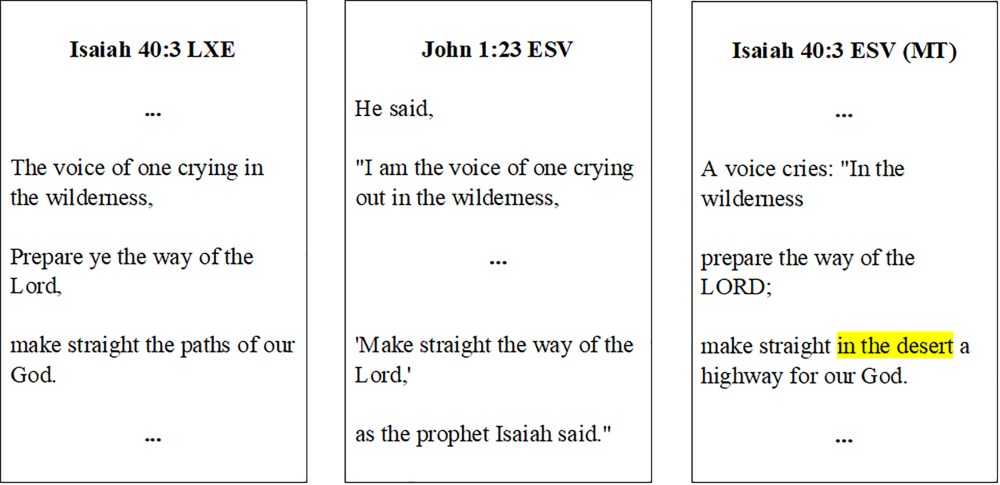
Original chart by Christina Wilson
When the reader of John 1:23 turns to the Old Testament to find the source of the quotation John uses, she will encounter a slightly different verse. In most modern versions, except those following the Greek Orthodox tradition, the Isaiah verse that John quotes has the additional phrase, “in the desert.” Well, John just left that out, you say. After all, he also left out the phrase, “Prepare the way of the Lord.” Okay, but this is not the only verse that differs. There are many such differences between our versions of the Old Testament and the New Testament quotations of it. Consider the following:
You took up the tent of Moloch and the star of your god Rephan, the images that you made to worship; and I will send you into exile beyond Babylon.’ (Acts 7:43 ESV)
But when you look up this quotation from Amos 5:26 in most translations, you will find that the quotation doesn’t match the OT verse:
You shall take up Sikkuth your king, and Kiyyun your star-god– your images that you made for yourselves, (Amos 5:26 ESV, the phrase “and I will send you into exile beyond Babylon” is from verse 27).
Compare the above modern translation based upon the Masoretic text with the Septuagint of Amos 5:26:
Yea, ye took up the tabernacle of Moloch, and the star of your god Raephan, the images of them which ye made for yourselves (Sir Lancelot Brenton translation of the Septuagint)
Clearly, the New Testament author was quoting the Septuagint (9).
Some of the differences in the Masoretic text tend to erase or minimize references to Messiah that come across strongly in the Septuagint. The following chart is from the “Orthodox Life” website: https://theorthodoxlife.wordpress.com/2012/03/12/masoretic-text-vs-original-hebrew/, accessed August 1, 2019.
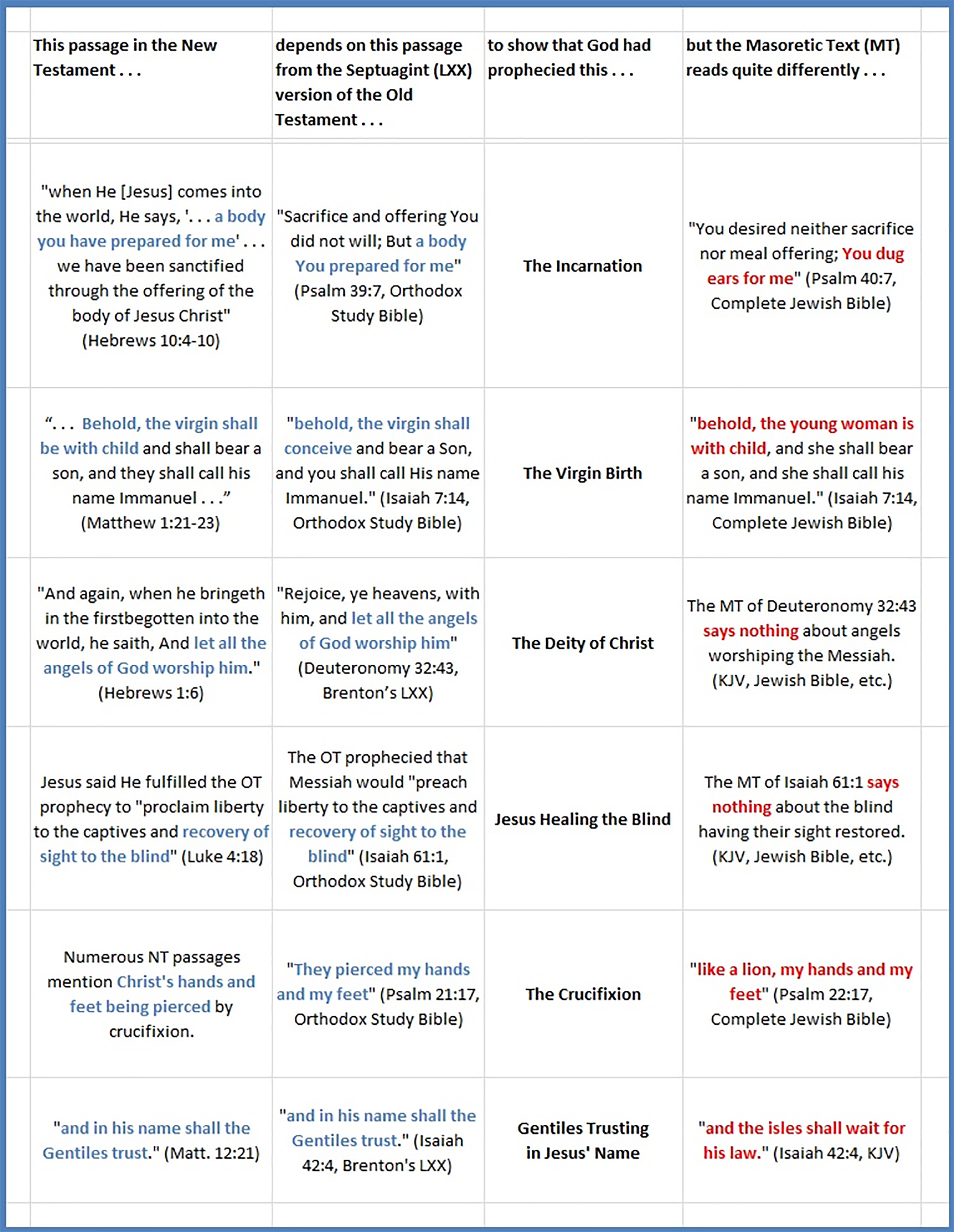
In the chart above, the right hand column for Psalm 40:7 is very similar to the NIV, ESV, and KJV. The NET gives its own interpretive paraphrase, “You make that quite clear to me!” Note that the New Testament in Hebrews 10:4-10, far left column, appears to quote the Septuagint to its immediate right, rather than the Masoretic text underlying the quotation on the far right. If we were to follow the NET, then the messianic prophecy in Hebrews 10:5, “…a body you have prepared for me,” is transformed into, “You make that quite clear to me!”
As another example in the chart above, among the English versions NIV, ESV, KJV, and NET, for Isaiah 7:14, NET is the only translation that insists upon the phrase, “this young woman.” The other three translations do say, “virgin,” perhaps following the Septuagint’s lead.
Modern biblical versions sometimes consider the Septuagint to help decipher Hebrew that doesn’t always appear clear. An example of this is found in Psalm 22:16 (LXX 21:17), “They pierced my hands and my feet,” as in the Septuagint, versus, “like a lion, my hands and my feet,” as in many, but not all, extant Hebrew manuscripts. Although the NET Bible has a very long study note for the lion phrase, both its translation and its study note fall far short of the simple note found in the ESV for its translation, “They have pierced my hands and feet.” The ESV translators chose to follow extant texts that differ from the MT. They explain, “Some Hebrew manuscripts, Septuagint, Vulgate, Syriac; most Hebrew manuscripts like a lion they are at my hands and feet.” So, some Hebrew manuscripts do say, “They have pierced my hands and feet.” In explanation of the lack of specific NT citations in the far left column, the Gospel accounts of the crucifixion imply rather than state that the soldiers nailed Jesus’s hands and feet to a cross; they state he was “crucified,” which by definition means to be suspended by nails to a cross. In confirmation of this, Luke 24:40 reads, “And when he had said this, he showed them his hands and his feet.” John 19:37 reads, “They will look on him whom they have pierced.” Again, John 20:25 speaks of nail marks in Jesus’s hands. But once again, the main point is that the Complete Jewish Bible and the NET choose to pass by a prophecy of the crucifixion in Psalm 22:16 when they choose to follow certain Hebrew texts rather than the Bible of the early Christian church, the Septuagint. And please note again that some Hebrew texts do contain what later became the Christian reading of this text.
The Septuagint Today
- Carefully consulting the study notes of the ESV reveals that this recent translation often follows the reading of the Septuagint, Vulgate, and Dead Sea Scrolls in verses that differ significantly from the Masoretic text. Some of the notes indicate the comparative readings, as in Deuteronomy 32:43. Interestingly, the NET, which translates only the Masoretic Text for the Deuteronomy verse, gives no study notes at all, even though this is a verse with several instances of multiple readings.
- The Orthodox faith has always used the Septuagint as their Old Testament Bible. According to Wikipedia, the world wide population of Eastern (Greek) Orthodoxy is 200-260 million people.
How does this impact us? Think about this. What is your favorite biblical translation, the one you use in your personal devotions and worship on a daily basis? Would you call that book, “the Bible?” Isn’t it for all practical purposes your Bible? Truth is that whenever a people group receives a Bible in their own tongue and uses it regularly, it becomes for them the Bible. If I happen to live in Papua New Guinea and I am a native, and if I receive a Bible that has been translated into my native language, then that translation for me is the Holy Word of God. Chances are it is the only Bible I will ever read.
Perhaps the most important cultural impact of the LXX in early Christian literature is due to the many translations of it into the main languages of late antiquity.
Not only did Christianity adopt a translated Bible as the official Bible, but from its beginnings it was a religion that favoured translation of the Bible into vernacular languages. Unlike Jewish communities, the Christian communities did not feel themselves to be chained to the Hebrew text as such but only to its contents, nor were they tied to the Greek text of the LXX. The new translations, as distinct from [what (inserted to correct text)] happened with the Aramaic Targumim, became independent and took the place of the original in the life of the communities. This attitude conferred on the new versions of a Bible a status unlike that of the Jewish translations. They were not merely an aid to understanding the text but they replaced the original with authority. Hence, biblical translation is spoken of as a specifically Christian activity.
It is appropriate to note that, with the exception of the Aramaic translations, most of the ancient versions of the Bible were made from the LXX and not from the Hebrew. Not even the Peshitta or the Vulgate, most of which was translated from Hebrew, are immune to the influence of the LXX.
–The entire quotation above is contiguous from Natalio Fernandez Marcos, The Septuagint in Context: Introduction to the Greek Version of the Bible, translated by Wilfred G. E. Watson (Brill: Leiden, the Netherlands, 2000), 346.
Worldwide, among believers of all times and places, there is not now nor has there ever been one, single, original Bible. And, like the Ark, Aron’s staff, and the cross of Christ, if there once were such a Bible, it is quite unavailable to everyone now. Believers have always used the Bible they like and the one that is at hand. And why should any believer be told by a group of remote scholars that “their” Bible is incorrect for purposes of “exegesis?” Modern scholarship has declared that Jesus’s followers and the authors of the New Testament used the Septuagint as their Bible. For these people, the Septuagint was God’s Holy Word.
But even deeper than all written texts and translations, God himself protects the substance of his Word by the gift of the Holy Spirit, who indwells each believer’s heart. The aggregate of the Spirit inspired beliefs of all Christians creates what is known as the “rule of faith.” It was by the “rule of faith” that the early church established the traditions of what was genuinely from the Lord and what was not. The “rule of faith,” not a body of influential and elite scholars, determined which gospels and which letters were genuinely from God. After many centuries, an important standard for canonicity was the “rule of faith,” that is, what the church as a body determined was orthodox, based upon what was spoken by the apostles and later repeated by word of mouth to all believers. What the “rule of faith” determined was Scripture, became New Testament Scripture (10). A group of church elders did no more than put their seal of approval upon those letters and gospels which the body of Christian believers through usage over time agreed to be the apostles’ teaching. This explains why there are two Bibles for two branches of Christian faith, namely, the Western and the Eastern.
Galatians 5:1 For freedom Christ has set us free. Stand firm, then, and do not be subject again to the yoke of slavery. (NET)
Are we free to choose? Scholars come, and scholars go, but the Word of our God stands forever. Personally, in my private devotions and worship, almost since my beginning in Christ, I have relied upon the Septuagint Bible and its English translation by Brenton for the book of Psalms and the book of Isaiah. I love this version because I find it speaks of Christ more directly than many of our other English choices. And isn’t Christ who the Bible is entirely about?
__________
1 Natalio Fernandez Marcos, The Septuagint in Context: Introduction to the Greek Version of the Bible, translated by Wilfred G. E. Watson (Brill: Leiden, the Netherlands, 2000), 338-339.
2 Timothy Michael Law, When God Spoke Greek: The Septuagint and the Making of the Christian Bible (Oxford University Press: New York, 2013), 118-119.
3 “The Aleppo Codex, the oldest Hebrew Bible that has survived to modern times, was created by scribes called Masoretes in Tiberias, Israel around 930 C.E. As such, the Aleppo Codex is considered to be the most authoritative copy of the Hebrew Bible. The Aleppo Codex is not complete, however, as almost 200 pages went missing between 1947 and 1957.” Overview summary by Bing, original article available at https://en.wikipedia.org/wiki/Aleppo_Codex, accessed August 3, 2019.
4 Karen H. Jobes and Moises Silva, Invitation to the Septuagint (Baker Academic: Grand Rapids, 2000), 278.
5 Natalio Fernandez Marcos, The Septuagint in Context: Introduction to the Greek Version of the Bible, translated by Wilfred G. E. Watson (Brill: Leiden, the Netherlands, 2000), 357.
6 Jennifer M. Dines, The Septuagint (T&T Clark Ltd: New York, 2004), 24 and 41-62.
7 Karen H. Jobes and Moises Silva, Invitation to the Septuagint (Baker Academic: Grand Rapids, 2000), 281. See pages 273-287 for further information on the history of the text of the Septuagint.
8 An interesting, easy-to-read article on this topic appears at this link: https://www.biblestudytools.com/bible-study/topical-studies/does-the-new-testament-misquote-the-old-testament.html. Another appears here: http://orthochristian.com/81224.html.
9 See Fr. John Whiteford, “The Septuagint vs. the Masoretic Text“ in Orthodox Christianity, http://orthochristian.com/81224.html, accessed August 1, 2019.
10 Andreas J. Kostenberger, L. Scott Kellum, Charles L Quarles, The Cradle, the Cross, and the Crown (B&H Academic: Nashville), 2009, 9. See also https://www.earlychurchtexts.com/public/tertullian_on_rule_of_faith.htm, accessed 08/02/2019.
Psalms 25 and 26: Guilty or Innocent?

In Psalm 25, the psalmist admits his guilt; in Psalm 26, he maintains innocence. How can both be true? Both Psalm 25 and Psalm 26 are ascribed to David. Psalm 25:7-11 and verse 18 confess and deal with the sin issue, while Psalm 26 in its entirety is a statement of the psalmist’s righteousness. Surely this anomaly needs an explanation?
Oddly, many commentators skip over the superscription attributing these psalms to David. It does not appear to be an item of interest, perhaps for the reason often stated that no specific incident in David’s life can be connected to either of them. Be that as it may, whenever a reader ascribes a psalm to a human person as its subject, certain difficulties may be encountered. For example, while Scripture attests fully to David’s sin with Bathsheba, it proves more difficult to justify David as the author of Psalm 26, since according to Scripture, he was not innocent, but a shameful adulterer and murderer (2 Samuel 11-12:15). Several commentators face this difficulty by modifying the meaning of “innocent” to refer to one’s attitude of loyalty to God when attempting to enter his temple, rather than to a meaning of moral purity and sinlessness. They claim that the speaker in Psalm 26 does not claim moral perfection, but a relative righteousness in comparison with his enemies, who hate God outright. But are these weasel words? [1]
Fortunately for the reader, consistently applying a few basic premises to the Psalter as a whole serves to clear up such difficulties. These premises are 1) that the Psalter is poetic prophecy of the Christ, and 2) that Christ is the speaker in the first-person singular psalms, especially those ascribed to David. Let’s apply these premises to Psalms 25 and 26.
First, consider these statements from the New Testament.
God made the one who did not know sin to be sin for us, so that in him we would become the righteousness of God.
(2 Corinthians 5:21 NET)He committed no sin nor was deceit found in his mouth. (1 Peter 2:22 NET)
For God has done what the law, weakened by the flesh, could not do. By sending his own Son in the likeness of sinful flesh and for sin, he condemned sin in the flesh, (Romans 8:3 ESV)
Christ redeemed us from the curse of the law by becoming a curse for us– for it is written, “Cursed is everyone who is hanged on a tree”– (Galatians 3:13 ESV)
…25 who was delivered up for our trespasses and raised for our justification. (Romans 4:25 ESV)
9 And they sang a new song, saying, “Worthy are you to take the scroll and to open its seals, for you were slain, and by your blood you ransomed people for God from every tribe and language and people and nation,
10 and you have made them a kingdom and priests to our God, and they shall reign on the earth.” (Revelation 5:9-10 ESV)
As we read these New Testament quotations in the light each one sheds upon the other, it becomes clear that Christ himself was without sin of any kind. He was morally perfect. Yet, he was the sacrificial lamb who not only took upon himself the sins of people, but even more than that, became sin for us.
Next, consider the question, how would you reveal this information to a people who were only being taught for the very first time a multi-person God? One of the purposes of the Psalter was to reveal that the one God has a Son (see Psalm 2:7).
Finally, to comprehend from poetry that God’s Son suffered and died as a sacrifice for sin would be no easy matter for Old Testament worshipers. God is holy, eternal, and sovereign–how then can he confess sin and die as a sacrifice? People in that era basically thought in concrete terms rather than spiritual. God designed the sacrificial system in order to teach about sin and atonement in a concrete way. The Psalter is a poetic application and spiritual extension of that concrete symbolism–not necessarily easy in that era for people to grasp.
Consider, even for many of us, who possess the facts of Jesus’ life as presented in the Gospels, it may be difficult to envision how one person could be innocent and guilty at the same time (see 2 Corinthian 5:21 above). When the Psalter was being written, I believe it fair to say that the vision of God’s people was far more limited than our vision today.
The solution? Two prophetic poems rather than one. Nevertheless, difficulties of comprehension still remained.
The Psalter reveals that the Christ was coming, that he was God’s holy King, that he would have enemies who falsely accuse and kill him, and that he would be raised from the dead to occupy God’s throne. Did God’s people understand all this? Scripture tells us that very few understood.
10 Concerning this salvation, the prophets who prophesied about the grace that was to be yours searched and inquired carefully,
11 inquiring what person or time the Spirit of Christ in them was indicating when he predicted the sufferings of Christ and the subsequent glories. (1Peter 1:10-11 ESV)7 But we impart a secret and hidden wisdom of God, which God decreed before the ages for our glory.
8 None of the rulers of this age understood this, for if they had, they would not have crucified the Lord of glory. (1Corinthians 2:7-8 ESV, Read also to the end of the chapter.)25 And he said to them, “O foolish ones, and slow of heart to believe all that the prophets have spoken!
26 Was it not necessary that the Christ should suffer these things and enter into his glory?”
27 And beginning with Moses and all the Prophets, he interpreted to them in all the Scriptures the things concerning himself. (Luke 24:25-27 ESV)44 Then he said to them, “These are my words that I spoke to you while I was still with you, that everything written about me in the Law of Moses and the Prophets and the Psalms must be fulfilled.”
45 Then he opened their minds to understand the Scriptures,
46 and said to them, “Thus it is written, that the Christ should suffer and on the third day rise from the dead,
47 and that repentance and forgiveness of sins should be proclaimed in his name to all nations, beginning from Jerusalem. (Luke 24:44-47 ESV)
Application and Exhortation to Faith: We today do not need to be “foolish” and “slow of heart” to believe. We have Christ’s own word that the Psalms were written about him. It behooves us to search out what they say and to stand upon the assurance of biblical faith that we who live in New Testament times most certainly do not need to limit our understanding of the Psalter to what a listener of that era may or may not have understood about the coming Christ. The Psalter is an amazing book, and we cheat ourselves if we do not see Christ predominantly in it.
For more on Christ in his mediatorial role, see Penitential Psalms: Psalm 51–A Personal God of Love and Psalm 25: Change of Person and Multiple Speakers.
_______________
1 See, for example, each of the following in its discussion of Psalm 26: 1) Bonar, Andrew A. Christ and His Church in the Book of Psalms: 150 Inspirational Studies. Grand Rapids: Kregel Publications, 1978. 2) Reardon, Patrick Henry. Christ in the Psalms, 2nd edition. Chesterton: Ancient Faith Publishing, 2011. 3) Belcher, Richard P. Jr. The Messiah and the Psalms: Preaching Christ from All the Psalms. Scotland: Christian Focus Publications, Ltd., 2006.
Psalm 24: Formal and Boring or Dramatic and Exciting?

clipart-library.com
A Bit of a Meandering Approach…
I remember the third stanza of Psalm 24 (verses 7-10) from my Sunday School childhood. Our teacher had selected this psalm for her class to memorize and present in a little program to the church. What did it mean? Who knows? We were never taught. My young mind created an image of large and heavy, wood and iron gates, fairytale style, cranking themselves up all by themselves, so that a King on a horse could enter over a stone road paved in large, boulder-like slabs to whatever it was that lay beyond. Did I know that the King was the Lord Almighty Jesus Christ at his ascension? No, not at all. The words held no concrete meaning for me at that point in my life. Actually, that the words came from “the Bible” meant nothing to me either. Nevertheless, I always remembered those few lines of this little poem. Our teacher had us perform the psalm chorus style. Although I enjoyed following her stage directions to deliver these final verses in a loud, strong voice, no internal emotion accompanied my recitation. No wonder, since the words held no meaning for my tiny life.
I reread this poem in January, and in the margin I wrote, “Awesome.” Then I forgot about it. This morning, when I read it again, my first reaction was one of confusion. What does Stanza 1 have to do with Stanza 2? And how do we get from there to Stanza 3? Nevertheless, I knew that something amazing was happening in the third stanza, and I wrote the one word response, “Wow.”
Finding the psalm to be beyond me, I went straight to my most spiritual commentator, John Barclay. In light of what I’ve written here, you my reader may understand why I burst out laughing, as in “LOL!”, when I read what Barclay had written. He wrote bunches, far more than normal.
Although it seems perfectly true, as all the commentators say, that this Psalm (and perhaps all the rest) was used to be sung in parts, by the different bands of sacred music which David (no doubt by the direction of the Holy Ghost) had appointed for the service of the Sanctuary; yet, if we attend any further than that, to the dull, dry, bare, and beggarly disquisitions of the carnally-minded … [academics] …, concerning the procession of the ark, its being received into the temple, and set upon its own place, with such like childish ideas, and nugatory [worthless, trivial] observations, retailed and enumerated every day, and almost in every place of worship, in the most stale and tedious manner imaginable; now do we find our whole spirit, fervor, and devotion, in the most amazing manner, all at once, as if it were by enchantment, damped, destroyed, and shrunk to nothing, after the manner, if we may so say, of the plump kine [cows], and full ears of corn, which were devoured and swallowed up by the lean, thin, blasted and shriveled!–But if, ceasing from the… [academicians], we take the spirit of the Psalm from the Spirit who inspired it, and read it in its own light, the light of its parallels, and especially the light of the New Testament, we will find, instead of the darkness of the Mosaic veil, the glory of God shining in the face of Jesus, filling our whole hearts… (Barclay, 147).
I hope you were able to wade through that–he did, after all, write those words in the early 1800’s, before texting, Twitter, and bit-speech were ever invented. I laughed when I read his impassioned description of dry, dead academia because of the confidence and unabashed moxy he displays in his vigorous attack of the “letter” that kills (2 Corinthians 3:6). I laughed because he sums up my thought exactly and bludgeons where I barely dare to hint.
So, what did Barclay (and others in my bibliography) find in Psalm 24? In short–a summation of the entire Bible and gospel.
Stanza 1, which is verses 1 and 2, represents Christ before time in his sovereignty and great creative act, as God and with God.
1 The earth is the LORD’s and the fullness thereof, the world and those who dwell therein, 2 for he has founded it upon the seas and established it upon the rivers. (ESV)
His parallel verses are John 1:1 and Colossians 1:17. I would add a phrase from Hebrews 1:3, “he upholds the universe by the word of his power.”
1 In the beginning was the Word, and the Word was with God, and the Word was God.
2 He was in the beginning with God.
3 All things were made through him, and without him was not any thing made that was made. (John 1:1-3 ESV)16 For by him all things were created, in heaven and on earth, visible and invisible, whether thrones or dominions or rulers or authorities– all things were created through him and for him.
17 And he is before all things, and in him all things hold together. (Col 1:16-17 ESV)
Stanza 2 extends from verse 3 through 6 and displays Christ in his sinless human nature making atonement as mediator between those sinners who nonetheless desire God, and God in his holiness. It is by the obedience of belief in this one man Christ that God declares every willing human righteous, who is “found in him… not having a righteousness of [their] own that comes from the law, but that which comes through faith in Christ, the righteousness from God that depends on faith.” (Philippians 3:9 ESV) This verse from Philippians is almost a restatement of Psalm 24:3-6 and presents the gospel message in a nutshell. In Psalm 24, verses 3-5 refer to Christ, and verse 6 to his followers.
3 Who shall ascend the hill of the LORD? And who shall stand in his holy place? 4 He who has clean hands and a pure heart, who does not lift up his soul to what is false and does not swear deceitfully. 5 He will receive blessing from the LORD and righteousness from the God of his salvation. 6 Such is the generation of those who seek him, who seek the face of the God of Jacob. Selah (ESV)
Stanza 3, verses 7 through 10, closes this short psalm with a dramatized declaration of Christ’s victory in battle over sin and death and his ascension to kingly reign alongside his Father in heaven–Christ is both Savior and Lord, both human and God, the point of connection between earth and heaven. Verse 8 makes reference to the battles Christ fought in his incarnation as human, and verse 10 displays him as the LORD of hosts, the King of glory, coequal with God.
7 Lift up your heads, O gates! And be lifted up, O ancient doors, that the King of glory may come in. 8 Who is this King of glory? The LORD, strong and mighty, the LORD, mighty in battle! 9 Lift up your heads, O gates! And lift them up, O ancient doors, that the King of glory may come in. 10 Who is this King of glory? The LORD of hosts, he is the King of glory! Selah (ESV)
A Bit of Editorial Meditation
There is no doubt that it is difficult for us as readers today to comprehend the life and vitality of these 10 verses. We are inundated by media that proclaim a worldview in staunch contrast and opposition to the faith-view presented in Psalm 24. Further, we are limited by a contemporary language that has descended to near illiteracy. Finally, we experience noise all around us constantly, noise which distracts us and robs us of contemplative moments when we can simply ask God by his Spirit to open the understanding of our spirit made in his image.
Yet these are not insurmountable obstacles. I believe a deeper issue lies at the heart of our inability to appreciate God’s biblical treasure map to us, our love letter-in-a-bottle, that is, Holy Scripture. The issue is pinpointed when we answer the question, Who do I worship? Negotiating daily life in today’s age has taught me to place myself at the center of everything. How am I doing? How do I rate? Are my needs being met? Am I performing adequately? Even our church worship services tend toward the me, me, me. Have I met God today? Have I been fulfilled by this service? Rather than, Have I presented God with a sacrifice of worship that pleases him?
Yes, the church is included in Psalm 24:6, but it’s not a psalm about the church, it’s a psalm about Jesus Christ. In order to fully appreciate Psalm 24 I need to accept that it’s a psalm not about me–it’s not about my successes and failures, my needs, my wants, my poverty, my riches–it’s a psalm about the person and fantastic success of Jesus Christ in his eternality and temporal mission. In all honesty, I find that most of my waking thoughts are about myself. Most of the living I do is an attempt to make my self happy, to fulfill my needs as I perceive them, and yes, even when I go to church. To let all that go and to find contentment in extolling an outsider–not myself–that is today’s challenge. To let someone else’s success be my own–that is rest. I do it for my favorite football team–why can’t I do it for Jesus Christ?
Am I making sense?
Penitential Psalms: Psalm 130–Praying from the Grave

1 [A Song of Degrees.] Out of the depths have I cried to thee, O Lord. 2 O Lord, hearken to my voice; let thine ears be attentive to the voice of my supplication. 3 If thou, O Lord, shouldest mark iniquities, O Lord, who shall stand? 4 For with thee is forgiveness: 5 for thy name’s sake have I waited for thee, O Lord, my soul has waited for thy word. 6 My soul has hoped in the Lord; from the morning watch till night. 7 Let Israel hope in the Lord: for with the Lord is mercy, and with him is plenteous redemption. 8 And he shall redeem Israel from all his iniquities. (Psalm 129(130) LXE, Brenton)
Prophecy, if prophecy, must tell a story. A large function of the Psalter is to prophesy. The seven penitential psalms (6, 32, 38, 51, 102, 130, and 143) prophesy of Christ: his innocence, the sacrificial nature of his atoning death, his human suffering, his resurrection, and the victory of his people. These portions of the life of Christ are not necessarily presented in chronological order within the penitential psalms. While other psalms speak of Christ’s suffering (Psalms 6, 32, 38, 102, and 143), Psalm 130 speaks from the grave (the depths) without making direct statements of suffering. Rather, the unique element of Psalm 130 is an extreme period of waiting, “For thy name’s sake have I waited for thee, O Lord, my soul has waited for thy word. My soul has hoped in the Lord; from the morning watch till night,” (Psalm 130:5-6 LXE). It is not difficult for faith to hear within these verses the voice of Christ as he waits within the grave for his resurrection.
Further, Psalm 130 contains no direct statements of personal sin or guilt, as do Psalms 38 and 51. Rather, Psalm 130 is a penitential psalm of atonement, due to its discussion of sin and forgiveness without personal confession of any sort. The word forgiveness in verse 4, which is ἱλασμός (il-as-mohss) in Greek, is a relatively rare word in Scripture, although it plays an enormous role in Christian evangelism and doctrine. Arndt and Gingrich (1) define it with two meanings: 1) propitiation or expiation, and 2) a sin-offering. While the major English translations (they are translating from Hebrew, not Greek) have “forgiveness” in verse 4, they use words such as “Day of Atonement” in Leviticus 25:9, “ram of atonement” in Numbers 5:8, “sin-offering” in Ezekiel 44:27, “propitiation” or “atoning sacrifice” in 1 John 2:2, and the same for 1 John 4:10. All of these occurrences in the Greek Septuagint are represented by the word ἱλασμός (il-as-mohss), which is translated as forgiveness in Psalm 130:4 (LXE Brenton) or atonement (NETS, Pietersma). (See footnotes 2 and 3.) Important to our discussion of the seven penitential psalms, this is the only occurrence of this word anywhere in the entire Psalter.
Who will receive the atoning forgiveness of verse 4? Verses 7 and 8 each name Israel. Israel, in the New Testament sense of the word (Romans 11:26), includes all believers, both saints of the Old Testament and saints of the New. What at first glance might seem to be a psalm of personal lament, therefore, is an intercessory prayer for the beneficiaries of Christ’s death. When God answers the Lord’s prayer for resurrection from the grave (verses 1-2 and 5-6 above), then his “unfailing love” (verse 7) and “full redemption” (verse 7) will be magnificently realized, for “He himself will redeem Israel from all their sins” (verse 8).
Comments: For those readers who consult commentaries, you might find that the point of view I present above, namely, that Christ is the subject of this prayer/poem–he is the one who is praying to God his Father from the grave–is underrepresented (4). The thesis of my approach is simple: the Psalter in its first person singular prayers speaks the voice of Christ.
I want to repeat what I wrote in the first post of this series on penitential psalms, “My purpose here is to hold up a road sign to you that says, “Have you tried this pathway through Psalms?” The pathway we will consider is Christ and his cross. Even in the so-called grouping of seven Penitential Psalms, we find Christ ever present and revealed. These psalms are not primarily about experiencing emotions of penitence designed to lead us to repentance. Rather, they are primarily about the life of Jesus Christ during his incarnation. My premise is that Psalms reveal Christ. He is their primary focus. As we see Christ revealed, we also learn about God’s love for us, and that is what makes them important” (The Penitential Psalms: A Fresh Look–New Series).
Premising Christ as speaker in all the penitential psalms at first appears to provide obstacles, the most difficult being what to do with a psalm of pure confession, such as Psalm 51. However, when we consider the seven psalms as a unified whole with the understanding that Christ is speaker throughout (except of course in those places which imply or directly state that God is addressing Christ, Psalm 102), we see that a clear picture of the several elements of the complete gospel emerges:
- Christ’s passion of human suffering (Psalms 6, 32, 38, 102, and 143)
- Christ’s innocence (Psalms 6, 102, and 130)
- the wrath of God upon Christ, the wrath that achieved propitiation (Psalms 6, 32, 38, 102, and 143)
- the persecution of Christ by his enemies (Psalms 6, 38, 102, and 143)
- Christ’s identity as both God and man (Psalm 102)
- Christ’s resurrection (Psalm 102:13)
- Christ’s prayer for his resurrection (Psalm 130)
- end results for Israel (or Zion) and the Church won by Christ in his victory through the cross (51, 102, and 130)
When the reader perceives Christ in their center, the penitential psalms (and the Psalter as a whole) gain a cohesion and sense of meaning that a consideration of each psalm separately does not provide. Also, this viewpoint provides deeper and more certain theological meanings than the isolated concepts of confession and repentance might individually supply. These psalms offer a great hope for the one who reads, a hope placed on the solid ground of the actions of the Son of God, rather than upon the alternative actions of an unnamed sinner with whom the reader must strain to identify. Once again, my purpose here is to hold up a road sign that says, “Have you tried this pathway through Psalms?” My prayer is that as you spend time with the Lord, asking him to reveal his presence to you within the words of Christ as expressed in these seven psalms, that God through his Holy Spirit will answer your heart to the fullest extent.
__________
1 Arndt, William F. and F. Wilbur Gingrich, Editors. A Greek-English Lexicon of the New Testament and Other Early Christian Literature, 2nd Edition. Revised and Augmented by F. Wilbur Gingrich and Frederick W. Danker from Walter Bauer’s Fifth Edition, 1958. Chicago: The University of Chicago Press, 1979.
2 Brenton, Sir Lancelot C. L. The Septuagint Version: Greek and English. Grand Rapids: Zondervan Publishing House, 1970.
3 Pietersma, Albert, ed. A New English Translation of the Septuagint: The Psalms. Translated by Albert Pietersma. New York: Oxford University Press, 2007. Available online at http://ccat.sas.upenn.edu/nets/edition/24-ps-nets.pdf. Accessed April 27, 2018.
4 John Barclay hears only the voice of Christ in Psalm 130. See Barclay, John. The Psalms of David, and the Paraphrases and Hymns: With a Dissertation on the Book of Psalms, and Explanatory Introductions to Each. Edinburgh: James Gall, 1826. Reprinted Digitally by Forgotten Books, registered trademark of FB &c Ltd., London, 2017. Available at http://www.ForgottenBooks.com, 2017. A better quality copy is available at https://babel.hathitrust.org/cgi/pt?id=nyp.33433068259260;view=1up;seq=205;size=75. Accessed April 11, 2019.
Penitential Psalms: Psalm 102–God’s Son Speaks: Technical Background
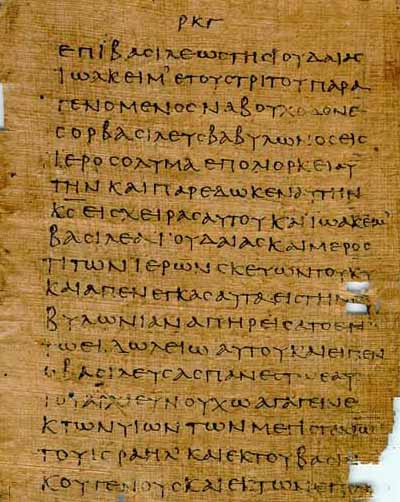
P 967 Rahlfs Daniel 1.1 (ca. 200 p. Chr. n., Papyrus-Sammlung Köln).
Accessed at http://www.hsaugsburg.de/~harsch/graeca/Chronologia/S_ante03/VT/vte_pd00.html#p967
Tragically, not many commentators hear the voice of Christ in Psalm 102. Spurgeon (1) does not. Generally, those who don’t hear the voice of Christ fail to hear the divine dialogue within this amazing psalm. Because two or more witnesses biblically establish a valid testimony (Deuteronomy 17:6; Matthew 18:16; John 8:18), I’m going to take time at the outset to provide these additional witnesses to my own. First, here is a link to the text itself, where the reader can find the entirety of Septuagint Psalm 101(102), and below that is an excerpt that contains the portion quoted in Hebrews 1:10-12.
Reader Resource: Bilingual Text LXX (Septuagint in Greek) and LXE (Brenton’s English Translation). Notice that in the Greek Septuagint and in Brenton’s translation, Psalm 102 in our English Bibles is numbered as Psalm 101. Also, verse numbers may differ, depending upon which Septuagint edition is being used. The numbers to the left follow the Masoretic tradition while those in parenthesis follow the numbering used by the link given.
23(24) He answered him in the way of his strength: tell me the fewness of my days.
24a(25a) Take me not away in the midst of my days: 24b(25b) thy years [are] through all generations.
25(26) In the beginning thou, O Lord, didst lay the foundation of the earth; and the heavens are the works of thine hands.
26(27) They shall perish, but thou remainest: and [they all] shall wax old as a garment; and as a vesture shalt thou fold them, and they shall be changed.
27(28) But thou art the same, and thy years shall not fail.
28(29) The children of thy servants shall dwell [securely], and their seed shall prosper for ever.
Here is the same text as presented in the ESV with the Septuagint English in brackets alongside: Psalm 102:23-28.
23 He has broken my strength in midcourse; [LXX: He answered him in the way of his strength:]
he has shortened my days. [LXX: tell me the fewness of my days.]
24 “O my God,” I say, “take me not away in the midst of my days— [LXX: Take me not away in the midst of my days:]
you whose years endure throughout all generations!” [LXX: thy years [are] through all generations.]
25 Of old you laid the foundation of the earth,
and the heavens are the work of your hands.
26 They will perish, but you will remain;
they will all wear out like a garment.
You will change them like a robe, and they will pass away,
27 but you are the same, and your years have no end.
28 The children of your servants shall dwell secure;
their offspring shall be established before you.
Finally, here is the portion (ESV) which the author of Hebrews quotes from the Septuagint:
10 And, “You, Lord, laid the foundation of the earth in the beginning,
and the heavens are the work of your hands;
11 they will perish, but you remain;
they will all wear out like a garment,
12 like a robe you will roll them up,
like a garment they will be changed.
But you are the same,
and your years will have no end.”
Second, as witness #1, here is how I perceive the dialogue in Psalm 101(102). Note that verse numbers differ and are dependent upon the edition being used. For reader convenience I am using the Masoretic numbers and referencing in brackets the numbers found in the “Bilingual Text” link in the “Reader Resource” paragraph at the top of this article.
- Verses 1 – 11 [1-12 in the bilingual link given above]. God’s Son speaks to his Father in the days of his incarnation and Passion.
- Verses 12 – 22 [13-23] God the Father replies through the Holy Spirit to his Son.
- Verses 23 – 24a [24-25a] God the Son answers God the Father. (23 “He answered him in the way of his strength: tell me the fewness of my days. 24a Take me not away in the midst of may days:)
- Verses 24b – 28 [25b-29] God the Father answers the Son. (24b “thy years are through all generations. 25 In the beginning thou, O Lord …]
Witness #2: John Barclay (2).
[Barclay uses the Masoretic numbering] In this Psalm we behold the sufferings of Christ, as expressed in his own person, by the Holy Ghost, from the beginning to verse 12, contrasted with the following glory, as declared by the same Spirit in the person of the Father, from verse 12 to 23. Then from the 23d to the middle of verse 24, the dialogue is again renewed, as at the beginning of the Psalm, in the person of the Son–to whom, from the middle of verse 24, to the end of the Psalm, the Father is again represented, as replying according to the former manner, mentioned from ver. 12 to 23: for so this Psalm, ver. 25, &c. is expressly applied and interpreted by the Holy Ghost, Heb. I. ‘Unto the Son he saith, Thy throne, O God, is for ever and ever–And thou, Lord, in the beginning, hast laid the foundation of the earth; and the heavens are the works of think hands,’ &c.–‘And they shall be changed: but thou are the same, and thy years shall not fail.’
My Comment: Very few biblical commentators will ascribe verses 12-24a to God the Father or God the Holy Spirit, even among those who readily find the Father replying to Christ in the final speech, verses 24b-28. Most gladly I recognize the kindred spirit that exists between John Barclay and myself.
In contrast to Barclay, the third witness, below, Robert Hawker, is one who readily hears the voice of Christ in his Passion in verses 1-11, yet who does not recognize the words of comfort found in verses 12-22 as proceeding from God the Father. He does, however, hear Christ speaking in verses 23-24a and the Father directly answering him in verses 25 to the end.
Witness #3: Robert Hawker (3).
After verse 28: From the apostle Paul’s quotation of this glorious passage, Heb. I. 10, &c. and his illustration of it, as there explained, it should seem very evident that these verses contain God the Father’s answer to Christ’s prayer, and form a blessed summary of all redemption mercies ensured to the church in Him…Reader, I know not what soul exercises or afflictions your heart may be wounded with; but I venture to believe, that the truest relief under all, is to view Christ in his unequalled sorrows. Poring over ourselves, or over our own sorrows, and magnifying them, will never bring comfort. But if I see Jesus with the eye of faith, in the tribulated path; if I mark his footsteps, and he calls to me, and leads me by the way of the footsteps of his flock, where he feeds his kids, beside the shepherds’ tents; I shall feel comfort.
My Comment: Very often, those commentators who do not perceive the voice of Christ in Psalm 102, but that of an unnamed human suppliant–these authors tend to focus on Christ as Creator, and that portion of Hebrews as a Creation passage. The reasoning is that the author of Hebrews merely “applies” the words of Psalm 102:25-28 to Christ as object. They consider verses 25-28 to be spoken by the unnamed single human speaker who speaks throughout the entire psalm. They argue that though this human poet addresses God throughout the entirety of the psalm, this particular portion is applied by the author of Hebrews as making reference to Christ as Creator. In other words, they see a human speaking to God throughout the psalm, complaining to God for a longer life, reasoning that because God has such a long life and such power to create, why can’t he give some of that to the suffering poet? They fail to grasp the nearly sacrilegious arrogance of such a supplication. These commentators claim that the author of Hebrews by inexplicable “divine” inspiration, wrenched these words in particular from the whole psalm, and applied them in reference to Christ as object (Creator). Not only does this do disservice to the entire concept of the Bible’s having been written in “plain, ordinary speech,” but it completely destroys the comfort Hawker and others preeminently find in this psalm, as they consider the sufferings of Christ and the comfort afforded both him and us, who are in him, by God the Father.
Witness #4: Arthur Pink (4)
Arthur Pink lines up with Hawker as perceiving Christ as speaker up until the Father’s reply quoted in Hebrews (verses 25-28). Myself and Barclay, the reader might recall, saw two sections in which God the Father spoke directly to the Son (verses 12-22 and 24b-28.) Pink sees only the latter. He adds to the discussion, however, by combining the author of Hebrews’ rhetorical (logical, argumentative) use of Christ as Creator with the devotional comfort found in Psalm 102 of Christ as suffering Savior. Pink writes:
“And Thou, Lord, in the beginning, hast laid the foundation of the earth.” The Psalm from which this is quoted is a truly wondrous one … It lays bare before us the Saviour’s very soul. Few, if any, of us would have thought of applying it to Christ, or even dared to, had not the Spirit of God done so here in Heb. 1. This Psalm brings before us the true and perfect humanity of Christ, and depicts Him as the despised and rejected One (p 69, see note 4).
After the above, Pink quotes the entire psalm (an indication of how very impressed he is with it) up through verse 22. He labels verses 23-24a as the “strong crying,” quoted in Hebrews 5:7, “of Him who was ‘acquainted with grief.'” Then Pink writes:
And what was Heaven’s response to this anguished cry of the Saviour? The remainder of the Psalm records God’s answer: “Thy years are throughout all generations. Of old hast Thou laid the foundation of the earth. And the heavens are the work of Thy hands. They shall perish, but Thou shalt endure, yea, all of them shall wax old like a garment; as a vesture shalt Thou change them, and they shall be changed: But Thou art the same, and Thy years shall have no end” (vv. 24-27).
Conclusion: In what I hope has not been a manner too arduous to read, I’ve presented four witnesses who agree that through the use of dialogue, Psalm 102 represents both the voice of the Son crying out to his Father in anguish during the days of his incarnation and Passion and the comforting voice of his Father in reply. I have been greatly encouraged recently to have discovered current academic writers who perceive divine dialogue between Father and Son in the book of Psalms (5). I’m sure up to date devotional material, such as this one seeks to be, will also follow.
I have presented these four witnesses so that the reader may have confidence to explore this pathway in a meditatively devotional session of his or her own. For those who follow this blog, I promise that a devotional interpretation of Psalm 102 will be written next.
For now, in consideration of Christian history’s regarding of Psalm 102 as one of the seven so-called penitential psalms, I just want the reader to notice how exactly the Holy Spirit wrote Scripture. We have seen that not all of the so-called “penitential” psalms are penitential in a sense that requires confession and repentance over sin. In this sense of the word, Psalm 51 is the most “penitential,” and Psalm 102 not at all. Note carefully that Psalm 51, which confesses and mourns over sin, does not represent Christ in any way as speaking from the divinity of his being. Rather, he speaks as mediator, a participant in humanity, a sacrificial lamb who took upon himself the sins of the world. Then, just as carefully, note that Psalm 102, which is highly “penitential” in the second meaning of the word, that of poverty and suffering of spirit, presents Christ both in his divinity and his human nature, but quite apart from sin. The reader can conclude that Christ God’s Son, as 2 Corinthians 5:21 states, “knew no sin,” as Psalm 102 demonstrates, and yet God “made him to be sin” “for our sake,” Psalm 51. Praise God.
__________
1 Spurgeon, Charles. The Treasury of David: Containing an Original Exposition of the Book of Psalms; A Collection of Illustrative Extracts from the Whole Range of Literature; A Series of Homiletical Hints upon Almost Every Verse; And Lists of Writers upon Each Psalm in Three Volumes. Peabody: Henrickson Publishers, No Date.
2 Barclay, John. The Psalms of David, and the Paraphrases and Hymns: With a Dissertation on the Book of Psalms, and Explanatory Introductions to Each. Edinburgh: James Gall, 1826. Reprinted Digitally by Forgotten Books, registered trademark of FB &c Ltd., London, 2017. Available at http://www.ForgottenBooks.com, 2017. A better quality copy is available at https://babel.hathitrust.org/cgi/pt?id=nyp.33433068259260;view=1up;seq=205;size=75.
3 Hawker, Robert S. The Poor Man’s Old Testament Commentary: The Book of Psalms, public domain. Available at http://grace-ebooks.com/library/Robert%20Hawker/RH_Poor%20Man%27s%20Old%20Testament%20Commentary%20Vol%204.pdf, published by Grace Baptist Church of Danville, Kentucky. Accessed May 3, 2018.
4 Pink, Arthur. An Exposition of Hebrews. Baker Book House: Grand Rapids, 1954, pages 68-74.
5 See Bates, Matthew W. The Birth of the Trinity: Jesus, God, and Spirit in New Testament & Early Christian Interpretations of the Old Testament. Oxford University Press: Oxford, United Kingdom, 2015 and Paperback Edition 2016. See also Bates, Matthew W. The Hermeneutics of the Apostolic Proclamation: The Center of Paul’s Method of Scriptural Interpretation. Baylor University Press: Wayco, Texas, 2012.
Penitential Psalms: Psalm 51–A Personal God of Love

It happens to be Maundy Thursday and tomorrow is Good Friday. Psalm 51 is an Easter Song if there ever was one. Psalm 51 is difficult for me and for everyone who strongly feels that Christ is the primary speaker in David’s psalms. The speaker in this psalm unquestionably confesses his personal guilt and sin. And Christ is sinless and holy. How can the speaker be Christ? And yet, that is my position.
Craig C. Broyles writes that of the seven penitential psalms (Pss. 6, 32, 38, 51, 102, 130, and 143), Psalm 51 is unique in its exclusive focus on sin (Broyles, p226). He also writes that among the psalms as a whole, it is “unrivaled … for its interest in inner transformation” (Ibid.). While Broyles in no way claims Christ as speaker, he states that within the psalm itself there is no reason to see David as speaker (Ibid., p 226-227). The superscripts were written by an ancient editor after the fact. None of the superscriptions above the psalms is to be considered Scripture.
Why is it so difficult to receive Christ as speaker in Psalm 51? Consider these words:
Have mercy on me, O God, according to your steadfast love; according to your abundant mercy blot out my transgressions. 2 Wash me thoroughly from my iniquity, and cleanse me from my sin! 3 For I know my transgressions, and my sin is ever before me. 4 Against you, you only, have I sinned and done what is evil in your sight, so that you may be justified in your words and blameless in your judgment. 5 Behold, I was brought forth in iniquity, and in sin did my mother conceive me. (Psalm 51:1 ESV)
Turn away thy face from my sins, and blot out all mine iniquities. (Psalm 51:9 LXE)
I must speak personally here, but I think I speak for many. To attribute the above words to Christ stirs up uncomfortable feelings of shame that are difficult to deal with. If Christ the sacrificial lamb speaks these words upon the painful cross, then that means that he the sinless one is speaking these words for me. It’s extremely humbling to go before the throne of grace knowing that He knows. It’s humbling to agree with him that yes, I did do these things. But what is most humbling is to see the big problem for God that my sin caused and to watch, childlike, as he himself pays the cost to fix the damage my sinful actions brought about. Yes, it’s very childlike. Come on, folks, admit it. God went to a lot of trouble to fix the problem humanity’s sin caused and it cost him a great deal. Because he is who he is, we in our puniness will never be able to possibly imagine what it was like for God’s Son, God himself, our creator, the all-powerful one, to become one of us and to take upon himself our sin.
Psalm 51 can be a great blessing for everyone whose sin is great. So often we hear about those who feel that God could never forgive their sin because of its excessive nature. “God can forgive others,” they may think, “but he could never forgive me.” Yes, he could! And he did! The actual words of the psalm itself don’t say what the sin was. When Israel’s high priest used to lay his hands upon the head of the scapegoat, he wasn’t just symbolically giving up the low-level sins of the people, but all their sins (Leviticus 16:7-10). God knows. Jesus on the cross knew what the sins were. He confessed them as his own.
What might the following words mean when translated into the actual experience of the One hanging on the cross? 
For our sake he made him to be sin who knew no sin, so that in him we might become the righteousness of God. (2Corinthians 5:21 ESV)
Might such a person, who has himself become sin, be able to confess the words of Psalm 51? For the sake of all who might ever believe in him, I say yes (1).
__________
1 Because Scripture calls for a witness of at least two, “Where two or more are gathered in my name…” “…take one or two others along…,” I’d like to bring along with me John Barclay. He writes:
… there is no blasphemy (as many have most blasphemously alleged there is) in this manner of interpretation [Christ as the sole speaker in all of Psalm 51]; which must either be admitted, or the New Testament made void! (Barclay, page 218)
While Barclay in his preface has multitudes of arguments to support his attributing all of Psalm 51 to Christ as speaker, one of his main arguments is the existence of parallel passages: Psalm 51:16-17 is parallel to Psalm 40:6. Psalm 40:6-8 is quoted in Hebrews 10:5-7. There the words are attributed directly to the mouth of Christ, “Therefore, when Christ came into the world, he said…” (Ibid.). Barclays’s logic is mathematical: If A = B and C = B, then A = C. Since the New Testament in Hebrews attributes Psalm 40:6 to Christ as speaker, then a parallel passage in another psalm (Psalm 51:16) must also be attributed to Christ (Barclay, page 47). It also follows that since there is one speaker throughout all of Psalm 51, if one portion is spoken by Christ, then the whole psalm, by the rules of plain English, must also be spoken by Christ (Ibid., page 42-43).
While I agree with this “head” explanation, I also fully agree with Barclay elsewhere, when he states that seeing Christ as our intercessor and mediator in Psalm 51 is mostly a matter of heart. Christ fully and consciously washed our sins away in his own blood. Why would anyone want to maintain that Christ our mediator did not stand in for us and acknowledge our sin as his own? If this were not so, Barclay asks, then how can we have confidence that the righteousness of Christ is ours? In other words, “How could sinners call his righteousness theirs, if he had not called their sin his?” (Ibid., page 71). And if our theology permits Christ to call our sin his, then in honesty, we cannot forbid him from confessing it. Yes, to see Christ as the speaker of Psalm 51 is to see what substitutionary atonement meant for the Lamb of God.
Many blessings upon you all; may this Easter be among the happiest you have ever known.
 One Small Voice