Home » Posts tagged 'spiritual' (Page 2)
Tag Archives: spiritual
Jesus Loved Them to the End: Words of Comfort
Week 14 John 14:1-31
(Link to Outline of John) (Link to the first lesson of Gems in John)
John’s Theme: John 20:31 … these are written so that you may believe that Jesus is the Christ, the Son of God, and that by believing you may have life in his name.
Overview of Chapters 14-17
Chapters 14-17 form a unit, possibly all taking place while in the upper room still at supper or shortly thereafter. Or, chapters 15-17 may have been given while in route to the Garden of Gethsemane. The text does not give enough information to know conclusively.
Chapters 14-16 form a single, long discourse by Jesus to his disciples, while chapter 17 is a prayer to God by Jesus both for himself and for his disciples. A general description of each chapter is given below.
- ch 14 Comfort with an emphasis upon the Trinity
- ch 15 Admonition
- ch 16 Prediction
- ch 17 High Priestly Prayer
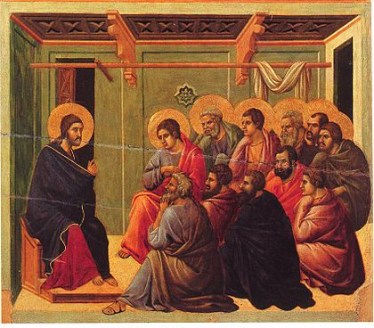
Jesus saying farewell to his eleven remaining disciples, from the Maesta by Duccio, 1308–1311 https://en.wikipedia.org/wiki/Farewell_Discourse
Chapter 14 Ten Approaches to Comfort (see Hendriksen, Vol. 2, 260-292)
Section 1: John 14:1 – 11
I. Trust in God and trust in me. I will still take care of you, even though I am leaving. Jesus strongly implies that he is God.
ESV John 14:1 “Let not your hearts be troubled. Believe in God; believe also in me.
“Troubled” is the same word used of Jesus himself at Lazarus’ death in chapter 11 and Jesus’ announcement that he would be betrayed by one of the twelve in chapter 12. Undoubtedly, Jesus himself, as a man, is still “troubled” in his own heart (witness the prayers and drops of bloody sweat in the Garden), yet here he is tenderly, patiently, and compassionately comforting his disciples.
From Fame to Shame in a single day:
In just one day, the disciples’ world has crashed down upon them utterly.
- The triumphal entry ends disappointingly for the disciples, as Jesus turns away from temporary fame and hides himself from the religious leaders (John 12:36b).
- Jesus announces that one of their own will betray him (implying that he will be handed over to death) (John 13:21).
- When Peter offered to lay down his life for his master, Jesus predicted that Peter would betray him (John 13:38).
Jesus fortifies their faith in chapter 14, so that when the “bad” events (although decreed by God) continue to happen and severe doubts assail the disciples, their faith will not completely collapse.
Antidote to Fear
The antidote to fear, as always in the entire Scripture, is trust in God. Believe, says Jesus. Take hold of your heart and combat your doubts and struggles of faith by believing in God. “Believe also in me.” Be placing belief in God side by side with belief in himself, Jesus is equating himself with God. The religious leaders were right all along–Jesus does claim to be God. This is not blasphemy, however, because as events of the resurrection unfold, ascension, and Pentecost unfold, the disciples do come to see and heartily believe that Jesus is indeed God.
II. I’m leaving to prepare a place for you.
John 14:2 In my Father’s house are many rooms. If it were not so, would I have told you that I go to prepare a place for you?
Jesus goes to heaven to prepare a place for not only each and every disciple, but also for every believer. There is plenty of room for all where Jesus is going. Jesus prepares the place, while the Holy Spirit, whom Jesus will send after his ascension, prepares the disciples and all believers for the place.
III. I’m coming again–I’ll take you with me.
John 14:3 And if I go and prepare a place for you, I will come again and will take you to myself, that where I am you may be also.
The “coming again” in this verse most likely refers to the Lord’s Second Coming to take all believers to be with him for eternity in his Father’s house (see context of vs 2). “To myself” is the same phrase John uses in 1:1, there translated as “with God.” It means face to face. Believers will once again be very close to Jesus (cf. Revelation 14:1; 19:14; 20:4). Believers today can encourage their hearts in knowing that there will always be a “place” for us right next to Christ, who is in and with the Father.
IV. I’m leaving but I am still the way, and the truth, and the life.
John 14:4 And you know the way to where I am going.”
Christ is going to be with the Father. For Christ, he is going the way of the cross. The disciples, on the other hand, know already that the way to the Father for them is Christ himself. They must go through Christ to get to the Father. Christ is inviting them to come to the Father by belief in himself, whom they know (see John 8:19; 10:1, 7,9, 37, 38; 12:26, 44, 45, 49, 50. See also Hebrews 11:13-16).
Thomas then becomes the spokesperson for the group. His question in verse 5 resembles the Pharisees’ question in John 7:35. Now as then, Thomas was thinking that Jesus would be going somewhere physically on earth. Although Thomas’ question reveals his doubtful, despairing heart, it also reveals his love for Jesus, in that he wants to go with him wherever that might be.
5 Thomas said to him, “Lord, we do not know where you are going. How can we know the way?”
Jesus’ response in verse 6 is classic and famous:
6 Jesus said to him, “I am the way, and the truth, and the life. No one comes to the Father except through me.
Thomas, as mentioned above, was asking Jesus how they would be able to follow in his way, whereas Jesus answers with the way that the disciples must take.
Verse 6 comprises the last of the seven “I Am” statements in John (Seven I Am Statements in John). Scripture shows that Christ teaches the way (Mark 12:14; Luke 20:21), he guides us in the way (Luke 1:79), he has dedicated for us the new and living way (Hebrews 10:20), and he is the way (John 14:6).
Because Jesus is the way, believers learn that we are not saved by a principle, nor a force, but by a person, which is a specific self-contained consciousness.
The way, the truth and the life–
- the way brings the believer to God
- the truth makes people free
- the life produces fellowship with God and with others who also have Christ’s life in them
7 If you had known me, you would have known my Father also. From now on you do know him and have seen him.”
Jesus’ further reply to the whole group in verse 7 implies that the disciples do not yet truly know Jesus as well as they could and should. Knowing Jesus is the same as knowing the Father. Had the disciples been listening, paying close attention, and praying the last three years. Jesus states in paraphrase, Now I am telling you clearly–you do see me and therefore you do know the Father.
Bless Philip! He says,
8 Philip said to him, “Lord, show us the Father, and it is enough for us.”
Philip, haven’t you heard anything at all that Jesus has been saying? Or, are you expecting a visible theophany of the manifestation of God’s glory, like Moses in the cleft of the rock in the desert when God passed by?
9 Jesus said to him, “Have I been with you so long, and you still do not know me, Philip? Whoever has seen me has seen the Father. How can you say, ‘Show us the Father’?
Again, what had Jesus been saying, teaching, and doing for the last three years if not manifesting the Father? (See John 1:18; 3:33-36; 5:17, 18 19-32; 6:29, 38, 57; 7:29; 8:16, 19, 28, 29, 42, 54, 55; 10:15, 30 33, 37, 38; 12:45; 13:31.)
“What the disciples lacked, however, was not genuine faith as such but genuine faith in full measure.” (Hendriksen, Vol. 2, 270)
10 Do you not believe that I am in the Father and the Father is in me? The words that I say to you I do not speak on my own authority, but the Father who dwells in me does his works.
Jesus and the Father are one essence, sharing one self-consciousness. How is this comfort?
- Every Jewish person of that day believed in one God, who was creator of everything. They knew God to be the all-powerful one. By making himself to be one with the Father (which the disciples still did not see yet), Jesus is comforting them that he is greater than all opposition, greater than all the adversaries.
- Further, even if he leaves, which he will, the Father is still the same, still with them, still the almighty and powerful one.
- Finally, by Christ’s being in the Father and the Father in Christ, Jesus is saying that he is eternal. Jesus will be alive and well even if he does go away for awhile.
11 Believe me that I am in the Father and the Father is in me, or else believe on account of the works themselves.
This section of encouragement ends very much the way it began:
John 14:1 “Let not your hearts be troubled. Believe in God; believe also in me.
John 14:11 Believe me that I am in the Father and the Father is in me,…
This time, however, there is only one “believe.” Believing in the Father and believing in Christ are one and the same, because they are one. Jesus is in the Father and the Father in him.
And, to make things super-easy for the disciples if that seems too difficult, Jesus adds, “or else believe on account of the works themselves.” No one could do all the works that Jesus has done before them unless he were God.
“…Believe on account of the works themselves,” is implied evidence for the continuation of miracles today. If Jesus permitted and encouraged the disciples to believe on account of all the miracles that he had done while he was with them, then even more so, why wouldn’t he allow non-believers today to access belief through miracles?
1 Timothy 2:3 …God our Savior, 4 who desires all people to be saved and to come to the knowledge of the truth.
Section 2: John 14:12-24
V. Because Jesus goes to live with the Father, the disciples will do great and greater works. They should pray and ask in Jesus’ name and he will do the works for them.
John 14:12 “Truly, truly, I say to you, whoever believes in me will also do the works that I do; and greater works than these will he do, because I am going to the Father. 13 Whatever you ask in my name, this I will do, that the Father may be glorified in the Son. 14 If you ask me anything in my name, I will do it.
Paraphrase of vs. 12–If you believe in me [Jesus], then I will continue to supply miracles from heaven. I have the power to do so, even after I am no longer with you. (Jesus and the Father are one.
It is clear from vs. 14 that even today, it will be Christ who performs miracles. Believers are to ask (pray) for “anything” in Jesus’ name (according to Jesus’ character and desires), and he will do it.
The greater works will occur because Jesus is going to the Father. These “greater” works are most likely spiritual in nature, because the spiritual is always more difficult than the material, and the material follows the spiritual.
Matthew 6:10 Your kingdom come, your will be done, on earth as it is in heaven.
VI. I and the Father will send you another Helper, the Spirit of truth. Knowing this should comfort you now, and when he comes, you will be greatly encouraged and comforted at that time.
John 14:15 “If you love me, you will keep my commandments. 16 And I will ask the Father, and he will give you another Helper, to be with you forever, 17 even the Spirit of truth, whom the world cannot receive, because it neither sees him nor knows him. You know him, for he dwells with you and will be in you.
15 “If you love me, you will keep my commandments.“
Jesus will not send the Holy Spirit to make his home among and with those who do not love him. And love is evidenced by obedience to Christ’s commandments (John 14:23-24 see below).
When Jesus went to heaven, he prepared the way for sending the Holy Spirit, who works on earth from within the church to perform miracles of belief in peoples’ hearts.
Great conversions of the Gentiles began to occur immediately after the Holy Spirit came on Pentecost day (see the “greater works than these” above in John 14:12).
16 And I will ask the Father, and he will give you another Helper, to be with you forever,
Both the Father and the Son–they are one–are involved in sending the Helper, the Holy Spirit. The Father is in the Son, and the Son is in the Father. Therefore, the Holy Spirit represents both of them. He is another Person of the Trinity; he is not different in essence.
This Helper will be with the disciples forever, i.e., with the church composed of the disciples and all believers who come after them. The Helper will never die, nor leave them. This is great encouragement indeed! And, Christ will continue to be their Helper in heaven, while the Holy Spirit will be their Helper on earth. Christ will plead the people’s case with God (Romans 8:34), while the Holy Spirit will continually plead God’s case with people (John 16:8).
17 even the Spirit of truth, whom the world cannot receive, because it neither sees him nor knows him. You know him, for he dwells with you and will be in you.
As the Spirit of truth, the Holy Spirit will guide those destined to belief into and within the realm of salvation in Christ. This is because Jesus is “the way, and the truth, and the life.”
The world cannot receive the Holy Spirit, because the world believes the deception of the wicked one. Nor does the world love Christ; nor is it obedient to him. Neither seeing nor knowing the Holy Spirit, the world cannot receive him.
The disciples on the other hand know the Holy Spirit, because he currently lives with them in the Person of Jesus Christ. After Jesus’ departure, he will send the Spirit as Spirit, and the Spirit will live in them and among them.
Alternatively, one can interpret this verse as meaning that when the Holy Spirit comes–at that time, the disciples will know him, because he will dwell with them, by their side, and within them. He will make the church his temple and live there forever.
VII. In that other Helper, I will spiritually return to you, to all who love and obey me, but not to the world.
John 14:18 “I will not leave you as orphans; I will come to you. 19 Yet a little while and the world will see me no more, but you will see me. Because I live, you also will live. 20 In that day you will know that I am in my Father, and you in me, and I in you. 21 Whoever has my commandments and keeps them, he it is who loves me. And he who loves me will be loved by my Father, and I will love him and manifest myself to him.” 23 Jesus answered him, “If anyone loves me, he will keep my word, and my Father will love him, and we will come to him and make our home with him. 24 Whoever does not love me does not keep my words. And the word that you hear is not mine but the Father’s who sent me.
In this connected paragraph Jesus repeats some of the elements he has previously stated.
1. Jesus is physically leaving them, but not without provision. They will not be orphans (vs. 18). Context determines that Jesus’ coming again in this verse is in the form of the Holy Spirit, not the Second Coming at the end of the age, as in vs. 3.
Other layers of meaning could imply the Second Coming and also the New Heaven and the New Earth in Revelation.
2. The world will see Jesus no more, but the disciples will see him (vs. 19).
a. The disciples will see Jesus during the 40 days between the resurrection and the ascension. The world did not see him at this time.
b. After Pentecost, the disciples will “see”
–in each other
–in the miracles
–in the conversion of multitudes of Gentiles
–and with the eyes of their living spirits, which will have been resurrected with Christ and sealed with the Holy Spirit
c. Without spiritual belief and love for Christ, the world will see nothing of him after his death on the cross.
3. “In that day”–(vs. 20) the day of Pentecost and beyond–the disciples’ spiritual eyes will continuously be opened to greater and greater understanding by the Holy Spirit. They will see clearly that Christ is in the Father and the Father in Christ.
4. The requirement for receiving the manifestation of Christ will be love. Those who love Christ are those who keep his word. The Father will love those who love Christ and keep his word. Christ will also love these and manifest himself to them, through the Holy Spirit, as implied in prior verses.
5. verse 22 Judas (not Iscariot) said to him, “Lord, how is it that you will manifest yourself to us, and not to the world?”
It is as though Judas had stepped out of the room and just returned. He asks Jesus to explain what he has just explained. Nevertheless, Jesus does not grow impatient, but explains in nearly identical words (vss. 23-24) the same concepts all over again.
This should give encouragement to us, who also need to hear the same truths repeated over and over again before they sink in and become real. This is especially true in times of emotional stress, such as that the disciples were just them experiencing.
22 Judas (not Iscariot) said to him, “Lord, how is it that you will manifest yourself to us, and not to the world?” 23 Jesus answered him, “If anyone loves me, he will keep my word, and my Father will love him, and we will come to him and make our home with him. 24 Whoever does not love me does not keep my words. And the word that you hear is not mine but the Father’s who sent me.
Notice that the Jewish leaders, who represent the entire Jewish nation, have neither loved nor obeyed Jesus. Therefore, by vss. 23 and 24, they will not receive the Father’s love, nor will the Father and Christ come to make their home with them. From this point forward, the entire Jewish nation, as a political entity on earth, is part of the “world.” There will always be a remnant of believers drawn out from the whole. The disciples and other Jewish believers at that time are part of the remnant.
Nations, such as Rome, are also part of the world.
____________________________________________________________________
♦ By announcing to the disciples the coming of the Holy Spirit and by saying to them that the world will no longer see him, Jesus is continuing to announce the Grand Shift from Concrete to Spiritual. From now on, Jesus’ dealings, the Father’s dealings, and the Holy Spirit’s dealings with people will be on a spiritual level only. Jesus has been contrasting the concrete and spiritual throughout his ministry, beginning with his conversations with Nicodemus and the woman at the well. Here, as he is about to leave the world and send the Holy Spirit in his place, he is teaching that the shift from concrete to spiritual will be complete. (This does not mean that concrete miracles will no longer occur.) ♦
____________________________________________________________________
Jesus closes this portion by reminding the disciples, as he has many times throughout the entirety of his ministry, that the words he speaks to them are not his words. That is, he is not the originator of what he is saying; the Father is. Jesus speaks the word of the Father.
Section 3: John 14:25-31
VIII. The Holy Spirit will teach and remind them of all that Jesus has been saying.
John 14:25 “These things I have spoken to you while I am still with you.
26 But the Helper, the Holy Spirit, whom the Father will send in my name, he will teach you all things and bring to your remembrance all that I have said to you.
Jesus seems to be saying that it will be to the advantage of both the disciples and the Kingdom which they will grow through their witness and mission activities that he go away. While with them, he has told them certain things. He has much more to say which they cannot at that moment bear to receive.
John 16:12 “I still have many things to say to you, but you cannot bear them now.”
But when Jesus leaves, the Holy Spirit, whom the Father will send in Jesus’ name, will teach them everything they need to know, including those things that Jesus had already told them. The Holy Spirit is like a living Replay button who also adds his own, new material.
IX. Jesus leaves behind the gift of his peace.
John 14:27 Peace I leave with you; my peace I give to you. Not as the world gives do I give to you. Let not your hearts be troubled, neither let them be afraid.
The peace Jesus leaves behind and gives is both legal and subjective.
1. Legally, by his death and resurrection from the cross, humankind’s sins have been forgiven. The atonement provides cleansing from sin and application of Christ’s righteousness. This is called justification. Only once in all eternity does humankind as a whole and persons as individuals ever need justification. The cross accomplished all.
2. Subjectively, Jesus gives and makes available to all believers an absence of spiritual unrest, the assurance of salvation, and the loving presence of God in all circumstances. This subjective feeling occurs in individuals and in the church as a collective body of individual believers, as both of these exercise faith in the Father and in Christ and draw from the abiding presence of the Holy Spirit.
The peace of Christ is permanent, durable, and sufficient, because Jesus gives not as the world gives. Paul calls it “the peace of God, which surpasses all understanding.” (Philippians 4:7).
Because of this gift of peace, the gift of the Holy Spirit, and Christ’s ongoing presence with the Father, Jesus once again admonishes his disciples, “Let not your hearts be troubled, neither let them be afraid.“
He had said them at the beginning of this discourse in vs. 1, “”Let not your hearts be troubled. Believe in God; believe also in me.”
X. Jesus repeats that he is going to the Father and that their love for him should cause them to rejoice at this.
John 14:28 You heard me say to you, ‘I am going away, and I will come to you.’ If you loved me, you would have rejoiced, because I am going to the Father, for the Father is greater than I.
It stands to reason that if there is anything at all in Jesus’ departure by death about which to rejoice, then the situation cannot be all that terribly bad. They should be comforted.
The Father in his heavenly divinity is greater than Jesus the man in his earthly tent of sorrowful flesh. Father God is greater than Son of Man in his role as mediator.
John 14:29 And now I have told you before it takes place, so that when it does take place you may believe. 30 I will no longer talk much with you, for the ruler of this world is coming. He has no claim on me, 31 but I do as the Father has commanded me, so that the world may know that I love the Father. Rise, let us go from here.
Verses 29 through 31 are a conclusion to what Jesus has been saying.
1. The purpose of his foretelling the disciples of his death and separation from them is to strengthen their belief and trust when it actually does occur in a short while.
2. Although Jesus knows that Satan is coming to attack him (even now Judas may be talking to the high priests and they may be on their way with soldiers to arrest him), he also has the bold confidence to know for a certainty that Satan has no claim on him.
3. It is the Father’s fore plan and purpose that Christ should suffer just as he has all along and is about to even more.
4. By Jesus’ behavior, the world will know that he loves the Father.
5. It’s time to get ready to leave.
Jesus Loved Them to the End: A New Commandment and a Tragic Dinner
Week 13 John 13:1-38 Washing the Disciples’ Feet; Foretelling Judas’ Betrayal; Prophesying Peter’s Denial
(Link to Outline of John) (Link to the first lesson of Gems in John)
John’s Theme: John 20:31 … these are written so that you may believe that Jesus is the Christ, the Son of God, and that by believing you may have life in his name.
Parallel Passages for Foot Washing: Mat 23:6-12; 10:24; 10:40; Luke 22:3; 12:37; 22:24-28; 6:40; 10:16; Joh 13:1-20
Update:
John 12:36 While you have the light, believe in the light, that you may become sons of light.” When Jesus had said these things, he departed and hid himself from them.
From this point forward, Jesus’ public ministry has ended. His entire focus is on what lies before him at the cross, and to this end, he prepares his disciples for Judas’ betrayal, Peter’s denial, and the need for them to love each other as he would if he were to remain physically with them. The section that begins in Chapter 13 continues through to his arrest in Chapter 18.
Introduction: The theme of Chapter 13 is love. The verse that ties the chapter together is verse 1:
John 13:1 Now before the Feast of the Passover, when Jesus knew that his hour had come to depart out of this world to the Father, having loved his own who were in the world, he loved them to the end.
I. Jesus Washes His Disciples’ Feet John 13:2-17
A. Setting (cf parallel passages listed above)
Unlike most of the popular paintings indicate, the disciples reclined on slightly elevated mats or mattresses  around a U-shaped table according to the manner of the day, lying most likely on their left sides with their right arms free to reach for food and eat. (Hendriksen, Vol. 2, 229; Weekend Nation Online, “Jesus and the Apostles did not sit on chairs at a table,” March 26, 2016, http://nation.lk/online/2016/03/26/jesus-and-the-apostles-did-not-sit-on-chairs-at-a-table.html.)
Everything was ready for the meal, including the pitcher of water, basin, and towel for washing the guests’ feet. Except…there was no servant to perform this menial task. (Hendriksen, Vol. 2, 228)
John 13:2-5 During supper, when the devil had already put it into the heart of Judas Iscariot, Simon’s son, to betray him, 3 Jesus, knowing that the Father had given all things into his hands, and that he had come from God and was going back to God, 4 rose from supper. He laid aside his outer garments, and taking a towel, tied it around his waist. 5 Then he poured water into a basin and began to wash the disciples’ feet and to wipe them with the towel that was wrapped around him.
The synoptic gospels tell how the disciples had been arguing among themselves about which of them was the “greatest.” (Luke 22:24) None of them performed the favor of washing the others’ feet. So Jesus did it.
B. What Did Jesus’ Washing His Disciples’ Feet Reveal?

Original source unknown.
1. His genuine LOVE for his disciples–as their Creator and Savior, he was also Caregiver and Physician. He was their Rabbi, Teacher and Master. They were his children (cf 13:33). Walking about all day on dusty, garbage-strewn streets which the donkeys and other animals also used, people’s feet got dirty and tired. Having their feet washed before eating was practical as well as physically refreshing and comforting for them. Jesus wanted to perform this act of love for them. He had a tender, compassionate, and affectionate heart for them. He loved them!
verse 1…having loved his own who were in the world, he loved them to the end.
2. His HUMILITY–Jesus’ identity as Son of God, Son of Man, Messiah, Master, Lord, and Teacher reveals that each of them should have been washing his feet, but they were all too proud to pick up the towel, pour the water, and begin.
John 1:27 even he who comes after me, the strap of whose sandal I am not worthy to untie.”–John the Baptist
Philippians 2:7 but made himself nothing, taking the form of a servant, being born in the likeness of men. 8 And being found in human form, he humbled himself by becoming obedient to the point of death, even death on a cross.
3. An EXAMPLE–soon Jesus will no longer be physically present with his disciples. The love which he customarily gave them, they must now give to each other.
John 13:33 Little children, yet a little while I am with you…34 A new commandment I give to you, that you love one another: just as I have loved you, you also are to love one another.
John 17:26 I made known to them your name, and I will continue to make it known, that the love with which you have loved me may be in them, and I in them.”
1 John 3:23 And this is his commandment, that we believe in the name of his Son Jesus Christ and love one another, just as he has commanded us.
4. A highly SYMBOLIC action
a. Jesus’ mission to humanity was to cleanse us from our sin.
i. Complete justification for believers occurred on the cross and need never be repeated.
ii. Sanctification for continued sin is an ongoing process involving confession (symbolically–recognizing that the feet are dirty and willingly receiving a foot-washing) and spiritual cleansing (through application of God’s Word upon a believer’s heart by the Holy Spirit).
John 13:9 Simon Peter said to him, “Lord, not my feet only but also my hands and my head!” 10 Jesus said to him, “The one who has bathed does not need to wash, except for his feet, but is completely clean. And you are clean, but not every one of you.”
John 17:17 Sanctify them in the truth; your word is truth.
Ephesians 5:25-26 …Christ loved the church and gave himself up for her, 26 that he might sanctify her, having cleansed her by the washing of water with the word,
iii. Jesus’ mission of cleansing a people for God involved his whole ministry of concrete (physical) actions, which also represented non-physical spiritual realities and truths.
a. John Chapter 3–Nicodemus–spiritual rebirth
b. John Chapter 4–woman at the well–spiritual water
c. John Chapter 6–Jesus the bread of life–spiritual nourishment
d. John Chapter 13–washing the disciples’ feet–spiritual cleansing
e. In order to partake of Christ, to be part of him, the believer must participate in every means of spiritual cleansing God provides in Christ
i. the blood of justification
ii. the daily means of sanctification
John 13:6 He came to Simon Peter, who said to him, “Lord, do you wash my feet?” 7 Jesus answered him, “What I am doing you do not understand now, but afterward you will understand.” 8 Peter said to him, “You shall never wash my feet.” Jesus answered him, “If I do not wash you, you have no share with me.” 9 Simon Peter said to him, “Lord, not my feet only but also my hands and my head!” 10 Jesus said to him, “The one who has bathed does not need to wash, except for his feet, but is completely clean. And you are clean, but not every one of you.”
b. No one can wash Jesus’ feet; he is the only one who can cleanse (Luke 11:37-39).
i. John the Baptist understood correctly that Jesus was the one who should have been baptizing him (Matthew 3:13-15).
ii. Jesus had no need of sanctification, because he had no sin (2 Corinthians 5:21).
iii. Jesus’ mission on earth was to cleanse believers from their sin (2 Corinthians 5:21).
iv. Therefore, Jesus was the one to express this symbolically by washing the disciples’ feet.
C. Application
Jesus is our great high priest (Hebrews 4:15) and intercessor (Romans 8:34). That means he prays for us and handles our sin issues.
Think about when we make trips to the doctor, or when we go to a friend or pastor or counselor with a sensitive difficulty. When I am in these situations, I want someone who is kind and gentle, not proud, non-condemning, not judgmental, to help me–in short, someone who is him-or-herself humble, someone who I think will be sympathetic with me. I also want someone who is wise and will know how to fix me.
Jesus is this person. As Son of God, he is the wisest person anywhere, strong, a truth teller, and capable. As Son of Man, Jesus by name, the foot-washer, he is more humble and tender than I am, by far. He’s the one person we can always turn to who will love us, not shame us, help us, not condemn us. His truth shining in our hearts will expose, cleanse, heal, and renew everything about us that is not right. He’s the one I want washing my feet.
And I should be like him, doing the same for others. “We love, because he first loved us” (1 John 4:19).
II. Jesus Announces His Betrayal
A. Jesus’ Own Emotions
John 13:18 …I know whom I have chosen. But the Scripture will be fulfilled, ‘He who ate my bread has lifted his heel against me.’ 19 I am telling you this now, before it takes place, that when it does take place you may believe that I am he. 20 Truly, truly, I say to you, whoever receives the one I send receives me, and whoever receives me receives the one who sent me.” 21 After saying these things, Jesus was troubled in his spirit, and testified, “Truly, truly, I say to you, one of you will betray me.“
Jesus was “troubled in his spirit.” The NET says “Jesus was greatly distressed in spirit.” We encountered this same phrase when Jesus met with those who stood weeping and grieving over the death of Lazarus.
John 11:33 When Jesus saw her weeping, and the Jews who had come with her also weeping, he was deeply moved in his spirit and greatly troubled. 34 And he said, “Where have you laid him?” They said to him, “Lord, come and see.” 35 Jesus wept. 36 So the Jews said, “See how he loved him!”
Jesus’ response on that occasion was to weep. Also, many of the Psalms reference the deep emotions of the psalmist and prophetically record the emotions and prayers of Messiah (Psalm 55:12-14; 55:20-21). Hebrews tells us that Jesus learned submission by the things he suffered (Hebrews 5:8).
As a man, therefore, we know that Jesus had all the emotions common to humanity. It pained and grieved him that one of his own disciples should betray him, even though he knew at the time that he chose Judas that it would be so.
John 6:70 Jesus answered them, “Did I not choose you, the Twelve? And yet one of you is a devil.”
B. The Disciples’ Response–the Proverbial Bombshell Dropped at Dinner

NIV John 13:22 His disciples stared at one another, at a loss to know which of them he meant.
NAU Matthew 26:22 Being deeply grieved, they each one began to say to Him, “Surely not I, Lord?”

Then, in response to questioning by Peter and John, Jesus revealed that Judas was the betrayer.
John 13:22 The disciples looked at one another, uncertain of whom he spoke. 23 One of his disciples, whom Jesus loved, was reclining at table close to Jesus, 24 so Simon Peter motioned to him to ask Jesus of whom he was speaking. 25 So that disciple, leaning back against Jesus, said to him, “Lord, who is it?” 26 Jesus answered, “It is he to whom I will give this morsel of bread when I have dipped it.” So when he had dipped the morsel, he gave it to Judas, the son of Simon Iscariot.
C. Judas’ Response
Alone of the twelve, Judas is the only one who displayed no genuine self investigation nor pain, even though he pretended not to know that it was he.
ESV Matthew 26:25 Judas, who would betray him, answered, “Is it I, Rabbi?” He said to him, “You have said so.”
John, however, chronicles a progression in Judas’ hardness of heart. First, Satan tempted Judas with the thought of betrayal.
John 13:2 During supper, when the devil had already put it into the heart of Judas Iscariot, Simon’s son, to betray him,
Second, Satan entered Judas’ heart.
John 13:26 …So when he had dipped the morsel, he gave it to Judas, the son of Simon Iscariot. 27 Then after he had taken the morsel, Satan entered into him…
This was the point of no return, both for Judas and for Jesus. Because Judas had rejected Jesus as his Teacher and Lord, Satan, who had already been tempting him, entered his heart. By lacking any desire to resist him, Judas had stepped beyond all possibility of repentance.
Satan entering Judas’ heart also signalled the point of no return for Jesus, because Judas was about to begin the chain of events that would move swiftly and inexorably towards the cross.
John 13:27 …”What you are going to do, do quickly.”
John 13:30 So, after receiving the morsel of bread, he immediately went out. And it was night.
The time of day was night, and John also intends us to know that for Judas the light had completely gone out–he was spiritually stumbling in the darkness, forever lost.
C. Jesus’ Care and Preparation of His Disciples
John always shows the reader how Jesus is in control of every situation and every scene. All that happens to him is by the sovereign plan of God. Nothing takes Jesus by surprise. Jesus uses these facts to comfort and encourage his disciples in this hour when all their hopes are being shattered. Just a short while ago, emotions and expectations most likely were soaring high in response to the crowd’s enthusiasm toward their Master at the triumphal procession. Now they are receiving blow after blow of shocking news.
First, Jesus goes into hiding from the Jews, rather than setting up the long-awaited messianic kingdom. Next, Jesus tells them that he will be betrayed by one of their own. After that, he will soon be leaving them.
Jesus’ goal is to prepare his beloved disciples for these events, telling them ahead of time, so that when these things happen, their faith will remain. This is an expression of his LOVE.
1. He tells them of the betrayal by one of their own. When that happens, they will know that his foreknowledge indicates God’s control.
John 13:11 For he knew who was to betray him; that was why he said, “You are not all clean.”
John 13:19 I am telling you this now, before it takes place, that when it does take place you may believe that I am he.
John 13:21 When Jesus had thus spoken, he was troubled in spirit, and testified, “Truly, truly, I say to you, one of you will betray me.”
John 13:25-26 So lying thus, close to the breast of Jesus, he said to him, “Lord, who is it?” 26 Jesus answered, “It is he to whom I shall give this morsel when I have dipped it.” So when he had dipped the morsel, he gave it to Judas, the son of Simon Iscariot.
2. Jesus encourages his disciples by reassuring them even though he will be betrayed, glory will come, and quickly.
John 13:31-32 When he had gone out, Jesus said, “Now is the Son of man glorified, and in him God is glorified; 32 if God is glorified in him, God will also glorify him in himself, and glorify him at once.
3. Jesus encourages and strengthens his disciples by telling them that their hour has not come.
John 13: 33 Little children, yet a little while I am with you. You will seek me; and as I said to the Jews so now I say to you, `Where I am going you cannot come.’
John 13:36 Simon Peter said to him, “Lord, where are you going?” Jesus answered, “Where I am going you cannot follow me now; but you shall follow afterward.”
4. There is still life and mission for the disciples, that is, a purposeful and prosperous future.
John 13:34 A new commandment I give to you, that you love one another; even as I have loved you, that you also love one another. 35 By this all men will know that you are my disciples, if you have love for one another.”
III. Bad News Not Over Yet–Jesus Prophesizes Peter’s Denial
Peter thought he knew his own heart, and while he did know the good part, he did not know his heart completely. The baser part of his heart lay hidden from his sight.
Jesus had just told the disciples that he was leaving and they cannot follow him (verse 36 above).
Peter brings out the good part of his heart.
John 13:33 …`Where I am going you cannot come.’
John 13:36 Simon Peter said to him, “Lord, where are you going?” Jesus answered, “Where I am going you cannot follow me now; but you shall follow afterward.”
37 Peter said to him, “Lord, why cannot I follow you now? I will lay down my life for you.”
Jesus brings out the base part of Peter’s heart.
38 Jesus answered, “Will you lay down your life for me? Truly, truly, I say to you, the cock will not crow, till you have denied me three times.
IV. Looking Ahead: Jesus Continues to Comfort and Fortify His Disciples
John 14:1 “Let not your hearts be troubled. Believe in God; believe also in me.
The Triumphal Entry: God Directs Events
Week 12 John 12:12-50: The Raising of Lazarus Leads to Public Acclaim
(Link to Outline of John) (Link to the first lesson of Gems in John)
John’s Theme: John 20:31 … these are written so that you may believe that Jesus is the Christ, the Son of God, and that by believing you may have life in his name.
Parallel Passages: Matthew 21:14-16, Mark 11:1-10, Luke 19:28-40

Introduction: We learn from Chapter 12 that God is in control and directs every event surrounding Jesus and his mission.
- The timing of Lazarus’ death and raising was placed close to the Jewish celebration of Passover, because that is the moment God chose in order to coincide with Old Testament prophecy and motif concerning the sacrificial lamb.

- The raising of Lazarus directly contributed to the enthusiasm of the crowds that greeted Jesus as he entered Jerusalem for the Passover Feast.
- Consequently, the triumphal entry forced the Pharisees’ hand to arrest and kill Jesus, not because they wanted to do so while everyone was watching, but because God had decreed in ages past that Jesus the Christ was the eternal Lamb to be slain, and symbolism required that this happen on Passover. They killed him because of jealousy and fear for their own “exalted” positions.
- Jesus Christ’s death and resurrection were designed by God, and the crucifixion was completely voluntary on Jesus’ part. God used the Pharisees’ own hardness of heart towards His own end of salvation for all humankind.

I. John 12:12-19 The Triumphal Entry
A. The raising of Lazarus flows right into the triumphal entry
1. The miracle caused such a stir among the people that the religious leaders had decided to arrest and kill him. John 11:45-57
2. Six days before the Passover, Jesus arrived at Bethany, very close to Jerusalem, where the family of Lazarus gave a dinner, (John 12:1-8) and a large crowd of people gathered to catch a glimpse of Jesus and of Lazarus.
3. The next day, Jesus and his disciples joined a great crowd on their way to Jerusalem for the Feast. Part of the crowd accompanied him from Bethany, and part came out from Jerusalem when they heard that he was on his way. The people from Bethany testified and spread the word about the miracle they had witnessed when Jesus raised Lazarus from the dead after four days. John 12:17-19
4. As Jesus entered the city sitting on a donkey’s young colt, the crowd welcomed him with palm branches. These represent rejoicing and triumph. John 12:13-15
5. All four gospels record this event, the three synoptics adding details of their own. Matthew 21:1-9, Mark 11:1-10, Luke 19:28-40
B. The triumphal entry causes the Pharisees to become even more excited in opposition to Jesus than they had been before.
C. The disciples did not see or understand the connection between the events of what we now call “Palm Sunday” and the Old Testament prophetic Scriptures. They only came to understand these events after Jesus’ crucifixion, burial, resurrection, and ascension into glory. John 12:16
ESV John 12:13 So they took branches of palm trees and went out to meet him, crying out, “Hosanna! Blessed is he who comes in the name of the Lord, even the King of Israel!”
LXE Psalm 118:22 The stone which the builders rejected, the same is become the head of the corner. 23 This has been done of the Lord; and it is wonderful in our eyes. 24 This is the day which the Lord has made: let us exult and rejoice in it. 25 O Lord, save now: O Lord, send now prosperity. [verse 25 is encompassed in the single word, “Hosanna!”] 26 Blessed is he that comes in the name of the Lord: we have blessed you out of the house of the Lord. 27 God is the Lord, and he has shined upon us: celebrate the feast with thick branches, binding the victims even to the horns of the altar.
ESV John 12:15 “Fear not, daughter of Zion; behold, your king is coming, sitting on a donkey’s colt!”
ESV Zechariah 9:9 Rejoice greatly, O daughter of Zion! Shout aloud, O daughter of Jerusalem! Behold, your king is coming to you; righteous and having salvation is he, humble and mounted on a donkey, on a colt, the foal of a donkey.
D. By entering Jerusalem this way, Jesus was openly and boldly announcing that he was indeed the long-awaited Messiah, Israel’s King.

II. John 12:20-36 Jesus’ Discourse Prompted by the Greeks’ Request
A. Some Greeks ask Philip if they can meet with Jesus. John 12:20-22
1. These Greeks are God-fearing Gentiles who regularly worship among the Jewish people. (Hendriksen, Vol. 2, 193)
2. Jesus fully explains his mission of salvation for the entire world. Philip and Andrew, whom Philip had consulted, then relay his words to the Greeks.
B. Jesus responds to the Greeks. John 12:23-33
1. The setting: Jesus has just passed through the Mount of Olives, the later scene of Jesus’ Gethsemane prayers just before his crucifixion, into Jerusalem in a triumphal procession that had begun in Bethany, the village of Lazarus and his sisters. As the city first comes into his view, Jesus pauses and weeps over it tenderly and with love and affection, for he knows of the coming catastrophe of destructive judgment which will befall it in 70 A.D.
Luke 19:41-44 And when he drew near and saw the city, he wept over it, 42 saying, “Would that you, even you, had known on this day the things that make for peace! But now they are hidden from your eyes. 43 For the days will come upon you, when your enemies will set up a barricade around you and surround you and hem you in on every side 44 and tear you down to the ground, you and your children within you. And they will not leave one stone upon another in you, because you did not know the time of your visitation.”
2. Jesus also knew that he himself was about to be painfully crucified. In answer to the Greeks’ request to see him, he begins speaking about his impending death:
a. as concerns himself
John 12:23-24 And Jesus answered them, “The hour has come for the Son of Man to be glorified. 24 Truly, truly, I say to you, unless a grain of wheat falls into the earth and dies, it remains alone; but if it dies, it bears much fruit.
• the fruit of which Jesus speaks includes all Gentiles from out of the whole world, as represented by the Greeks. They are part of the offspring prophesied by Isaiah.
Isaiah 53:10 Yet it was the will of the LORD to crush him; he has put him to grief; when his soul makes an offering for guilt, he shall see his offspring; he shall prolong his days; the will of the LORD shall prosper in his hand.
Isaiah 54:1 “Sing, O barren one, who did not bear; break forth into singing and cry aloud, you who have not been in labor! For the children of the desolate one will be more than the children of her who is married,” says the LORD. 2 “Enlarge the place of your tent, and let the curtains of your habitations be stretched out; do not hold back; lengthen your cords and strengthen your stakes. 3 For you will spread abroad to the right and to the left, and your offspring will possess the nations and will people the desolate cities.
Galatians 4:26 [the Apostle Paul addressing Gentile believers in Christ in Galatia, citing Isaiah 54:1-3] But the Jerusalem above is free, and she is our mother. 27 For it is written, “Rejoice, O barren one who does not bear; break forth and cry aloud, you who are not in labor! For the children of the desolate one will be more than those of the one who has a husband.” 28 Now you, brothers, like Isaac, are children of promise.
• in order to bear this fruit, Jesus knows that he must die.
b. as concerns all of his present and future disciples (the Greeks, you, me)
John 12:25 Whoever loves his life loses it, and whoever hates his life in this world will keep it for eternal life. 26 If anyone serves me, he must follow me; and where I am, there will my servant be also. If anyone serves me, the Father will honor him.
c. Jesus’ sacrifice is voluntary and according to the predetermined will of God. See Isaiah 53:10 and 54:1-3 above and vss 27-28 below.
John 12:27 “Now is my soul troubled. And what shall I say? ‘Father, save me from this hour’? But for this purpose I have come to this hour. 28 Father, glorify your name.” Then a voice came from heaven: “I have glorified it, and I will glorify it again.”
3. immediate confirmation of Jesus’ words from God the Father
John 28b-30 …Then a voice came from heaven: “I have glorified it, and I will glorify it again.” 29 The crowd that stood there and heard it said that it had thundered. Others said, “An angel has spoken to him.” 30 Jesus answered, “This voice has come for your sake, not mine.
4. Jesus summarizes and proclaims in four parts the purpose and effect of his crucifixion.
John 12:31-32 a) Now is the judgment of this world; b) now will the ruler of this world be cast out. c) 32 And I, when I am lifted up from the earth, d) will draw all people to myself.”
a. “This world” (the Jewish religious leaders who reject and condemn their Messiah King to death, Judas who later betrays Christ, the Roman governor Pilot who sentences him, the Roman soldiers who beat and scorn him, and all people of all societies everywhere who reject him, the entire world system ruled by evil) is judged and condemned by God for the action of rejecting and killing his beloved Son.
b. “The ruler of this world” is Satan. (Revelation 12:3; Luke 4:6; 2 Corinthians 4:4; Ephesians 2:2, 6:12) By means of the cross (c above) he loses his power grip of death over the world and the nations, as Christ’s resurrection and ascension into glory open a pathway and invitation by God to all men everywhere to be reunited with Him in peace and love.
c. “Lifted up from the earth” is the biblical way of naming death by crucifixion. Jesus is describing the means of his death. 
d. “Will draw all people to myself” is the result. Jesus is the actor who does the drawing. “All people” refers to people from every time, nation, ethnicity, and cultural group. None are excluded who wish to be included. The coming of the Gentile Greeks to seek to see Jesus are representative of all those who will be drawn to Christ.
III. Jesus as Son of Man and the Crowd’s Skeptical Response John 12:34-36
A. Most likely, from what the crowd knew of the Law and the entire Old Testament, they expected the Christ to remain forever.
John 12:34 So the crowd answered him, “We have heard from the Law that the Christ remains forever. How can you say that the Son of Man must be lifted up? Who is this Son of Man?”
1. Sample passages: Psalm 110:4; Isaiah 9:7; Ezekiel 37:25
Daniel 7:13 “I saw in the night visions, and behold, with the clouds of heaven there came one like a son of man, and he came to the Ancient of Days and was presented before him. 14 And to him was given dominion and glory and a kingdom, that all peoples, nations, and languages should serve him; his dominion is an everlasting dominion, which shall not pass away, and his kingdom one that shall not be destroyed.
2. Paraphrase: What does Messiah/Son of Man have to do with crucifixion? What crucifixion?
B. Jesus as Son of Man
1. Hendriksen points out that Jesus’ designation of himself as “Son of Man” most likely is a reference to the above verses from Daniel and the fact that Jesus is transcendent by nature, being God the Son who descended from heaven in his incarnation (Hendriksen, Vol. 2, 206-207)
2. Because Jesus is man, he is connected to the entire human race. As God himself, he is Son of God and Son of Man.
3. As a man, he partakes of the suffering of all humankind, and as the Son of Man, who is the perfect sacrifice for sin, he also partakes of his own extreme sorrow.
a. suffering as God suffering over mankind
b. suffering on the cross as the sacrifice for sin, bearing the full weight of God’s wrath against sinful humanity on his own shoulders.
C. Jesus responds to the crowd’s skepticism by telling them what they must do.
John 12:35-36a So Jesus said to them, “The light is among you for a little while longer. Walk while you have the light, lest darkness overtake you. The one who walks in the darkness does not know where he is going. 36 While you have the light, believe in the light, that you may become sons of light.”…
1. It is only a short while that Jesus the light will be with them.
2. They would do well to pay attention and consider the words of the light, of the one who did so many unheard of, amazing miracles among them.
3. If they do not obey the teaching of Jesus about himself, then the darkness will overtake them.
4. No one walking in darkness knows where they are going–they are lost and vulnerable.
5. If they believe in Jesus Christ the Light, then they will become sons of light.
D. After speaking the above words, Jesus leaves them, an indication of what will soon happen when he is crucified.
John 12:36b…When Jesus had said these things, he departed and hid himself from them.
III. John 12:37-43 The Jewish Leaders’ Response
A. John the writer steps in with narrative to describe and explain the religious leaders’ response, which was even worse than that of the crowd in general.
John 12:37-43 Though he had done so many signs before them, they still did not believe in him,
Jesus had performed all the signs expected of Messiah.
38 so that the word spoken by the prophet Isaiah might be fulfilled: “Lord, who has believed what he heard from us, and to whom has the arm of the Lord been revealed?”
John tells us that Isaiah had prophesied many centuries earlier that Messiah’s arrival would be met with disbelief (Isaiah 53)
39 Therefore they could not believe. For again Isaiah said, 40 “He has blinded their eyes and hardened their heart, lest they see with their eyes, and understand with their heart, and turn, and I would heal them.”
John further states that not only did they not believe, they could not believe. This is because at some point in Israel’s long history of disobedience as a nation, they had passed the point of no return. Their continually obstinate walk of hardened disobedience caused the Lord to harden their hearts even further, so that repentance as a nation was no longer possible.
41 Isaiah said these things because he saw his glory and spoke of him.
Isaiah the prophet had been shown the future Messiah’s glory and spoke about him in Scripture, nearly as much as the New Testament itself.
42 Nevertheless, many even of the authorities believed in him, but for fear of the Pharisees they did not confess it, so that they would not be put out of the synagogue; 43 for they loved the glory that comes from man more than the glory that comes from God.

God always leaves a pathway and door of repentance open to individuals. Many of the religious leaders did believe in Jesus, although here again, they would not confess him publicly for fear of being put out of the synagogue by the others. They loved the temporal and fading glory of man, rather than the glory that comes from God. They loved the kind of glory that we see being given by the media to one celebrity after another. Because they loved this worldly glory, they would not confess Christ publicly, even though they believed.
B. Recap: Ultimate Rejection Is How Christ’s Triumphal Entry Ended. Jesus’ Passion Has Almost Arrived.
IV. John 12:44-50 A Summary of Jesus’ Teaching as Given by John
John 12:44 And Jesus cried out and said,
“Whoever believes in me, believes not in me but in him who sent me. (John 4:21 7:16; 8:19, 42; 12:30; 13:20)
45 And whoever sees me sees him who sent me. (John 14:9; 8:19; 10:38)
46 I have come into the world as light, so that whoever believes in me may not remain in darkness. (John 3:16; 1:4; 1:9; 8:12; 9:5; 12:35, 36)
47 If anyone hears my words and does not keep them, I do not judge him; for I did not come to judge the world but to save the world. (John 3:17; 8:15, 16)
48 The one who rejects me and does not receive my words has a judge; the word that I have spoken will judge him on the last day. (John 5:24; 45-47; 8:31, 37, 51; 14:23, 24)
49 For I have not spoken on my own authority, but the Father who sent me has himself given me a commandment–what to say and what to speak. (John 7:16; 3:11; 8:26, 28, 38; 14:10)
50 And I know that his commandment is eternal life. What I say, therefore, I say as the Father has told me.” (John 3:16; 6:63)
V. Looking Ahead: Jesus Retires to Spend His Last Hours Alone with His Disciples (cf. John 12:36b). In Chapter 13 He Washes Their Feet.

Raising Lazarus: What Kind of Miracle? Human or Divine?
Week 11 John 11:1-12:11: Raising a Man Who Has Been Dead for 4 Days
(Link to Outline of John) (Link to the first lesson of Gems in John)
John’s Theme: John 20:31 … these are written so that you may believe that Jesus is the Christ, the Son of God, and that by believing you may have life in his name.
Parallel Passages: No Parallels
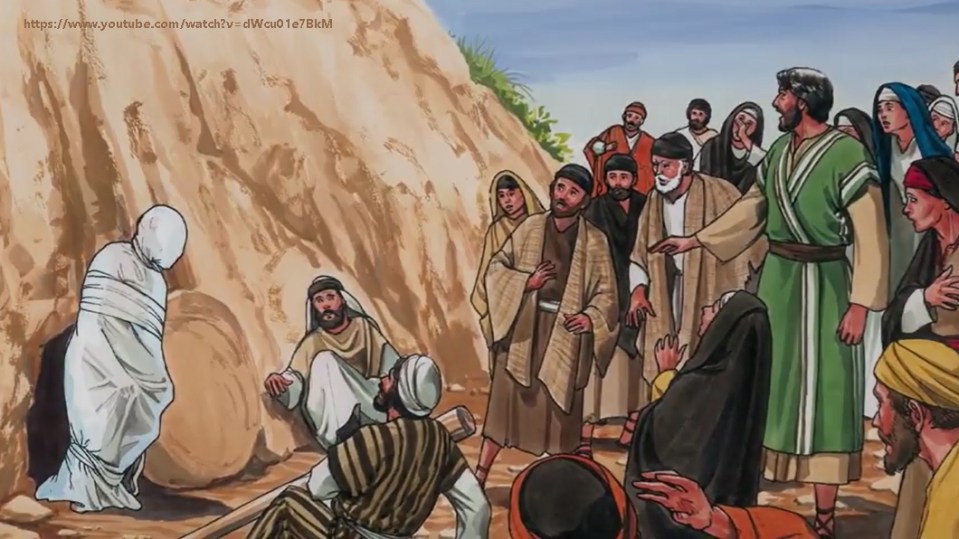
“Robert Langdon [to Sophie Neveu near end of film, “The Da Vinci Code”]: … But, Sophie, the only thing that matters is what you believe. History shows us Jesus was an extraordinary man, a human inspiration. That’s it. That’s all the evidence has ever proved. But… when I was a boy… when I was down in that well Teabing told you about, I thought I was going to die, Sophie. What I did, I prayed. I prayed to Jesus to keep me alive so I could see my parents again, so I could go to school again, so I could play with my dog. Sometimes I wonder if I wasn’t alone down there. Why does it have to be human or divine? Maybe human is divine. Why couldn’t Jesus have been a father [not divine, not the Son of God] and still be capable of all those miracles?” (Quotation from the movie version of The Da Vinci Code)
Langdon’s Words Directly Contradict John’s Thesis–
What do you think? Is a human being capable of raising a man who has been dead for four days?
ESV John 11:17 Now when Jesus came, he found that Lazarus had already been in the tomb four days.
A Dramatic Event
Can you tell briefly what happens in this section of Scripture? In other words, describe the miracle.
Can you spot?
…how this chapter is different than any chapter so far in the Gospel of John? (My own thoughts are at the bottom of Section 4 — Jesus Himself)
Sections
1. Jesus and his disciples
2. Jesus and the sisters
3. Jesus himself
4. Jesus at the internment site–the miracle
5. Jesus and the Jewish people
–those who believed and were glad
–those who believed and were angry
………………..
1. Jesus and His Disciples
Questions:
A. How did Jesus and the group of disciples relate? For example: Was the relationship robotic? (Did the disciples mindlessly do as they were told?) Was the relationship dictatorial?
In answering, consider the following sets of verses:
John 11:7 Then after this he said to the disciples, “Let us go to Judea again.” 8 The disciples said to him, “Rabbi, the Jews were just now seeking to stone you, and are you going there again?”
John 11:14 Then Jesus told them plainly, “Lazarus has died, 15 and for your sake I am glad that I was not there, so that you may believe. But let us go to him.” 16 So Thomas, called the Twin, said to his fellow disciples, “Let us also go, that we may die with him.” (Who seems to be getting the group actually moving? Was it Jesus or someone else? What do you make of that?)
B. What emotion do the disciples express when Jesus suggests they all go back to Judea? (see verses 7-8 above)
C. How does Jesus comfort them? Can you translate into your own understanding verses 9-10?
John 11:9 Jesus answered, “Are there not twelve hours in the day? If anyone walks in the day, he does not stumble, because he sees the light of this world. 10 But if anyone walks in the night, he stumbles, because the light is not in him.”
Suggestions: 1–Jesus is the Light of the world. As long as he is with the disciples, that is, before he is crucified, nothing will happen to them. His “time has not yet come.” 2–Further, Jesus knew in advance all about the amazing miracle he was about to perform (John 11:4 But when Jesus heard it he said, “This illness does not lead to death. It is for the glory of God, so that the Son of God may be glorified through it.”). He knew that by going to Bethany, located within two short miles of Jerusalem, he would be walking in the will of God for him. Walking in God’s will and favor is like walking in the day–it is safe and secure. The more specific and clear the communication from God concerning his will in a given situation, the more assurance of light and safety the Christian will have. Walking apart from God’s will or favor is like walking in the dark, a time when stumbling occurs. Unbelievers do not have the light of Christ in them.
2. Jesus and the sisters (John 11:17-33)
Jesus meets and speaks with each of the two women one at a time somewhere at or near the village and away from the house.
Questions:
1. The conclusion expressed in several commentaries is that when each of the sisters separately said to Jesus, “If you had been here, my brother would not have died,” (Martha in vs 21 and Mary in vs 32) they were not blaming him of neglect or lack of caring. Why do you think each of these women made this statement?
2. Why might Jesus have met the women one at a time?
3. How does this speak to your heart about your relationship with the Lord?
4. What, if anything, were they expecting when they spoke with Jesus?
5. How would you describe Martha’s faith? Did she experience any challenges? Do you think her faith grew or changed in any way as the story progresses? (See vss. 11:21-22, 24, 27, 28, and 39)
3. Jesus Himself
Questions:

A. What do you learn about Jesus from the following verses?
John 11:3 So the sisters sent to him, saying, “Lord, he whom you love is ill.”
John 11:5 Now Jesus loved Martha and her sister and Lazarus.
John 11:11 After saying these things, he said to them, “Our friend Lazarus has fallen asleep, but I go to awaken him.”
John 11:33 When Jesus saw her weeping, and the Jews who had come with her also weeping, he was deeply moved in his spirit and greatly troubled.
John 11:35 Jesus wept.
John 11:38 Then Jesus, deeply moved again, came to the tomb. It was a cave, and a stone lay against it.
B. Compare and contrast the verses from Question A with those from Question B. What do you notice? How would you characterize what each set of verses teaches about Jesus?
John 11:4 But when Jesus heard it he said, “This illness does not lead to death. It is for the glory of God, so that the Son of God may be glorified through it.”
John 11:6 So, when he heard that Lazarus was ill, he stayed two days longer in the place where he was.
John 11:11 After saying these things, he said to them, “Our friend Lazarus has fallen asleep, but I go to awaken him.”
John 11:15 and for your sake I am glad that I was not there, so that you may believe. But let us go to him.”
John 11:23 Jesus said to her, “Your brother will rise again.” 24 Martha said to him, “I know that he will rise again in the resurrection on the last day.” 25 Jesus said to her, “I am the resurrection and the life. Whoever believes in me, though he die, yet shall he live, 26 and everyone who lives and believes in me shall never die. Do you believe this?”
John 11:40 Jesus said to her, “Did I not tell you that if you believed you would see the glory of God?” 41 So they took away the stone. And Jesus lifted up his eyes and said, “Father, I thank you that you have heard me. 42 I knew that you always hear me, but I said this on account of the people standing around, that they may believe that you sent me.” 43 When he had said these things, he cried out with a loud voice, “Lazarus, come out.” 44 The man who had died came out, his hands and feet bound with linen strips, and his face wrapped with a cloth. Jesus said to them, “Unbind him, and let him go.”
John 12:7 Jesus said, “Leave her alone, so that she may keep it for the day of my burial.
C. Note: Both the world and the church have for two thousand years probed and discussed the manner in which Jesus Christ encompasses both human and divine natures. A technical sample of the discussion can be found here: Council of Chalcedony, 451, Section V and a modern presentation here: Desiring God .
D. Question: As you spend time with God in prayer and Scripture, spend time thinking about his love toward humankind, and especially about his love for you in particular. What does the union of God’s divinity and humanity in Jesus Christ tell us about his love? For example, Jesus in the Gospel of John is omniscient, knowing all things, even what Nathanael was thinking (John 1:47-49). And we learn from Luke that Jesus knew and predicted what Peter would do and say later in the day (Luke 22:34). Jesus is eternal (Matthew 28:20) and (John 17:8-11). That means that he is alive and omniscient right now. He can read and know each one of our thoughts and the feelings in our hearts–right now! And he is also human. He had human friends, and he cried when they were hurting and died. He knows first-hand from the weakness of human flesh what our suffering feels like. And he wants to help. That’s why he left heaven, came to us, and died on the cross.
John 3:16 “For God so loved the world, that he gave his only Son, that whoever believes in him should not perish but have eternal life.
4. Jesus at the internment site–the miracle
Jesus had been staying at Bethany across the Jordan. After waiting the extra two days from when he first heard that Lazarus was sick, he and his disciples travelled to a different Bethany, located just two miles outside Jerusalem (a short walking distance from where the angry people had recently tried to stone him to death.)
Location 1: Bethany “…across the Jordan [at] the place where John had been baptizing at first” (John 10:40) This is approximately twenty miles from the location of Lazarus and the sisters.
Location 2: Bethany near Jerusalem (a different Bethany) (John 11:18) This Bethany lies within two miles of Jerusalem (not a long walk).
This is the narration John gives of the miracle.
John 11:34 And he said, “Where have you laid him?” They said to him, “Lord, come and see.” 35 Jesus wept. 36 So the Jews said, “See how he loved him!” 37 But some of them said, “Could not he who opened the eyes of the blind man also have kept this man from dying?” 38 Then Jesus, deeply moved again, came to the tomb. It was a cave, and a stone lay against it. 39 Jesus said, “Take away the stone.” Martha, the sister of the dead man, said to him, “Lord, by this time there will be an odor, for he has been dead four days.” 40 Jesus said to her, “Did I not tell you that if you believed you would see the glory of God?” 41 So they took away the stone. And Jesus lifted up his eyes and said, “Father, I thank you that you have heard me. 42 I knew that you always hear me, but I said this on account of the people standing around, that they may believe that you sent me.” 43 When he had said these things, he cried out with a loud voice, “Lazarus, come out.” 44 The man who had died came out, his hands and feet bound with linen strips, and his face wrapped with a cloth. Jesus said to them, “Unbind him, and let him go.”
Questions:
1. What happens?
2. What words did Jesus say after they rolled the stone away and before he told Lazarus to come out? (see vss. 41-42)
3. Does the picture at the top of this post match the picture you formed in your mind as you read about Jesus raising Lazarus from the dead?
4. Did Jesus ever enter the tomb? Did he touch Lazarus in any way? Why do you suppose he did this miracle in just the way he did it?
(My answer to “Can you Spot?” above: This chapter is one of the few, or only, chapter in John, and perhaps in the gospels, which gives a look into Jesus’ personal life as a man. For example, how did he relate to his disciples when not on the public stage? Did he have friends? What were his friendships like? John prior to this point has focused on showing that Jesus is divine. Yes, he does demonstrate Jesus’ divine nature magnificently in this chapter, and beyond this, he shows that Jesus is human, just like you or I. He is the one-of-a-kind, totally unique, God-man.)
5. Jesus and the Religious People
Throughout the Gospel of John, we’ve seen a division among the religious people, who in Jesus’ day were Jewish, just as he and his disciples were. Interestingly, no one doubted the fact of the miracles Jesus did. We saw this when Jesus healed the paralyzed man (Link to Week 5 Part 2), when he fed the 5,000 people and later talked about the meaning (Link to Week 7 Part 4), and when he gave sight to the man born blind (Link to Week 9). In the same way, when Jesus called Lazarus out from his tomb after he had been dead four days, the whole countryside, including the religious leaders, believed that he had really done so. Lazarus was there to tell them himself. Some believed and were glad, receiving Jesus as their own, while others believed and were angry, plotting how to destroy not only Jesus but Lazarus, the living evidence of the miracle (see below).
A. Some believed and were glad.
John 11:45 Many of the Jews therefore, who had come with Mary and had seen what he did, believed in him,
John 12:1 Six days before the Passover, Jesus arrived at Bethany, where Lazarus lived, whom Jesus had raised from the dead. 2 Here a dinner was given in Jesus’ honour. Martha served, while Lazarus was among those reclining at the table with him…12:9 When the large crowd of the Jews learned that Jesus was there, they came, not only on account of him but also to see Lazarus, whom he had raised from the dead. 10 So the chief priests made plans to put Lazarus to death as well, 11 because on account of him many of the Jews were going away and believing in Jesus.
B. Some believed and were angry.
John 11:44 The man who had died came out, his hands and feet bound with linen strips, and his face wrapped with a cloth. Jesus said to them, “Unbind him, and let him go.” 45 Many of the Jews therefore, who had come with Mary and had seen what he did, believed in him, 46 but some of them went to the Pharisees and told them what Jesus had done.
John 11:46 but some of them went to the Pharisees and told them what Jesus had done. 47 So the chief priests and the Pharisees gathered the Council and said, “What are we to do? For this man performs many signs. 48 If we let him go on like this, everyone will believe in him, and the Romans will come and take away both our place and our nation.”
John 11:53 So from that day on they made plans to put him to death. 54 Jesus therefore no longer walked openly among the Jews, but went from there to the region near the wilderness, to a town called Ephraim, and there he stayed with the disciples.
John 11:57 Now the chief priests and the Pharisees had given orders that if anyone knew where he was, he should let them know, so that they might arrest him.
John 12:9 When the large crowd of the Jews learned that Jesus was there, they came, not only on account of him but also to see Lazarus, whom he had raised from the dead. 10 So the chief priests made plans to put Lazarus to death as well, 11 because on account of him many of the Jews were going away and believing in Jesus.
So was Robert Langdon correct in his personal assessment of Jesus? (see quotation at the top of this post) What do you think?

I would love to hear your replies to this question. You can use the Comments section at the bottom of this post. Just to be fair, I will tell you up front that I believe Jesus is who he said he is–the eternal God himself.


Hey! What’s Your Problem?
Reader Challenge: As you read through this portion of Scripture, John chapters 7 and 8 (see link just below), try to answer the question found in the title of this blog–What is the problem that the enemies of Jesus have that prevents them from seeing Christ for who he actually is?
Week 8 Part 2 John 7:1-8:59 Focus–Jesus Confronts His Enemies
(Link to Outline of John)
John’s Theme: John 20:31 … these are written so that you may believe that Jesus is the Christ, the Son of God, and that by believing you may have life in his name.
Summary of Chapter 7 (based upon Hendriksen, Vol. 2, 30-31)
The Galilean Ministry has ended. Jesus has retired to the northern regions of the country. After six months, he returns again to Judea for the Later Judean Ministry and the feast of Tabernacles.
1. John 7:1-13 His blood brothers, not yet believers, (see Acts 1:14 for their later belief) attempt sarcastically to entice him to go to the feast with them. Jesus refuses, but later goes up “not publicly, but in secret” (vs 10). In the meantime, at the feast, the “Jews” are murmuring about where “that man” might be, while the crowds call him a “good man” They are all afraid to say anything openly, for fear of the religerati©.
2. John 7:14 Halfway through the feast, Jesus goes up to the temple and begins to teach. He causes a stir.
ESV John 7:37 On the last day of the feast, the great day, Jesus stood up and cried out, “If anyone thirsts, let him come to me and drink. 38 Whoever believes in me, as the Scripture has said, ‘Out of his heart will flow rivers of living water.'”
3. John 7:15-52 The people react.
a. The “Jews” are generally skeptical and oppositional (15, 20, 35-36).
b. The crowd is divided–some derisive and some more or less open (vss 12, 20, 25-27, 31, 40-44).
c. The Pharisees sent guards to arrest him (32, 45-52).
d. The guards sent to arrest him are dumfounded with awe-filled amazement at the manner in which Jesus spoke while teaching (32, 45-46).
e. Nicodemus, one of the Pharisees who had personally gone to inquire of Jesus (John 3:1-12), speaks up in defense of the law, a fairly safe and noncommittal way to defend Jesus himself (50, 51).
Summary of Chapter 8 (based on Hendriksen, Vol. 2, 68-69)
1. John 7:53-8:11 Discussion among experts is inconclusively split concerning whether or not this section should be included in Scripture.
This is the highly popular and famous scene in which Jesus loves unto salvation a woman caught “in the act of adultery.” The great contrast is between the non-judgmental (yet highly aware) love of Jesus versus the callous condemnation and deceitfulness of the “teachers of the laws and the Pharisees.”
2. John 8:12-59 The confrontation between Jesus and the religerati© continues (see Hendriksen, Vol. 2, 68-69).
Scene: the temple courts the following day (1-2)

Jesus: [Theme 1–the light] “I am the light of the world. He who follows Me shall not walk in darkness, but have the light of life.” (12) [JESUS’ SECOND GREAT “I AM” IN JOHN] (Light of the World: 1:4,5,7,8-9; 3:19, 20, 21; 8:12; 9:5; 11:9, 10; 12:35, 36; 12:46)
Pharisees: “You bear witness of Yourself; Your witness is not true.” (13)
Jesus: [Theme 2–Sent by God] The [my] Father sent me (7:28; 8:14b, 15, 16, 17, 18, 26, 49-50; 5:31, 5:38)
Pharisees: They don’t get it–they remain literalistic and concrete; their scope is narrowly focused on the physical, carnal world only.
• “Where is your father?” (8:19) [slanderous insinuation]
• “You, who are you?” (8:25) [scornful disdain]
• “They did not recognize that he spoke to them of the Father.” (8:27) [ignorance born of prejudice]
The Crowd of Religious People: “While he was saying these things, many believed in him.” (8:30) [mental agreement only, quickly changing to disdain–8:31, 33, 39, 41, 44, 48, 52, 53, 57, 59] [see also The Parable of the Sower, especially vss 5-6 and 20-21]
Jesus: [Theme 3–The Son of Man to be lifted up] “When you will have lifted up the Son of man, then you will know that I am he.” (3:14-16; 8:28; 12:32-33) [Also, Theme 6–I AM]
Jesus: [Theme 4–Truth] “If you remain [abide] in my word, you are truly my disciples, and you will know the truth, and the truth will set you free.” (8:31-32; 1:9, 14, 17; 3:21, 33; 4:18, 23, 24, 37; 5:31, 32, 33, 45; 6:32; 7:18, 28; 8:13, 14, 16, 17, 26, 32, 40, 44, 45, 46)
The [Supposedly] Believing Crowd of Religious People: “We are Abraham’s descendants, and have never been in bondage to anyone. How can you say, ‘You will be made free’?” (8:33)
Jesus: [Theme 5–My Father, your father] “I speak what I have seen with My Father, and you do what you have seen with your father.” (8:38) “If you are Abraham’s children, you are doing the works of Abraham. But now you are seeking to kill, me, a man who has been telling you the truth which I heard from God. This Abraham did not do. You are doing the works of your father.” (8:39-40)
The [by now] Non-believing Crowd of Religious People: “Abraham is our father.” (8:39) “We were not born of sexual immorality. We have one Father–even God.” (8:41)
Jesus: [Theme 5–My Father God, your father the devil] “If God were your Father, you would love me, for I came from God and I am here. I came not of my own accord, but he sent me (8:42) [Also Theme 2–Sent by God]. Why do you not understand what I say? It is because you cannot bear to hear my word. You are of your father the devil, and your will is to do your father’s desires. He was a murderer from the beginning, and has nothing to do with the truth, because there is no truth in him. When he lies, he speaks out of his own character, for he is a liar and the father of lies.” (8:44) “Whoever is of God hears the words of God. The reason why you do not hear them is that you are not of God.” (8:47)
The [now] Hostile Crowd of Religious People: “Are you greater than our father Abraham, who died? And the prophets died! Who do you make yourself out to be?” (8:53)
Jesus: [Theme 2–Sent by God] “If I glorify myself, my glory is nothing. It is my Father who glorifies me, of whom you say, ‘He is our God.’ 55 But you have not known him. I know him. If I were to say that I do not know him, I would be a liar like you, but I do know him and I keep his word.” (8:54-55)
Jesus: [Theme 5–My Father, your father] “Your father Abraham [according to the flesh] rejoiced that he would see my day. He saw it and was glad.” (8:56)
The Hostile Crowd of Religious People: “You are not yet fifty years old, and have you seen Abraham?” (8:57)
Jesus: [Theme 6–I AM] “Truly, truly, I say to you, before Abraham was, I am.” (8:58)
The Hostile Crowd of Religious People: [Theme 7–Jesus’ Enemies want to kill him] So they picked up stones to throw at him, but Jesus hid himself and went out of the temple. (8:59; 5:18; 7:1, 19, 20, 25; 8:37, 40)
So how did we do in the Reader Challenge? (see top of post)
Hint: What is the one thing that Jesus had that none of his enemies had? L-O-V-E.
1. See Jesus’ many miracles:
• water to wine demonstrates compassion for a groom, his bride, and the parents (2:1-11)
• healing the nobleman’s son demonstrates love for a social class not his own (4:46-54)
• healing the paralyzed man demonstrates Jesus’ love for the outwardly weak and defeated, the unattractive and unlovely (5:1-9)
• healing the paralyzed man on a Sabbath demonstrates Jesus’ (and God’s) love for people above an overly zealous and ungodly love for human religious tradition
• feeding the 5,000 people demonstrates love for people’s physical needs 6:1-15
2. Jesus’ actions demonstrate love:
• cleansing the temple demonstrates love for God and for God’s house of prayer (2:13-22)
• Jesus’ conversation with Nicodemus demonstrates love for potentially hostile people (3:1-21)
• Jesus’ conversation with the Samaritan woman at the well and his long visit in her village demonstrates his love for ethnic and religious classes not his own (Jesus was Jewish by human birth) (4:4-43)
• Jesus’ long discourses with his enemies in chapters 6, 7, and 8 demonstrate his love for those who hate them
• These same discourses demonstrate Jesus’ love for God in his willingness that none should go without hearing the gospel of salvation, even those whom he knows will use this gospel against him in order to kill him
3. Lack of love prevented Jesus’ enemies for recognizing that Jesus was a good man.
Yet, even without LOVE, two other attributes would have worked to help these blind enemies of Christ: KNOWLEDGE and OBEDIENCE

1. Obedience
2. Knowledge
John 7:17 If anyone’s will is to do God’s will, he will know whether the teaching is from God or whether I am speaking on my own authority.
obedience–if anyone’s will is to do God’s will
knowledge–he will know
Obedience–John 7:19 Has not Moses given you the law? Yet none of you keeps the law. Why do you seek to kill me?”
John 7:23 If on the Sabbath a man receives circumcision, so that the law of Moses may not be broken, are you angry with me because on the Sabbath I made a man’s whole body well?
Knowledge–John 7:27 But we know where this man comes from, and when the Christ appears, no one will know where he comes from.” 28 So Jesus proclaimed, as he taught in the temple, “You know me, and you know where I come from? But I have not come of my own accord. He who sent me is true, and him you do not know. 29 I know him, for I come from him, and he sent me.”
Obedience and Knowledge–John 7:49 But this crowd that does not know the law is accursed.” 50 Nicodemus, who had gone to him before, and who was one of them, said to them, 51 “Does our law judge a man without first giving him a hearing and learning what he does?” [The chief priests and Pharisees do not obey the law that they claim to know.]
Knowledge and Obedience–John 8:4 they said to him, “Teacher, this woman has been caught in the act of adultery. 5 Now in the Law Moses commanded us to stone such women. So what do you say?” … John 8:7 And as they continued to ask him, he stood up and said to them, “Let him who is without sin among you be the first to throw a stone at her.” 8 And once more he bent down and wrote on the ground. 9 But when they heard it, they went away one by one, beginning with the older ones, and Jesus was left alone with the woman standing before him. [In their claimed knowledge of the Law, the Pharisees test Jesus to see if he will deny the love for common folk, which he often displays, or deny his obedience to the Law of Moses. Jesus’ outwits them by causing them to recognize their own guilt of disobedience.
Knowledge and Obedience–John 8:49 Jesus answered, “I do not have a demon, but I honor my Father, and you dishonor me. [The religious leaders did not know God, nor did they obey him. They dishonored God by dishonoring his Sent One–Christ.]
Summary: If they had known God and wanted to obey him, they would have investigated Jesus’ claim of being God’s Son with an open mind and an open heart, given that God backed up Jesus’ claims with astounding miracles, and that Jesus taught with astounding teaching. If these Pharisees had sought to honor God (to know, obey, and love him), they would have fairly investigated Jesus’ claims, as Nicodemus, who was one of them, apparently did. Seeking to do God’s will (obedience), they would have discovered (knowledge) that Jesus truly was who he claimed to be. Knowledge of God and his Son leads to love for both. So, in love, they would have honored God by honoring the Son. They did none of these, thereby showing that they had neither knowledge of God, nor a heart of obedience towards him, nor did they have the love of God in their hearts. Jesus told them flat out that they had none of these because they were not “of God” but of their father, the devil (8:44).

Spiritual Versus Concrete Continues in John 6
Week 7 Part 4 John 6:22-71: Focus–Concrete (Concrete Literal) vs Spiritual (Spiritual Reality)
(Link to Outline of John)
John’s Theme: John 20:31 … these are written so that you may believe that Jesus is the Christ, the Son of God, and that by believing you may have life in his name.
In chapter 6 John continues the steady development of his presentation of the great salvation theme of his letter, and he continues to contrast the concrete-only understanding of the religious pundits of his day with the spiritual realities of eternal life.
I. John 3: Nicodemus and the necessity of being born again of the Spirit
John 3:3 Jesus answered him, “Truly, truly, I say to you, unless one is born again he cannot see the kingdom of God.” 4 Nicodemus said to him, “How can a man be born when he is old? Can he enter a second time into his mother’s womb and be born?” 5 Jesus answered, “Truly, truly, I say to you, unless one is born of water and the Spirit, he cannot enter the kingdom of God. 6 That which is born of the flesh is flesh, and that which is born of the Spirit is spirit.
II. John 4: The Woman at the Well and Christ the giver of living water that springs up in believers to a fountain of eternal life
John 4:10 Jesus answered her, “If you knew the gift of God, and who it is that is saying to you, ‘Give me a drink,’ you would have asked him, and he would have given you living water.” 11 The woman said to him, “Sir, you have nothing to draw water with, and the well is deep. Where do you get that living water? 12 Are you greater than our father Jacob? He gave us the well and drank from it himself, as did his sons and his livestock.” 13 Jesus said to her, “Everyone who drinks of this water will be thirsty again, 14 but whoever drinks of the water that I will give him will never be thirsty again. The water that I will give him will become in him a spring of water welling up to eternal life.” 15 The woman said to him, “Sir, give me this water, so that I will not be thirsty or have to come here to draw water.”
John 4:24 God is spirit, and those who worship him must worship in spirit and truth.” 25 The woman said to him, “I know that Messiah is coming (he who is called Christ). When he comes, he will tell us all things.” 26 Jesus said to her, “I who speak to you am he.”
III. John 6: Christ the bread of life and the necessity of eating his flesh and drinking his blood
John 6:31 Our fathers ate the manna in the wilderness; as it is written, ‘He gave them bread from heaven to eat.'” 32 Jesus then said to them, “Truly, truly, I say to you, it was not Moses who gave you the bread from heaven, but my Father gives you the true bread from heaven. 33 For the bread of God is he who comes down from heaven and gives life to the world.” 34 They said to him, “Sir, give us this bread always.” 35 Jesus said to them, “I am the bread of life; whoever comes to me shall not hunger, and whoever believes in me shall never thirst.
John 6:41 So the Jews grumbled about him, because he said, “I am the bread that came down from heaven.” 42 They said, “Is not this Jesus, the son of Joseph, whose father and mother we know? How does he now say, ‘I have come down from heaven’?“
John 6:48 I am the bread of life.
John 6:51 I am the living bread that came down from heaven. If anyone eats of this bread, he will live forever. And the bread that I will give for the life of the world is my flesh.” 52 The Jews then disputed among themselves, saying, “How can this man give us his flesh to eat?” 53 So Jesus said to them, “Truly, truly, I say to you, unless you eat the flesh of the Son of Man and drink his blood, you have no life in you. 54 Whoever feeds on my flesh and drinks my blood has eternal life, and I will raise him up on the last day. 55 For my flesh is true food, and my blood is true drink. 56 Whoever feeds on my flesh and drinks my blood abides in me, and I in him. 57 As the living Father sent me, and I live because of the Father, so whoever feeds on me, he also will live because of me.
Recap:
- To Nicodemus Jesus said, You must be born again. Nicodemus responded concretely–asking whether he needed to crawl back into his mother’s womb as an old man.
- To the Woman at the Well Jesus said, I will give you Living Water. The woman initially responded concretely by asking for the water so as not to have to go to the well to fill her bucket every day.
- To all the listeners in John 6 (the religious pundits, his larger circle of disciples, and his own group of 12 disciples) Jesus reveals that he himself is the living water, and that those who want the fountain of water springing up to eternal life must eat his flesh and drink his blood. He was not speaking of cannibalism, but of the spiritual necessity of fully embracing himself in deepest communion–also known as believing in him. Many who heard him interpreted his words as though he were speaking of cannibalism, and they were repulsed.
This one verse sums up Jesus’ teaching well–
John 6:63 It is the Spirit who gives life; the flesh is no help at all. The words that I have spoken to you are spirit and life.
Application:
- Can you find other verses in which a teaching of Jesus is interpreted concretely rather than as the spiritual truth he intends?
- Given the strength and clarity of Jesus’ teaching concerning Spirit and flesh (see John 6:63 above), why do you suppose there are some today whose minds still focus on concrete fulfillment of spiritual words rather than on the spiritual realities to which the concrete symbols point?
Just the Facts, Ma’am
Week 6 Part 2 John 6:1-15: Jesus Feeds 5,000 People from One Lunch
(Link to Outline of John)
John’s Theme: John 20:31 … these are written so that you may believe that Jesus is the Christ, the Son of God, and that by believing you may have life in his name.
Parallel Passages: Matthew 14:13-21; Mark 6:30-44; Luke 9:10-17
Important Items to Notice 
- The healing of the nobleman’s son, Jesus’ second sign recorded in John’s Gospel (see Outline of John, Week 5), occurred at the beginning of what is called the “Great Galilean Ministry.” This fourth sign, in which Jesus feeds 5,000 men plus women and children from five “loaves” of Mediterranean flat bread and two fish, occurs at the end of his Galilean ministry.
- John 5 records how Jesus was rejected in Judea; John 6 shows how he was rejected in Galilee also.
- In Judea, John records how the Jewish religious leaders rejected Jesus; here in Galilee, it was not just the leaders but his own disciples (the twelve excepted) who also rejected him.
- This is the only miracle recorded in all four gospels (see links above, Parallel Passages).
- As recorded by John, the disciples’ faith had not grown sufficiently for them to expect or even believe that Jesus could feed the enormous crowd from one boy’s lunch (John 6:5-9).
- Nevertheless, the disciples obeyed Christ and arranged the men in orderly groups of about fifty each (Luke 9:14-15). Application: Obedience is a servant to faith in the outworking of miracles in our lives. Obeying Christ’s clear commands even when our faith falls short is sometimes enough for our miracle to happen (cf. the miraculous results of Peter’s obedience without faith in Luke 5:3-9).
- Apart from the resurrection, this is the most well attested sign that Jesus performed, witnessed and participated in by over 5,000 people at once.
Many of Those Whom Jesus Fed Later Rejected Him (John 6:66).
John supplies a key to their actions:
NIV John 6:15 Jesus, knowing that they intended to come and make him king by force, withdrew again to a mountain by himself.
This was an unruly mob ruled by the concrete reality of their stomachs. They wanted control over a puppet king of their own making, one who would do their own bidding and feed them on demand. They had no interest in Jesus as a person–who was this amazing man? Nor did their eyes lift to the heavens to recognize the source of the awesome power Jesus displayed. Their interest in him was earthbound, not spiritual.
The writer John explores their attitudes and motivations later as Chapter 6 continues.
Application: How does this miracle demonstrate John’s theme–that Jesus is the Son of God. What does this mean for me personally in my own life?
Week 6 Part 2 John 6:15-21: The Fifth Sign–Jesus Walks on Water
John’s Theme: John 20:31 … these are written so that you may believe that Jesus is the Christ, the Son of God, and that by believing you may have life in his name.

Genesis 1:2 … And the Spirit of God was hovering over the face of the waters.
After the miracle of the bread and fish, Jesus sent the crowds away. Then he sent his disciples away into the one boat down on the shore and bid them sail to the other side of the lake, while he himself retreated into the mountains to pray. He prayed for a good deal of the night, while his disciples rowed against the wind on high seas in a fierce storm. By the middle of the night, they were still out in the middle of the lake, suspended half way from shore to shore, about 2-1/2 miles out.
Suddenly, an apparition-like form came moving across the water, and the disciples in the boat were terrified. The form spoke in a familiar voice, “It is I; do not be afraid.” At this, they recognized that it was Jesus, and they willingly brought him into the boat. Again suddenly, all at once, they found themselves and the boat on the shore towards which they had laboriously been rowing for hours.
Question: How does this fifth sign achieve John’s thematic purpose of demonstrating that Jesus is the Son of God? How does this affect me in my life personally?
……………………………………..
And the Spirit of God was hovering over the face of the waters.
This miracle-story should be accepted by faith. If one does not believe it, however, let him not try to explain it away. Let him be honest and say, “I do not believe it.” (Hendriksen, vol. 1, 227)

Like Father Like Son
John 20:31 … these are written so that you may believe that Jesus is the Christ, the Son of God, and that by believing you may have life in his name.
Week Six: Discourse—Does Jesus Himself Claim to Be Divine? (Link to John 5:18-47)
Main Point: 34 Not that the testimony that I receive is from man, but I say these things so that you may be saved.
A Dramatic Scene
A GRAND miracle has just been performed—Jesus suddenly and completely heals a man who had been paralyzed for 38 years. The man picks up his sick-bed mat and carries it off.
“Wow!! Awesome!! Praise God!! We’ve never seen or heard anything like this in our whole lives!! Who is this man who did this healing?”
Wrong!—The religious leaders said, “You both picked the wrong day of the week for your dramatic little display. We are the keepers of the law, and it is against our law for anyone to heal, lift, and carry on the Sabbath. You are both sinners.”
Jesus: “Ah, but you are wrong. My Father and I are One, and we hold ultimate authority over the Sabbath. We created the Sabbath, not as a set of picayune laws to trip people up, but as a day of rest to help people weary from their labors.
“I want to help you to understand and believe, so listen to me.”
Part One: If it quacks like a duck…
ESV John 5:18 This was why the Jews were seeking all the more to kill him, because not only was he breaking the Sabbath, but he was even calling God his own Father, making himself equal with God.
19 So Jesus said to them, “Truly, truly, I say to you, the Son can do nothing of his own accord, but only what he sees the Father doing. For whatever the Father does, that the Son does likewise.
20 For the Father loves the Son and shows him all that he himself is doing. And greater works than these will he show him, so that you may marvel.
21 For as the Father raises the dead and gives them life, so also the Son gives life to whom he will.
22 The Father judges no one, but has given all judgment to the Son,
23 that all may honor the Son, just as they honor the Father. Whoever does not honor the Son does not honor the Father who sent him.
24 Truly, truly, I say to you, whoever hears my word and believes him who sent me has eternal life. He does not come into judgment, but has passed from death to life.
25 “Truly, truly, I say to you, an hour is coming, and is now here, when the dead will hear the voice of the Son of God, and those who hear will live.
26 For as the Father has life in himself, so he has granted the Son also to have life in himself.
27 And he has given him authority to execute judgment, because he is the Son of Man.
28 Do not marvel at this, for an hour is coming when all who are in the tombs will hear his voice
29 and come out, those who have done good to the resurrection of life, and those who have done evil to the resurrection of judgment.
30 “I can do nothing on my own. As I hear, I judge, and my judgment is just, because I seek not my own will but the will of him who sent me.
It is possible for a son or daughter to share many physical and personality traits with their parent. This is because they share one-half of a complete set of genes. That’s a lot of genes for two people to have in common!
Nevertheless, parent and child are independent of each other in many ways, especially their thought life, their speech, and most importantly, their will (their center of volition, their driving force.)
When Jesus states in verse 19, “the Son can do nothing of his own accord,” he is not describing a shortcoming in himself. Rather, he is saying that there is nothing in the Son that is independent of the Father. They share everything, even their will. Christ is purely, exactly like his Father. And because this is so, they are One.
Hebrews 1:3 He is the radiance of the glory of God and the exact imprint of his nature, and he upholds the universe by the word of his power. After making purification for sins, he sat down at the right hand of the Majesty on high,
Three strands of thought intertwine in Jesus’ discourse above.
1. The Son possesses all the Father possesses and does not possess any trait or quality, apart from his human nature, which the Father does not also possess. This indicates that Father and Son are identical (vss 18-20).
A limited analogy might be human fathers and sons, in which the father openly shows the son all he does—his garage and office, his hobbies, his work, his philosophies and ethic, and so on. As the son grows and matures, he displays his identity as his father’s son by taking on for himself many characteristics of his father.
2. Just as God has life in himself and the power of life over death, so the Son has life in himself and power of life over death (vss 21, 25-26). And, as the Father makes sovereign choices in matters of life versus death, so does the Son (vss 21, 24-26, 28-29).
3. God has given the final judgment to his Son (vss 22, 24, 27-30).
Part Two: The Witnesses
John 5:31 If I alone bear witness about myself, my testimony is not deemed true.
32 There is another who bears witness about me, and I know that the testimony that he bears about me is true.
33 You sent to John, and he has borne witness to the truth.
34 Not that the testimony that I receive is from man, but I say these things so that you may be saved.
35 He was a burning and shining lamp, and you were willing to rejoice for a while in his light.
36 But the testimony that I have is greater than that of John. For the works that the Father has given me to accomplish, the very works that I am doing, bear witness about me that the Father has sent me.
37 And the Father who sent me has himself borne witness about me. His voice you have never heard, his form you have never seen,
38 and you do not have his word abiding in you, for you do not believe the one whom he has sent.
39 You search the Scriptures because you think that in them you have eternal life; and it is they that bear witness about me,
40 yet you refuse to come to me that you may have life.
41 I do not receive glory from people.
42 But I know that you do not have the love of God within you.
43 I have come in my Father’s name, and you do not receive me. If another comes in his own name, you will receive him.
44 How can you believe, when you receive glory from one another and do not seek the glory that comes from the only God?
45 Do not think that I will accuse you to the Father. There is one who accuses you: Moses, on whom you have set your hope.
46 For if you believed Moses, you would believe me; for he wrote of me.
47 But if you do not believe his writings, how will you believe my words?”
Jesus Presents His Five Witnesses
1. Jesus Himself (vs 31).
I know that my testimony is true, because I know who my Father is and where I come from. Nevertheless, if I were the only witness to myself, you might not believe me. Therefore…
2. God the Father (vss 32, 36-38)
- He sent me (John 3:2).
- His voice, which you have not heard, has identified me (John 1:33-34; Mark 1:10-11).
- He commissioned me for these works as his ambassador (John 3:2).
- He sent the prophets and gave them the Scripture (Luke 24:26-27).
3. John the Baptist (vss 33-35)
I don’t need John’s testimony, as I have plenty of divine testimony, which is far stronger. John the Baptist was sent for you, as a herald to announce my coming and to prepare the soil for the good seed. As regards John the Baptist, you are like the seed that fell on stony ground (Luke 8:5-6).
4. Jesus’ Signs and Miracles (vs 36)
These were given to me by God my Father, and none could perform these miracles without his endorsement (John 3:2).
5. Scripture and the Prophets (39-40, 45-46)
The Scripture and prophets all speak of me, especially Moses, whom you adore and on whom you place your trust. I don’t need to condemn you at the final judgment—Moses will condemn you by the words he spoke about me, which you neither believed nor received (Hebrews 1:1-2).
Jesus Accuses His Accusers (37-47)
1. They do not know the Father (vs 37).
2. God’s Word does not abide in them (vs 38, 43).
3. They do not believe the One whom God sent (vs 38).
4. Their hearts are hard (vs 40).
5. The love of God is not in them (vs 42).
6. They refuse to receive the One God sent (# 3 above, vss 38, 43), yet they will receive another who comes in his own name (promoting his own glory and not having endorsement from God).
7. They seek and receive glory from the wrong places (vs 44).
8. They neither understand nor believe their hero, Moses (vss 45-46).
9. They misunderstand the basics (vs 47).
Link to Outline: Gospel of John
 One Small Voice
