Home » 2018 (Page 4)
Yearly Archives: 2018
Psalm 1: If You Eat All That Candy, You’ll Get Worms in Your Stomach

Pixabay
My dad used to send me out trick-or-treating for Halloween, and then whenever he saw me eating some of my stash, he’d tell me I was going to get worms in my stomach. Go figure…
Wisdom cries aloud in the street, in the markets she raises her voice; 21 at the head of the noisy streets she cries out; at the entrance of the city gates she speaks: (Proverbs 1:20-21 ESV)
Every culture teaches its own wisdom either for good or for evil, either freely or for pay. Parents come first to mind within the culture of homes. The American culture generally abounds with offers of wisdom for pay: secrets of obtaining wealth, secrets of losing weight, secrets of building confidence, and so forth. Then there are cultures of evil, which often require initiation rites to test the novice’s loyalty, to exact a payment, or to acquire incriminating evidence to hold over the initiate’s head as a threat if the person decides later to leave. Think fraternities or Oliver Twist or gangs. Movies provide many examples of cultures of crime that exact payment of one sort or another from initiates. God’s culture is different than all these.
Within the Psalter and the Bible as a whole, God claims to be the creator, owner, and ruler of everything. The Psalter offers a culture of wisdom, God’s wisdom, for those desiring to join his team, as it were, or to place themselves under his protection. Psalm 1 teaches wisdom in much the same way as Proverbs 1:20-21, quoted above. There we learn that God’s wisdom exacts no initiation fee from the novice, it is offered to everyone, it is not secretive or hidden, it seeks to give to all, and it presents itself in places where it is likely to be found. In other words, in the body of psalms, God shares his wisdom freely with all. Psalm 1 states in the clearest language possible the simple wisdom of God, the beginning and end of all things human, and how to survive the final judgment.
Think of a mountain high in heaven and picture a spring of clear, cold, fresh, pure water bubbling up from God as its source. The water from the spring forms a stream which flows down the mountain giving water to everything it meets. This is the position of Psalm 1 at the head of the Psalter. It lays the foundation of the psalms and tells the final outcome. Everyone seeking God’s wisdom, the wisdom that leads to a prosperous and fruitful life, should begin here.
These are the principles of Psalm 1:
- God exists and is all-powerful.
- God is good and his path leads to blessing.
- God is just and does not reward those who go against him.
Psalm 1 breathes out Proverbs 1:7–
Proverbs 1:7 The fear of the LORD is the beginning of knowledge; fools despise wisdom and instruction. (ESV)
Psalm 1 is an invitation to enter into the presence of God, to drink deeply from his waters of instruction, and to travel the flow of his river to its final destination of happiness forever. God gives to all who come to him.
Link to next post in this series
Link to prior post in this series
Link to Contents for this series
Psalm 1: Headwater to the Psalter

San Andreas Fault. Photo by John Wiley.
There is a plain located on a fault line on the southwestern side of North America, where the Pacific Plate meets the North American Plate. These two plates slide past each other, the Pacific to the north, and the North American to the south. “For years the plates will be locked with no movement at all as they push against one another. Suddenly the built-up strain breaks the rock along the fault, and the plates slip a few feet all at once. The breaking rock sends out waves in all directions, and it is the waves that we feel as earthquakes.” (Lynch, see Bibliography)
A hill rises along the highway at the northwestern end of this plain which lies along the fault line. Visitors can walk up its short but steep incline to a view point and see the entire plain stretched out before them. It’s an exciting and breathtaking view, as various geological features can be noted. Such a view point is Psalm 1 at the head of the Psalter. Psalm 1 in six short verses sketches out the fault line between the blessedly happy righteous person, whom the Lord guards and protects for all eternity, and the wicked, whom the wind blows away like chaff and who ultimately perishes.
Psalm 1 describes real life in condensed form. As we live our lives, we see the righteous and the wicked side by side. Often they seem locked with no apparent movement as they push against one another. The righteous do not seem to be blessed, confer Psalms 22, 31, and 88 among many others, and the wicked apparently prosper, confer Psalms 37 and 73. Suddenly–for us, not for God–the built up strain causes breakage, as in an earthquake, slippage occurs, and the final outcomes for the righteous and the wicked are revealed. The righteous of earth continuously move toward God’s blessings, while the wicked move in the opposite direction. Psalm 1 describes the fault line between these two.
Link to next post in this series
Link to prior post in this series
Link to Contents for this series
Primer: How Do I Know That God Is Real?
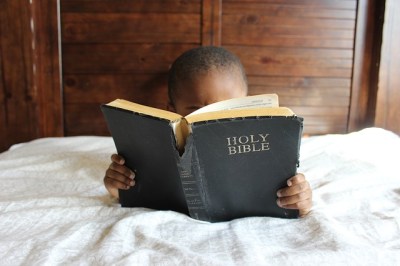
Pixabay
How do I know there is a God?
1. God gives us his word that he exists and is good.
…Because God says so. God speaks for himself. We can trust what he says, because he is God.
13 Then Moses said to God, “If I come to the people of Israel and say to them, ‘The God of your fathers has sent me to you,’ and they ask me, ‘What is his name?’ what shall I say to them?” 14 God said to Moses, “I AM WHO I AM.” And he said, “Say this to the people of Israel, ‘I AM has sent me to you.'” (Exodus 3:13-14, ESV)
5 I am the LORD, and there is no other, besides me there is no God; I equip you, though you do not know me,
6 that people may know, from the rising of the sun and from the west, that there is none besides me; I am the LORD, and there is no other.
7 I form light and create darkness, I make well-being and create calamity, I am the LORD, who does all these things. (Isaiah 45:5-7, ESV)For thus says the LORD, who created the heavens (he is God!), who formed the earth and made it (he established it; he did not create it empty, he formed it to be inhabited!): “I am the LORD, and there is no other. (Isaiah 45:18, ESV)
And he said to me, “It is done! I am the Alpha and the Omega, the beginning and the end. To the thirsty I will give from the spring of the water of life without payment. (Revelation 21:6, ESV)
2. God gives us his Holy Spirit so that we may know his word is true and meant for us.
…God backs up his word with himself. The Holy Spirit is God. The Holy Spirit is God reaching out to us. God shows us he is real and his word is truth through special events in our life and by his keeping us company inside us. The Holy Spirit makes God’s word alive and real in our hearts. He shows us within our hearts that the Bible is God’s word and that it is true. The Holy Spirit shows each person that the words of God are meant for them. He helps each person believe and want God.
The earth was without form and void, and darkness was over the face of the deep. And the Spirit of God was hovering over the face of the waters. (Genesis 1:2, ESV)
139:7 Where shall I go from your Spirit? Or where shall I flee from your presence? (Psalm 139:7, ESV)
But the Helper, the Holy Spirit, whom the Father will send in my name, he will teach you all things and bring to your remembrance all that I have said to you. (John 14:26, ESV)
Romans 5:5 and hope does not put us to shame, because God’s love has been poured into our hearts through the Holy Spirit who has been given to us. (Romans 5:5, ESV)
Psalms 18 and 118: Up from the Grave He Arose!

Resurrection Glory
After the dark Tenebrae chords of Psalm 88 and after the discordant realities of Messiah’s abased life while on earth as recorded in Psalm 89, Psalms 18 and 118 both ring out like joyful peals of Easter bells. Christ is alive! He did not die. Just as we heard from Messiah the God-man in his human form expressing in lament his petitions to his Father, in these psalms we also hear the voice of a man singing his carols of victory, salvation, and release from the grave. Below are a few highlights from each of these psalms. I encourage the reader to read both of these psalms with the vision provided by the apostolic kerygma, the proclamation of the gospel of Jesus Christ. We rejoice as believers, because he rejoices as one of us. His triumph was a triumph of humanity over sin and the grave.
Psalm 18
After the dark pleadings of Psalm 88–
5 like one set loose among the dead, like the slain that lie in the grave, like those whom you remember no more, for they are cut off from your hand.
6 You have put me in the depths of the pit, in the regions dark and deep.
7 Your wrath lies heavy upon me, and you overwhelm me with all your waves. Selah (Psa 88:5-7 ESV)—
God replies. He was silent and absent in Psalm 88, but in Psalm 18, his response is nothing short of tremendous. And, just as Jesus pleaded his lament with great emotional overtones, God his Father replies with great emotional drama as well. Hear what the psalmist says.
4 The cords of death encompassed me; the torrents of destruction assailed me;
5 the cords of Sheol entangled me; the snares of death confronted me.
6 In my distress I called upon the LORD; to my God I cried for help. From his temple he heard my voice, and my cry to him reached his ears.
7 Then the earth reeled and rocked; the foundations also of the mountains trembled and quaked, because he was angry.
8 Smoke went up from his nostrils, and devouring fire from his mouth; glowing coals flamed forth from him.
9 He bowed the heavens and came down; thick darkness was under his feet.
10 He rode on a cherub and flew; he came swiftly on the wings of the wind.
11 He made darkness his covering, his canopy around him, thick clouds dark with water.
12 Out of the brightness before him hailstones and coals of fire broke through his clouds.
13 The LORD also thundered in the heavens, and the Most High uttered his voice, hailstones and coals of fire.
14 And he sent out his arrows and scattered them; he flashed forth lightnings and routed them.
15 Then the channels of the sea were seen, and the foundations of the world were laid bare at your rebuke, O LORD, at the blast of the breath of your nostrils.
16 He sent from on high, he took me; he drew me out of many waters.
17 He rescued me from my strong enemy and from those who hated me, for they were too mighty for me.
18 They confronted me in the day of my calamity, but the LORD was my support.
19 He brought me out into a broad place; he rescued me, because he delighted in me (cf 22:8). (Psa 18:4-19 ESV)
Psalm 118
In Psalm 118, the psalmist/resurrected Messiah sings with pure joy and loud celebration his victorious release from the grave and salvation to life. God heard and answered his prayers, and he is no longer confined alone and friendless in the dank darkness of the pit of death, as recorded in Psalm 88.
1 Oh give thanks to the LORD, for he is good; for his steadfast love endures forever!
… … … …
5 Out of my distress I called on the LORD; the LORD answered me and set me free.
6 The LORD is on my side; I will not fear. What can man do to me?
7 The LORD is on my side as my helper; I shall look in triumph on those who hate me.
… … … …
10 All nations surrounded me; in the name of the LORD I cut them off!
11 They surrounded me, surrounded me on every side; in the name of the LORD I cut them off!
12 They surrounded me like bees; they went out like a fire among thorns; in the name of the LORD I cut them off!
13 I was pushed hard, so that I was falling, but the LORD helped me.
14 The LORD is my strength and my song; he has become my salvation.
15 Glad songs of salvation are in the tents of the righteous: “The right hand of the LORD does valiantly,
16 the right hand of the LORD exalts, the right hand of the LORD does valiantly!”
17 I shall not die, but I shall live, and recount the deeds of the LORD.
18 The LORD has disciplined me severely, but he has not given me over to death.
19 Open to me the gates of righteousness, that I may enter through them and give thanks to the LORD.
20 This is the gate of the LORD; the righteous shall enter through it.
21 I thank you that you have answered me and have become my salvation.
22 The stone that the builders rejected has become the cornerstone.
23 This is the LORD’s doing; it is marvelous in our eyes.
24 This is the day that the LORD has made; let us rejoice and be glad in it.
25 Save us, we pray, O LORD! O LORD, we pray, give us success!
26 Blessed is he who comes in the name of the LORD! We bless you from the house of the LORD.
27 The LORD is God, and he has made his light to shine upon us. Bind the festal sacrifice with cords, up to the horns of the altar!
28 You are my God, and I will give thanks to you; you are my God; I will extol you.
29 Oh give thanks to the LORD, for he is good; for his steadfast love endures forever! (Psa 118:1-29 ESV)
Christians celebrate Easter, which they often call Resurrection Sunday, because in Christ, his victory over sin and death is their victory over sin and death. Because Christ is resurrected, by faith in him, they are resurrected. Because he lives forever, they live forever.
The Bible’s promises are so majestic and broad in scope that words fail. There are no qualifications for anyone to receive all the benefits of God’s covenant of life made with Jesus Christ and through him to all believers. The one and only requirement is a lifelong TRUST in the life, death, and resurrection of the ascended Jesus Christ of Nazareth, as both Savior and Lord. The duration of the lifelong commitment might be no more than one minute, for those who choose to believe on their deathbeds, or an entire span of multiple decades in a hard labor camp. Eternal life is so great that no one merits it and not one more than another (Matthew 20:1-16).
If you have not already done so, won’t you give Christ your allegiance (1) today?
_______________
1 For an interesting approach to the word “allegiance” as it relates to “faith,” see Matthew W. Bates, Salvation by Allegiance Alone. Baker Academic: Grand Rapids, 2017.
Link to next post in this series
Link to prior post in this series
Link to Contents for this series
Psalm 88: A Tenebrae Psalm
A Tenebrae service in its current evangelical format is a dark service commonly observed on the Thursday evening before Good Friday. It is a church service in which the events of Christ’s Passion are acknowledged and honored. Scripture is read, music is sung, and lights or candles gradually dim or are extinguished, until the service room is very dark. Worshipers often exit in silence. Psalm 88 is highly suitable for a Tenebrae service. This psalm dramatically prophesies Christ’s final suffering and death in his own first person voice. The psalm foretells in this man’s own words what it felt like for him to die. Notice that the psalm has two characters–1) the speaker, and 2) the silent character, God. What a treasure this is for us to find in God’s Word.
…………………………………….
Psalm 88 (ESV)
O LORD, God of my salvation; I cry out day and night before you.
2 Let my prayer come before you; incline your ear to my cry!
3 For my soul is full of troubles, and my life draws near to Sheol.
4 I am counted among those who go down to the pit; I am a man who has no strength,
5 like one set loose among the dead, like the slain that lie in the grave, like those whom you remember no more, for they are cut off from your hand.
6 You have put me in the depths of the pit, in the regions dark and deep.
In verses 1-3, we sense the events of Holy Week–our Lord’s deep, deep, constant prayers, his foreknowledge of his betrayal, his suffering in the Garden, his arrest and trial, his close friend’s three denials, and finally, his crucifixion. By verse 4, Jesus the man is dead, or nearly so. Verse 6 works very well as a description of a tomb.
7 Your wrath lies heavy upon me, and you overwhelm me with all your waves. Selah
8 You have caused my companions to shun me; you have made me a horror to them. I am shut in so that I cannot escape;
Verses 7 and 8 might be a repetition of the period Christ spent on the cross, resulting in his being placed in a small, dark cave, a tomb, from which he could not escape.
9 my eye grows dim through sorrow. Every day I call upon you, O LORD; I spread out my hands to you.
10 Do you work wonders for the dead? Do the departed rise up to praise you? Selah
11 Is your steadfast love declared in the grave, or your faithfulness in Abaddon?
12 Are your wonders known in the darkness, or your righteousness in the land of forgetfulness?
13 But I, O LORD, cry to you; in the morning my prayer comes before you.
14 O LORD, why do you cast my soul away? Why do you hide your face from me?
15 Afflicted and close to death from my youth up, I suffer your terrors; I am helpless.
16 Your wrath has swept over me; your dreadful assaults destroy me.
17 They surround me like a flood all day long; they close in on me together.
18 You have caused my beloved and my friend to shun me; my companions have become darkness.
The last ten verses (9-18) are best read as a whole. They seem to repeat in different words the first eight verses with a deeper development of the prayers of pleading the psalmist prayed. We hear notes of what Christ may have spoken to his Father when he cried out to him those three times in the Garden, “Father, if you are willing, remove this cup from me.” (Luke 22:42; Matthew 26:36-44)
Jesus loved his friends; it grieved him that they shunned him as a horror (verses 8 and 18).
The words dark or darkness are mentioned three times in this prayer-poem: once in verse 6, once in verse 12, and once in verse 18.
Link to next post in this series
Link to prior post in this series
Link to Contents for this series
Psalm 116: Christ Loves the Father

Psalm 116 is a song of worship, praise, and thanksgiving for the author of love, God the Father. In it, Christ recounts a brief history of the cross, and his relation to the Father throughout its enactment in history. Christ loves the Father and believes. Therefore, he sings this song.
…………………………………….
Psalms are love songs between Father and Son. As the Father loves the Son (Psalm 2:7-8; Psalm 18), so the Son loves the Father. “I love the Lord!” (Psalm 116:1). “I will lift up the cup of salvation and call on the name of the Lord,” (verse 13). The cup of salvation is the Eucharist (cup of communion) for the early church and in today’s Orthodox tradition (Reardon, 232 and The Orthodox Study Bible, 760). It represents the sacrifice of Christ on the cross.
Psalm 116 states reasons for the Son’s love for his Father: God heard his prayer and delivered him from death.
- He heard my voice and my pleas for mercy. (v 1)
- He bent his ear toward me and responded to my prayer. (v 2)
- I was about to die, and in fact I did die! (v 3)
- I cried out to the Lord and he saved me marvelously. (vv 4-8)
- Now I am alive and I walk freely with the Lord in the land of the living. (v 9)
Psalm 116 describes the Son’s love for his Father.
Short Version of this Section (Scroll Down for the Longer Version)
- He believes, even in the middle of all his horrible experiences. (v 10; Hebrews 11:6)
- “The cup of salvation” (v 13) is the cup that brings eternal life. Its cost of purchase was the death of the Son.
- Both of the phrases in Psalm 116:11, 1) I said in my alarm, and 2) all mankind are liars, conceivably make reference to the cross. (Read the longer version below to find out how.) This interpretation lines up perfectly with the context and received church tradition of Psalm 116 in its entirety. Verse 11 describes the Son’s agony as he sacrificed himself to the Father in love.
- “I will pay my vows to the Lord in the presence of all his people.” (vv 14, 18) What vows? Quite out in the open and publicly, Christ paid his eternal vows to his Father, sacrificing his body and life on the cross. His obedience demonstrates his love for his Father.
- Verse 16 speaks of resurrection. The bonds of servitude are distinguished here from the bonds of death. Christ in verses 17-19 offers the sacrifice of thanksgiving, praise, and continued intercession in prayer (Romans 8:34), thereby displaying his love for his Father God.
Longer Version of this Section
1. He believes, even in the middle of all his horrible experiences. (v 10; Hebrews 11:6)
2. “The cup of salvation” (v 13) is the cup that brings eternal life. Its cost of purchase was the death of the Son. In the early days of the church, many Christians were eager and happy to give up their lives in martyrdom as an expression of their love for Christ (Acts 7:54-60). Christians are martyred today for believing in the Lord. Jesus said, “Greater love has no one than this, that someone lay down his life for his friends.” (Joh 15:13 ESV)
3. Psalm 116:11 is a difficult verse. “I said in my alarm, All mankind are liars.“ Jesus Christ’s love for his Father surpasses the unworthiness of the people for whom Christ died. (Romans 3:23; Psalm 14:1-3; John 2:24-25) When Jesus was tried, convicted, and hung on a cross, none came forward to speak on his behalf (Pilate’s wife did mention to her husband the nightmare she had experienced concerning him). There was no one to comfort him (Handel’s Messiah quoting Psalm 69:20). Because the human race, as represented by all who were gathered and by those who chose to stay away and avoid trouble, allowed and encouraged the great Creator’s crucifixion, they all in essence, denied his deity. To not receive Christ, to not acknowledge God’s love in Christ, is to lie. (Romans 1:18 For the wrath of God is revealed from heaven against all ungodliness and unrighteousness of men, who by their unrighteousness suppress the truth. 19 For what can be known about God is plain to them, because God has shown it to them. 20 For his invisible attributes, namely, his eternal power and divine nature, have been clearly perceived, ever since the creation of the world, in the things that have been made. So they are without excuse. (Rom 1:18 ESV) In this sense, in the crucifixion of Christ, the crucifixion of deity, all humankind was deceived and lied about the true relationship between themselves and their Creator/Savior.
The word “alarm” in Hebrew can mean “haste, hurry, to hurry in alarm.” In the Greek Septuagint, the word is “ecstasy,” which refers to a strong emotional state that is not normal, in the sense of not usual. We say that “So-and-so is beside herself.” It can be produced by great terror, bewilderment, astonishment, (as in response to a powerful miracle that overrides physical laws of nature (Mark 5:42, where Jesus resurrected a dead girl; Luke 5:26, where Jesus healed the paralyzed man; Mark 16:8, where the women were beside themselves in astonishment upon meeting the angel in Christ’s tomb, who told them that he had arisen from the dead). A second meaning for “ecstasy” is a trance (Acts 22:17, Peter’s vision of the blanket filled with unclean foods). This second meaning does not seem applicable here.
Continuing with the first meaning of strong emotion, often brought on by great fear, the Greek word “ecstasy” appears in the superscription of Psalm 31, which is Psalm 30 in the Septuagint. The English translation of the Septuagint reads, “For the end, a Psalm of David, an utterance of extreme fear,” or, εἰς τὸ τέλος ψαλμὸς τῷ Δαυιδ ἐκστάσεως in Greek. Jesus speaks Psalm 31:5 from the cross, “Into your hand I commit my spirit,” (Luke 23:46) and the whole psalm speaks of death and resurrection. It should not be difficult to perceive Christ the man experiencing great trepidation both before and while he was being crucified. Witness his sweating of blood in the Garden as he prayed concerning the trial and crucifixion that lay just ahead.
Therefore, both of the phrases in Psalm 116:11– 1) I said in my alarm, and 2) all mankind are liars, conceivably make reference to the cross. This interpretation lines up perfectly with the context and received church tradition of Psalm 116 in its entirety. Verse 11 describes the Son’s agony as he sacrificed himself to the Father in love.
4. “I will pay my vows to the Lord in the presence of all his people.” (vv 14, 18) What vows? The prior verse (v 13) speaks of “the cup of salvation.” This cup (Luke 22:42) included the cross. The triune God determined the plans for the salvation of humanity in eternity past (Ephesians 1:11; 1 Peter 1:20; Titus 1:2). God made certain promises to his Son, and Christ the Son made promises to his Father. (See an excellent article expanding this topic by R. C. Sproul: Link, accessed 3/30/2018.) Another word for promises is “vows.” Christ in his life and death was constantly surrounded by crowds of people. Quite out in the open and publicly, Christ paid his vows to his Father through his obedience unto death, thereby demonstrating his love. The greatest vow was the sacrifice of his body and life on the cross. His obedience demonstrates his love for his Father.
5. Verse 16 speaks of resurrection. The bonds of servitude are distinguished here from the bonds of death. Christ in verses 17-19 offers the sacrifice of thanksgiving, praise, and continued intercession in prayer (Romans 8:34), thereby displaying his love for his Father God.
Summary and Conclusion
Psalm 116 is a song of worship, praise, and thanksgiving for the author of love, God the Father. In it, Christ recounts a brief history of the cross, and his relation to the Father throughout its enactment in history. Christ loves the Father and believes. Therefore, he sings this song.
It is amazing to me how many facets of approach every bit of the Psalter carries for its many readers. My approach today may not be my approach tomorrow. What I discover and emphasize today may not be the discovery and emphasis of another writer. God speaks one language with as many strings as there are hearts of those who seek him. This is wonderful in my eyes. I just want to encourage you to take time and prayer to allow the Lord to open his Word to your heart. You may not see what I see, but what you see directly from the Lord will be just wonderful for you.
Link to next post in this series
Link to prior post in this series
Link to Contents for this series
Psalm 116:1-9–Simple and Beautiful; Beautifully Simple

Photo by Christina Wilson
Devotional
Psalm 116:1-9 (114 LXX) is simple and beautiful, a beautifully simple psalm.
I love the Lord because He has heard the voice of my supplication.
Because He inclined His ear to me, therefore I will call on Him as long as I live.
The snares of death encompassed me; the pangs of Sheol laid hold on me;
I suffered distress and anguish; then I called upon the name of the Lord: “O Lord, deliver my soul!”
Gracious and righteous is the Lord, and our God is merciful.
The Lord preserves the simple; when I was brought low, He saved me.
Return, O my soul, to your rest; for the Lord has dealt bountifully with you.
For He has delivered my soul from death, my eyes from tears, my feet from stumbling;
therefore, I desire to please the Lord in the land of the living. (The Ancient Faith Psalter, 256)
“I love the Lord!” exclaims the psalmist. Psalm 116 is the only psalm that opens with this exclamation. How many Christians spontaneously cry out this way when the Lord blesses in a big way? Whenever something outstanding pleases them, people often say things like, “I love this food!” “I love my car!” “I love my house!” “Oh, I love this dress!” This psalmist loves the Lord, and for good reason, which he explains in verse 8:
“He has delivered my soul from death, my eyes from tears, my feet from stumbling.”
Where were you when the Lord Jesus found you? This line exactly sums up my salvation experience. Immediately, also, in the very opening lines of the psalm, I hear the voice of Jesus Christ looking back on his experience with the cross and death. And so, Christ and I are intertwined in the words of this psalm. Verse three–the snares of death were in fact encompassing me when I first cried out to the Lord for his help, I felt the pangs of hell, and I was indeed suffering distress and anguish–all this metaphorically. Christ, on the other hand, experienced and suffered all these things concretely, intensely, in his body and soul as he hung nailed upon the cross and witnessed himself descending into Sheol, or hell*. “…then I called upon the name of the Lord: “O Lord, deliver my soul!” (vs 4). *(See Apostle’s Creed, available at https://www.ccel.org/creeds/apostles.creed.html)
4 Gracious and righteous is the Lord, and our God is merciful.
Unlike idols humans make for themselves, our God is a God who hears (Psalm 115:3-8). He is both gracious and righteous.
God’s righteousness is found in his judgment and condemnation of sin. We all know what condemnation feels like. We all see and experience it in our own court system. God’s judgment first expressed itself when he threw (cast) Adam and Eve out of their garden home. How many parents have ever thrown their own children out of their homes when they feel their behavior merits such stern discipline? God is holy, and he demands holiness in those who are near him, even his own created beings.
God’s graciousness appears when God takes the form of human beings and takes upon himself the judgment and condemnation of the sin he detests. Our creator took the punishment of his creation’s sin in his own flesh and blood. God did not abandon, he made a way where there was no way. In Christ, God opened the door of return to his home and to his own side.
Jesus, however, sings this psalm not in his role as Creator God but as human being, as one of us, a brother in distress.
The Lord preserves the simple; when I was brought low, He saved me.
All Christians can sing this line as their personal testimony, “… when I was brought low, He saved me.”
Psalm 116:1-9 (114 LXX) is truly a resurrection song, an Easter Sunday rejoicing.
Link to next post in this series
Link to prior post in this series
Link to Contents for this series
Psalm 132: Concrete-Literal and Spiritual-Literal

Addendum
Before leaving Psalm 132, I want to comment on one of the most amazing differences between Old Testament faith and New Testament faith–the experiencing of the Holy Spirit.
Saints of the Old Testament received the saving grace of God through faith, just as New Testament believers do. It is and always has been God’s grace through faith.
Ephesians 2:8 For by grace you have been saved through faith. And this is not your own doing; it is the gift of God, (ESV)
There is a great difference in salvation experience between the Testaments, however. When Paul came to Ephesus in Acts 19:1-7, why did he ask the believers there, “Did you receive the Holy Spirit when you believed? (Act 19:2)?” They replied, “No, we have not even heard that there is a Holy Spirit.” (vs 2) They had been baptized with John the Baptist’s baptism of repentance. Paul then baptized them in the name of “the Lord Jesus.” “And when Paul had laid his hands on them, the Holy Spirit came on them, and they began speaking in tongues and prophesying.” (vs 6) Right in these verses is the difference between salvation in the Old Testament and the New Testament: the location of the Holy Spirit.
The Holy Spirit played a significant role in the Old Testament.
- All Israel knew the presence of the Lord in the wilderness, since he manifested as a cloud by day and a pillar of fire by night (Exodus 13:21-22).
- The Ark was revered because it contained the presence of the Lord.
- When Moses entered the Tent of Meeting in the wilderness to speak with God before the Ark, he would place a veil over his face when he left, to hide the fading glow he received in his encounter with the Lord there (Exodus 33:7-11; 34:33-35).
- God’s Holy Spirit inhabited the First Temple of Solomon as a cloud, “10 And when the priests came out of the Holy Place, a cloud filled the house of the LORD, 11 so that the priests could not stand to minister because of the cloud, for the glory of the LORD filled the house of the LORD.” (1 Kings 8:10-11)
- In Ezekiel 10, the prophet describes his vision of the Glory of the Lord leaving this same temple.
The common denominator in all the prior biblical scenes is that the presence of the Lord, his Holy Spirit, was external. He manifested in a visible, concrete-literal way. By literal I mean real. These events really happened; they are true. Concrete means apparent to the physical senses. Spiritual means of the Spirit of God, who is himself invisible. The Holy Spirit accompanied the congregation of Israel in the Old Testament, and his presence was concrete-literal. This is why, I believe, prophecy played such an important role in the Old Testament. David needed a prophet like Nathan to walk up to him and tell him what the Lord was saying, because David did not have the Holy Spirit within him to speak to him directly in his heart.
It is impossible to overstate the change from the Old Testament to the New in the shift from external to internal of God’s Holy Spirit. This is a change from a concrete-literal manifestation of the Holy Spirit among the people to a spiritual-literal. John the Apostle previews this change in Jesus’ discourse with Nicodemus in John 3 and with the woman at the well in John 4. To understand the prominent position Scripture gives this change we can recall Jesus’ last directions to his disciples before he ascended.
Luke 24:49 And look, I am sending you what my Father promised. But stay in the city until you have been clothed with power from on high,” and “… you will receive power when the Holy Spirit has come upon you, and you will be my witnesses in Jerusalem and in all Judea and Samaria, and to the end of the earth.” (Act 1:8)
Acts chronicles the multiple occasions when believers received the Holy Spirit, and Paul in his letters again and again proclaims the Spirit’s presence in a new way within the church corporately and within believers singly.
For example, see:
Romans 8:9 You, however, are not in the flesh but in the Spirit, if in fact the Spirit of God dwells in you. Anyone who does not have the Spirit of Christ does not belong to him. (ESV)
Romans 8:14 For all who are led by the Spirit of God are sons of God. 15 For you did not receive the spirit of slavery to fall back into fear, but you have received the Spirit of adoption as sons, by whom we cry, “Abba! Father!” 16 The Spirit himself bears witness with our spirit that we are children of God,
Galatians 4:6 And because you are sons, God has sent the Spirit of his Son into our hearts, crying, “Abba! Father!”
Ephesians 2:19 So then you are no longer strangers and aliens, but you are fellow citizens with the saints and members of the household of God, 20 built on the foundation of the apostles and prophets, Christ Jesus himself being the cornerstone, 21 in whom the whole structure, being joined together, grows into a holy temple in the Lord. 22 In him you also are being built together into a dwelling place for God by the Spirit.
New Testament believers currently experience the fulfillment of God’s statement in Psalm 132:13-14.
13 For the LORD has chosen Zion; he has desired it for his dwelling place:
14 “This is my resting place forever; here I will dwell, for I have desired it.
The writer of the Letter to the Hebrews sums up the effect of the difference between the concrete-literal experiencing of God’s Holy Presence in the Old Testament and what New Testament believers experience now:
Hebrews 12:20 For they could not endure the order that was given, “If even a beast touches the mountain, it shall be stoned.” 21 Indeed, so terrifying was the sight that Moses said, “I tremble with fear.”
22 But you have come to Mount Zion and to the city of the living God, the heavenly Jerusalem, and to innumerable angels in festal gathering, 23 and to the assembly of the firstborn who are enrolled in heaven, and to God, the judge of all, and to the spirits of the righteous made perfect, 24 and to Jesus, the mediator of a new covenant, and to the sprinkled blood that speaks a better word than the blood of Abel.
As New Testament believers in Jesus Christ join with Old Testament believers in the hope of Messiah by singing the prayer of Psalm 132, may we feel fortunate (blessed) and joyful to know that we are part of the psalm’s fulfillment in grace. Praise God for having restored and even increased the close, intimate fellowship of humans with their Creator.
Link to Psalm 132 in a former series
Link to next post in this series
Link to prior post in this series
Link to Contents for this series
Psalm 132: Intercession and Divine Speech
Introduction
This week I begin a new section: Specific Psalms.
Why begin with Psalm 132?
- I’ve been reading through the Psalter, and this is where I was when I needed to choose the first psalm to write about: plain and simple.
- As I was reading, the Lord sparked my interest in this psalm. Is it a coincidence that the last post of my previous series on the Psalter ended with Psalms 132? Perhaps the Lord is saying that he wasn’t finished yet.
- This is a Lenten psalm, according to The Orthodox Study Bible (Bibliography), and we are currently in the season of Lent.
- This psalms brings together in one place several aspects, or threads of interest, in the Psalter generally. It combines in one psalm: Messiah, reported direct divine speech, a view of the relationship between Father and Son, enemies, intercessors, the Ark, and specific prophecy. This post will not cover all these topics.
- Psalm 132 displays similarity with The Lord’s Prayer.
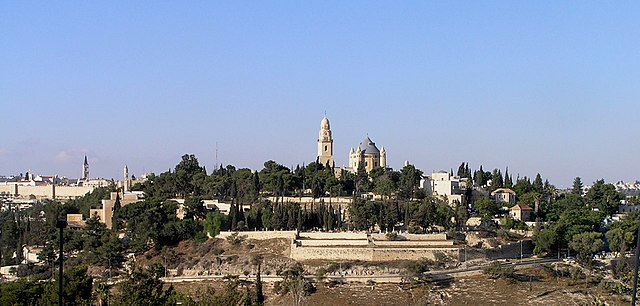
Temple Mount Today. https://upload.wikimedia.org/wikipedia/commons/thumb/9/9f/MtZion_from_Abu_Tor.jpg/640px-MtZion_from_Abu_Tor.jpg
General Description
With eighteen verses, Psalm 132 is of medium length. It was not written by David. It is not an intimate psalm. Other than the reported speech of God himself, no use is made of singular first person, meaning that this is a group, or corporate, psalm.
1 Remember, O Lord, in David’s favor,
all the hardships he endured,
2 how he swore to the Lord
and vowed to the Mighty One of Jacob,
3 “I will not enter my house
or get into my bed,
4 I will not give sleep to my eyes
or slumber to my eyelids,
5 until I find a place for the Lord,
a dwelling place for the Mighty One of Jacob.”
6 Behold, we heard of it in Ephrathah;
we found it in the fields of Jaar.
7 “Let us go to his dwelling place;
let us worship at his footstool!”
8 Arise, O Lord, and go to your resting place,
you and the ark of your might.
9 Let your priests be clothed with righteousness,
and let your saints shout for joy.
10 For the sake of your servant David,
do not turn away the face of your anointed one.
11 The Lord swore to David a sure oath
from which he will not turn back:
“One of the sons of your body
I will set on your throne.
12 If your sons keep my covenant
and my testimonies that I shall teach them,
their sons also forever
shall sit on your throne.”
13 For the Lord has chosen Zion;
he has desired it for his dwelling place:
14 “This is my resting place forever;
here I will dwell, for I have desired it.
15 I will abundantly bless her provisions;
I will satisfy her poor with bread.
16 Her priests I will clothe with salvation,
and her saints will shout for joy.
17 There I will make a horn to sprout for David;
I have prepared a lamp for my anointed.
18 His enemies I will clothe with shame,
but on him his crown will shine.”
(English Standard Version (ESV) The Holy Bible, English Standard Version. ESV® Text Edition: 2016. Copyright © 2001 by Crossway Bibles.)
Vocabulary
Three proper names need explanation:
1. Ephrathah (6 Behold, we heard of it in Ephrathah;) refers to a place name, whose exact location is not agreed upon by scholars. Some say a small town outside of Bethlehem or even Bethlehem itself (Ruth 4:11; Micah 5:2; Genesis 35:19); some say Bethel; and others say a district of Ephraim, location of Shiloh, where the Ark first rested (Bonar, 402).
2. Jaar is also a place name. (6 … we found it in the fields of Jaar). A reasonable explanation is that this term meaning field or wood, stands in for Kiriath-jearim (1 Samuel 7:1), where the Ark rested in the house of Abinadab for twenty years after the Philistines released it and David rescued it. The reader can easily imagine Abinadab’s allotment containing both fields and woods, or forests.
3. Zion. Zion is a very large and meaningful word in the Psalter. It can signify a particular mountain on which Jerusalem is built (Psalm 78:68; 135:21; 68:16), the early City of David, the temple mount, the city of Jerusalem, God’s chosen Israel (Easton, Psalm 51:18; 87:5), and in Christian times, the Church (Easton, Hebrews 12:22), the Heavenly City of Jerusalem (Hebrews 12:22; Revelation 14:1), and Christ himself (John 2:19-22). Verses 13-16 of this psalm, referencing Zion, have been set to music and are currently sung in worship settings (YouTube lyrics and music).
4. The Ark was a “holy box” (International Children’s Bible) located in a fabulous tent the Israelites had constructed during their exodus from Egypt through the wilderness. God would meet with Moses inside the tent above the Ark, which was also called “the mercy seat,” because this is where God revealed his mercy and compassion for his people (Exodus 40:20; Hebrews 9:3-5). During the period of judges, the Ark had been lost in a battle with the Philistines (1 Samuel 4). The Philistines could not keep it very long, because God was cursing them for having it in their possession (1 Samuel 5-6:1). They mounted the Ark on a cart and sent it back to Israel (1 Samuel 6), where it remained with Abinadab (see number 2 above), who lived in the fields or the woods, perhaps both. After twenty years (2 Samuel 7:2), David, who had become king, reclaimed the Ark (2 Samuel 6) and eventually made all the preparations for a glorious temple to house it. Solomon, his son, built the temple using all the resources of talent and substance his father had collected (1 Kings 6:1-8:66).
Setting
Psalm 132 is located and labeled in the Psalter with other songs of ascent. Jerusalem was built on hills, the southeastern bearing the name Mount Zion. Pilgrims from all over the kingdom would travel yearly to the temple in Jerusalem to worship there. Because the first person plural “we” is not identified, the reader can assume the pilgrims are speaking. This is one of the psalms they most likely sang as the temple in all its splendor came into view (Mark 13:1 And as he came out of the temple, one of his disciples said to him, “Look, Teacher, what wonderful stones and what wonderful buildings!” ESV).
Plot Line
The excitement of the pilgrims for their journey expresses itself as intercessory prayer for Messiah (in Hebrew), who is God’s “anointed,” (Christos in Greek) (vss. 10, 11, 17-18).
The Prayer
1) The prayer begins with the pilgrims asking God to “remember” (vs 1). Remember, Lord, your servant David who pleased you so much because of the zeal and humility he expressed in his desire to build you a house, a permanent dwelling place for the Ark of your presence (see 4 above, The Ark). Verses 2-5 give details of David’s humility and zeal in placing the Lord above himself.
2) David’s zeal was contagious. It spread to all the people. They recount their excitement to worship God at the location of the Ark (verses 6-9).
3) God’s anointed, the Messiah, the descendant of David, becomes the new subject of intercession in verse 10, which repeats the intercession of verse 1, with that difference now in view. The pilgrims rehearse God’s promise in regard to Messiah in verses 11-12. Verse 13 gives the reason why God made the promise: he desires Zion to be his habitation forever. The thought is implied that if God is going to inhabit Zion, there must be a King there who is faithful to him. God’s relationship to his King is described in verses 17-18. God has many great blessings planned for his King.
Psalm 132 A Model for Prayer
1. This intercessory psalm teaches us to pray Scripture. Our requests should be based upon the clearly expressed will of God. The pilgrims’ understanding of God’s will is stated throughout their prayer. They recount God’s will by quoting his past statements. God speaks his will in first person in verses 11-12 and 14-18, and his statements in these verses concur with other portions of Scripture. When we pray God’s will as revealed through Scripture, as the pilgrims did in Psalm 132, we can be certain that we perceive his will correctly. The following two verses reinforce the importance of praying God’s will:
Psalm 37:4 Delight yourself in the LORD, and he will give you the desires of your heart.
1 John 5:14 And this is the confidence that we have toward him, that if we ask anything according to his will he hears us.
2. This psalm teaches us to pray out from our personal history with God. These pilgrims knew their history, and they knew how that history agreed with the will of God. They remind God of this history and his promises to them in the first portion of the psalm. Then, in the second portion of the psalm, God replies that his will towards them has not changed.
3. So, as the pilgrims walk up the hill in the long ascent to Jerusalem, their place of worshipping God, they prepare their hearts by means of song and prayer to meet him there.
Similarities with the Lord’s Prayer
Jesus taught his disciples to pray by means of giving them a model prayer commonly known as the Lord’s prayer. In it, he taught them to pray, “Your kingdom come, your will be done…” (Matthew 6:10). This is exactly what Psalm 132 demonstrates. In Psalm 132, the pilgrims pray for God’s kingdom to come and for his will to be done.
Psalm 132 as Poetic Literature
Psalm 132 is a remarkable piece of poetic literature:
1. Speech
Psalm 132 makes liberal use of quotation. Thirteen of its eighteen verses contain direct or reported speech. The psalm’s speech panels give a dramatic immediacy to the poem. There is reported speech by David (verses 3-5), reported speech by God (verses 11-12), recollected first person plural speech (the worshipers in verses 7-9), and a second block of reported or direct speech by God (verses 14-18).
Adding to the sense of dramatic immediacy is the first person recollection of the people’s excited response to historical events (verses 6-7).
2. Remarkable Compactness and Brevity
In eighteen verses, this psalm sums up nearly the entire history of the Old Testament, moving from the inception of God’s dwelling with his people to its eschatological, or end times, conclusion. The centerpiece of Old Testament history is the temple of God, his dwelling place among his chosen ones, Israel. The centerpiece of the New Testament is the temple of God, which is Christ and his church, God’s eternal dwelling place among his chosen of all humankind.
3. Poetic Devices Reinforce Spiritual Content
The image of the pilgrims ascending the mountain corresponds poetically with the Bible’s progression through history, a metaphorical rising of thought and purpose from the strictly concrete-literal of the Old Testament to the spiritual-literal of the New. The poem itself is like a pilgrim’s journey. Temporally, the poem is set mid-way in the stream of God’s realities. The speakers in the poem look back upon God’s promises at the beginning of the Ark’s history, while at the same time praying forward to their fulfillment. We as readers look back upon the beginning of the fulfillment, which took place with Christ’s incarnation, death, resurrection, and ascension. And even while we look back upon Christ’s first coming, we, like the pilgrims in the psalm, look forward and pray for the final fulfillment of God’s promise (the often repeated already/not yet of prophecy and faith). The prayer of Psalm 132 will ultimately be fulfilled with Christ’s second coming. We who pray this psalm today are united with those pilgrims of Israel’s past who prayed it yesterday. The unity is centered in the person of Messiah, God’s anointed, Jesus Christ.
Link to Psalm 132 in a former series
Link to next post in this series
Link to prior post in this series
Link to Contents for this series
Next Post in Psalms–Second Series

Pixabay
 One Small Voice
