Home » Short Devotionals (Page 3)
Category Archives: Short Devotionals
God Is Light

When seeking solutions, something to remember.
Trust in the Lord

Trust in the Lord with All Your Heart
Trusting in the Lord is like a “bridge over troubled water.” (1) Notice: a bridge is only a bridge if it is already built when the waters become troubled. Don’t get me wrong, it’s never too late to trust in the Lord. But when the trials and difficulties begin–the storms and troubled water in our lives– honestly, it’s hard in those moments to trust in the Lord if that’s not already our ingrained habit. Why is that?
Speaking from my own experience–
- Trials blind me
- They scare me
- They confuse me
- And my heart and mind–my thoughts, my understanding of what’s going on, especially the WHY of it all–become a jumbled, chaotic mess of confusion and fear
- My response of either “run” or “fight” can easily take over and control my actions
- Worst of all, I might even turn and accuse the Lord, as though he did it to me. (Let me confess, I do this very, very rarely, but I’ve known others who do this to the point of abandoning their faith in God.)
How then do we build the bridge ahead of time, before the storms and trials begin? It’s easy! We just follow the advice (exhortations, admonitions, encouragements) of pretty much all of our Bible study teachers and pastors. Here’s how to get your bridge built, or in another analogy, to lay that firm foundation.
- Make sure my faith is real–
- Do I truly believe in Jesus? Do I have back and forth conversations with him?
- Do I have a history in my life of interventions by the Lord that I can trace and point to?
- Read my Bible often
- Pray whenever I think of it, and if I never think of it, then pray at a fixed time every day
- Ask the Lord frequently, “Lord, give me a check-up. Show me where I stand with you.”
- Fellowship with other believers, engaging in worship, conversation, and activities with them
Listen, when storms and trials come, and they often come so suddenly–like a flood that sweeps over our heads–faith in our faith will not sustain us. It’s faith in the Lord that sustains us. Our “feelings” toward the Lord won’t sustain us–not when we’re experiencing pure panic. What sustains us is the bridge we’ve already built and used frequently, the bridge that lifts us above the troubled water and carries us to the Rock. Jesus called it a house built upon a Rock (Matthew 7:24-25).
Make sure you work on building your bridge, your foundation, every single day. Don’t be like the grasshopper who looks at the sunshine and says to herself, “It’s never going to rain.” “In the world you WILL have tribulation,” (John 16:33). That is Jesus’s guarantee to us. But he also says, “Take heart; I have overcome the world.” The bridge you build now will take you over the troubled waters to the safety of the Lord. How’s your bridge doing today?
__________
1 Bridge Over Troubled Water is the name of a popular song written by Simon and Garfunkel.

Why Should Christians Gather?

In my prior post (Jesus Don’t You Care?) I related how Scripture declares the intimate relationship each Christian can have with God directly through faith in Christ and the Holy Spirit God sends into every believer’s heart. In this post, I want to explain briefly what we all seem to know instinctively–we need each other!
So, why should Christians gather with each other? Isn’t a direct relationship with God enough?
John 15:13 Greater love has no one than this, that someone lay down his life for his friends.
Hebrews 10:24 And let us take thought of how to spur one another on to love and good works, 25 not abandoning our own meetings, as some are in the habit of doing, but encouraging each other, and even more so because you see the day drawing near.
I. We have physical bodies and God does not.
- Our physical bodies with all their material and emotional needs are often best served by others like us.
- We have arms and legs to carry and provide, which God does not.
- Seeing God’s love in others helps us to see beyond the physical to see God himself.
II. We are family.
- Although the three-in-one being of God is impossible for our limited minds to grasp, we can grasp that God is a God of communication. He communicates among himself, and we are modeled to be like him. Communication is basic to the life God created in us.
- Families meet often to share each other–to be family together. Family by definition means more than one.
- God created us to be family–both with him and with each other.
III. We encourage each other in Christ when we meet together.
- Together, we balance out and correct false or incomplete doctrine.
- Alone, we are easy targets for our spiritual enemies, Satan and his demons.
- Speaking for myself, we forget. I sometimes forget to pray, I forget God loves me, I forget my Christian duties, I forget how to worship. My sisters and brothers in Christ remind me of these things.
- Again, speaking for myself, I am not always in close fellowship with God. I go off track, I might get strange ideas, I am tempted in various ways and may fall prey. Hearing the testimonies of others and witnessing the movement of God in their lives encourages me to keep on keeping on. My family in Christ animates me to worship and adore the Lord.
IV. It’s often lots of fun!
V. We live out the love of Christ for us by loving others. When I lay down my life in love for another, I understand experientially what it cost Christ to lay down his life for me. No amount of words can give me such an understanding. The result is worship.
CONCLUSION:
I. As a Christian, I have a direct and intimate relationship through the Holy Spirit by faith in Christ with God the Father. I must do what I can to nurture this relationship.
- give priority to making time to be alone and quiet with God
- learn to hear and recognize his voice when he speaks
- cry out to him regularly and truthfully in prayer
- obey when he acts the parent and gives me a task to do
- fellowship with him through his word
- love, adore, worship, and submit to him in private time alone and together with him
- remember and take advantage of the fact that he is always present
II. As a Christian, I have a direct and spiritually intimate relationship with other Christians through the fellowship of the Holy Spirit with those who share my faith in Christ.
- Christians are all spiritually one
John 17:20 “I do not ask for these only, but also for those who will believe in me through their word, 21 that they may all be one, just as you, Father, are in me, and I in you, that they also may be in us, so that the world may believe that you have sent me. 22 The glory that you have given me I have given to them, that they may be one even as we are one, 23 I in them and you in me, that they may become perfectly one, so that the world may know that you sent me and loved them even as you loved me.
Ephesians 4:11 And he gave the apostles, the prophets, the evangelists, the shepherds and teachers, 12 to equip the saints for the work of ministry, for building up the body of Christ, 13 until we all attain to the unity of the faith and of the knowledge of the Son of God, to mature manhood, to the measure of the stature of the fullness of Christ, 14 so that we may no longer be children, tossed to and fro by the waves and carried about by every wind of doctrine, by human cunning, by craftiness in deceitful schemes. 15 Rather, speaking the truth in love, we are to grow up in every way into him who is the head, into Christ, 16 from whom the whole body, joined and held together by every joint with which it is equipped, when each part is working properly, makes the body grow so that it builds itself up in love.
- God’s purpose for each of us and for Christ’s body as a single whole is fulfilled as we meet and serve one another in love. This love and service becomes visible to the world as a testimony to the truth of the Gospel message of life in Jesus Christ.
III. Christ is the source of all, the center of all, and the purpose of all, whether we fellowship alone with God through the Holy Spirit or in groups together. As Christians, we need both. As we individually drink from the source, may we share our living water with others, so that all may grow to maturity in one body and in love.
Matthew 18:20 For where two or three are gathered in my name, there am I among them.”
Jesus Don’t You Care?

Although I looked, I could not find a copyright for this picture.
One day Jesus called his disciples into a boat, and they headed out across a large lake. But Jesus fell asleep. While he slept, a violent windstorm came down on the lake. The waves became huge and started swamping the boat. They were in danger of drowning. At this point, the disciples could bear it no longer. They shouted at Jesus and woke him up, “Master, Master, we’re going to drown!” Well, that woke him up. He rebuked the wind and the raging waters. The storm subsided, all was calm. (Adapted from Luke 8:22-24)
In this narrative, who was asleep? The text says that Jesus, God in the flesh, slept, unaware that a monstrous storm had arisen, threatening to capsize and sink the boat that carried the disciples. But was Jesus the only one in the boat who was sleeping? Weren’t the disciples also asleep? Verse 25 displays what I mean.
“Where is your faith?” he asked his disciples. In fear and amazement they asked one another, “Who is this? He commands even the winds and the water, and they obey him.”
At this point in their walk, the disciples really had no clue who Jesus was. They were asleep to the real identity of their Rabbi. But that’s not what I want to talk about. Notice, in the whole story there’s only one place where the disciples talked to Jesus directly. That was in verse 24, where they awakened him and shouted at him, “Master, Master, we’re going to drown!” Then, verse 25 tells us that in “fear and amazement” the disciples talked about Jesus to one another. “Who is this?” No one turned to Jesus, looked him straight in the face and asked, “Who are you?”
There’s an enormous difference between knowing about Jesus and knowing Jesus. Why is the Bible divided into two very distinct sections, the Old Testament and the New? It hinges on this very point. It’s about how God communicates with people. The Old Testament begins with face to face communication between God and individual people having been cut off. Genesis 3 records how Adam and Eve were cut off from intimate, in-person communication with God. From that time forward, God communicated with people only through specifically chosen spokespersons called prophets and through historical events, concrete objects, and ceremonies. Most people didn’t know God personally. They knew about him through the historical record of their nation, their religious ceremonies, and the words of specifically chosen individuals.
Then comes the New Testament. The Gospel of John repeats over and over throughout its chapters the imminent reopening of direct communication with people and God the Father through the Holy Spirit. Jesus’ very name means, “God with us,” (Matthew 1:23). It is true that Christ died on the cross as a sacrifice for sins and rose from the dead in victory over sin, but what was the purpose of the cleansing of the human heart for those who by faith receive from Christ that victory over sin and death? Was it that we should be able to live happy and peaceful lives forever? Or is there something more?
Please listen carefully, because this is so important.
- Matthew 1:18 tells that Mary “was found to be with child from the Holy Spirit.”
- Matthew 3:11 quotes John the Baptist, “I baptize you with water for repentance, but he who is coming after me … will baptize you with the Holy Spirit and fire.”
- In John 3:5-6, Jesus told Nicodemus, “… no one can enter the kingdom of God unless they are born of water and the Spirit. Flesh gives birth to flesh, but the Spirit gives birth to spirit.”
- He told the woman at the well in John 4:14, “… the water I give them will become in them a spring of water welling up to eternal life.” And in verse 23, “… the true worshipers will worship the Father in the Spirit …”
- In John 14:26 Jesus tells his disciples, “But the Comforter, even the Holy Spirit, whom the Father will send in my name, he shall teach you all things …”
- Jesus’s great commission to his disciples in Matthew 28:19 includes the third Person of God, “Go therefore and make disciples of all nations, baptizing them in the name of the Father and of the Son and of the Holy Spirit,”
- Acts 2:4 records this great, historical event, “And they were all filled with the Holy Spirit …”
- In Acts 2:33, Peter explained to the crowd that the arrival of the Holy Spirit fulfilled the Old Testament promise of the Father, “[Jesus] Being therefore exalted at the right hand of God, and having received from the Father the promise of the Holy Spirit, he has poured out this that you yourselves are seeing and hearing.”
- Peter in Acts 2:38 claims that the Holy Spirit is for all believers in Jesus, “Repent and be baptized every one of you in the name of Jesus Christ for the forgiveness of your sins, and you will receive the gift of the Holy Spirit.”
- Acts 8:17 supports Peter’s words, “Then Peter and John placed their hands on them, and they [the Samaritans] received the Holy Spirit.
- In Acts 10:44-45, the Gentiles receive the Holy Spirit, “While Peter was still saying these things, the Holy Spirit fell on all who heard the word … The circumcised believers … were astonished that the gift of the Holy Spirit had been poured out even on Gentiles.”
- Paul describes one benefit of having the Holy Spirit in Romans 5:5, “and hope does not disappoint, because the love of God has been poured out in our hearts through the Holy Spirit who was given to us.”
- In Romans 8:14-15 Paul continues speaking about the importance of the Holy Spirit in our lives, “For those who are led by the Spirit of God are the children of God. The Spirit you received does not make you slaves, so that you live in fear again; rather, the Spirit you received brought about your adoption to sonship. And by him we cry, ‘Abba, Father.'”
- Romans 14:17, “For the kingdom of God is not a matter of eating and drinking, but of righteousness, peace and joy in the Holy Spirit.”
- Romans 15:13, “May the God of hope fill you with all joy and peace as you trust in him, so that you may overflow with hope by the power of the Holy Spirit.”
- 1 Corinthians 12:3, “… no one can say, ‘Jesus is Lord,’ except by the Holy Spirit.”
- Fellowship with God and with each other is made possible by the Holy Spirit who lives inside every believer: 2 Corinthians 13:14, “May the grace of the Lord Jesus Christ, and the love of God, and the fellowship of the Holy Spirit be with you all.”
- When Paul speaks of PROMISE anywhere at all in the New Testament (I’m making a huge claim here) he ALWAYS means the Holy Spirit, never physical property–land. Here is one example in Ephesians 1:13, “And you also were included in Christ when you heard the message of truth, the gospel of your salvation. When you believed, you were marked in him with a seal, the promised Holy Spirit.”
- The Holy Spirit lets us know God himself, not merely to know about him, Ephesians 1:17, “I keep asking that the God of our Lord Jesus Christ, the glorious Father, may give you the Spirit of wisdom and revelation, so that you may know him better.”
- 1 Thessalonians 1:6, “… you welcomed the message in the midst of severe suffering with the joy given by the Holy Spirit.”
- What more could a believer possibly want than the very presence of God himself living within her heart, 1 Thessalonians 4:8, “… the very God who gives you his Holy Spirit.”
- 2 Timothy 1:14, “Guard the good deposit that was entrusted to you–guard it with the help of the Holy Spirit who lives in us.”
- Titus 3:5-7, “he saved us, not because of righteous things we had done, but because of his mercy. He saved us through the washing of rebirth and renewal by the Holy Spirit, whom he poured out on us generously trhough Jesus Christ our Savior, so that, having been justified by his grace, we might become heirs having the hope of eternal life.”
- Hebrews 3:7-8 and 12 records how God cries out every day to a lost and lonely people, “So, as the Holy Spirit says: ‘Today, if you hear his voice, do not harden your hearts as you did in the rebellion, during the time of testing in the wilderness, … See to it, brothers and sisters, that none of you has a sinful, unbelieving heart that turns away from the living God.”
Jesus died and rose again in order to open the pathway back to God–remember Genesis 3–by means of faith through the Holy Spirit. The Holy Spirit is the difference between knowing about God–hearing about him, reading this blog written about him, listening to sermons about him–and knowing God yourself. Knowing God himself means that occasionally you will feel his presence in you, touching you, wrapping his arms around you, and at times speaking directly to you, so that you know unmistakably that he knows you, sees you, loves you, sometimes corrects you, and is with you.
In closing, I want to talk about my second granddaughter when she was two, and even now, when she is three. Sometimes her parents would have me babysit after school and stretch it out through the dinner hour and even past bedtime. Bedtime was difficult. This little girl wanted to be tucked in for the night by mommy or daddy. She would cry and cry. I would sit on her bed and tell her that mommy and daddy would return, that they loved her, that when she awakened they would be with her, and that she would never be alone. She would never be alone because I myself would not leave the house until her mommy and daddy returned. Sometimes she would fall asleep crying softly with these reassurances. This part of the story represents hearing and knowing about Jesus.
Often, however, the little girl refused to be comforted by my words about her parents’ love for her and the promise that they would return. Often she just refused to fall asleep. Occasionally, the parents would come back while I was still in the room. Then mommy or daddy would enter and hold her in their arms hugging her and whispering softly to her that they were home, that they loved her, and that it was time for her to take a rest and sleep. That part of the story represents knowing Jesus directly through the Holy Spirit.
So, what are we to do in times of stormy trial when we are close to death? We are supposed to do as the psalmist did again and again, and as the disciples did in the boat when the wind and waves threatened to capsize their little boat and cause them to drown. We are to awaken Jesus by giving it all we are worth, shouting even, Savior, don’t you know that I am about to drown? Help me!
Why does God allow turbulent times to happen in our lives? Jesus said in Luke 5:31, “… It is not the healthy who need a doctor, but the sick.” Our sickness is that we are cut off from God. Jesus came to change that. I opened by saying that in a sense the disciples were asleep to the real identity of the Rabbi/teacher who rode in the boat with them. If the storm had not come, would they have become frightened enough to call out to him for help? Would they have known that they were sleeping in the sickness of death? Would they ever have seen his power over nature?
From time to time there are storms in our lives and all around us. Factual, historical events cause our hearts to fear and tremble. We lose control, we lose our peace, we lose our joy, and often we lose hope. That is when we need to turn to Jesus and cry out to him, “Jesus, Jesus, I’m going to drown. Help me!” His promise to us is that he will.
It’s the death of the soul within us that is the greatest danger of all. Peter, quoting the prophet Joel (2:32), spoke these words of promise and assurance in Acts 2:21, “And everyone who calls on the name of the Lord will be saved.” I love Pa in the Little House on the Prairie book series. The family faced one catastrophe after another, and as narrated through the eyes of his little daughter Laura, he always would say, “There is no great loss without some small gain.” The world and our nation are currently passing through a time of tremendous loss. May there be not a small gain, but a huge gain–eternal life for the many who turn to the Lord, cry out to him, and are saved.
Weeping May Last for the Night, But…Joy!

There is so much
to weep about in our world recently. Bad things happen as surely as night follows day. (John 16:33) It seems as though our country–along with most other parts of the world–has been experiencing one very long night. Will the violence and human pain never end? Yet for those who find their eternal hope in our great God and Savior (Titus 2:13), Scripture carries the promise of a bright day to follow each and every dark night: “For his anger is but for a moment, and his favor is for a lifetime. Weeping may tarry for the night, but joy comes with the morning” — (Psalm 30:5).”
Christians know this biblical promise of God is true, because Christ has already deposited within them the fountain of life and joy–his Holy Spirit (John 7:38; Ephesians 1:13). And this fountain of joy and life is eternal; it can never be quenched no matter how much external circumstances say otherwise. And so we sing–
” “Spring up, O well! — Sing to it!”
Christians know and experience that God’s love and mercy arrive fresh and new every morning (Lamentations 3:22-23), and therefore unquenchable joy is their strength (Nehemiah 8:10).

No Virtue Will Get You In! No Defect Will Keep You Out!
This is a reprint from 2016.
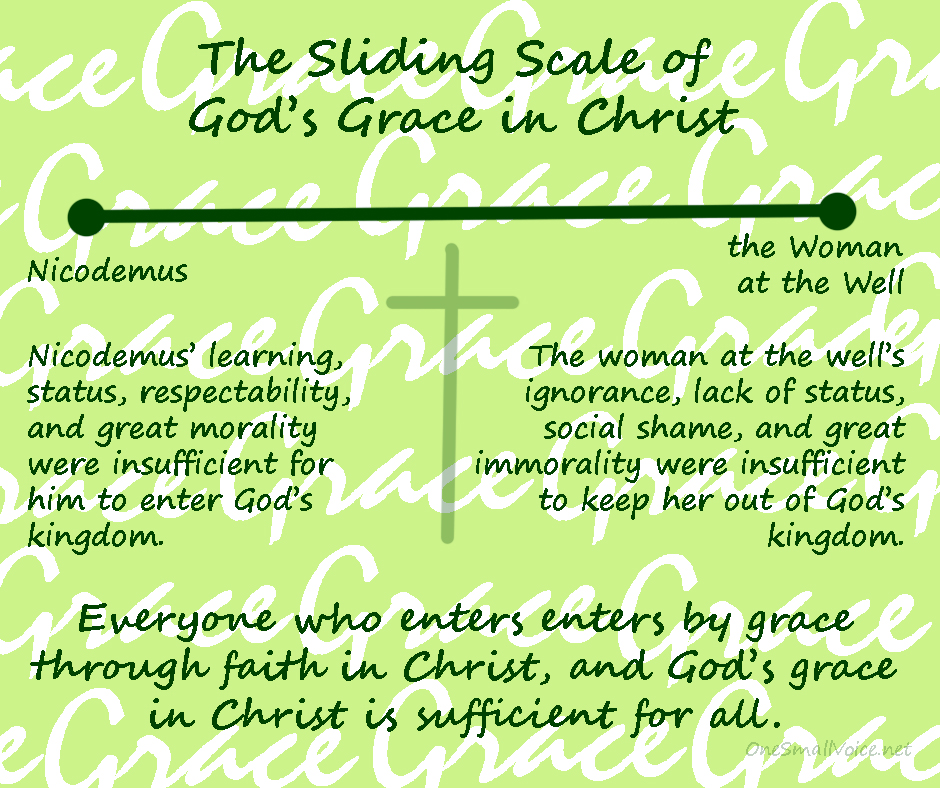
No Virtue Will Get You In! No Defect Will Keep You Out!
Link: The New Birth–Its Necessity and Its Joy
Link: Concrete to Spiritual: How Jesus Changes the Old Testament to the New
Psalm 18: Original Paraphrase–Papa Roars and Rescues

Drama from the Past
* God the Son endangered, the ropes of death ensnared him, squeezed his breath away. A tsunami of destruction crashed upon his head. He couldn’t breathe. Hell’s net pulled him tighter, under. Death held its vise-like grip. There was no way for him to escape. In gasping anguish he cried out loud; he called to his Father for help.
“Papa! Help me! Save me! Death must not win forever!”
God in his holy temple heard his Son’s voice; the pleading cry of desperation reached the Father’s ear. Though his Son lay buried, three days in the grave, Almighty Papa roared and pierced the sky to save.
The earth reeled and rocked; foundations of mountains trembled. The royal Papa’s anger shook, an earth-quaking gush of love. Smoke rose from his nostrils; devouring fire consumed, glowing coals of flame no dragon ever produced.
God bowed the heavens descending, thick darkness under his feet. He rode a cherub and flew swiftly on wings of wind. Almighty Papa in darkness cloaked, a canopy surrounds him. Thick clouds dark with water cover his form from view. Bursting through this darkness, his brightness once concealed, with flashes of fire and brimstone, his golden light breaks through. He thunders in the heavens, blasting out his voice, hailstones and coals announcing–Papa on the move.
Scattering forth his arrows, flashing out his lightnings, God routed the enemy, death…(and here the Son breaks in…)
“The channels of the sea you exposed, the foundations of the world laid bare. You rebuked them, O Lord, my Father, when your nostrils blasted your breath.”
“Did you see all this, my people? Were you watching? Did you see? When he came from on high and took me and pulled me from the waves? He rescued me from my strong enemy, from those who hated and surrounded. They were too mighty for me, confronting, that one single day. But he, the LORD my Papa came through. To this broad place he brought me. He heard my cry and rescued, because he delights in me.”
*This poem draws heavily from the English Standard Version of Psalm 18:4-19
Link to next post in this series
Psalm 89: Short Devotional

Psalm 89 tells an interesting story of God’s promises to Israel concerning Messiah. The exalted expectations are then contrasted with the harsh realities of the Messiah’s life during his incarnation. The psalmist/Messiah points out the contradictions to the Lord, reminding him of his promises. He asks the Lord why his life compares so unfavorably with the promises. Nevertheless, he closes by blessing the Lord.
The reader needs to bear in mind that the psalm is prophecy, and this is Scripture’s way of announcing that the Messiah’s life would be one of suffering. The facts of his future incarnation of suffering do not seem to resemble the facts of God’s promises. No one understood this in the days when Jesus walked on earth, not even his own disciples. It was left to the Lord to explain the prophetic Scriptures concerning himself to his disciples after his resurrection. We, as readers today, have the great advantage of hindsight, although even today, many believers, if not most, do not perceive the messianic prophecies in this psalm. Psalm 89 is not listed as being messianic in most study Bibles.
In the first section concerning creation, verses 2 and 5-18, we see that God created all things, and his power is supreme. Righteousness and justice are the foundation of his throne; steadfast love and faithfulness go before him. (v 14)
The second section describes God’s promises to Israel through Messiah from verses 3-4 and 19-37. God’s righteous, just, loving, and faithful nature, as established, manifested, and proven throughout all of creation, form the basis of his covenant with Israel, as represented by David his servant, and by the Greater David, Messiah. God’s people know and understand God’s nature and are blessed because they walk in it. In the long speech block from verse 19 thr0ugh 37, God describes in his own words the future messianic kingdom, Messiah’s loving response to him (verse 26), and the nature of his disciplinary yet covenantal interactions with Messiah’s progeny. Just as God proves himself to be righteous, just, loving, and faithful in all his created works, so the Israelites and Messiah can count on him to be the same in all his covenantal dealings with them.
Section three, verses 38-51, describes Messiah’s actual incarnated experience with statements such as:
38 But now you have cast off and rejected; you are full of wrath against your anointed.
39 You have renounced the covenant with your servant; you have defiled his crown in the dust.
… … … … …
42 You have exalted the right hand of his foes; you have made all his enemies rejoice.
… … … … …
45 You have cut short the days of his youth; you have covered him with shame. Selah
Using our reader’s hindsight and what we know of the gospel message about the life of Jesus of Nazareth, we can recognize that the words of prophecy in Psalm 89 describe well Messiah’s actual life during his incarnation.
Section 4 records Messiah’s prayerful protest to God. As we read these words, there can be no doubt that Messiah was fully man. These words are spoken from a human vantage, and a suffering human at that. Well may Paul have had Psalm 89 in mind when he wrote of Christ to the Philippians:
5 Have this mind among yourselves, which is yours in Christ Jesus,
6 who, though he was in the form of God, did not count equality with God a thing to be grasped,
7 but emptied himself, by taking the form of a servant, being born in the likeness of men.
8 And being found in human form, he humbled himself by becoming obedient to the point of death, even death on a cross. (Phi 2:5-8 ESV)
Finally, the last verse concludes the psalm with a word of blessing for the Lord. In this, the psalmist/Messiah reminds us that even when the path is difficult and strewn with trials of all kinds, God is faithful to perform what he promises, notwithstanding all appearances to the contrary, and in that we worship and adore him.
Psalm 89 does not solve the mystery of a suffering Messiah–it simply announces the mystery. Nevertheless, by the time Jesus walked the earth, his entire people had lost sight of the full scope of this psalm’s message. They grasped well enough the exalted promises of God to Israel through a glorified Messiah, but they apparently had never connected or had forgotten the last portions of the psalm, which paint a portrait of a suffering Messiah. How like ourselves–don’t we so often want the glory without the pain?
Link to next post in this series
Link to prior post in this series
Link to Contents for this series

 One Small Voice