Home » A. Bible Studies » Gems from John (Page 4)
Category Archives: Gems from John

Signs Part 1: Turning Water into Wine


Week 3: John Chapter 2, Part 1
First Sign: Water to Wine 2:1-11
What is a  ?
?
…a miracle viewed as a proof of divine authority and majesty…
…a physical illustration of a spiritual principle…
…the sign points away from itself to the One who performed it…
The First Sign in the Gospel of John
Synopsis:
ESV John 2:1 On the third day there was a wedding at Cana in Galilee, and the mother of Jesus was there. 2 Jesus also was invited to the wedding with his disciples. 3 When the wine ran out, the mother of Jesus said to him, “They have no wine.” 4 And Jesus said to her, “Woman, what does this have to do with me? My hour has not yet come.” 5 His mother said to the servants, “Do whatever he tells you.” 6 Now there were six stone water jars there for the Jewish rites of purification, each holding twenty or thirty gallons. 7 Jesus said to the servants, “Fill the jars with water.” And they filled them up to the brim. 8 And he said to them, “Now draw some out and take it to the master of the feast.” So they took it. 9 When the master of the feast tasted the water now become wine, and did not know where it came from (though the servants who had drawn the water knew), the master of the feast called the bridegroom 10 and said to him, “Everyone serves the good wine first, and when people have drunk freely, then the poor wine. But you have kept the good wine until now.” 11 This, the first of his signs, Jesus did at Cana in Galilee, and manifested his glory. And his disciples believed in him.
At a literal level, what Jesus did at the wedding was IMPOSSIBLE. This points to Jesus’ special powers.
Why does this miracles constitute a SIGN?
Water in the New Testament symbolizes the Word of God.
ESV Ephesians 5:25 Husbands, love your wives, as Christ loved the church and gave himself up for her, 26 that he might sanctify her, having cleansed her by the washing of water with the word,
Christ is called the living Word of God.
John 1:1 In the beginning was the Word, and the Word was with God, and the Word was God.
14 And the Word became flesh and dwelt among us, and we have seen his glory, glory as of the only Son from the Father, full of grace and truth.
Wine in the New Testament symbolizes the blood of Christ shed on the cross as an atonement for sin.
Matthew 26:27 And he took a cup, and when he had given thanks he gave it to them, saying, “Drink of it, all of you, 28 for this is my blood of the covenant, which is poured out for many for the forgiveness of sins.
The physical wine itself pales in comparison to the realization that here is a man who shows himself to have great power and love, by his working of a supernatural feat to bless the guests at the wedding, including the bridegroom and his bride.
WHO IS THIS MAN?
ESV John 2:11 This, the first of his signs, Jesus did at Cana in Galilee, and manifested his glory. And his disciples believed in him.
This first sign shows that Jesus is the master of both QUALITY (he is the best wine) and QUANTITY (100-150 gallons is lots of wine!!) (Hendriksen, 119)
He can also CHANGE PHYSICAL SUBSTANCES, making him to be God!

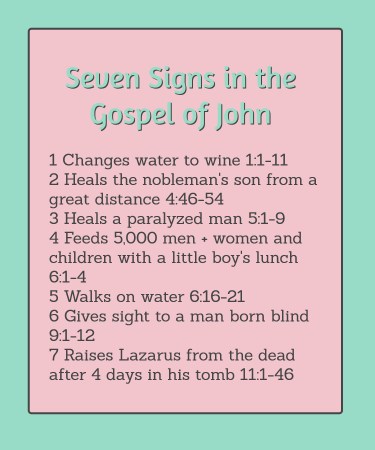
Why Signs?
Jesus is the Light of men. This Light shines in the darkness, and the darkness just can’t put it out.
We all know from taking photos that too much light destroys color and detail–everything becomes a burned out white. Our eyes themselves can’t function when the light is too bright. Christ’s light (the light of God himself) would blind us if we saw it unfiltered.
A Sign Miracle is a toning down of the exposure of Christ’s light.
The Miracle Signs illuminate Christ to our understanding without overexposing our human minds to a blinding light.
John’s writing places all else but Christ in background tones of shadows while at the same time painting Christ in vivid, detailed colors.
Christ himself is a “Sign” that points to God as love.

Outline of the Gospel of John
Weekly Links to Gems from the Gospel of John
Week 1: Visual Summary of Prologue of John 1:1-5 (Link to Week 1 Visual Summary)
Week 1: Word of God John 1:1-5 (Link to Week 1 Word of God)
Week 1: Prologue of John 1:1-18 (Link to Week 1 Outline of Prologue)
Week 2: John the Baptist, Jesus, and the First Disciples (Link to Week 2)
Week 3 Part 1: First Sign–Water to Wine (Link to Week 3 Part 1)
Week 3 Part 2: Cleansing of the Temple (Link to Week 3 Part 2)
Week 3 Takeaway Poster: So GO and Invite! (Link to Poster)
Week 4 New Birth–Its Necessity and Joy: John 3:1-21 and John 4:1-42 (Link to Week 4 New Birth)
Week 4 Concrete to Spiritual: How Jesus Changes the Old Testament to the New (Link to Week 4 Concrete to Spiritual)
Week 4 God’s Sliding Scale of Grace in Christ: No Virtue Will Get You In! No Defect Will Keep You Out! (Link to Week 4 God’s Sliding Scale of Grace)
Week 5 Second Sign–Healing the Nobleman’s Son (Link to Week 5)
Week 5 Third Sign–Healing a Paralyzed Man (Link to Week 5 Part 2)
Week 6 Jesus’ Discourse Following his Healing of the Paralyzed Man (Link to Week 6 Part 1)
Week 6 Fourth and Fifth Signs–Feeding 5,000 and Walking on Water (Link to Week 6 Part 2)
Week 7 Bread of Life Discourse (Link to Week 7 Part 1: Jesus’ “I Am” Statements)
Week 7 Jesus Sent by God and Endorsed by Him (Link to Week 7 Part 2: Sent and Endorsed)
Week 7 Impossibility of Faith without God (Link to Week 7 Part 3)
Week 7 Spiritual Replaces Concrete: John Continues Developing This Theme (Link to Week 7 Part 4)
Week 8 How Love and Knowledge Interact (Link to Week 8 Part 1)
Week 8 Jesus Confronts his Enemies with the Truth of Salvation (Link to Week 8 Part 2)
Week 9 Sixth Sign–Jesus Gives Vision to a Man Born Blind (Link to Week 9)
Week 10 Jesus’ Seven “I Am” Statements in John (Link to Week 10 “I Am’s”)
Week 10 Jesus the Good Shepherd (Link to Week 10 The Good Shepherd)
Week 10 Jesus and the Father Are One (Link to Week 10 I and the Father Are One)
Week 11 Synthesis of Christ the Son of God and Christ the Human Being: Raising Lazarus from the Dead (Link to Week 11 Raising Lazarus)
Week 12 The Triumphal Entry (Link to Week 12 The Triumphal Entry)
Week 13 The Final Meal (Link to Week 13 The Final Dinner)
Week 14 Final Discourse: Comfort (Link to Week 14 Final Discourse: Comfort)
Week 15 Final Discourse: Admonition (Link to Week 15 Final Discourse: Admonition)
Week 16 Final Discourse: Prediction (Link to Week 16 Final Discourse: Prediction)
Week 17 High Priestly Prayer: A Petition for Fellowship in Glory Among Father, Son, and All Believers in Christ (Link to Week 17 High Priestly Prayer)
Week 18 Jesus’ Arrest, Trial, Crucifixion and Burial (Link to Week 18, Chapters 18-19)
Week 19 Resurrection, Conclusion, and Final Scenes (Link to Week 19, Chapters 20-21)
Outline of the Book of John
I. Christ’s Identity
- Christ the Eternal Word 1:1-12
- Christ the Incarnate Word 1:13-18
- Prologue Summarized 1:18
II. Presentation of Christ as the Son of God (1:9-12:50)
A. John the Baptist testifies of Christ 1:19-36
B. Jesus calls his first disciples 1:37-50
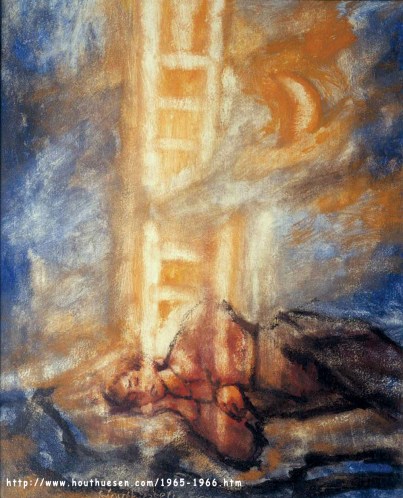
1. Jesus fulfills Jacob’s vision of a Ladder between Heaven and Earth 1:51
C. First Sign: water to wine 2:1-11
D. Cleansing the Temple 2:12-22
1. Jesus does not entrust himself to the people who saw his miracles 2:23-25
E. Explaining the necessity of the new birth to Nicodemus John 3:1-21
F. Explaining the desirability of the new birth to the woman at the well John 4:1-42
1. Jesus’ omniscience demonstrates that he is the Son of God
G. Second Sign: Jesus heals a nobleman’s son from a great distance John 4:46-54
H. Third Sign: Jesus heals a man paralyzed for 38 years and endures and defends against the attacks of his critics John 5:1-47
I. Fourth Sign: Jesus feeds 5,000 men plus women and children from a single lunch John 6:1-15
J. Fifth Sign: Jesus walks on water John 6:16-21
K. Jesus further explains the difference between concrete/spiritual in relation to himself, the living bread from heaven (see also Nicodemus and the Woman at the Well) John 6:22-71
1. “I Am” statements in John 6
2. Jesus sent and endorsed by God
3. Jesus declares the impossibility of faith without God
4. Galilee as a whole rejects the Son of God
5. Some of his disciples walk away
6. Peter confesses Christ as the Holy One of God
7. One of the twelve will betray him.
L. Back to Judea for the Feast of Tabernacles: Jesus Confronts His Enemies (chapters 7 and 8)
M. Sixth Sign: Jesus Gives Sight to a Man Born Blind John 9
N. Jesus Is the Good Shepherd Who Enters Legitimately by the Door (10:1-21)
O. Jesus says, “I and the Father are one.” His enemies pick up stones to stone him, and also try to arrest him. This is the end of the later Judean Ministry. (10:22-42)
P. Christ’s Identity Revisited: the Eternal Word and the Incarnate Word Demonstrated in the Raising of Lazarus from the Dead (John 11:1-12:11)
Q. The Great Stir Caused by the Raising of Lazarus from the Dead Flows into the Triumphal Entry. Ultimately, the Crowd in General Again Rejects Jesus (John 12:11-50)
III. Instruction to the Twelve by the Son of God: The New Commandment of Love (13:1-17:26)
A. The Last Supper as related by John (13:1-38)
1. Washing the Disciples’ Feet (1-17)
2. Announcement of Judas’ Betrayal (18-30)
3. Comfort and Instruction (31-35)
4. Prophesying of Peter’s Denial (36-38)
B. Final Discourse
1. Words of Comfort (Chapter 14)
2. Words of Admonition (Chapter 15)
3. Words of Prediction (Chapter 16)
IV. Jesus’ High Priestly Prayer (Chapter 17)
V. Suffering of Christ as the Son of God and Son of Man (18:1-20:31)
A. Arrest in the Garden (Chapter 18)
B. Trial (Chapters 18-19)
C. Crucifixion and Death (Chapter 19)
D. Burial (Chapter 19)
VI. The Resurrection of Jesus Christ from the Grave (Chapter 20)
A. As witnessed by Mary (20:1-2, 11-18)
B. As witnessed by Peter and John (20:3-10)
C. As witnessed by the disciples as a group excluding Thomas (20:19-24)
D. As witnessed by the disciples as a group including Thomas (20:24-29)
E. John’s conclusion of his gospel and stated purpose for writing (20:30-31)
VII. Epilogue: the Continuing Work of the Son of God (21:1-25)
A. The third resurrection appearance to a group of disciples (21:1-14)
B. Peter’s reinstatement and prophesy of the manner of his death (21:14-19)
C. What about John? (21:20-23)
D. Statement of John’s credibility as witness (21:24)
E. Last word concerning the greatness of Jesus Christ incarnated (21:25)

Jacob’s Ladder = Jesus Christ: Gospel of John Explains
John the Baptist, Jesus, and the First Disciples: John 1:19-51
Outline of This Presentation
I. Points of confusion concerning what the text is saying (Including Jacob’s Ladder)
II. Highlights of content
III. Personal applications
………………………………….
I. Points of confusion concerning what the text is saying:
I’ve read through John’s gospel many times over the course of my lengthy relationship with Christ. Below are a few questions I’ve asked as I’ve read this text.
A. John the Baptist–is he or isn’t he Elijah?
19And this is the testimony of John, when the Jews sent priests and Levites from Jerusalem to ask him, “Who are you?” 20He confessed, and did not deny, but confessed, “I am not the Christ.” 21And they asked him, “What then? Are you Elijah?” He said, “I am not.” “Are you the Prophet?” And he answered, “No.” 22So they said to him, “Who are you? We need to give an answer to those who sent us. What do you say about yourself?” 23He said, “I am the voice of one crying out in the wilderness, ‘Make straighth the way of the Lord,’ as the prophet Isaiah said.”
24(Now they had been sent from the Pharisees.) 25They asked him, “Then why are you baptizing, if you are neither the Christ, nor Elijah, nor the Prophet?” 26John answered them, “I baptize with water, but among you stands one you do not know, 27even he who comes after me, the strap of whose sandal I am not worthy to untie.” 28These things took place in Bethany across the Jordan, where John was baptizing.
Question:
Verse 21: If John the Baptist is not Elijah (Malachi 4:4-6), as he states, then why does Jesus in Matthew 11:14 and Matthew 17:10-12 say that John is Elijah?
Possible Answer:
In the context of the then current expectations of the priests and Levites sent by the Jewish religious leaders in Jerusalem, John replied to their question, “No,” he was not Elijah. He was not literally and physically Elijah resurrected.
Yet Jesus states unequivocally in the Matthew 11:14 that John is Elijah, if his listeners are willing to accept that, and in Matthew 17:10-12 Jesus states to his disciples that Elijah already came in John the Baptist.
The angel that spoke prophetically to John’s father Zechariah in Luke 1:17 said that his about-to-be-born son would go ahead of Messiah in the “spirit and power of Elijah.”
So, the answer would be no to a concrete, literal, physical Elijah, and yes to a symbolic, spiritual Elijah.
As to the charge of “spiritualizing” the Old Testament, yes, the Gospel records Jesus doing that abundantly.
B. How could John the Baptist say that he “did not know” Christ?
29The next day he saw Jesus coming toward him, and said, “Behold, the Lamb of God, who takes away the sin of the world! 30This is he of whom I said, ‘After me comes a man who ranks before me, because he was before me.’ 31I myself did not know him, but for this purpose I came baptizing with water, that he might be revealed to Israel.” 32And John bore witness: “I saw the Spirit descend from heaven like a dove, and it remained on him. 33I myself did not know him, but he who sent me to baptize with water said to me, ‘He on whom you see the Spirit descend and remain, this is he who baptizes with the Holy Spirit.’ 34And I have seen and have borne witness that this is the Son of God.”
Question:
How can John say in verses 31 and 33, “I myself did not know him,” when Jesus was his relative and he recognized Messiah as early as his mother’s womb? (Luke 1:36, 39-41)
Possible Answer:
The best answer I have found comes from William Hendriksen (Hendriksen, 99, 100), who states that John did not recognize Jesus in his “quality as Messiah,” according to either the mental process of intuition and reason or the physical process of observation and experience.
John knew that this person Jesus, who came to him physically in order to be baptized, was the Messiah, the Lamb of God, and the Son of God only because the God who had commissioned him had told him that as he is baptizing, the one on whom the Spirit comes down and remains as a dove is the One.
So John received his knowledge by revelation from God.
C. Why did Nathanael respond so strongly? And what exactly is Jacob’s Ladder?
35The next day again John was standing with two of his disciples, 36and he looked at Jesus as he walked by and said, “Behold, the Lamb of God!” 37The two disciples heard him say this, and they followed Jesus. 38Jesus turned and saw them following and said to them, “What are you seeking?” And they said to him, “Rabbi” (which means Teacher), “where are you staying?” 39He said to them, “Come and you will see.” So they came and saw where he was staying, and they stayed with him that day, for it was about the tenth hour. 40One of the two who heard John speak and followed Jesus was Andrew, Simon Peter’s brother. 41He first found his own brother Simon and said to him, “We have found the Messiah” (which means Christ). 42He brought him to Jesus. Jesus looked at him and said, “You are Simon the son of John. You shall be called Cephas” (which means Peter).
43The next day Jesus decided to go to Galilee. He found Philip and said to him, “Follow me.” 44Now Philip was from Bethsaida, the city of Andrew and Peter. 45Philip found Nathanael and said to him, “We have found him of whom Moses in the Law and also the prophets wrote, Jesus of Nazareth, the son of Joseph.” 46Nathanael said to him, “Can anything good come out of Nazareth?” Philip said to him, “Come and see.” 47Jesus saw Nathanael coming toward him and said of him, “Behold, an Israelite indeed, in whom there is no deceit!” 48Nathanael said to him, “How do you know me?” Jesus answered him, “Before Philip called you, when you were under the fig tree, I saw you.” 49Nathanael answered him, “Rabbi, you are the Son of God! You are the King of Israel!” 50Jesus answered him, “Because I said to you, ‘I saw you under the fig tree,’ do you believe? You will see greater things than these.” 51And he said to him, “Truly, truly, I say to you, you will see heaven opened, and the angels of God ascending and descending on the Son of Man.”
Question:
Why was Nathaniel’s response so “over the top?” How did Nathanael get such tremendous faith and spiritual insight from Jesus’ one statement, “I saw you under the fig tree.” What am I missing?
Possible Answer:
A. The Miracle Itself
1. Jesus saw Nathanael under a particular fig tree before Philip had found him.
2. This fig tree was not present at the Jordan River where Jesus had been (:43), since he had already left there and was on his way to Galilee the next day.
3. Therefore, Jesus had supernaturally seen Nathanael in another place and another time, and this is what Nathanael realized.
4. Not only had Jesus seen Nathanael’s outward form sitting under the fig tree, he had apparently been reading his thoughts long distance as he sat there meditating.
5. Philip had called Jesus the One the Scriptures had prophesied would come, and with that context prodding him, Nathanael knew that only the Son of God could know what he had been thinking when he was miles away both in distance and time.
B. Unravelling the Significance of Jesus’ Statement about an Israelite without Guile
1. Within the context of the entire passage, Jesus has been thinking of the patriarch Jacob, who tricked (used guile) his brother out of his blessing as firstborn son.
2. The use of trickery, deceit, or guile characterized both Jacob (Genesis 30:37-43) and his posterity (Genesis 34, whole chapter about Dinah and her brothers’ trickery to vindicate their honor).
3. Nathanael understands Jesus to be assessing his character as being without guile, and agreeing with this assessment, he asks, “How do you know me?”
Jacob’s Ladder Explained
4. After Jesus’ explanation of having supernaturally seen into Nathanael’s thoughts, and after Nathanael’s exclamation of astonished, profoundly convinced faith, Jesus continues with a prophecy concerning himself, “Truly, truly, I say to you, you will see heaven opened, and the angels of God ascending and descending on the Son of Man.”
5. This statement refers to Jacob’s vision while asleep of a ladder stretching from heaven to earth and angels moving up and down, back and forth, upon (ἐπ᾽ in Greek, abbreviated form of ἐπὶ) the ladder. (Genesis 28:11-13)
6. Jesus connects this ladder with himself, saying in verse 51 that the angels would be moving up and down on (upon) (ἐπὶ in Greek) himself. He IS the ladder in Jacob’s dream.
7. Jesus is announcing that he is the connection between earth and heaven, between man and God. Jesus is the mediator, the go-between, the way, the access to God. He stands in relation not only to Israel as Israel’s king, but also in relation to humankind in its entirety, for he is the “Son of Man,” and as such, the Savior of all mankind.
………………………………….
II. Highlights of John 1:19-51

Hayford, Jack W., exec. ed. John: Living Beyond the Ordinary. Nashville: Thomas Nelson, Inc., 2009, 15-16.

Pink, Arthur W. Exposition of the Gospel of John: Three Volumes Complete and Unabridged in One. Grand Rapids: The Zondervan Corporation, 1975, 73.
What was the Difference between John’s and Jesus’ Baptisms?
John’s purpose was to manifest (show out, point out, make known) Christ to Israel. It was to prepare a people for him. John prepared this people by bringing them to see and acknowledge their sin before God in the symbolic act of water baptism. By being baptized by John, they acknowledged that death was their due. They were then prepared to receive Christ as Savior dying in their place as condemned sinners.
Christian baptism is different. A Christian believer does not confess that death is his due, but he demonstrates, again symbolically, that he has already died in Christ to sin. Christian baptism signifies the Christian’s having died with Christ. And, of course, the Christian’s coming up from the water signifies resurrection with Christ.
John the Baptist’s Sevenfold Witness to Christ

Pink, Arthur W. Exposition of the Gospel of John: Three Volumes Complete and Unabridged in One. Grand Rapids: The Zondervan Corporation, 1975, 61.
Why does John 1:35-42 differ from Mark 1:16-20?
One simple answer given by Arthur Pink (Pink, 62-63) is that the account in John describes these disciples’ conversion, while the account in Mark describes their call to service.
“Behold the Lamb of God”

Original artwork by Christina Wilson
Arthur Pink teaches that if we’re going to see Jesus as the “Lamb of God” (John 1:36), we must stop to “behold” him. We must quit striving in our own flesh; we must “come to the end of ourselves.” (Pink, 66)
ESV Exodus 14:13 And Moses said to the people, “Fear not, stand firm, and see the salvation of the LORD, which he will work for you today. For the Egyptians whom you see today, you shall never see again.
As Jesus said, “Blessed are the poor in spirit, for theirs is the kingdom of heaven.” (Matthew 5:3)
God calls to saving conversion in various ways
1. by testimony of preachers: John and Andrew (John 1:35-39)
2. by testimony of friends: Andrew got Peter (John 1:40-42); Philip got Nathanael (John 1:44-46)
3. without human vehicle–directly by God: Christ got Philip (John 1:43)
III. Personal Applications
Do I know Jesus personally? Or, do I rely mostly upon my church and my pastor(s)?
1. John the Baptist, Jesus Christ, the disciples, and God himself chose not to use the vehicle of the then-current religious structure of the Jewish leaders of Jesus’ day.
2. John the Baptist taught in the wilderness, not in Jerusalem.
3. Neither John, nor Christ, nor the disciples had been educated by the Jewish leaders.
4. Why do you suppose God chose not to introduce Christ to the world through the vehicle of the Jewish religious institution of that day?
5. Have there ever been times in your life when you have had to leave the teachings of a church in order to follow Christ and his teachings?
Have I experienced the call of God upon my life? How does this affect me in specific situations I may face every day?
Jack Hayford (Hayford, 17, 20-21)points out the positive effects on one’s life of the sure knowledge of God’s calling:
1. Jesus knew his calling.
2. John the Baptist knew his calling.
3. Each of the disciples experienced their own specific call by God.
4. What about me?
Gems from John: Outline John 1:19-51
Gems from the Gospel of John
Week 2: John the Baptist’s Testimony and Jesus’ First Disciples
THEME OF JOHN:
ESV John 20:31 … these are written so that you may believe that Jesus is the Christ, the Son of God, and that by believing you may have life in his name.
- Christ is Son of God
- Our appropriate response is belief
- Belief yields LIFE in his name
I. John the Baptist’s witness of himself (1:19-28)
- John’s own identity (:19-28)
II. John Points Out Christ (:29-36)
- Day One — to the crowd (:29-34)
- Day Two — to his own disciples (:35-36)
III. Jesus’ First Disciples
- Andrew and the Unnamed (who is John the Author of this Gospel) (:37-40)
- Andrew’s brother Simon (Christ renames him “Peter”) (:41-42)
- Philip (:44)
- Nathanael (:45-49)
IV. Jesus Is the Ladder between Earth and Heaven (:50-51)
Read the Full Lesson Notes Here: Jacob’s Ladder = Jesus Christ: Gospel of John Explains
Gems from John: Outline of the Prologue
Gems from the Gospel of John
Week 1: Prologue John 1:1-18
THEME OF JOHN:
ESV John 20:31 … these are written so that you may believe that Jesus is the Christ, the Son of God, and that by believing you may have life in his name.
- Christ is Son of God
- Our appropriate response is belief
- Belief yields LIFE in his name
OUTLINE OF JOHN
I. Prologue (1:1-18)
- Christ the Eternal Word 1:1-12
- Christ the Incarnate Word 1:13-18
- Prologue Summarized 1:18
II. Presentation of Christ as the Son of God (1:9-12:50)
III. Instruction to the Twelve by the Son of God (13:1-17:26)
IV. Suffering of Christ as the Son of God and Son of Man (18:1-20:31)IV
V. Epilogue: the Continuing Work of the Son of God (21:1-25)
THREE SYNOPTIC (Seeing Together) GOSPELS AND JOHN
- Matthew: Lord Jesus is Son of David, heir to Israel’s throne, the King of the Jews
- Mark: Christ is Servant of Jehovah, the perfect Workman of God
- Luke: Christ the Savior is the Son of Man, the perfect Man
- John: Christ is the Son of God made flesh
The three synoptic gospels share 1) much similar material, 2) a similar chronology, and 3) a point of view that shows Jesus’ interactions as man with men. John’s material is 90% unique, and his chronology suits his own purpose, which is to demonstrate through the witness of 1) God, 2) John the Baptist, 3) his miracles, 4) his disciples, and 5) his resurrection that he is God’s unique Son, very God of very God.
OUTLINE OF JOHN 1:1-13—CHRIST THE ETERNAL WORD (Pink, 17-18)
- The Relation of Christ to Time – “In the beginning,” therefore, Eternal: 1:1.
- The Relation of Christ to the Godhead – “With God,” therefore, One of the Holy Trinity: 1:1.
- The Relation of Christ to the Holy Trinity – “God was the Word” – the Revealer: 1:1
- The Relation of Christ to the Universe – “All things were made by him” – the Creator: 1:3.
- The Relation of Christ to Men – Their “Light”: 1:4, 5
- The Relation of John the Baptist to Christ – “Witness” of His Deity: 1:6-9.
- The Reception which Christ met here: 1:10-13.
- “The world knew him not”: 1:10.
- “His own (Israel) received him not”: 1:11.
- A company born of God “received him”: 1:12, 13.
OUTLINE OF JOHN 1:14-18—CHRIST, THE WORD INCARNATE (Pink, 32)
- Christ’s Incarnation – “The word became flesh” 1:14.
- Christ’s Earthly sojourn – “And tabernacled among us” 1:14.
- Christ’s Unique Glory – “As of the only Begotten”
- Christ’s Supreme excellency – “Preferred before” 1:15.
- Christ’s Divine sufficiency – “His fulness” 1:16.
- Christ’s Moral perfections – “Grace and truth” 1:17.
- Christ’s Wondrous revelation – Made known “the Father” 1:18
SUMMARY OF PROLOGUE USING ONLY VERSES 1 AND 14 (Pink, 42)
1) “In the beginning was the word” 1:1
a) “And the word became flesh” tells of the beginning of his human life. 1:14
2) “And the word was with God” 1:1
b) “And tabernacled among us” shows Him with men. 1:14
3) “And the word was God” 1:1
c) “Full of grace and truth,” and this tells what God is. 1:14
** In Christ God and mankind meet. Christ is the meeting place of God and people.
DIFFERENCES BETWEEN LAW AND GRACE (Pink, 46)
ESV John 1:17 For the law was given through Moses; grace and truth came through Jesus Christ.
- Law addresses men as members of the old creation; Grace makes men members of a new creation.
- Law manifested what was in Man – sin; Grace manifests what is in God – Love.
- Law demanded righteousness from men; Grace brings righteousness to men.
- Law sentences a living man to death; Grace brings a dead man to life.
- Law speaks of what men must do for God; Grace tells of what Christ has done for men.
- Law gives a knowledge of sin; Grace puts away sin.
- Law brought God out to men; Grace brings men in to God.
John 1:9 CHARACTERISTICS OF THE “TRUE LIGHT” WHICH CHRIST IS (From Bishop Ryle)
1 – Undeceiving Light
2 – Real Light
3 – Underived Light
4 – Supereminent Light – Above ALL Others
Bibliography for Gems from John
Gingrich, F. W., BibleWorks 9 Software for Biblical Exegesis & Research. Norfolk, VA: BibleWorks, 2011
Hayford, Jack W., exec. ed. John: Living Beyond the Ordinary. Nashville: Thomas Nelson, Inc., 2009.
Hendriksen, William. New Testament Commentary: Exposition of the Gospel According to John, Two Volumes Complete in One. Grand Rapids: Baker Book House, 1953.
Pink, Arthur W. Exposition of the Gospel of John: Three Volumes Complete and Unabridged in One. Grand Rapids: The Zondervan Corporation, 1975.

Word of God
John 1:1 In the beginning was the Word,
and the Word was with God,
and the Word was God.
2 He was in the beginning with God.
3 All things were made through him,
and without him was not any thing made that was made.
4 In him was life, and the life was the light of men.
5 The light shines in the darkness,
and the darkness has not overcome it.

Jesus and the Big Bang: Prologue John 1:1-18

Jesus Christ is the Full Expression of God:
Jesus Is God the Word — John 1:1, 14
Jesus Is God the Creator — John 1:3-4, 10
Jesus Is Life and Light — John 1:4-5, 9
Jesus Is God the Savior — John 1:12, 17
Jesus Is the BIG BANG of God ! Without Jesus, God would not be known — John 1:18
 One Small Voice