Home » Academic/Biblical (Page 9)
Category Archives: Academic/Biblical

Signs Part 2: Water to Wine and Cleansing the Temple Compared and Contrasted
Week 3: John Chapter 2, Part 2
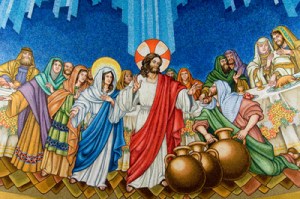

credit: goodsalt.com
ESV John 2:12 After this he went down to Capernaum, with his mother and his brothers and his disciples, and they stayed there for a few days.
13 The Passover of the Jews was at hand, and Jesus went up to Jerusalem.
14 In the temple he found those who were selling oxen and sheep and pigeons, and the money-changers sitting there.
Malachi 3:1 “Behold, I send my messenger, and he will prepare the way before me. And the Lord whom you seek will suddenly come to his temple; and the messenger of the covenant in whom you delight, behold, he is coming, says the LORD of hosts.
15 And making a whip of cords, he drove them all out of the temple, with the sheep and oxen. And he poured out the coins of the money-changers and overturned their tables.
16 And he told those who sold the pigeons, “Take these things away; do not make my Father’s house a house of trade.”
Isaiah 56:7 these I will bring to my holy mountain, and make them joyful in my house of prayer; their burnt offerings and their sacrifices will be accepted on my altar; for my house shall be called a house of prayer for all peoples.”
17 His disciples remembered that it was written, “Zeal for your house will consume me.”
Psalm 69:9 For zeal for your house has consumed me, and the reproaches of those who reproach you have fallen on me.
18 So the Jews said to him, “What sign do you show us for doing these things?”
19 Jesus answered them, “Destroy this temple, and in three days I will raise it up.”
20 The Jews then said, “It has taken forty-six years to build this temple, and will you raise it up in three days?”
21 But he was speaking about the temple of his body.
22 When therefore he was raised from the dead, his disciples remembered that he had said this, and they believed the Scripture and the word that Jesus had spoken.
NET Acts 10:40 but God raised him up on the third day and caused him to be seen,
ESV 1 Corinthians 15:4 that he was buried, that he was raised on the third day in accordance with the Scriptures,
John 20:16 Jesus said to her, “Mary.” She turned and said to him in Aramaic, “Rabboni!” (which means Teacher). [Mary’s and Jesus’ post-resurrection meeting here]
John the Poet
Scripture includes poetry. God is a poet. (Anyone having marveled at a sunrise or sunset must know that this is true.) The Psalms are poems; The poetry of Psalms is Scripture.
2 Timothy 3:16 All Scripture is breathed out by God and profitable for teaching, for reproof, for correction, and for training in righteousness,
John’s prologue, verses 1-5, though prose, is a most profound and beautiful poem expressing eternal truth with very few and very simple words. (John 1:1-5)
And like most poets, John uses symbolism to develop layers of meaning.
Disclaimer: To say that John is a poet does not mean that the events he describes are “poetic” only. This author believes as literally true every word that John writes. But God as poet designed events to occur which were in and of themselves symbolic of spiritual realities. This is, after all, the New Testament, where Spirit overtakes and surpasses concrete types. (We will see this spelled out in John Chapters 3 and 4.)
The Symbolism of Chapter 2
Scene 1 is about purification: the water of purification was turned into wine, which represents Christ’s blood shed for the remission of sins, i.e., for purification from sins.
- Just as wine is better than water at a wedding, so blood is better than water for cleansing from sin.
- The type (the literal event of Jesus’ turning the water into wine) is concrete–they drank physical wine; the reality underlying the symbols of the literal event (antitype) is spiritual.
- The crucifixion and shedding of Christ’s blood were concrete–real blood flowed–the reality beneath these literal events is spiritual–cleansing from sins is a spiritual reality, not a concrete reality, not one that can be handled and touched.
- Spiritual blood received by faith in Christ’s having shed his literal, physical, concrete blood is better than literal, concrete water for cleansing–purifying–the soul from sin. (Witness MacBeth’s wife trying in vain to remove her guilt by washing her hands with literal, concrete water–it didn’t work!)
John 2:6 Now there were six stone water jars there for the Jewish rites of purification…
John 2:7 “Fill the jars with water,” Jesus told them. So they filled them to the brim.
John 2:9 When the chief servant tasted the water (after it had become wine)…
John 2:4 …My hour has not yet come. [The hour of Christ’s crucifixion: John 17:1 …”Father, the hour has come; glorify your Son that the Son may glorify you,”]
Revelation 7:14 …They have washed their robes and made them white in the blood of the Lamb.
Hebrews 9:22 Indeed, under the law almost everything is purified with blood, and without the shedding of blood there is no forgiveness of sins.
1 John 1:7 But if we walk in the light, as he is in the light, we have fellowship with one another, and the blood of Jesus his Son cleanses us from all sin.
Scene 2 is also about purification: Jesus chased out from the temple the money changers and the sellers of sacrificial animals. The problem, as much as doing business in God’s house of prayer, was that these merchants were cheating the people right and left, overcharging and selling for large profits. (Matthew 21:13) And one thing extremely clear from the Old Testament is that God loves his poor people.
Isaiah 58:5 Is such the fast that I choose, a day for a person to humble himself? Is it to bow down his head like a reed, and to spread sackcloth and ashes under him? Will you call this a fast, and a day acceptable to the LORD? 6 “Is not this the fast that I choose: to loose the bonds of wickedness, to undo the straps of the yoke, to let the oppressed go free, and to break every yoke? 7 Is it not to share your bread with the hungry and bring the homeless poor into your house; when you see the naked, to cover him, and not to hide yourself from your own flesh?
Jesus came and “purified” his Father’s temple.
Water to Wine and Cleansing the Temple Side by Side: Their Symbols Compared and Contrasted
1. Cleansing occurs in both scenes.
Scene 1 is an inward cleansing of heart and mind received by drinking the blood of the Lamb through faith.
Scene 2 is an outward cleansing of God’s temple which Jesus accomplished by rejecting and casting out the impure elements of sinful theft fueled by monetary greed.
2. The two cleansings result in opposite effects for those involved.
In Scene 1 drinking the blood of the Lamb (symbolized by the wine that Jesus created) results in joy, festivity, happiness, celebration, and fellowship of family and friends.
In Scene 2 the sin of hardened hearts (repeatedly and willfully stealing from the poor under the excuse of religion) results in shame, confusion, anger, bitterness, and exclusion from the temple, which symbolizes Christ himself.
3. The two cleansings sum up the Gospel message of salvation vs judgment.
— Gospel message of salvation
John 3:16 “For God so loved the world, that he gave his only Son, that whoever believes in him should not perish but have eternal life. 17 For God did not send his Son into the world to condemn the world, but in order that the world might be saved through him. 18 Whoever believes in him is not condemned, but whoever does not believe is condemned already, because he has not believed in the name of the only Son of God.
— Gospel message of judgment
John 5:22 The Father judges no one, but has given all judgment to the Son,
John 12:31 Now is the judgment of this world; now will the ruler of this world be cast out.
John 12:48 The one who rejects me and does not receive my words has a judge; the word that I have spoken will judge him on the last day.
THEME OF JOHN:
ESV John 20:31 … these are written so that you may believe that Jesus is the Christ, the Son of God, and that by believing you may have life in his name.
- Christ is Son of God
- Our appropriate response is belief
- Belief yields LIFE in his name
A Kind of Belief That Yields No Permanent Beneficial Outcome
John continues writing…
John 2:23 Now when he was in Jerusalem at the Passover Feast, many believed in his name when they saw the signs that he was doing.
24 But Jesus on his part did not entrust himself to them, because he knew all people
25 and needed no one to bear witness about man, for he himself knew what was in man.
Later in John, we see people like these–those who follow Jesus because of his miracles only–turning back when the teaching becomes too costly (difficult) for them to accept.
John 6:66 After this many of his disciples turned back and no longer walked with him. [Read the entire context here and an even broader context here.]
John 6:36 But I said to you that you have seen me and yet do not believe. 37 All that the Father gives me will come to me, and whoever comes to me I will never cast out. 38 For I have come down from heaven, not to do my own will but the will of him who sent me. 39 And this is the will of him who sent me, that I should lose nothing of all that he has given me, but raise it up on the last day. 40 For this is the will of my Father, that everyone who looks on the Son and believes in him should have eternal life, and I will raise him up on the last day.”
Can we see how the verses above, which come later in John, relate to the two scenes in Chapter 2? John foreshadows the rest of his gospel in his simple recounting of Jesus’ changing water to wine and the cleansing of the temple (Scene 1 and Scene 2), which, inspired by the Holy Spirit, he places side by side at the outset of Christ’s public ministry.
APPLICATION:
What about me? Is my heart’s desire the joyfully glad cleansing of Scene 1–drinking the wine of Christ and joining the festive wedding celebration–
–or do I prefer the cleansing of Scene 2–being cast out by Christ, away from him and all his people, away from the wedding feast?
New Testament Scripture teaches very clearly that I will be cleansed by Christ. Which shall it be? The joyful cleansing of salvation? Or the painful cleansing by exclusion that comes with judgment?
Revelation 20:12 And I saw the dead, great and small, standing before the throne, and books were opened. Then another book was opened, which is the book of life. And the dead were judged by what was written in the books, according to what they had done. 13 And the sea gave up the dead who were in it, Death and Hades gave up the dead who were in them, and they were judged, each one of them, according to what they had done. 14 Then Death and Hades were thrown into the lake of fire. This is the second death, the lake of fire. 15 And if anyone’s name was not found written in the book of life, he was thrown into the lake of fire.
The verses above were written by John, the same John who wrote the Gospel of John. And so we see by John’s theme in his gospel (John 20:31 … these are written so that you may believe that Jesus is the Christ, the Son of God, and that by believing you may have life in his name) that he is very much an evangelist at heart. He wants us to believe, to find life, and to be spared from the judgment of Jesus Christ upon all people who reject the living wine–the blood of his life sacrificed on the cross–which alone leads to eternal life.
This is what the Bible teaches, and I verify that the life in Christ that John teaches is true. I have not yet witnessed the final judgment–no one has because it hasn’t happened yet. And if the one is true–life in Jesus–why would the Bible be lying about the other?
What about you? As seen in chapter 1, Jesus hears your thoughts even now. And this is the promise he extends to the whole world:
Joel 2:32 And it shall come to pass that everyone who calls on the name of the LORD shall be saved. For in Mount Zion and in Jerusalem there shall be those who escape, as the LORD has said, and among the survivors shall be those whom the LORD calls.
Acts 2:21 And it shall come to pass that everyone who calls upon the name of the Lord shall be saved.’
Romans 10:13 For “everyone who calls on the name of the Lord will be saved.”
What about you? What about now? Call out to the Lord and be saved!
Outline of the Gospel of John
Weekly Links to Gems from the Gospel of John
Week 1: Visual Summary of Prologue of John 1:1-5 (Link to Week 1 Visual Summary)
Week 1: Word of God John 1:1-5 (Link to Week 1 Word of God)
Week 1: Prologue of John 1:1-18 (Link to Week 1 Outline of Prologue)
Week 2: John the Baptist, Jesus, and the First Disciples (Link to Week 2)
Week 3 Part 1: First Sign–Water to Wine (Link to Week 3 Part 1)
Week 3 Part 2: Cleansing of the Temple (Link to Week 3 Part 2)
Week 3 Takeaway Poster: So GO and Invite! (Link to Poster)
Week 4 New Birth–Its Necessity and Joy: John 3:1-21 and John 4:1-42 (Link to Week 4 New Birth)
Week 4 Concrete to Spiritual: How Jesus Changes the Old Testament to the New (Link to Week 4 Concrete to Spiritual)
Week 4 God’s Sliding Scale of Grace in Christ: No Virtue Will Get You In! No Defect Will Keep You Out! (Link to Week 4 God’s Sliding Scale of Grace)
Week 5 Second Sign–Healing the Nobleman’s Son (Link to Week 5)
Week 5 Third Sign–Healing a Paralyzed Man (Link to Week 5 Part 2)
Week 6 Jesus’ Discourse Following his Healing of the Paralyzed Man (Link to Week 6 Part 1)
Week 6 Fourth and Fifth Signs–Feeding 5,000 and Walking on Water (Link to Week 6 Part 2)
Week 7 Bread of Life Discourse (Link to Week 7 Part 1: Jesus’ “I Am” Statements)
Week 7 Jesus Sent by God and Endorsed by Him (Link to Week 7 Part 2: Sent and Endorsed)
Week 7 Impossibility of Faith without God (Link to Week 7 Part 3)
Week 7 Spiritual Replaces Concrete: John Continues Developing This Theme (Link to Week 7 Part 4)
Week 8 How Love and Knowledge Interact (Link to Week 8 Part 1)
Week 8 Jesus Confronts his Enemies with the Truth of Salvation (Link to Week 8 Part 2)
Week 9 Sixth Sign–Jesus Gives Vision to a Man Born Blind (Link to Week 9)
Week 10 Jesus’ Seven “I Am” Statements in John (Link to Week 10 “I Am’s”)
Week 10 Jesus the Good Shepherd (Link to Week 10 The Good Shepherd)
Week 10 Jesus and the Father Are One (Link to Week 10 I and the Father Are One)
Week 11 Synthesis of Christ the Son of God and Christ the Human Being: Raising Lazarus from the Dead (Link to Week 11 Raising Lazarus)
Week 12 The Triumphal Entry (Link to Week 12 The Triumphal Entry)
Week 13 The Final Meal (Link to Week 13 The Final Dinner)
Week 14 Final Discourse: Comfort (Link to Week 14 Final Discourse: Comfort)
Week 15 Final Discourse: Admonition (Link to Week 15 Final Discourse: Admonition)
Week 16 Final Discourse: Prediction (Link to Week 16 Final Discourse: Prediction)
Week 17 High Priestly Prayer: A Petition for Fellowship in Glory Among Father, Son, and All Believers in Christ (Link to Week 17 High Priestly Prayer)
Week 18 Jesus’ Arrest, Trial, Crucifixion and Burial (Link to Week 18, Chapters 18-19)
Week 19 Resurrection, Conclusion, and Final Scenes (Link to Week 19, Chapters 20-21)
Outline of the Book of John
I. Christ’s Identity
- Christ the Eternal Word 1:1-12
- Christ the Incarnate Word 1:13-18
- Prologue Summarized 1:18
II. Presentation of Christ as the Son of God (1:9-12:50)
A. John the Baptist testifies of Christ 1:19-36
B. Jesus calls his first disciples 1:37-50
1. Jesus fulfills Jacob’s vision of a Ladder between Heaven and Earth 1:51
C. First Sign: water to wine 2:1-11
D. Cleansing the Temple 2:12-22
1. Jesus does not entrust himself to the people who saw his miracles 2:23-25
E. Explaining the necessity of the new birth to Nicodemus John 3:1-21
F. Explaining the desirability of the new birth to the woman at the well John 4:1-42
1. Jesus’ omniscience demonstrates that he is the Son of God
G. Second Sign: Jesus heals a nobleman’s son from a great distance John 4:46-54
H. Third Sign: Jesus heals a man paralyzed for 38 years and endures and defends against the attacks of his critics John 5:1-47
I. Fourth Sign: Jesus feeds 5,000 men plus women and children from a single lunch John 6:1-15
J. Fifth Sign: Jesus walks on water John 6:16-21
K. Jesus further explains the difference between concrete/spiritual in relation to himself, the living bread from heaven (see also Nicodemus and the Woman at the Well) John 6:22-71
1. “I Am” statements in John 6
2. Jesus sent and endorsed by God
3. Jesus declares the impossibility of faith without God
4. Galilee as a whole rejects the Son of God
5. Some of his disciples walk away
6. Peter confesses Christ as the Holy One of God
7. One of the twelve will betray him.
L. Back to Judea for the Feast of Tabernacles: Jesus Confronts His Enemies (chapters 7 and 8)
M. Sixth Sign: Jesus Gives Sight to a Man Born Blind John 9
N. Jesus Is the Good Shepherd Who Enters Legitimately by the Door (10:1-21)
O. Jesus says, “I and the Father are one.” His enemies pick up stones to stone him, and also try to arrest him. This is the end of the later Judean Ministry. (10:22-42)
P. Christ’s Identity Revisited: the Eternal Word and the Incarnate Word Demonstrated in the Raising of Lazarus from the Dead (John 11:1-12:11)
Q. The Great Stir Caused by the Raising of Lazarus from the Dead Flows into the Triumphal Entry. Ultimately, the Crowd in General Again Rejects Jesus (John 12:11-50)
III. Instruction to the Twelve by the Son of God: The New Commandment of Love (13:1-17:26)
A. The Last Supper as related by John (13:1-38)
1. Washing the Disciples’ Feet (1-17)
2. Announcement of Judas’ Betrayal (18-30)
3. Comfort and Instruction (31-35)
4. Prophesying of Peter’s Denial (36-38)
B. Final Discourse
1. Words of Comfort (Chapter 14)
2. Words of Admonition (Chapter 15)
3. Words of Prediction (Chapter 16)
IV. Jesus’ High Priestly Prayer (Chapter 17)
V. Suffering of Christ as the Son of God and Son of Man (18:1-20:31)
A. Arrest in the Garden (Chapter 18)
B. Trial (Chapters 18-19)
C. Crucifixion and Death (Chapter 19)
D. Burial (Chapter 19)
VI. The Resurrection of Jesus Christ from the Grave (Chapter 20)
A. As witnessed by Mary (20:1-2, 11-18)
B. As witnessed by Peter and John (20:3-10)
C. As witnessed by the disciples as a group excluding Thomas (20:19-24)
D. As witnessed by the disciples as a group including Thomas (20:24-29)
E. John’s conclusion of his gospel and stated purpose for writing (20:30-31)
VII. Epilogue: the Continuing Work of the Son of God (21:1-25)
A. The third resurrection appearance to a group of disciples (21:1-14)
B. Peter’s reinstatement and prophesy of the manner of his death (21:14-19)
C. What about John? (21:20-23)
D. Statement of John’s credibility as witness (21:24)
E. Last word concerning the greatness of Jesus Christ incarnated (21:25)
Gems from John: Outline John 1:19-51
Gems from the Gospel of John
Week 2: John the Baptist’s Testimony and Jesus’ First Disciples
THEME OF JOHN:
ESV John 20:31 … these are written so that you may believe that Jesus is the Christ, the Son of God, and that by believing you may have life in his name.
- Christ is Son of God
- Our appropriate response is belief
- Belief yields LIFE in his name
I. John the Baptist’s witness of himself (1:19-28)
- John’s own identity (:19-28)
II. John Points Out Christ (:29-36)
- Day One — to the crowd (:29-34)
- Day Two — to his own disciples (:35-36)
III. Jesus’ First Disciples
- Andrew and the Unnamed (who is John the Author of this Gospel) (:37-40)
- Andrew’s brother Simon (Christ renames him “Peter”) (:41-42)
- Philip (:44)
- Nathanael (:45-49)
IV. Jesus Is the Ladder between Earth and Heaven (:50-51)
Read the Full Lesson Notes Here: Jacob’s Ladder = Jesus Christ: Gospel of John Explains
Gems from John: Outline of the Prologue
Gems from the Gospel of John
Week 1: Prologue John 1:1-18
THEME OF JOHN:
ESV John 20:31 … these are written so that you may believe that Jesus is the Christ, the Son of God, and that by believing you may have life in his name.
- Christ is Son of God
- Our appropriate response is belief
- Belief yields LIFE in his name
OUTLINE OF JOHN
I. Prologue (1:1-18)
- Christ the Eternal Word 1:1-12
- Christ the Incarnate Word 1:13-18
- Prologue Summarized 1:18
II. Presentation of Christ as the Son of God (1:9-12:50)
III. Instruction to the Twelve by the Son of God (13:1-17:26)
IV. Suffering of Christ as the Son of God and Son of Man (18:1-20:31)IV
V. Epilogue: the Continuing Work of the Son of God (21:1-25)
THREE SYNOPTIC (Seeing Together) GOSPELS AND JOHN
- Matthew: Lord Jesus is Son of David, heir to Israel’s throne, the King of the Jews
- Mark: Christ is Servant of Jehovah, the perfect Workman of God
- Luke: Christ the Savior is the Son of Man, the perfect Man
- John: Christ is the Son of God made flesh
The three synoptic gospels share 1) much similar material, 2) a similar chronology, and 3) a point of view that shows Jesus’ interactions as man with men. John’s material is 90% unique, and his chronology suits his own purpose, which is to demonstrate through the witness of 1) God, 2) John the Baptist, 3) his miracles, 4) his disciples, and 5) his resurrection that he is God’s unique Son, very God of very God.
OUTLINE OF JOHN 1:1-13—CHRIST THE ETERNAL WORD (Pink, 17-18)
- The Relation of Christ to Time – “In the beginning,” therefore, Eternal: 1:1.
- The Relation of Christ to the Godhead – “With God,” therefore, One of the Holy Trinity: 1:1.
- The Relation of Christ to the Holy Trinity – “God was the Word” – the Revealer: 1:1
- The Relation of Christ to the Universe – “All things were made by him” – the Creator: 1:3.
- The Relation of Christ to Men – Their “Light”: 1:4, 5
- The Relation of John the Baptist to Christ – “Witness” of His Deity: 1:6-9.
- The Reception which Christ met here: 1:10-13.
- “The world knew him not”: 1:10.
- “His own (Israel) received him not”: 1:11.
- A company born of God “received him”: 1:12, 13.
OUTLINE OF JOHN 1:14-18—CHRIST, THE WORD INCARNATE (Pink, 32)
- Christ’s Incarnation – “The word became flesh” 1:14.
- Christ’s Earthly sojourn – “And tabernacled among us” 1:14.
- Christ’s Unique Glory – “As of the only Begotten”
- Christ’s Supreme excellency – “Preferred before” 1:15.
- Christ’s Divine sufficiency – “His fulness” 1:16.
- Christ’s Moral perfections – “Grace and truth” 1:17.
- Christ’s Wondrous revelation – Made known “the Father” 1:18
SUMMARY OF PROLOGUE USING ONLY VERSES 1 AND 14 (Pink, 42)
1) “In the beginning was the word” 1:1
a) “And the word became flesh” tells of the beginning of his human life. 1:14
2) “And the word was with God” 1:1
b) “And tabernacled among us” shows Him with men. 1:14
3) “And the word was God” 1:1
c) “Full of grace and truth,” and this tells what God is. 1:14
** In Christ God and mankind meet. Christ is the meeting place of God and people.
DIFFERENCES BETWEEN LAW AND GRACE (Pink, 46)
ESV John 1:17 For the law was given through Moses; grace and truth came through Jesus Christ.
- Law addresses men as members of the old creation; Grace makes men members of a new creation.
- Law manifested what was in Man – sin; Grace manifests what is in God – Love.
- Law demanded righteousness from men; Grace brings righteousness to men.
- Law sentences a living man to death; Grace brings a dead man to life.
- Law speaks of what men must do for God; Grace tells of what Christ has done for men.
- Law gives a knowledge of sin; Grace puts away sin.
- Law brought God out to men; Grace brings men in to God.
John 1:9 CHARACTERISTICS OF THE “TRUE LIGHT” WHICH CHRIST IS (From Bishop Ryle)
1 – Undeceiving Light
2 – Real Light
3 – Underived Light
4 – Supereminent Light – Above ALL Others
Bibliography for Gems from John
Gingrich, F. W., BibleWorks 9 Software for Biblical Exegesis & Research. Norfolk, VA: BibleWorks, 2011
Hayford, Jack W., exec. ed. John: Living Beyond the Ordinary. Nashville: Thomas Nelson, Inc., 2009.
Hendriksen, William. New Testament Commentary: Exposition of the Gospel According to John, Two Volumes Complete in One. Grand Rapids: Baker Book House, 1953.
Pink, Arthur W. Exposition of the Gospel of John: Three Volumes Complete and Unabridged in One. Grand Rapids: The Zondervan Corporation, 1975.

Paul’s Passion for Prayer: Colossians 4:2
(NIV) Colossians 4:2 Devote yourselves to prayer…
Sometimes–not always, but sometimes–a word study is a fruitful way to dig meaning from a verse. I believe this to be the case with Colossians 4:2.
“Devote yourselves” to prayer is used by the NIV, NAU, and NET, as opposed to the “continue steadfastly” of the older KJV and newer ESV. The NKJV approaches the NIV and NET with “continue earnestly.”
Why do I prefer “devote yourselves” over “continue steadfastly”?
I believe this translation better captures the author Paul, a passionate, loving Christian who does nothing halfway.
1. Devotion speaks of passionate love.
- a lover for his or her mate
- an artist for their art
- an athlete who endures much suffering for their sport or skill (dancers, gymnasts, mountain bikers, long distance hikers and so on)
- a father or mother for their child
- some children for their parents
- a writer for their writing
- a photographer for their photography
- a pastor for his flock
- a missionary for his sheep
- Christ for His church
- Father God for the world
2. Grammar: “Devote yourselves” already implies the present active imperative (an ongoing command) form of the Greek verb.
- One cannot practice devotion without ongoing (steadfast) endurance.
- The ESV on the other hand must pack into “continue steadfastly” the full force of the main verb (for which see below), leaving out all the beautiful connotations of devotion.
3. While steadfastness is a virtue, the connotations of “continue steadfastly” do not capture Paul’s passionate intent of eager, energetic enthusiasm, but rather–
- an endurance of duty not necessarily accompanied by joy and faith of fulfillment
- it leaves out many of the positive connotations of “devote yourselves”
4. The meaning and other biblical uses of the Greek word itself.
A Look at the Greek Behind “devote yourselves”
The Greek form of the English “devote yourselves” is προσκαρτερεῖτε (pros-kar-te-ree-tay). Grammatically it is a command for ongoing action. There is a prefix προσ (pros), and the command form built from the base word καρτερέω (kar-te-ray-oh), which comes from an adjective meaning “strong,” which in turn comes from the noun κράτος (kra-tohss), meaning strength.
κράτος (kra-tohss) appears in Greek (the Septuagint translation) Old Testament verses which speak of strength or might.
Psalm 62:11 …power belongs to God…
(Septuagint) Job 12:16 With him are strength and power: he has knowledge and understanding.
(Septuagint) Isaiah 22:21 and I will put on him thy robe, and I will grant him thy crown with power…
We see this word κράτος (kra-tohss) in the New Testament in verses such as:
(ESV) Luke 1:51 He has shown strength with his arm…
(ESV) Colossians 1:11 May you be strengthened with all power, according to his glorious might, for all endurance and patience with joy,
(NET) 1 Timothy 6:16 He alone possesses immortality and lives in unapproachable light, whom no human has ever seen or is able to see. To him be honor and eternal power!
(NET) Revelation 5:13 Then I heard every creature– in heaven, on earth, under the earth, in the sea, and all that is in them– singing: “To the one seated on the throne and to the Lamb be praise, honor, glory, and ruling power forever and ever!”
The prefix προσ (pros) generally means a motion toward someone or something. It can also mean attachment to something in space or time. It can further mean a reference to something, where the thing is the verb that follows it. The concept of “continuing,” in some of the English translations (KJV, NKJV, and ESV), while certainly in agreement with the present imperative (ongoing command) form of the verb, derives more from the prefix προσ (pros) than the verb tense.
So, an expanded translation of Τῇ προσευχῇ προσκαρτερεῖτε (tee pros-ev-khee pros-kar-te-ree-tay), in addition to 1) devote yourselves to prayer (NIV) , 2) continue earnestly in prayer (NKJV), and 3) continue steadfastly in prayer (ESV), might be the following:
1) apply your strength fixedly in prayer, 2) always apply your full strength mightily and powerfully in prayer.
Paul says the Colossians should always stand ready to give themselves fully and powerfully to prayer. They should never hold any part of themselves back when they are praying. They should give prayer all they’ve got. He asks that while they are doing this to include himself and his ministry in their prayers, so that God would open doors for him and his friends to tell others the good news of Jesus Christ.
What about me? Do I pray for God’s Kingdom according to Paul’s command to the Colossians?
Vision Blinding
Fear Sees What Fear Fears Fear fears what it hears Fear sees its end In the blowing wind What it can’t see It imagines seeing Fear makes its fear Come into being By its behavior attracting Wh…
Source: Vision Blinding
S P E C K: Read and Question
How much do we get from Scripture when we read? Use these 5 questions as you read to help you better focus, understand, and absorb.
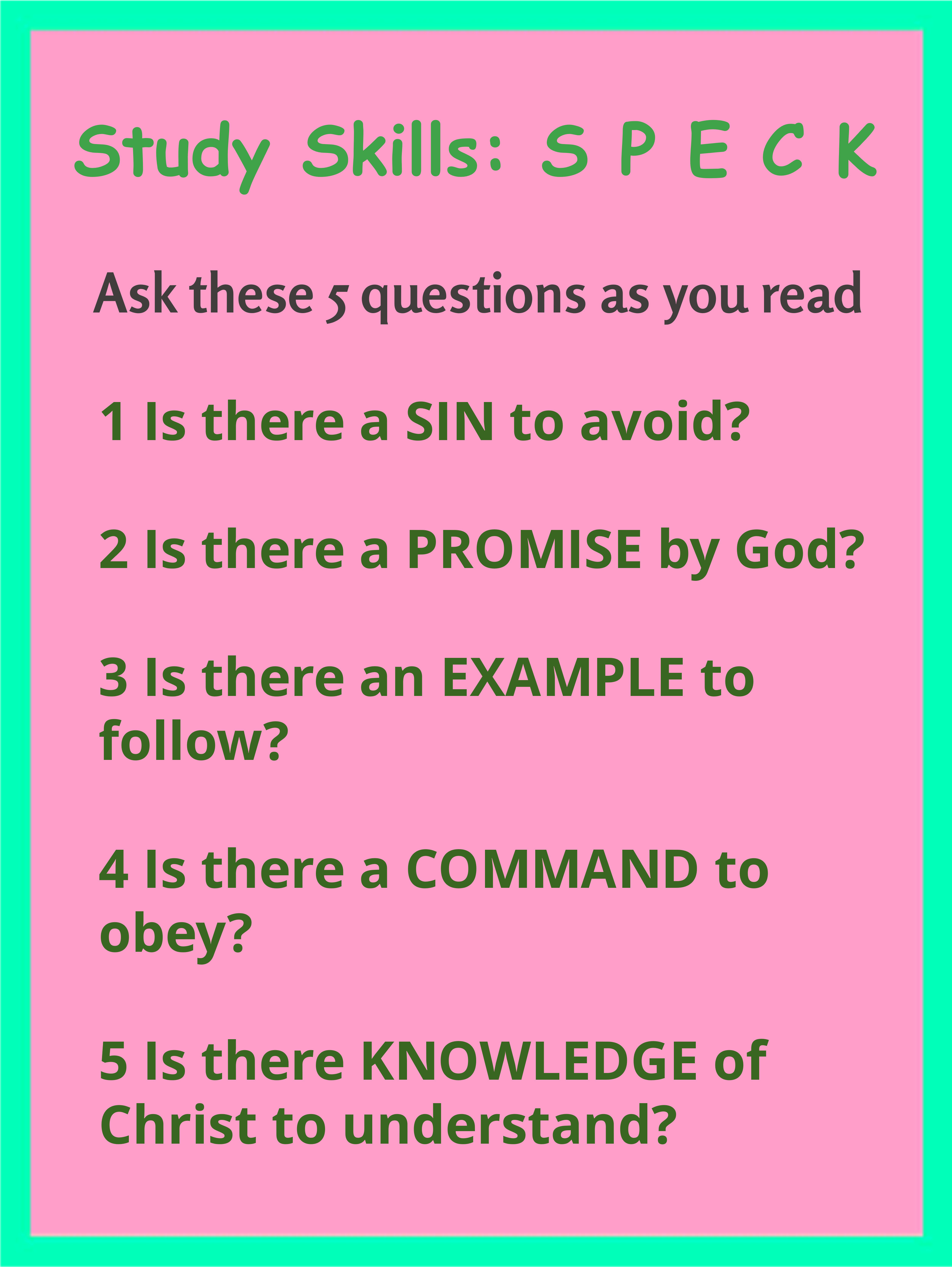
The Navigators. LifeChange Series: A life-changing encounter with God’s Word from the books of Colossians & Philemon. 2nd ed. Colorado Springs: NavPress, 2013, 77.

Does Paul Spiritualize the Concrete?: The Great Shift Exemplified in Colossians 2:8-3:4

Click for Text Here: Colossians 2:8-3:4
Gospel Precedents and Biblical Background of Spiritual Elements in Colossians 2
I. One of the great markers of the New Testament Gospels is the translation of concrete and historical Old Testament realities into spiritual and historical realities:
A. Jesus becomes the sacrificial lamb.
1. OT: Abraham begins to sacrifice Isaac (Genesis 22:1-14)
NT: John the Baptist of Jesus–“Behold, the Lamb of God.” (John 1:29, 36)
2. OT: Passover blood of the sacrificial lamb on the lintel (Exodus 12:7)
NT: Jesus sacrificed during Passover (Luke 22:7-8)
B. Jesus becomes the temple.
1. OT: (2 Chronicles 7:11-12)
NT: (John 2:19-22)
C. Concrete worship becomes spiritual.
1. OT: God commanded a certain location where he was to be worshiped (Deuteronomy 12:2-7)
NT: Jesus changed a specific, physical (concrete) location of worship into a spiritual locus of worship with no physical correspondence (John 4: 20-24)
2. OT: God gave the Israelites manna to keep them alive in the wilderness (Exodus 16)
NT: Jesus gives his followers spiritual blood and spiritual bread (spiritual representations of his own physical–i.e., concrete–body) to keep them spiritually alive (John 6:30-35, 49-58)
D. God called Israel his son  God calls Jesus his Son

OT: (Hosea 11:1)
NT: (Matthew 3:17; Luke 3:22)
E. The Old Covenant becomes the New Covenant
1. OT: The many OT covenants had physical (concrete) markers
a. the Noahic Covenant, marked by a rainbow, in which God promised not to physically destroy all living flesh by water (Genesis 9:12-17)
b. covenant with Abraham marked by the sacrifice of a physical ram (Genesis 22:9-18)
c. covenant with Israel through Moses (Exodus 24:3-8) marked by sacrificial blood (“This is the blood of the covenant which the LORD has made with you according to all these words.” Exodus 24:8) and the Ten Commandments (Exodus 24:8, 12; 25:16; 34:28)
d. covenant with David and his house (Psalm 89:3-4; 2 Samuel 7:13) marked by the establishment of his kingdom
2. NT: Jesus gives a New Covenant marked by the concrete (physical) sacrifice of his own body on a cross and the symbolic remembrance of that sacrificed blood in communion (“This cup that is poured out for you is the new covenant in my blood.” Luke 22:20
II. The New Testament epistles continue to replace concrete (physical) realities with spiritual realities sometimes marked by concrete symbols:
A. Continuation of Jesus’ blood as a symbolic marker of the New Covenant (1 Corinthians 11:25)
B. Continuation of the spiritual temple motif (Hebrews 10:19-20)
C. Continuation of spiritual worship (John 4:23-24; Philippians 3:3; Revelation 21:22)
D. Scripture continues to refer to Jesus as God’s son (Acts 8:37; Romans 1:1-4; 2Peter 1:17) and to his followers as sons (includes daughters) of God (Romans 8:14; Galatians 3:26; Hebrews 12:7)
E. The epistles continue to refer to the New Covenant as having replaced the Old (in prophecy Jeremiah 31:31-34; 2 Corinthians 3:6; Hebrews 8:8-13; Hebrews 9:15; Hebrews 12:24)
Paul’s Movement from Concrete (Physical) to Spiritual in Colossians
I. In matters of food, drink, festivals, new moon, a sabbath
Colossians 2:16 Therefore let no one pass judgment on you in questions of food and drink, or with regard to a festival or a new moon or a Sabbath. 17 These are a shadow of the things to come, but the substance belongs to Christ.
A. Paul’s list includes all concrete substances (food and drink) or practices (celebrating a festival, a new moon, or a Sabbath).
B. He calls these a “shadow,” but Christ is the “substance,” or the reality that casts the shadow. Not being physically present on Earth at this time, Christ is Spirit, present by means of the Holy Spirit, who lives in believers and among them.
C. Paul calls these concrete religious practices “elemental spirits” or “elementary principles” as in the NAU. (Gr: στοιχεῖον) (Colossians 2:20)
D. They fall within the category of what Paul labels “flesh” or “fleshly,” (Colossians 2:18; 3:22) what this post refers to as “concrete” or “physical.”
E. These practices concern concrete (physical) items, such as food and drink, which perish as they are used–i.e., they have no eternal value–and they are not useful in helping one to achieve the spiritual practices God desires (Colossians 3:23). The spiritual practices which God desires Paul begins to present in 3:5.
II. Paul moves circumcision from concrete to spiritual
Colossians 2:11 In him also you were circumcised with a circumcision made without hands, by putting off the body of the flesh, by the circumcision of Christ,
III. Baptism, itself a concrete action, signifies a spiritual correspondence to and spiritual identification with Christ’s death and resurrection
Colossians 2:12 having been buried with him in baptism, in which you were also raised with him through faith in the powerful working of God, who raised him from the dead.
IV. In a spiritual way, the record of debts owed under the Old (First) Covenant was nailed to the cross with Christ and thereby cancelled, forgiven (2:13)
Colossians 2:14 by canceling the record of debt that stood against us with its legal demands. This he set aside, nailing it to the cross.
V. Paul’s point is that the Colossians, as believers in Christ, have moved from the old, concrete form of worshipping God to the new, spiritual form of worship.
Colossians 2:20a If with Christ you died to the elemental spirits of the world,
They are therefore free of the old ways, having died with Christ to them, and having been raised with him into newness of life under the New Covenant of Spirit
and no longer need to follow these old, concrete (physical, fleshly) ways of worship and thinking and living
Colossians 2:20b why, as if you were still alive in the world, do you submit to regulations–
VI. Paul’s Alternative to the Old Ways 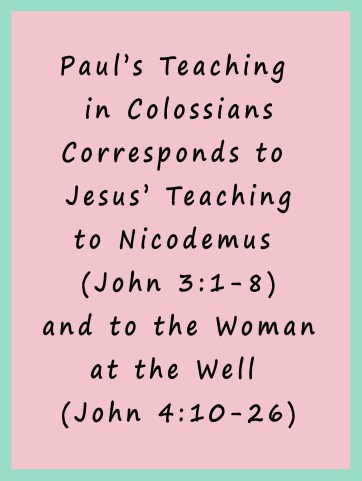

A. His rationale
Colossians 3:1a Since, then, you have been raised with Christ
Colossians 3:3 For you have died, and your life is hidden with Christ in God.
B. His conclusion
Colossians 3:1b set your hearts on things above, where Christ is, seated at the right hand of God.
C. How should the Colossians’ thinking change?
Colossians 3:2 Set your minds on things that are above, not on things that are on earth.
D. What will the end result be?
Colossians 3:4 When Christ who is your life appears, then you also will appear with him in glory.
VII. Paul begins to answer the question, How then shall we live?
NIV Colossians 3:5a Put to death, therefore, whatever belongs to your earthly nature (your concrete, fleshly body)
[not in text: and begin to live to the spiritual in the following ways, which he begins to state in 3:5b]
Link: Concrete to Spiritual: How Jesus Changes the Old Testament to the New
Colossians Reference List
- A Greek-English Lexicon of the New Testament and Other Early Christian Literature, 2nd Edition, edited by William F. Arndt and F. Wilbur Gingrich. Chicago: The University of Chicago, 1979.
- BibleWorks 9 Software for Biblical Exegesis & Research. Norfolk, VA: BibleWorks, 2011.
- Community Bible Study. Engaging God’s Word: Colossians. Colorado Springs: Community Bible Study, 2013.
- Duffield, Guy P. and Nathaniel M. Van Cleave. Foundations of Pentecostal Theology. 4th ed. Los Angeles: Foursquare Media, 2008.
- Fee, Gordon D. and Douglas Stuart. How to Read the Bible for All Its Worth. 3rd ed. Grand Rapids: Zondervan, 2003.
- Friberg, Timothy, Barbara Friberg, and Neva F. Miller. Analytical Lexicon to the Greek New Testament. Baker’s Greek New Testament Library. Grand Rapids: Baker, 2000. BibleWorks, v.9.
- Hendriksen, William. New Testament Commentary: Exposition of Colossians and Philemon. Grand Rapids: Baker Book House, 1964.
- The Holy Bible: New International Version®. NIV®. Copyright © 1973, 1978, 1984, 2011 by Biblica. All rights reserved worldwide. (New International Version Bible Online). http://www.biblestudytools.com/colossians/.
- The Navigators. LifeChange Series: A life-changing encounter with God’s Word from the books of Colossians & Philemon. 2nd ed. Colorado Springs: NavPress, 2013.
- O’Brien, Peter T. Understanding the Basic Themes of Colossians, Philemon: Quick Reference Bible Topics. Edited by David A. Hubbard. Dallas: Word Publishing, 1991.
- Pink, Arthur W. Gleanings from Paul. Edited by Rev. Terry Kulakowski. Zeeland, MI: Reformed Church Publications, 2009. Accessed February 26, 2016. http://www.davidcox.com.mx/m/files/Pink-Gleanings_From_Paul(PPC).pdf.
- Shorter Lexicon of the Greek New Testament, 2nd Edition, edited by F. Wilbur Gingrich and Frederick William Danker. Copyright © 1965 by The University of Chicago Press.
- Thayer, Joseph. A Greek-English Lexicon of the New Testament (Abridged and Revised Thayer Lexicon). Ontario, Canada: Online Bible Foundation, 1997. BibleWorks, v.9.
- Wright, N. T. Tyndale New Testament Commentaries Vol. 12: Colossians and Philemon. Downer’s Grove: Intervarsity Press, 1986.
 One Small Voice