






John 6:35 Jesus said to them, “I am the bread of life; whoever comes to me shall not hunger, and whoever believes in me shall never thirst. God Our Father
One of millions special and unique
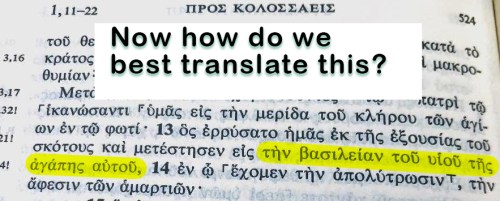
Photo by Christina Wilson
Most translations of Colossians 1:13b read, “kingdom of his beloved Son,” as in the ESV, or, “kingdom of the Son he loves,” as in the NIV and NET. Alternatively, both the NKJ and and the much older ASV (1901) read, “kingdom of the Son of his love.” The interlinear, literal translation portion of Marshall’s Greek-English New Testament reads, “kingdom of the Son of the love of him,” an exact correspondence with the Greek. My thesis is that the translation, “Son of his love,” though older, still recommends itself as a strong possibility based on evidence from context and comparison with the Greek structure of other biblical verses concerning God’s love and his Son.
The phrase in Colossians 1:13b reads in Greek, “τὴν βασιλείαν τοῦ υἱοῦ τῆς ἀγάπης αὐτοῦ.” This phrase is unique to the entire Bible, as well as the portions that read, “τοῦ υἱοῦ τῆς ἀγάπης,” and “τῆς ἀγάπης αὐτοῦ.” The phrase “his beloved Son” in English translations, including the ESV, NAU, and “dear Son” in the KJV, occurs only in Colossians 1:13. The English phrase Son he loves occurs only in Colossians 1:13. That this Greek construction is so unique accounts for the imprecision in its translation.
The English phrase “my beloved Son” occurs nine times in the KJV and seven times in the ESV. The corresponding “my Son, whom I love” (NIV) occurs eight times, all in the New Testament, and only in the NIV. The Greek construction corresponding to “my beloved Son” differs entirely from the Greek construction of “the Son of his love.” “My beloved Son” with a capital “S” is “ὁ υἱός μου ὁ ἀγαπητός” in six of the seven instances of its occurrence in the Bible, all of which occur in the New Testament (1). There is also one occurrence of the same construction in the accusative (Luke 20:13). “The Son of his love” in Greek, as noted above, is “τοῦ υἱοῦ τῆς ἀγάπης αὐτοῦ,” and also as noted above, is unique to all of Scripture.
In the genitive, the Greek word for love, “ἀγάπης,” occurs twenty-one times in the Bible, three of these in the Septuagint and the remaining eighteen in the New Testament. Two of the Septuagint references occur in Song of Solomon and the third in Jeremiah. All of the New Testament occurrences are in the epistles. Of all the occurrences of “ἀγάπης,” the one in Colossians 1:13 is the only one that occurs in close proximity to mention of Christ as God’s Son. Of the eighteen New Testament occurrences of the phrase “ἀγάπης,” only that in 2 Corinthians 13:11, “ὁ θεὸς τῆς ἀγάπης καὶ εἰρήνης,” displays a structure similar to the phrase in Colossians 1:13, “τοῦ υἱοῦ τῆς ἀγάπης αὐτοῦ.”
Wallace in Greek Beyond the Basics (107) identifies 2 Corinthians 13:11 as a possible example of a genitive of product, that is, a product which is produced by the head noun. If this is so, then the phrase could be translated as, “the God who produces love and peace,” which suits the context nicely. Since the Greek phrase in 2 Corinthians is the only phrase in all of Scripture that uses ἀγάπης in a structure similar to that found in Colossians 1:13–and both verses are Pauline–it appears reasonable to consider that the genitive in Colossians might carry a meaning similar to the one found in 2 Corinthians. If this were the case, the translation might read, “the Son who produces his [the Father’s] love.”
There is another quite different sense for the phrase, “of the Son of his love,” a sense which is also rare in Scripture. The phrase “the son who is characterized by such-and-such a quality,” captures the essence of this further meaning. Illustrations are found in John 17:12 and 2 Thessalonians 2:3, where the phrase in question is, “the son of destruction,” or, “ὁ υἱὸς τῆς ἀπωλείας.” Acts 4:36 provides another example in the phrase “son of encouragement,” or “υἱὸς παρακλήσεως.” Such a meaning for “τοῦ υἱοῦ τῆς ἀγάπης αὐτοῦ,” or paraphrased, “of the Son who is characterized by and embodies the love of the Father,” fits well with the meaning of the entire verse in which the domain of darkness is contrasted with the kingdom of the Son of God, who is characterized by and embodies the Father’s love.
_________
1 The seventh KJV occurrence of “my beloved Son” occurs in Luke 9:35. It is ὁ υἱός μου ὁ ἐκλελεγμένος, or my Son, the chosen One.

Start with your white rice, reheated okay. Sauté with a small portion of cashews. Add sweet peppers you just steamed, and lastly, a generous amount of canned peaches with their juice. The peaches should be about 1/5 the total bulk. Serve on a plate with a tablespoon of spicy chili on top for a modest, low calorie, pick-me-up hot lunch.
This recipe reminds us that Christians should find that perfect balance of sweetness and spice.
Matthew 5:13 (ESV) “You are the salt of the earth, but if salt has lost its taste, how shall its saltiness be restored? It is no longer good for anything except to be thrown out and trampled under people’s feet.”
OneSmallVoice.net
John 6:35 Jesus said to them, “I am the bread of life; whoever comes to me shall not hunger, and whoever believes in me shall never thirst. God Our Father

Photo by Jude Beck on Unsplash
Paul always opened his letters with a mention of God the Father or even “God our Father,” as in Colossians 1:3. Christians nowadays are so used to hearing about God as Father that we tend to just gloss over these references at the beginning of Paul’s letters as mere formalities. Paul, however, never wrote, “God our Father,” without great joy.
The Bible of Paul and all the early Christians was the Old Testament, since the New Testament was still in process of being written. In the Old Testament, God was rarely referred to as “Father.” Scholars have counted only fourteen such occurrences (1). Some of these were specifically about Christ the Messiah to come.
2 Samuel 7:12 When your days are fulfilled and you lie down with your fathers, I will raise up your offspring after you, who shall come from your body, and I will establish his kingdom. 13 He shall build a house for my name, and I will establish the throne of his kingdom forever. 14 I will be to him a father, and he shall be to me a son… (ESV)
Others were about Israel as a whole, but often showed God’s displeasure with his chosen people.
Jeremiah 3:2 Lift up your eyes to the bare heights, and see! Where have you not been ravished? By the waysides you have sat awaiting lovers like an Arab in the wilderness. You have polluted the land with your vile whoredom. 3 Therefore the showers have been withheld, and the spring rain has not come; yet you have the forehead of a whore; you refuse to be ashamed. 4 Have you not just now called to me, ‘My father, you are the friend of my youth–5 will he be angry forever, will he be indignant to the end?’ Behold, you have spoken, but you have done all the evil that you could.”
(ESV)
Gregory Brown writes,
When God delivered Israel out of Egypt, he adopted them as his “firstborn son” (Ex 4:22). Therefore, occasionally, Jewish prayers would reference this. But no Israelites personally called God, “Father”–ever. In fact, out of respect for God, they even stopped using his covenant name, Yahweh, and instead, would simply say Adonai or some other name of God. For a Jew to call God, “Father,” would have been considered irreverent and even blasphemous (2).
One of the most beautiful passages in all of Scripture is when Jesus spoke to Mary after his resurrection:
John 20:17 Jesus said to her, “Do not cling to me, for I have not yet ascended to the Father; but go to my brothers and say to them, ‘I am ascending to my Father and your Father, to my God and your God.'” (ESV)
Far too infrequently do churchgoers hear their pastors teach about the great differences between the two testaments of Scripture, the big changes that occurred after the death, resurrection, and ascension of Christ. One of these changes is what Christ spoke in the quotation just above. Because Jesus Christ was God’s very own offspring, his Son, and because post-cross believers are joined to Christ–only for that reason can followers of Christ now call God their Father. This is huge. Paul never forgot this glorious outcome of Christ’s sacrifice. This is why he never tired of repeating, “God our Father,” in the greetings of his letters.
In church and in Christian music we often hear about, “The glory of the cross.” This is one reason why the cross is so glorious: Believers in Christ can now call God, “Father.” I pray that Christians everywhere will know how special they are to the heart of God, their own Father, and that they will never quit praising him, thanking him, and rejoicing in this marvelous outcome of what began as shameful tragedy–the cross of Christ.
__________
1 Brown, Gregory, “The Sermon on the Mount: Experiencing God’s Kingdom on Earth. 20. Our Father (Matthew 6:9a),” available at https://bible.org/seriespage/20-our-father-matthew-69a#_ftnref3, accessed May 20, 2020.
2 Ibid.

Angels are real; they are biblical; they are ministering servants of God who worship him and do his bidding. Googling “angels + Billy Graham” (1) or “angels + David Jeremiah” (2) will reveal articles these men have written that explore what the Bible says about angels. But do angels take my prayers and “roll” them into God’s presence for me?
Recently I read a blog post written by a friend who described a self-proclaimed “vision” she had received from (she said) God. In her “picture” she saw herself “rolling” her prayers to God. She could only roll them a short distance, however. Two angels then took over and rolled her needs over the vast expanses of the universe to the very laps of God the Father and Jesus, who were seated together in heaven. Although my friend did make some excellently comforting points in her post about negative feelings, worries, fears, and the like being dispelled in the presence of God’s love and peace, I couldn’t help but wonder, “Is her picture biblical? Do angels indeed intercede for us and transport our prayers into God’s presence?”
Actually, no, this is not what the Bible teaches. If I lived “back in the day,” I would even call this a Gnostic teaching. While God does send angels to watch over, guard, and protect his children, we do not ever need angels to “roll” our prayers to him.
What does the Bible say?
Romans 8:26-27 Likewise the Spirit helps us in our weakness. For we do not know what to pray for as we ought, but the Spirit himself intercedes for us with groanings too deep for words. 27 And he who searches hearts knows what is the mind of the Spirit, because the Spirit intercedes for the saints according to the will of God. (ESV)
Romans 8:34 Who is to condemn? Christ Jesus is the one who died– more than that, who was raised– who is at the right hand of God, who indeed is interceding for us. (ESV)
The above passages teach that God the Holy Spirit and God the Son intercede for us. I don’t know about you, but with two of the three persons of the Trinity interceding for me, I don’t think I need angels to pray as well. What else does the Bible teach?
Hebrews 7:25 Consequently, he is able to save to the uttermost those who draw near to God through him, since he always lives to make intercession for them. (ESV)
The verse in Hebrews 7:25 and its surrounding context teach that Jesus Christ is the eternal high priest of the saints, who “always lives to make intercession for them.” The word “intercession” means to pray for someone else. Hebrews also teaches that Christ’s death, resurrection, and ascension into heaven have given Christians, those who believe in Christ, direct access to God the Father. Christians don’t need angels to “roll” their prayers into God’s presence–I myself can enter God’s presence in Christ who lives in me:
Hebrews 4:14 Since then we have a great high priest who has passed through the heavens, Jesus, the Son of God, let us hold fast our confession … 16 Let us then with confidence draw near to the throne of grace, that we may receive mercy and find grace to help in time of need. (ESV)
Colossians 1:27 To them God chose to make known how great among the Gentiles are the riches of the glory of this mystery, which is Christ in you, the hope of glory. (ESV)
Angels are created beings, just as humans have been created. Jesus Christ the Son of God is eternal co-creator with God the Father. He is God. The distance between us and angels is nothing compared to the distance between angels and God. Listen to these amazing verses about Christ alone from Colossians:
Colossians 1:15-20 He is the image of the invisible God, the firstborn of all creation.
16 For by him all things were created, in heaven and on earth, visible and invisible, whether thrones or dominions or rulers or authorities– all things were created through him and for him. 17 And he is before all things, and in him all things hold together. 18 And he is the head of the body, the church. He is the beginning, the firstborn from the dead, that in everything he might be preeminent. 19 For in him all the fullness of God was pleased to dwell, 20 and through him to reconcile to himself all things, whether on earth or in heaven, making peace by the blood of his cross. (ESV)
Colossians 2:2…Christ, 3 in whom are hidden all the treasures of wisdom and knowledge. (ESV)
Colossians 2:9 For in him the whole fullness of deity dwells bodily, 10 and you have been filled in him, who is the head of all rule and authority. (ESV)
The only verses in the New Testament connecting prayer with angels are found in Revelation. John’s writing in this letter is highly symbolic. In context with the verses from Romans and Hebrews the few Revelation verses, spoken as they are in symbolic pictures, cannot establish a theology of angels transporting prayers to Christ, as though without the angels the prayers could not traverse the distance. There is no distance between Christians and Christ.
John 17:21 … you, Father, are in me, and I in you, that they also may be in us, 23 I in them and you in me, … (ESV)
Paul’s prayer for the Colossians is that they “may be filled with the knowledge of his will in all spiritual wisdom and understanding,” (Colossians 1:9). Part of spiritual wisdom is learning to discern between what is Scripture and what is not Scripture. It is scriptural to believe that the prayers of Christians are heard directly by the Father because of Christ. It is not scriptural to believe that Christians need the services of angels to carry their prayers a vast distance between themselves and the throne of grace. There is no distance. Spiritually, all Christians are united with the Father through Jesus Christ the Son.
__________
1 “The Bible doesn’t say the angels pray for us — and the reason is because One far greater than the angels already is praying for us: the Lord Jesus Christ. He alone is the divine Son of God, who even now sits in heaven interceding for us (see Hebrews 7:25). Is your faith and trust in Him — both for today and for eternity?” Quotation from Billy Graham, available at https://billygraham.org/answer/do-the-angels-in-heaven-pray-for-us/, accessed May 18, 2020.
2 “We are never told to pray to angels. We pray to God, and He sends the help we need.” Quotation from David Jeremiah, available at https://davidjeremiah.blog/angels-in-the-bible/, accessed on May 18, 2020.

When seeking solutions, something to remember.

Trust in the Lord with All Your Heart
Trusting in the Lord is like a “bridge over troubled water.” (1) Notice: a bridge is only a bridge if it is already built when the waters become troubled. Don’t get me wrong, it’s never too late to trust in the Lord. But when the trials and difficulties begin–the storms and troubled water in our lives– honestly, it’s hard in those moments to trust in the Lord if that’s not already our ingrained habit. Why is that?
Speaking from my own experience–
How then do we build the bridge ahead of time, before the storms and trials begin? It’s easy! We just follow the advice (exhortations, admonitions, encouragements) of pretty much all of our Bible study teachers and pastors. Here’s how to get your bridge built, or in another analogy, to lay that firm foundation.
Listen, when storms and trials come, and they often come so suddenly–like a flood that sweeps over our heads–faith in our faith will not sustain us. It’s faith in the Lord that sustains us. Our “feelings” toward the Lord won’t sustain us–not when we’re experiencing pure panic. What sustains us is the bridge we’ve already built and used frequently, the bridge that lifts us above the troubled water and carries us to the Rock. Jesus called it a house built upon a Rock (Matthew 7:24-25).
Make sure you work on building your bridge, your foundation, every single day. Don’t be like the grasshopper who looks at the sunshine and says to herself, “It’s never going to rain.” “In the world you WILL have tribulation,” (John 16:33). That is Jesus’s guarantee to us. But he also says, “Take heart; I have overcome the world.” The bridge you build now will take you over the troubled waters to the safety of the Lord. How’s your bridge doing today?
__________
1 Bridge Over Troubled Water is the name of a popular song written by Simon and Garfunkel.



 One Small Voice