How Could a Loving God…?
“How could a loving God allow this?”
“If God exists, how could he allow this?”
Nonbelievers and those overwhelmed by tragedy often ask some form of the above two questions.
Twice in human history, God answered.
The first was the global flood recorded in Genesis 6 and in cultural stories and artifacts from all over the world. In the Genesis account, God passed judgment on the entire human race. God spared only one man he judged righteous and seven others of his close family. Everyone else in the entire human race died.
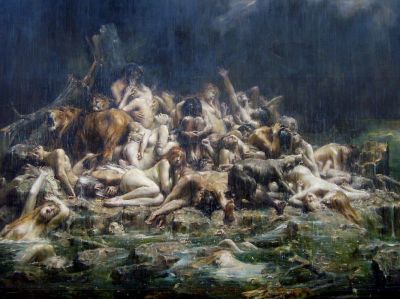
Public domain painting by Leon Comerre
The second time God answered the “How could he…?” question, he lifted his Son on a cross. In this judgment, one righteous man died so that the entire human race might be rescued. The only thing God requires of people is to Believe and Receive.

Public domain by Leon Bonnat
Sin is ugly in all its forms, especially to our creator, who is good and who made us good. Yet in answer to our, “How could a loving God…?” question, so many rebel at the choices God gives when he tells us that he does NOT, in fact, allow these things. So many refuse the “believe and receive” option. They might prefer a sliding scale if they judge their own sin to be nonexistent or quite small. I don’t have an answer for your heart, only my own. But knowing my own deep, dark secrets and all the acts I’ve ever done or left undone, I prefer God’s second option. Knowing Jesus is not that bad. He’s far, far better than God the judge, and he takes good care of his own. It’s your call. Each of us chooses for ourselves.
Running to God: Psalm 16

Photo by Hanson Lu on Unsplash
The speaker of Psalm 16 has an amazing relationship with the Lord. He runs onto the stage in verse 1, makes a beeline to the Lord, and cries out, “Help me!” (Protect me, save me, guard me.) “Here’s the deal,” he says, “I’m hiding in you. You are my refuge, my safety, my one spot, my only hope.”
Then he grants the Lord everything, “You are the Lord. You are the One. I have nothing worth anything anywhere in all myself or my life apart from you.” Talk about putting your eggs into one basket! What a confession this is.
Scholars concede that verses 3 and 4 are difficult, as in not clear, not understood. Let’s just say that the psalmist makes reference to other people, whether for good or for bad, but dismisses them all and turns back to the Lord.
“You are the One. You are my reward and blessing.” The original of verse 5 reads, “You are my piece of inheritance and my cup.” Not a house, nor a piece of property, not a castle, nor acres and acres of land, but You, a person, you are my inheritance and my daily provision. “I will settle myself down in You and drink of You.” Crazy, huh? Can we even imagine relating to another person in this way? I can only think of someone who is madly in love. Verse 5 also says, “You make my lot secure.” That speaks of knowing someone who both owns the lottery and controls the machine that chooses the numbers. This person matches up the winning number with the ticket I hold in my hand. Can’t get any more certain than that.
I also like the Septuagint translation of the last part of verse 5, “You are he who restores my inheritance to me.” The word restore means to bring back what was lost, to bring back what was once beautiful, whole, powerful, good, and strong. Think about the entire Bible from start to finish. What was lost in Genesis? What gets restored in Revelation? Humankind’s innocence was lost in Genesis–peace, prosperity, walking and talking in the presence of God in a place that was paradise. All this is restored in Revelation. But not just people lost out when Eve surrendered to God’s enemy and ate the apple–God lost out. The Creator and his Son, who was always by his side, they lost what they created to an enemy who destroyed and ruined what they had made for their eternal enjoyment. The Bible tells the story of how all God’s creation gets restored to God. In verse 5 the psalmist speaks of his inheritance portion of all this. Then in verse 6 we see the psalmist surveying his inheritance. “Yep,” he says, “I got the best piece. My inheritance is really good, better than anything else.”
By now we might be wondering who this psalmist is. His tone is so certain, so sure, so totally convinced that he himself is the winner of all. Who talks like this? Verse 7 gives a clue. The psalmist is someone who is close to the Lord. All night long the Lord keeps him awake instructing him, giving him guidance and counsel; we might even say child-training him, educating him, discipling him. Verse 8 tells us the psalmist is someone who sees the Lord always directly in front of his face. He never loses sight of him, never loses track. Further, the Lord is at his right hand. The right side symbolically is the position of power, the leading side, the side of protection and favor. Such confidence in the Lord is amazing.
The psalmist’s confidence in his Lord translates into an overwhelming sense of gladness and joy that in verse 9 completely floods the psalmist’s heart and every other part of him. Even his body rests securely, not the least bit anxious about anything. Verse 10 is the most amazing statement of all. The psalmist speaks out his faith and confidence in God by saying, “You will not leave my soul in hell, neither will you allow your Holy One, me, to see corruption.” In other words, even when I die, the psalmist is saying, You, God, are not going to leave me dead, and you’re not going to allow my body to rot as every other living thing since creation itself does when it dies. I’m different. I’m special. You God will not allow my body to rot at death, nor will you let me stay dead.
There is only one human being in all of history who can make a claim like this one and have it come true–Jesus Christ, God’s Son. The apostle Peter said so in Acts 2:25-28. There he quotes Psalm 16:8-11 and applies these verses pointedly to Jesus shortly after all the apostles and many others witnessed his resurrection.
Psalm 16 closes in verse 11 with this great verse, quoted here from the NET Bible, “You lead me in the path of life; I experience absolute joy in your presence; you always give me sheer delight.” What could be better than this?
Before I leave here, I just want to point out what strikes me about Psalm 16.
- When the psalmist runs to God for safety in verse 1, he is running for a reason. He’s in trouble.
- The psalmist, God’s Son, has total confidence and assurance in who God is. He knows that God is able to help him and is eager to do so.
- The psalmist knows who he himself is. He is someone whom God very certainly wants to help.
- The psalmist speaks to God from a point in time far before the historical events that equate with this psalm, the events of Jesus’ life, death, and resurrection. In other words, this is prophecy. Christ the Son existed eternally before he became human, before his incarnation. This is how through the human penman he was able to foresee and foretell his future through this psalm.
- This one is important for us as readers. What is true of Christ in this psalm is also true of all those who give allegiance to him as their King. Just as the psalmist places his trust 100% in God as his Lord and benefactor, so believers must place their trust 100% in Christ as the King whom they follow and rely upon in everything. The New Testament teaches this everywhere.
- All the blessings the psalmist receives from God, God also gives to those who own Christ, to those who by their allegiance to him are found to be in him.
Romans 8:11 If the Spirit of him who raised Jesus from the dead dwells in you, he who raised Christ Jesus from the dead will also give life to your mortal bodies through his Spirit who dwells in you. (ESV)
Romans 8:14 For all who are led by the Spirit of God are sons of God.
Romans 8:38 For I am sure that neither death nor life, nor angels nor rulers, nor things present nor things to come, nor powers, 39 nor height nor depth, nor anything else in all creation, will be able to separate us from the love of God in Christ Jesus our Lord.
7. Therefore, we can read Psalm 16 with Christ as speaker, or we can read it with ourselves as speaker. It works both ways.
God’s Take on Current Events and Daily News: Psalm 15
Aromal M S @aro_mal on Unsplash.com

How does God feel about what we read in our daily news? Read Psalm 15 here to find out.
ESV Psalm 15:1 A Psalm of David. O LORD, who shall sojourn in your tent? Who shall dwell on your holy hill? 2 He who walks blamelessly and does what is right and speaks truth in his heart; 3 who does not slander with his tongue and does no evil to his neighbor, nor takes up a reproach against his friend; 4 in whose eyes a vile person is despised, but who honors those who fear the LORD; who swears to his own hurt and does not change; 5 who does not put out his money at interest and does not take a bribe against the innocent. He who does these things shall never be moved.
God will not be mocked, and his Word will not be trumped. In crystal clear, plain language God proclaims what he expects from people. God is Creator, the Great Benefactor, the Savior, and Judge.
God is good. Psalm 15 describes what goodness is in God’s eyes. He sees everything. Nothing escapes his notice.
The question is: Does God expect us to behave politically the same way he expects us to behave toward our families and our friends? Psalm 15 makes no distinction. And Jesus clarified his Father’s word even further.
ESV Matthew 5:43 “You have heard that it was said, ‘You shall love your neighbor and hate your enemy.’ 44 But I say to you, Love your enemies and pray for those who persecute you, 45 so that you may be sons of your Father who is in heaven. For he makes his sun rise on the evil and on the good, and sends rain on the just and on the unjust.
Within the Psalter, God fully declares his expectations of us.
Rejection: Psalm 43
Where do you turn when the one you love rejects you? Turn to Jesus–He knows.

Anyone here who has never experienced rejection? How about rejection from someone you trusted, or even loved? A spouse, a parent, a child, a sibling, a best friend, a co-worker, the boss who hired you, the nation where you were born? Jesus is human. Jesus experienced rejection.
Psalm 43 prophetically records Jesus’ feelings of rejection by God his very own Father.
1 Vindicate me, O God, and defend my cause against an ungodly people, from the deceitful and unjust man deliver me!
2 For you are the God in whom I take refuge; why have you rejected me? Why do I go about mourning because of the oppression of the enemy?
3 Send out your light and your truth; let them lead me; let them bring me to your holy hill and to your dwelling!
4 Then I will go to the altar of God, to God my exceeding joy, and I will praise you with the lyre, O God, my God.
5 Why are you cast down, O my soul, and why are you in turmoil within me? Hope in God; for I shall again praise him, my salvation and my God. (Psalm 43:1-5 ESV)
Some see in this poem a song of joy and hope, while others see an extension of the sad strains of Psalm 42. I bundle it with Psalms 42, 22, 13, and others like these.
God’s main focus in all of Scripture is his Son. Jesus said so. “You search the Scriptures because you think that in them you have eternal life; and it is they that bear witness about me,” (John 5:39 ESV). The Old Testament had the job of predicting and setting the stage for the New. Psalms announces the human life of the divine Son. When the psalmist speaks, he prophesies, and the voice he prophesies is the voice of Christ.
Verses 1 and 2 of Psalm 43 indicate that an ungodly nation rejected Jesus and he was oppressed by unjust and deceitful enemies. We previously learned this in Psalm 13. There we see God being very slow to hear the psalmist’s plea for help. Verse 2 of Psalm 43 takes the psalmist one step further. Here he accuses God of rejecting, or spurning, him. This is not quite as strong yet as Psalm 22:1, “My God, my God, why have you forsaken me?” where “forsaken” means left me behind, abandoned me.
We get the picture. Not only did God’s holy, anointed Son receive the blows of his own people, but while they were doing this, God himself rejected, turned away from, and abandoned him. How must Jesus the man have felt? Shouldn’t the Bible, if it is God’s word, predict this? Who would think? Who would expect? The Bible must tell us these things if we are to place our trust in this person hanging naked and dead upon a cross, then buried in the ground.
Jesus’ disciples had lost faith after his crucifixion. They were afraid and confused. They hadn’t yet heard of his resurrection when Jesus anonymously came by two of them on the road and walked with them awhile. Jesus pinpointed their lack of faith, “O foolish ones, and slow of heart to believe all that the prophets have spoken!” (Luke 24:25 ESV) Then he explained to them what the Old Testament had predicted concerning his death and resurrection, “26 Was it not necessary that the Christ should suffer these things and enter into his glory?” 27 And beginning with Moses and all the Prophets, he interpreted to them in all the Scriptures the things concerning himself (Luke 24:26-27 ESV). Their faith was strengthened. They went running all the way back to where they had just left and shared with the other disciples what they had learned. Prophecy bolsters faith. Knowing this, God included Psalms in Scripture.
Psalms: Poetic Prophecy

Photo by Dương Trần Quốc on Unsplash
Media service providers love to bundle–TV, internet, land lines. Why do some Old Testament scholars deny God that privilege? God bundles. Psalms can be grouped according to themes. This is not news. But God does more than repeat themes and scatter them throughout Psalms. He loves to string psalms like pearls on a single strand.
The major thread running through Psalms is the story of God’s Son, especially what happened to him on the cross. When God foretells a story centuries before its occurrence, the foretelling is called prophecy.
Acts 2:23 this Jesus, delivered up according to the definite plan and foreknowledge of God, you crucified and killed by the hands of lawless men. (ESV)
25 For David says concerning him, “‘I saw the Lord always before me, for he is at my right hand that I may not be shaken;
30 Being therefore a prophet, and knowing that God had sworn with an oath to him that he would set one of his descendants on his throne, 31 he foresaw and spoke about the resurrection of the Christ, that he was not abandoned to Hades, nor did his flesh see corruption.
Acts 13:36 For David, after he had served the purpose of God in his own generation, fell asleep and was laid with his fathers and saw corruption,
Why did God prophesy the events of his Son’s life centuries before they occurred? I can think of a few reasons. Perhaps collectively we can think of more:
- to prove the presence of the supernatural
- to provide supernatural credentials for his incarnate (born as a human) Son
- to provide a road map of education and warning for the Son’s journey through human existence
- to prepare a people ready to receive his Son
- to bolster the faith of his Son during a very rocky ride
- to bolster the vision and understanding of the first disciples, the first followers of Christ
- to bolster the faith of the first disciples-turned-missionaries
- to convince all that God is for us, not against us, as we discover that the very human voice of the psalmist is my voice, and your voice, and the voice of people everywhere
God told the events ahead of time, so that we who were to follow could see, understand, and believe.
Why poetry? Why write prophecy as poems? Is there a better media than poetry to convince us “stubborn of heart” people that Christ, God’s chosen and anointed, was and is every bit as human as we are? Poems can be a subjectively accurate display of the heart, feelings, mind, and thoughts of the person speaking them.
God loves people so much that he sent himself in the person of his Son to bring life to us–to raise us from the dead. And with his Son, even before his Son’s arrival, he sent these magnificent poems to display the utter humanity of his Son in a way that an itinerant preacher/healer could not do in real time. Think of Jesus and his disciples so pressed upon by the anxious crowds that they had time neither to eat nor sleep. Think about the thousands of people Jesus healed, the thousands (?) of miles they walked, the hundreds of sermons he preached in three years, the hours and hours of private praying he did. Who would be there to write down his meditations and prayers? God provided. He sent a prophet-poet named David centuries ahead of time to record the thoughts, feelings, and prayers of his yet-to-be-incarnated Son. In this way God foretold the life of his Son.
Who in the culture of that day would have expected that God’s Son, his anointed, the mighty King to be (see Psalms 2 and 110), would live a life of poverty and suffering? Who in their wildest dreams would even dare to imagine that God would reject his Son unto death? Who would possibly dare to claim that the nakedly shamed and beaten Jesus of Nazareth was…Messiah? Impossible! No one but God would think these things. Therefore God predicted in advance through the prophecies of Psalms and other books, such as that written by Isaiah, so that at the right moment, we could recognize the divine Christ in his human form when he came.
In the voice of the suffering psalmist, I hear my own voice. As I do, I realize the fact that God ultimately wrote these words and included them in his book. This tells me that just as God sees the psalmist, God sees me, he sees you, he loves me, and he loves you. And just as the psalmist turned to God through all his trials, cried out to him for help, and praised him, God wants me to do the same. God is love.
Psalms Are Interactive
Human hands wrote the Psalms. Even so, God stands behind them all. He has complete charge. He makes the rules for his own Psalms. He states this principle elsewhere in the Bible. “All writings are inspired by God.”[1]
Psalms are amazingly interactive. When the reader brings her heart to bear upon her reading, God often responds by personally placing a word, a line, or a thought from one of the psalms directly into the intelligent or feeling portion of her comprehension. By this I mean that God brings the poem home into the reader’s heart and mind, applying what she is reading to her personally. It’s amazing and fun when this happens. Reading Psalms is like reading no other book.
This means that a psalm can change its emphasis with each reading. Just because you’ve read one once doesn’t mean you’ve finished reading it. Just as audience response affects performers on a stage, or a teacher interacts with her students, or a choir interacts with the music they are singing, or an orchestra interacts with the score or a conductor, so God himself can interact with those who read his Psalms. God is alive and present as you read.
This doesn’t mean I’m saying that Psalms can mean any old thing whatsoever that readers desire. The meaning must always stand within the nature, or character, of God. But critics often suggest that each line of the Bible has one exact meaning. They define that meaning as whatever they think the original human author meant when he physically wrote the words. Additionally, they enjoy limiting the meaning of portions of the Bible, including Psalms, to what they might imagine it meant to its original readers. I say “imagine,” because these critics weren’t there either when the Bible was written, or when a supposed “original” group of readers or listeners saw or heard it read.
For you who are reading this blog, that’s neither here nor there. For now, I just want to encourage you to pick up Psalms and read them for yourselves. You might be amazed to discover that God may choose to speak directly into your heart, which he often does for readers of Psalms. It’s totally delightful when this happens, even when he addresses the hurting and painful spots in your heart, like a doctor or a surgeon might your body. Always remember, God is love, and he loves you. He wants you to grow to love him, as well. Reading Psalms can help you do this.
[1] 2 Timothy 3:16. See also John 10:35.
Intellectual Assent Versus Desire

I know a little girl who loves the story of the baby born under a star in a stable. The young mother had ridden a donkey a long way with her husband so the infant could be laid on straw shared by cattle and sheep. The visitors came–wise men, kings, and shepherds. “I love this story so much!” the little girl responds.
Then along comes thought, the thinking brain. “I know God lives in our hearts. But does he live out there?” gesturing with a wide arm to the outside world. “How do we know?” She asks these questions in her barely five year old head, because her dear gramma says God created and her even dearer papa says there is no God.
Little girl, I just want to say to you, “It’s not about your gramma or your papa. It’s about you. Follow your heart.”
Your heart is the head and your head is the tail. Don’t let the tail wag the dog. If you want to believe in God, then believe. God in his kindness will accept your desire, even if you lack reason for it. As years pass, over time, he may or may not answer the questions of your head. If God had wanted the blessing of belief to come through the head, he would have made it so. As it is, he chose faith. Turn your heart toward God, and your head will follow.
Waiting Out the Storm: Psalm 130

Photo by Jian Xhin on Unsplash
The prayers have been prayed. The battle has been fought. In Psalm 130, the psalmist finds himself alone in a deep, deep place. If we see Christ praying this psalm, we would say that his human body and soul have died, and he lies buried in death. That’s about as deep as a human being can ever go.
What does the divine Son do, united as he is with our humanity? He does what he always does. He turns to the Lord, gives voice to his people-ness, and cries out to him, just as he always did in life.
Psalm 130:1 A Song of Ascents. Out of the depths I cry to you, O LORD!
2 O Lord, hear my voice! Let your ears be attentive to the voice of my pleas for mercy! (ESV)
The Bible teaches that Christ died for our sins. In the next verses the psalmist/Christ reminds God of the reason for his whole being on earth, that God would forgive.
3 If you, O LORD, should mark iniquities, O Lord, who could stand?
4 But with you there is forgiveness, that you may be feared. (ESV)
Now everything that can possibly be done has been done. The entire resurrection is predicated upon God’s action, upon God’s forgiveness. So what does the psalmist do? He waits. From the deepest deep of the depths, having been removed from all possibility of doing more, the psalmist waits.
5 I wait for the LORD, my soul waits, and in his word I hope;
6 my soul waits for the Lord more than watchmen for the morning, more than watchmen for the morning. (ESV)
A narrator, possibly the Holy Spirit, breaks in here and encourages the Lord’s people to do the same: to wait in steadfast hope on the Lord. Because his faith in God tells him that redemption is on its way.
O Israel, hope in the LORD! For with the LORD there is steadfast love, and with him is plentiful redemption.
8 And he will redeem Israel from all his iniquities. (ESV)
Do you think we can apply this psalm to our own life situations?
Waiting can be a most difficult time. Our faith is tested while we wait. Do we wait in hope of deliverance, as the psalmist did? (See his deliverance in Psalm 18.) Do we wait in peace and even joy, as Paul and Silas did while chained in the depths of a foreign dungeon? (Acts 16:16-40) Do we wait in isolation, as the Apostle John on the Island of Patmos? (Revelation 1:9)
Christ was rewarded with resurrection. Paul and Silas were rewarded with freedom and vindication. When we hide ourselves in Christ, we also receive multitudes of “small” resurrections and releases. These small resurrections from the heart wrenching trials of life point to one great, enormous resurrection from death and the grave itself. What a day that will be, a day worth waiting for.
A Criticism of NET Word Choice in Psalm 33:6
I take issue with NET’s translation of Psalm 33:6.
I. In the first line, I would use the majority translation “word” rather than the minority translation “LORD’S decree,” because the context does not support NET’s paraphrase over the literal text of the original Hebrew and Greek.
ESV Psalm 33:6 By the word of the LORD the heavens were made, and by the breath of his mouth all their host.
NET Psalm 33:6 By the LORD’s decree the heavens were made; by a mere word from his mouth all the stars in the sky were created. (Psa 33:6 NET)
LXE Psalm 32:6 By the word of the Lord the heavens were established; and all the host of them by the breath of his mouth.
The following translations use “word” in verse 6: ESV, NIV 1984, NIB (British NIV, 1984), NAS, BBE (Bible in Basic English), LXE (Brenton’s Septuagint English Translation), NETS (New English Translation of the Septuagint, Pietersma, 2009), KJV, NKJV, NRS (New Revised Standard Version, 1989), and the NIV, 2011. “Word” literally translates both the Greek of the Septuagint and the Hebrew, as the NET points out in its notes. However, the NET model, 2006, and the NIRV (New International Reader’s Version, 1998) have taken the liberty to interpret the literal “word” of the two original languages and to place the interpretation into the text. NET then puts the literal translation into the notes. Can these two be right and everyone else wrong?
The NET writes for Psalm 33:6, “By the LORD’s decree the heavens were made; by a mere word [breath, or spirit] from his mouth all the stars in the sky were created.” The NIRV writes, “The heavens were made when the LORD commanded it to happen. All of the stars were created by the breath of his mouth.”
The interpretation NET and NIRV have given (although the 2011 NIV returns to “word”) is a narrow slice of the semantic range of possible meanings of the literal “word” of the original. In the case of the NET, I strongly suspect that this is an editorial decision based upon the philosophy (hermeneutics) of Old Testament interpretation the editors have chosen. NET is fond of placing the literal in the margin and their particular interpretation in the text itself.
Why does this matter?
1) These two versions are changing the literal translation of God’s word.
2) They are interpreting for God the meaning of the text, rather than allowing the reader to do so under the guidance of God.
One of the readers of Psalms was John the Apostle. In John 1:1-5, he writes,
1 In the beginning was the Word, and the Word was with God, and the Word was God.
2 He was with God in the beginning.
3 Through him all things were made; without him nothing was made that has been made.
4 In him was life, and that life was the light of all mankind.
5 The light shines in the darkness, and the darkness has not overcome it. (NIV, 2011)
The author of Hebrews writes,
2 but in these last days he has spoken to us by his Son, whom he appointed heir of all things, and through whom also he made the universe.
Why rob the reader the pleasure of seeing the Word, the Son, in Psalm 33:6 by changing the literal translation “word” to “LORD’s decree“? The semantic domain of “word” includes the concept of “decree,” while “decree” erases the possibility of the Personhood of God’s Word.
In support of keeping the original rather than NET’s interpretation, the text of Psalm 148:5-6 is interesting in its contextual similarity to Psalm 33:6.
5 Let them praise the name of the LORD, for he commanded and they were created.
6 He set them in place for ever and ever; he gave a decree that will never pass away. (NIB, NIV 1984)5 Let them praise the name of the LORD, for he gave the command and they came into existence.
6 He established them so they would endure; he issued a decree that will not be revoked. (NET)
In these verses, “them” means everything named in verses 2-4: angels, heavenly hosts, sun, moon, shining stars, highest heavens, and waters above the skies, i.e., creation, apart from the earth. These verses contain the translations “commanded…created,” “set them in place,” and “gave a decree.” Interestingly, NET notes does not mention any of the three verbal phrases.
In comparison with Psalm 33:6, the immediate creation context is identical. “6 By the word of the LORD were the heavens made, their starry host by the breath of his mouth.” Yet even though the context is identical, the original Greek and Hebrew words referring to the act of creation are different. Psalm 33, as noted above, uses the Hebrew and Greek original for “word,” “logos” (see Strong’s H1697 and G3056), whereas Psalm 148:5-6 uses different words more directly related to “command” (see Strong’s H6680, H8765, G1781, G2476, and G4367).
“Logos,” which is “word” in the New Testament, carries great weight, and one cannot help but wonder why the NET chose to minimize its potential importance in Psalm 33:6, given that NET’s claimed translation “the LORD’s decree” uses other, specific Hebrew and Greek words that God could have chosen, as for example, those he did choose in Psalm 148:5-6 in an identical context. Are we to think that God pays less attention to details than NET? In Psalm 33:6, if God intentionally chose Hebrew “dabar” and Greek “logos,” both meaning “word,” then “word” it is.
3) There is yet another reason why an accurate translation should stick with the Greek and Hebrew, rather than an interpretation. This has to do with God’s creation. We are in a period of time in church history in which some churches and pastors are abandoning the traditional understanding of Genesis 1 and 2 as actual history and substituting an interpretation that compromises with naturalistic, materialistic science. These compromising methods of interpretation sometimes fall into the categories of “literary framework” and “poetic.”
While this particular article is not the venue for exploring the above allegation in detail, the readers may consider this a signpost pointing them to an area they might want to study. To my ear, the non-literal, interpretive translation of NET Psalm 33:6, “By the LORD’s decree the heavens were made,” allows for a “decree” whose manner is unspecified. How was this decree made? The reader doesn’t know. Perhaps it could have been a decree whose form permitted natural processes only to unfold for millions and millions of years before the events in the later chapters of Genesis. When the ESV writes, By the word of the LORD the heavens were made, the connection between God personally speaking as a Being and something immediately happening is made clear.
4) Hebrew poetry often consists of couplets or triplets. Psalm 33:6 contains a couplet (two lines), which basically state the same thought in two slightly differing ways. Why did the NET feel it preferable to disrupt the Hebrew symmetry by substituting the original words of the first line with a narrower, paraphrased interpretation?
ESV Psalm 33:6 [Line 1] By the word of the LORD the heavens were made, [Line 2] and by the breath of his mouth all their host.
NET Psalm 33:6 [Line 1] By the LORD’s decree the heavens were made; [Line 2] by a mere word from his mouth all the stars in the sky were created.
5) NET also reinterprets the second line of Psalm 33:6 in its paraphrase. A reader without access to the original languages might think that the NET compensated for their paraphrase of Line 1 by stating what should have been stated there in Line 2. Isn’t everything clear now? However, as the ESV makes clear, both the Hebrew and Greek do not say, “word,” or “mere word,” as NET writes in Line 2. The original word used in Hebrew is, “ruwach,” meaning “wind, breath, mind, spirit,” according to Strong’s number 07307. The original word in Greek specifies “spirit,” Spirit,” or “breath;” the word is πνεύματι, or “pneuma.” Genesis 1:2 (ESV) teaches that,”the Spirit of God was hovering over the face of the waters.” NET’s choice of “mere word” does means neither, “breath,” nor “spirit, or Spirit,” nor “word.” The NET has completely obscured the act of the triune God in creation. Consider the following:
ESV Genesis 1:1 In the beginning, God created the heavens and the earth. 2 The earth was without form and void, and darkness was over the face of the deep. And the Spirit of God was hovering over the face of the waters. 3 And God said, “Let there be light,” and there was light.
The ESV above gives an accurate translation, based upon both Hebrew and Greek. There in verse 1, the reader perceives God, as in God Almighty. The word in Hebrew is plural. In verse 2, the reader finds the Spirit active in creation. Finally in verse 3, the reader finds the Word in the phrase, “And God said…” The Apostle John verifies this meaning in John 1:1-3, “John 1:1 In the beginning was the Word, and the Word was with God, and the Word was God. 2 He was in the beginning with God. 3 All things were made through him, and without him was not any thing made that was made.” (John 1:1-3 ESV)
SUMMARY: Psalm 33:6 summarizes the presence of the Word and the Spirit in creation in its two lines, [Line 1] By the word of the LORD the heavens were made, [Line 2] and by the breath of his mouth all their host (ESV). The NET obscures these truths, [Line 1] By the LORD’s decree the heavens were made; [Line 2] by a mere word from his mouth all the stars in the sky were created.
For Lovers of God: Psalm 33
Psalm 33 1) beautifully describes God’s nature as reflected in his many activities and 2) encourages people everywhere to worship him loudly and clearly with joyful praise and celebration.

myjoyonline.com
Psalm 33 opens with a clarion call to praise that pictures a scene of genuine celebration:
1 Sing joyfully to the LORD, you righteous; it is fitting for the upright to praise him.
2 Praise the LORD with the harp; make music to him on the ten-stringed lyre.
3 Sing to him a new song; play skillfully, and shout for joy. (Psalm 33:1-3 NIV, 1984)
Verses 4 and 5 give four reasons to celebrate God:
- For the word of the LORD is right and true; (vs 4)
- He is faithful in all he does (vs 4)
- The LORD loves righteousness and justice; (vs 5)
- the earth is full of his unfailing love. (vs 5)
The body of the psalm develops these four points:
1. For the word of the LORD is right and true (vs 4)
God created by his Word (see footnote 1, technical).
6 By the word of the LORD were the heavens made, their starry host by the breath of his mouth.
7 He gathers the waters of the sea into jars; {Or sea as into a heap} he puts the deep into storehouses.
8 Let all the earth fear the LORD; let all the people of the world revere him.
9 For he spoke, and it came to be; he commanded, and it stood firm.
2. He is faithful in all he does (vs 4)
10 The LORD foils the plans of the nations; he thwarts the purposes of the peoples.
11 But the plans of the LORD stand firm for ever, the purposes of his heart through all generations.
As we consider today’s shifting political market and humankind’s long world history, we see that various nations and people groups rise and fall. “But the plans of the LORD stand firm for ever, the purposes of his heart through all generations.” God is faithful, unchanging, ever true, and powerful.
3. The LORD loves righteousness and justice; (vs 5)
12 Blessed is the nation whose God is the LORD, the people he chose for his inheritance.
13 From heaven the LORD looks down and sees all mankind;
14 from his dwelling-place he watches all who live on earth–
15 he who forms the hearts of all, who considers everything they do.
16 No king is saved by the size of his army; no warrior escapes by his great strength.
17 A horse is a vain hope for deliverance; despite all its great strength it cannot save.
The LORD blesses those who follow his ways (vs 12). His ways are righteousness and justice. God did not simply create and then disappear into the vastness of an infinite space (deus ex machina). Verses 13-15 state that God looks and sees everyone everywhere. He judges by his own standards of uprightness, of righteousness and justice. Verses 16-17 state that history is full of examples in which leaders with great armies, great strength, and the best of equipment find all those insufficient to save. It is God who saves.
4. the earth is full of his unfailing love. (vs 5)
18 But the eyes of the LORD are on those who fear him, on those whose hope is in his unfailing love,
19 to deliver them from death and keep them alive in famine.
The LORD knows his own. He watches over them carefully, minutely, and always. The text describes God’s people as those who love him, respect, trust in, and obey him (text: fear him) as well as place their hope in God’s loyal and faithful actions and attitude of love towards them. We might call these actions faith. God delivers from death those who place their faith in him, who give their loyalty to him. He also keeps them alive in famine.
What should our response be?
Verses 20 and 21 recap the introductory verses 1-3.
20 We wait in hope for the LORD; he is our help and our shield.
21 In him our hearts rejoice, for we trust in his holy name.
Verse 22 concludes with a prayer that 1) asks the faithful God to continue blessing his people just as he has done in the past, and 2) expresses the continued loyalty of the people.
22 May your unfailing love rest upon us, O LORD, even as we put our hope in you.
Application:
Explanations of a psalm are never as good as the psalm itself, just as reading a synopsis of a book or movie is never as good as experiencing. When someone tells about a great time they had, the description comes nowhere near the great time itself. Explanations like the above serve at best as a roadmap to lead the way or guideposts to point out interesting sights. Whereas experiencing a psalm and being swept up into its mood or passion can happen in just a few short minutes, digesting an explanation can dampen the joy of movement. So read the psalm when you are fresh and celebrate God’s ever present goodness.
_______________
Translation Note: Verse 6 NET translations differs significantly from the original Hebrew, the Greek Septuagint, and most modern English translations. A detailed analysis of this verse can be found here: A Criticism of NET Word Choice in Psalm 33:6.
 One Small Voice