S P E C K: Read and Question

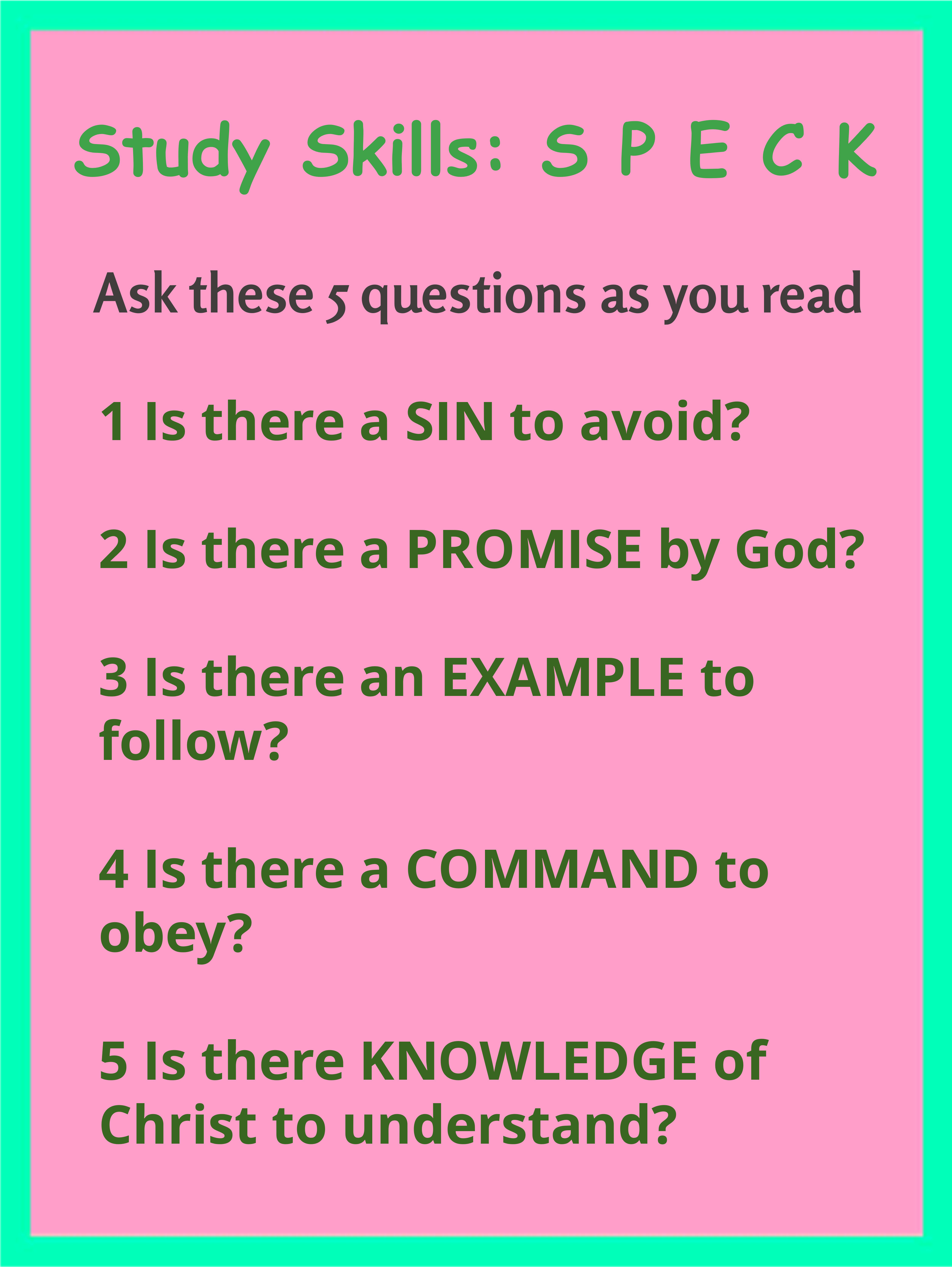
How much do we get from Scripture when we read? Use these 5 questions as you read to help you better focus, understand, and absorb.

SPECK by Snappa


The Navigators. LifeChange Series: A life-changing encounter with God’s Word from the books of Colossians & Philemon. 2nd ed. Colorado Springs: NavPress, 2013, 77.

S P E C K: A Study Skills SideBar

As we read passages of Scripture, such as Colossians 3:1-18, we can ask ourselves questions such as those summed up by the acronym SPECK.


SideBar SPECK

Does Paul Spiritualize the Concrete?: The Great Shift Exemplified in Colossians 2:8-3:4


Click for Text Here: Colossians 2:8-3:4

Gospel Precedents and Biblical Background of Spiritual Elements in Colossians 2


I. One of the great markers of the New Testament Gospels is the translation of concrete and historical Old Testament realities into spiritual and historical realities:

A. Jesus becomes the sacrificial lamb.

1. OT: Abraham begins to sacrifice Isaac (Genesis 22:1-14)

NT: John the Baptist of Jesus–“Behold, the Lamb of God.” (John 1:29, 36)

2. OT: Passover blood of the sacrificial lamb on the lintel (Exodus 12:7)

NT: Jesus sacrificed during Passover (Luke 22:7-8)

B. Jesus becomes the temple.

1. OT: (2 Chronicles 7:11-12)

NT: (John 2:19-22)

C. Concrete worship becomes spiritual.

1. OT: God commanded a certain location where he was to be worshiped (Deuteronomy 12:2-7)

NT: Jesus changed a specific, physical (concrete) location of worship into a spiritual locus of worship with no physical correspondence (John 4: 20-24)

2. OT: God gave the Israelites manna to keep them alive in the wilderness (Exodus 16)

NT: Jesus gives his followers spiritual blood and spiritual bread (spiritual representations of his own physical–i.e., concrete–body) to keep them spiritually alive (John 6:30-35, 49-58)

D. God called Israel his son Text Arrow God calls Jesus his Son

OT: (Hosea 11:1)

NT: (Matthew 3:17; Luke 3:22)

E. The Old Covenant becomes the New Covenant

1. OT: The many OT covenants had physical (concrete) markers

a. the Noahic Covenant, marked by a rainbow, in which God promised not to physically destroy all living flesh by water (Genesis 9:12-17)

b. covenant with Abraham marked by the sacrifice of a physical ram (Genesis 22:9-18)

c. covenant with Israel through Moses (Exodus 24:3-8) marked by sacrificial blood (“This is the blood of the covenant which the LORD has made with you according to all these words.” Exodus 24:8) and the Ten Commandments (Exodus 24:8, 12; 25:16; 34:28)

d. covenant with David and his house (Psalm 89:3-4; 2 Samuel 7:13) marked by the establishment of his kingdom

2. NT: Jesus gives a New Covenant marked by the concrete (physical) sacrifice of his own body on a cross and the symbolic remembrance of that sacrificed blood in communion (“This cup that is poured out for you is the new covenant in my blood.” Luke 22:20

II. The New Testament epistles continue to replace concrete (physical) realities with spiritual realities sometimes marked by concrete symbols:

A. Continuation of Jesus’ blood as a symbolic marker of the New Covenant (1 Corinthians 11:25)

B. Continuation of the spiritual temple motif (Hebrews 10:19-20)

C. Continuation of spiritual worship (John 4:23-24; Philippians 3:3; Revelation 21:22)

D. Scripture continues to refer to Jesus as God’s son (Acts 8:37; Romans 1:1-4; 2Peter 1:17) and to his followers as sons (includes daughters) of God (Romans 8:14; Galatians 3:26; Hebrews 12:7)

E. The epistles continue to refer to the New Covenant as having replaced the Old (in prophecy Jeremiah 31:31-34; 2 Corinthians 3:6; Hebrews 8:8-13; Hebrews 9:15; Hebrews 12:24)

Paul’s Movement from Concrete (Physical) to Spiritual in Colossians


I. In matters of food, drink, festivals, new moon, a sabbath

Colossians 2:16 Therefore let no one pass judgment on you in questions of food and drink, or with regard to a festival or a new moon or a Sabbath. 17 These are a shadow of the things to come, but the substance belongs to Christ.

A. Paul’s list includes all concrete substances (food and drink) or practices (celebrating a festival, a new moon, or a Sabbath).

B. He calls these a “shadow,” but Christ is the “substance,” or the reality that casts the shadow. Not being physically present on Earth at this time, Christ is Spirit, present by means of the Holy Spirit, who lives in believers and among them.

C. Paul calls these concrete religious practices “elemental spirits” or “elementary principles” as in the NAU. (Gr: στοιχεῖον) (Colossians 2:20)

D. They fall within the category of what Paul labels “flesh” or “fleshly,” (Colossians 2:18; 3:22) what this post refers to as “concrete” or “physical.”

E. These practices concern concrete (physical) items, such as food and drink, which perish as they are used–i.e., they have no eternal value–and they are not useful in helping one to achieve the spiritual practices God desires (Colossians 3:23). The spiritual practices which God desires Paul begins to present in 3:5.

II. Paul moves circumcision from concrete to spiritual

Colossians 2:11 In him also you were circumcised with a circumcision made without hands, by putting off the body of the flesh, by the circumcision of Christ,

III. Baptism, itself a concrete action, signifies a spiritual correspondence to and spiritual identification with Christ’s death and resurrection

Colossians 2:12 having been buried with him in baptism, in which you were also raised with him through faith in the powerful working of God, who raised him from the dead.

IV. In a spiritual way, the record of debts owed under the Old (First) Covenant was nailed to the cross with Christ and thereby cancelled, forgiven (2:13)

Colossians 2:14 by canceling the record of debt that stood against us with its legal demands. This he set aside, nailing it to the cross.

V. Paul’s point is that the Colossians, as believers in Christ, have moved from the old, concrete form of worshipping God to the new, spiritual form of worship.

Colossians 2:20a If with Christ you died to the elemental spirits of the world,

They are therefore free of the old ways, having died with Christ to them, and having been raised with him into newness of life under the New Covenant of Spirit

and no longer need to follow these old, concrete (physical, fleshly) ways of worship and thinking and living

Colossians 2:20b why, as if you were still alive in the world, do you submit to regulations–

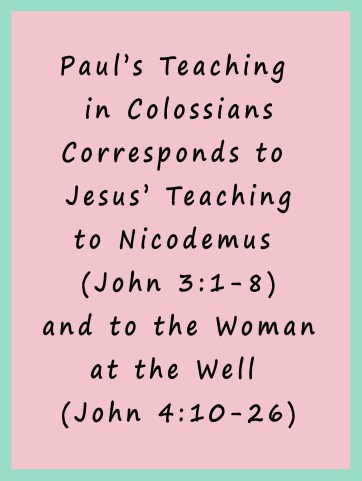
VI. Paul’s Alternative to the Old Ways Concrete_Spiritual
A. His rationale

Colossians 3:1a Since, then, you have been raised with Christ

Colossians 3:3 For you have died, and your life is hidden with Christ in God.

B. His conclusion

Colossians 3:1b set your hearts on things above, where Christ is, seated at the right hand of God.

C. How should the Colossians’ thinking change?

Colossians 3:2 Set your minds on things that are above, not on things that are on earth.

D. What will the end result be?

Colossians 3:4 When Christ who is your life appears, then you also will appear with him in glory.

VII. Paul begins to answer the question, How then shall we live?

NIV  Colossians 3:5a Put to death, therefore, whatever belongs to your earthly nature (your concrete, fleshly body)

[not in text: and begin to live to the spiritual in the following ways, which he begins to state in 3:5b]


Link: Concrete to Spiritual: How Jesus Changes the Old Testament to the New
 

  • A Greek-English Lexicon of the New Testament and Other Early Christian Literature, 2nd Edition, edited by William F. Arndt and F. Wilbur Gingrich. Chicago: The University of Chicago, 1979.
  • BibleWorks 9 Software for Biblical Exegesis & Research. Norfolk, VA: BibleWorks, 2011.
  • Community Bible Study. Engaging God’s Word: Colossians. Colorado Springs: Community Bible Study, 2013.
  • Duffield, Guy P. and Nathaniel M. Van Cleave. Foundations of Pentecostal Theology. 4th ed. Los Angeles: Foursquare Media, 2008.
  • Fee, Gordon D. and Douglas Stuart. How to Read the Bible for All Its Worth. 3rd ed. Grand Rapids: Zondervan, 2003.
  • Friberg, Timothy, Barbara Friberg, and Neva F. Miller. Analytical Lexicon to the Greek New Testament. Baker’s Greek New Testament Library. Grand Rapids: Baker, 2000. BibleWorks, v.9.
  • Hendriksen, William. New Testament Commentary: Exposition of Colossians and Philemon. Grand Rapids: Baker Book House, 1964.
  • The Holy Bible: New International Version®.  NIV®.  Copyright © 1973, 1978, 1984, 2011 by Biblica.  All rights reserved worldwide. (New International Version Bible Online). http://www.biblestudytools.com/colossians/.
  • The Navigators. LifeChange Series: A life-changing encounter with God’s Word from the books of Colossians & Philemon. 2nd ed. Colorado Springs: NavPress, 2013.
  • O’Brien, Peter T. Understanding the Basic Themes of Colossians, Philemon: Quick Reference Bible Topics. Edited by David A. Hubbard. Dallas: Word Publishing, 1991.
  • Pink, Arthur W. Gleanings from Paul. Edited by Rev. Terry Kulakowski. Zeeland, MI: Reformed Church Publications, 2009. Accessed February 26, 2016. http://www.davidcox.com.mx/m/files/Pink-Gleanings_From_Paul(PPC).pdf.
  • Shorter Lexicon of the Greek New Testament, 2nd Edition, edited by F. Wilbur Gingrich and Frederick William Danker.  Copyright © 1965 by The University of Chicago Press.
  • Thayer, Joseph. A Greek-English Lexicon of the New Testament (Abridged and Revised Thayer Lexicon). Ontario, Canada: Online Bible Foundation, 1997. BibleWorks, v.9.
  • Wright, N. T. Tyndale New Testament Commentaries Vol. 12: Colossians and Philemon. Downer’s Grove: Intervarsity Press, 1986.

Paul: You Colossians Already Have It All

Tracing Out a Single Strand in Paul’s Letter


Corbis Getty Image Hair

His Argument


I. The Colossians’ Position in Christ

Paul's Syllogism

  1. The Colossians have faith and love (1:4).
  2. They heard the gospel and fully understood and recognized (ἐπιγινώσκω) the grace of God in truth (1:6).
  3. They learned this true gospel from Epaphras, a faithful minister of Christ (1:7).
  4. They are no longer estranged (1:21) but are now reconciled and will be presented by God holy, blameless, and irreproachable before him (1:22),
  5. IF they continue in the faith, stable and steadfast, not shifting from the hope of the gospel they heard (1:23) (and again in 2:6).
  6. They currently have good order and firmness of faith in Christ (2:5).


THEREFORE: (2:6)


II. Exhortations


A. As you received Christ Jesus the Lord, so live (walk) in him (2:6) (Having come full circle–inclusio–this verse repeats 1:23).

  • How? (2:7)
    • rooted in Christ
    • built up in Christ
    • established in the faith (as you were taught in the gospel by Epaphras)
    • overflowing with thanksgiving


B. Don’t do this:

  • Don’t let others deceive and draw you astray into their cul-de-sac of false belief (2:8),
  • Because you don’t need them:
    • Christ is everything (2:9)
    • and you have been:
      • filled in Christ (he is the presence with which you have been filled)  (he is the agent) (you are located in him) (2:10)
      • spiritually circumcised in Christ(2:11)
      • buried and raised with Christ (2:12)
      • made alive with Christ (2:13)
      • forgiven (2:13)
    • You are debt free (2:14)
    • Your creditors have been defeated and publicly shamed by God through Christ (2:15)


C. Don’t let this happen:

  • That anyone should pass judgment on you in regard to food, drink, festivals, new moons, or Sabbaths (2:16).
  • Because
    • You died with Christ (cf. 2:12) to all these worldly things (2:20)
    • and have been raised with Christ (cf. 2:12) (3:1).


D. But do this:

  • Seek the things that are above, where Christ is seated at the right hand of God (3:1).
  • Set your minds on things that are above, not on things that are on earth (3:2).
  • Because
    • you have died and your life is hidden with Christ in God (3:3) [!!!!!]
    • when Christ our life appears, you will appear with him in glory (3:4).


III. Paul Continues Explaining in Detail How the Colossians Should Live (3:5-4:6)

Three Eggs

Neva's Eggs copy

Photo by Nevada

 Psalm 30:1 A psalm. A song. For the dedication of the temple. Of David.

I will exalt you, LORD, for you lifted me out of the depths and did not let my enemies gloat over me.

2 LORD my God, I called to you for help, and you healed me.

3 You, LORD, brought me up from the realm of the dead; you spared me from going down to the pit.

4 Sing the praises of the LORD, you his faithful people; praise his holy name.

5 For his anger lasts only a moment, but his favor lasts a lifetime; weeping may stay for the night, but rejoicing comes in the morning.

6 When I felt secure, I said, “I will never be shaken.”

7 LORD, when you favored me, you made my royal mountain stand firm; but when you hid your face, I was dismayed.

8 To you, LORD, I called; to the Lord I cried for mercy:

9 “What is gained if I am silenced, if I go down to the pit? Will the dust praise you? Will it proclaim your faithfulness?

10 Hear, LORD, and be merciful to me; LORD, be my help.”

11 You turned my wailing into dancing; you removed my sackcloth and clothed me with joy,

12 that my heart may sing your praises and not be silent. LORD my God, I will praise you forever.

Evergreen Tree

Paul Summarizes the Message of His Letter: Colossians 2:6-7

A Short Discussion Guide

Paul Summarizes the Message of His Letter: Colossians 2:6-7

ESV  Colossians 2:6 Therefore, as you received Christ Jesus the Lord, so walk in him, 7 rooted and built up in him and established in the faith, just as you were taught, abounding in thanksgiving.

Paul’s message is “Christ Jesus the Lord.”

Philippians 1:21 For to me to live is Christ, and to die is gain.


  1. Verse 6: Therefore, as you received Christ Jesus the Lord, so walk in him,


For Discussion:

  • What was the gospel that the Colossians received? (What does Christ’s Lordship include?) Look back in Chapter 1.
  • Think about Paul’s command to “walk in him.” How does the image of someone walking describe our life of faith?
  • Do we walk alone? Who is with us?
  • Can you paraphrase (say in your own words) verse 6? 
  1. Verse 7: rooted and built up in him and established in the faith, just as you were taught, abounding in thanksgiving.


For Discussion:

  • What are the four images Paul uses in verse 7?
  1. ___________________________
  2. ___________________________
  3. ___________________________
  4. ___________________________

Think about these images one at a time. How does each image illustrate our relationship with Christ and our walk of faith?


A Fuller Leader’s Guide

ESV  Colossians 2:6 Therefore, as you received Christ Jesus the Lord, so walk in him, 7 rooted and built up in him and established in the faith, just as you were taught, abounding in thanksgiving.

Paul’s message is “Christ Jesus the Lord.”

Philippians 1:21 For to me to live is Christ, and to die is gain.


I. Verse 6: Therefore, as you received Christ Jesus the Lord, so walk in him,

A. as you received

  • Thayer: to receive something transmitted, such as a narrative or instruction by teachers (Thayer)
  • Paraphrase: The teaching you received from Epaphras (Colossians 1:5-7) is good, true, and complete. Stick with that.

B. “Christ Jesus the Lord

  • Why do you think Paul added “the Lord” to “Christ Jesus”? What does Lord signify? What is the impact of this word?
    • Christ IS Lord. He is the Lion of Judah (Psalm 29:9; Revelation 5:5)
    • Order, rank, supremacy, deity above all else (Philippians 2:5-11)
    • There is one Lord (1 Corinthians 8:6; Ephesians 4:4-5)
    • Naming Christ Lord establishes our relationship to him as servant (slave) to master.
      • This is not a bad thing–it is 1) reality, and 2) worshipful
      • Paul, arguably one of the “greatest” Christians of all time, said this about his own relationship to Christ: (Romans 1:1; Titus 1:1)
      • Being a servant to Christ does not exclude our being his 1) friend (John 15:14-15 How does v. 15 cast light on the apparent contradiction in v. 14?) and 2) sibling (Mark 3:34; John 20:17; Hebrews 2:11).
    • When we receive Christ the Lord, we have an obligation as servant to obey him.
    • Paul establishes Christ as superior to all other spiritual beings whom the false teachers might claim the Colossians need.

C. In this verse, what does Paul mean by saying “so walk in him”?

  • Translation comparison: 1) MESSAGE You received Christ Jesus, the Master; now live him. 2) MOUNCE So then, just as you received · Christ Jesus as Lord, continue to live in him, 3) NET Therefore, just as you received Christ Jesus as Lord, continue to live your lives in him, 4) NIV So then, just as you received Christ Jesus as Lord, continue to live your lives in him,
  • What connotations (associated meanings) does the word walk bring to our minds?
    • movement
    • movement forward
      • progressive
      • sustained
      • orderly
    • not running; not hurky-jerky, not sprinting
    • implies a destination, a goal, a purpose, a definite period of time
      • not meandering, nor wandering, nor strolling
    • implies a steady speed over time
    • good for a long distance
  • Therefore, walk in him is a commandment
    • implying that we have control over our movement, that we are making a choice, that living out our faith is neither passive nor forced;
    • We are under our own volition.
    • Yet, we are being commanded–so walking is something we need to do and should do.
    • The commandment implies a leader–the one who gives the command–Paul, and behind Paul, Christ.
  • The above is how we are to move in Christ, how we are to live out our lives in him.

Definition of walk: to move by foot by our own energy at a comfortable, sustainable pace in a directed or guided motion towards a destination or goal or for an established length of time.

  • BTW: We are NOT alone!
    • Hebrews 13:5c …for he has said, “I will never leave you nor forsake you.”
    • ESV  John 14:16 And I will ask the Father, and he will give you another Helper, to be with you forever,
    • Helper in Greek is “paraclete” παρακλητος:  “one called alongside to help; (1) as a legal technical term, as one who appears in another’s behalf advocate, defender, intercessor (1J 2.1); (2) as one who gives protection, help, and security helper, comforter, counselor ( JN 14.16) (Friberg).

So we have God with us–the Helper, the One who walks alongside us and in us, the Holy Spirit–to sustain, guide, and direct us in our walk in Christ.

D. Paraphrase (in other words): Keep on keeping on in Christ alone, just as you were taught from the beginning by Epaphras, your faithful pastor and teacher.

II. Verse 7: rooted and built up in him and established in the faith, just as you were taught, abounding in thanksgiving.

A. Paul mixes his metaphors! (Since we know that Paul was a highly educated man, we can conclude that literary style differed then from now.)

1. Rooted in Christ

onesmallvoice.net

onesmallvoice.net

  • If we are like roots, then Christ is the soil.
  • Roots are organic, alive, growing.
  • Roots are the part of a plant that is beneath the ground; therefore, outwardly invisible. Christ nourishes and sustains us from within.
  • Roots are the means by which a plant is nourished from the soil.
  • Roots cling to the soil and are all but inseparable from it.
  • Roots and soil, therefore, provide the nourishment, stability, support, and growth of a plant.

2. Built up in Christ

  • “Built up” implies that we are like a structure whose foundation and framework is faith.
  • The structure is increasing in size.
  • A structure passively increases under the hands of a builder–God is ultimately in control of who we become in Christ–and we participate as living stones (1 Peter 2:5).
  • A structure is that which is above the foundation–it is visible from the outside.
  • A structure built in Christ is solid, strong.

3. Established in the Faith

  • confirmed
  • made sure
  • strengthened
  • established
  • tested, tried, and proven, as a secure legal document (the building inspection is passed! and the building is now ready to be used for its intended purpose)

4. Abounding (overflowing) in Thanksgiving

  • overflowing with thanksgiving like a full cup of wine (Wright, 104)

B. Why do you suppose thanksgiving is central to and characteristic of life in Christ?

  • Continuing Paul’s metaphors, thanksgiving might be thought of as…
    • the fertilizer and nutrients in the soil
    • the rebar that runs through and strengthens a structure
    • the official “seal of approval” on a legal document
  • Functions of thanksgiving
    • acknowledges that a blessing has been received
    • opens a door for further blessings
    • focuses our eyes on the giver of the blessings–Father God and the Lord Jesus Christ
    • increases our awareness of blessings
    • places us as debtors to the One who gives
    • feeds joy
    • places trials and hardships in perspective
    • lightens our load
    • completes the circle of grace
    • unites us with the body of Christ–other believing Christians
  • When and how did you learn about thanksgiving in your Christian walk?

III. Verse 6 is Paul’s commandment; Verse 7 provides a “floor plan” of verse 6.


Red and Yellow: Theme of Morning Walk