Weeping May Last for the Night, But…Joy!

There is so much
to weep about in our world recently. Bad things happen as surely as night follows day. (John 16:33) It seems as though our country–along with most other parts of the world–has been experiencing one very long night. Will the violence and human pain never end? Yet for those who find their eternal hope in our great God and Savior (Titus 2:13), Scripture carries the promise of a bright day to follow each and every dark night: “For his anger is but for a moment, and his favor is for a lifetime. Weeping may tarry for the night, but joy comes with the morning” — (Psalm 30:5).”
Christians know this biblical promise of God is true, because Christ has already deposited within them the fountain of life and joy–his Holy Spirit (John 7:38; Ephesians 1:13). And this fountain of joy and life is eternal; it can never be quenched no matter how much external circumstances say otherwise. And so we sing–
” “Spring up, O well! — Sing to it!”
Christians know and experience that God’s love and mercy arrive fresh and new every morning (Lamentations 3:22-23), and therefore unquenchable joy is their strength (Nehemiah 8:10).
Gramma, What Does Grace Mean?
Down below is a reprinted article from just over one year ago, here on this blog.
But before I give you that, let me tell you a little story of something that just happened. My granddaughter is six years old now and is in first grade. Two days ago, while sitting right next to me at the lunch table with all my atheist family, she asked me if I knew her “class” number at school. She meant her room number.
“Is it six?” I guessed.
“No,” she said.
“Is it five?” I guessed again.
“Yes.”
“That’s good. Five is a good number,” I said.
“Why is five a good number?” she asked.
“Because five is the number of grace.”
“What does grace mean?”
“Grace is when you need another chance and you get it. And when you need another chance after that, you get it. And when you need another chance, you get it.”
At this point she nodded. I didn’t need to continue, because she understood what I was saying. She knew from her own experience what I was talking about. I could tell she felt content. I could see by her face and relaxed body posture that she agreed that grace is a good thing, and she received it as her own. She was happy to be in a classroom at school with the number five for grace.
………..
Now the reprint from just over a year ago. I pray the little explanation of how I know that God exists blesses someone who reads it.

“Gramma, how do you know that God exists?”
My dear, sweet granddaughter, only five years old, you are asking an age old question whose answer no one agrees on. Basically, I think, there are two kinds of people. There are those who look out at the world, and they see the world. There are others who look out at the world, and they have a great desire to know who made the world.
The first group feels no need to think there’s a maker. They don’t know that God exists. Neither do they know that he doesn’t exist. It just happens that they’re happy enough without him.
The second group is not satisfied and never will be until they meet the one who made the world. How do they know that someone made the world? They don’t. It’s just the only explanation that makes sense to them, because the world bears the imprint of God. Why these two groups? Only God knows.
How do people in the second group–we can call them believers–how do believers know that God exists? By faith. What is faith? Faith is choosing to believe in God even when you don’t know. Faith is desiring God. Here is what the Bible teaches about faith.
By faith we understand that the universe was created by the word of God, so that what is seen was not made out of things that are visible. (Hebrews 11:3 ESV)
Now faith is the assurance of things hoped for, the conviction of things not seen. (Hebrews 11:1 ESV)
Believers know God as a person. Ask any believer and they will tell you that by some means or another God has spoken to them and changed their life somehow. This is how they know that God exists. God is invisible Spirit. He cannot be known by the five senses nor deduced by measurement. He is not an intellectual conclusion. He is a Being who speaks, hears, and acts. All believers have experienced some sort of interaction with God that amazes them. This amazement persists throughout the remainder of their lives.
Now, after a person becomes a believer, that is, after they experience their initial transaction with God or become aware of his presence in them, then there are a multitude of ways that knowing God exists gets reinforced throughout their lives. Here are some of those ways.
- They hear the stories of many, many other believers which in some ways match their own story.
- They read the Bible and experience the voice of God speaking directly to them through its words.
- They read the Bible and notice how incredibly well each part supports and interacts with other parts.
- They read the Bible and are convinced by the prophecies it contains.
- They experience miracles in their lives or hear first hand from people who have had miracles happen to them.
- They feel an influence upon their minds, hearts, and behaviors that makes most sense as coming from God.
- Good things happen to them. When bad things happen, they know they are not alone. They find that God helps them through the bad stuff.
- God continues to speak to them in such a way that they know it’s him. “The sheep hear his voice, and he calls his own sheep by name and leads them out.” (John 10:3 ESV)
- Something convinces them that God has heard them thinking.
- Prayers get answered.
- They sense God’s presence.
- They’re happier than they have ever been before they knew God.
My little one, the best way I know for you to know that God exists is to speak with him. Tell him that you want to know that he exists, but you don’t know how. Actually speak to him. Address him respectfully by name. Be honest with him and tell him where you’re at. If you find in your heart that you would like to know God, then be patient–God will reveal himself to you, just as Jesus promised.
If anyone wants to do God’s will, he will know about my teaching, whether it is from God or whether I speak from my own authority. (John 7:17 NET)
Let me explain that verse to you. God wants everyone to know him. If you want to know God, then he will show himself to you. If you want to know God, just ask him. If you’re not sure that you want to know God, but you think you might perhaps like to know him, then tell him that. God loves you, and he would love for you to turn to him. He is not a monster, and he won’t eat you alive.
So to answer your question, how do I know that God exists, I know that he exists because when I talk to him, he answers me. When I talk to you and you answer me, I don’t say, “How do I know my granddaughter exists?” I know you exist because I know you. It’s the same way with God.
Oops! Wrong Baby
A possible subtitle for this post would be: Christianity–Why Be Exclusive? This is a reprint of an article from a different blog by the same author.

A brand new mother prepared to check out of the neonatal unit of her local hospital. A nursery worker came and gently handed the baby to her. “But this isn’t my child!” exclaimed the astonished mother. “Oh, but look—don’t you see?” replied the nursery worker. “There are so many strong resemblances, and it’s a very fine child. Why don’t you just take this baby home with you?”
In similar fashion, Christians may at times be encouraged from within or without to embrace other world religions based upon strong similarities which most likely really do exist among them. Should they take these religions home with them? In answering, consider the mother in the story above. She knows instinctively that it’s not a host of similarities and agreements which are essential to her, but the core identity of her child. For Christians as well, the essential thing is not how their faith may resemble many others, but how their faith differs. The difference is Jesus Christ. A Christian who knowingly embraces any wise and noble religion that excludes Jesus Christ the crucified and risen Son of God from its core identity is like a mother who willfully embraces a strange child and calls him her own. Ultimately, her heart will break.

No Virtue Will Get You In! No Defect Will Keep You Out!
This is a reprint from 2016.
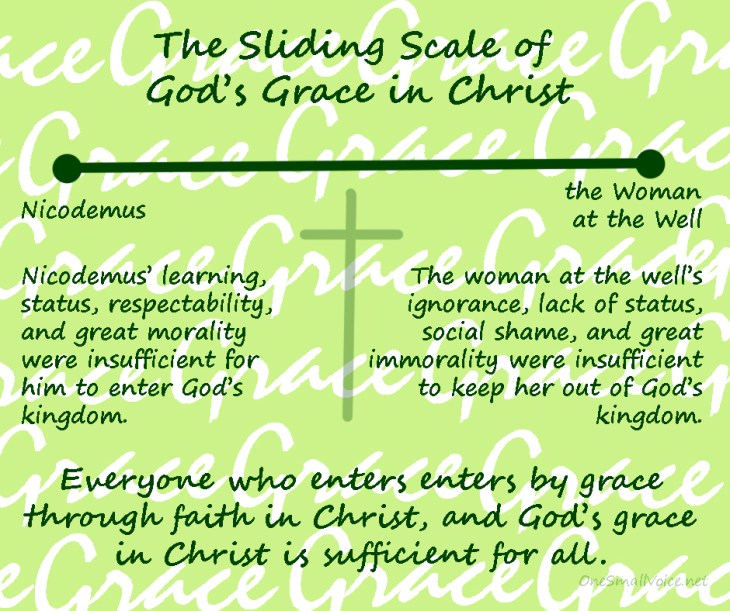
No Virtue Will Get You In! No Defect Will Keep You Out!
Link: The New Birth–Its Necessity and Its Joy
Link: Concrete to Spiritual: How Jesus Changes the Old Testament to the New
Penitential Psalms: Conclusion

Photo by Christina Wilson
Saint Augustine, it is said, had written out and pinned at eye level four psalms on the wall beside his bed. These he could read and reread as often as he liked, as he lay there dying. These four psalms became the core of the seven later known as the Penitential Psalms. Although the Penitential Psalms played a significant role in the medieval church, as witnessed by many paintings of the period, during the Reformation and beyond, they diminished in importance and liturgical practice. In the evangelical church today, few have even heard the phrase “penitential psalms,” let alone know which they are or why they are called that.
Association of penitence with seven particular psalms is rather a misnomer and a mistake. The seven particular psalms considered “penitential” as a group are Psalms 6, 32, 38, 51, 102, 130, and 143. As the centerpiece, Psalm 51 is indeed penitential. Psalm 51 supposedly records David’s heartfelt remorse for his sin of adultery with Bathsheba and his later murdering of her husband as a coverup when it became known that David had caused her to become pregnant. David expresses genuine and merited sorrow for his reprehensible sins. However, Psalm 6 and Psalm 102 carry no mention of sin at all. In fact, in each of these the speaker attributes his suffering to the persecution of his enemies. Enemies are a persistent theme throughout these seven psalms. Psalms 32 and 51 are the only ones which make no mention of enemies.
What is the reader to make of these inconsistencies of theme? Why group seven psalms which vary in such basic ways? One possibility is to consider that the traditional understanding of the word “penitent” is at fault. The use of the word penitence to represent a sorrow and suffering over one’s own sin follows a Latin language tradition. There is, however, a Greek semantic pathway using the base syllable “-pen-“, which corresponds to a meaning of extreme sorrow born of deep humility and humbleness of state. The core of this semantic pathway does not require a sense of guilt for sins committed. Rather, the humility can be a response to any number of physical or situational causes, such as poverty, lowliness of social estate, or physical distress. And sorrow born of suffering is in fact a theme which unites the seven penitential psalms. When one considers that the earliest church Bibles were written in Greek and that the Septuagint was the Old Testament of the early church for several centuries, this explanation of the grouping of the penitential psalms seems reasonable.
But the question remains: why does the psalmist maintain his innocence and righteousness, while at the same time grieving and mourning over his sins? Apart from Christ, there can be no reasonable explanation for unity among these psalms. Christ alone, as a human being, can maintain complete righteousness and innocence. This characteristic of the actions of his incarnated life, combined with his sinless divine nature, are what qualified him to be the lamb of God. The sacrificial lamb of Old Testament tradition needed to be one without spot or blemish of any kind. Only Christ qualifies. And yet, five of the seven penitential psalms carry confession of sin in greater or lesser extent.
The answer is simple. “God made the one who did not know sin to be sin for us, so that in him we would become the righteousness of God.” (2Corinthians 5:21 NET) The hermeneutic key that unlocks the Psalter is Jesus Christ. The New Testament teaches everywhere that Christ the man suffered, and that he suffered for our sins. Christ the man is the voice of the psalmist throughout the penitential psalms and so many others. As prophecy, these seven psalms foretell in first person the sufferings of the innocent, righteous Christ as he bore the sins of the world in his own person. Only with Christ does the psalmic paradox of the righteous sinner disappear. So, Christ is the dramatic speaker persona of the penitential psalms.
Before closing, one further word about why these seven psalms as a grouping have fallen into disuse and even disfavor. For all but the earliest history of the church, the majority opinion has not recognized that Christ is the voice of the psalmist. Further, the Latin textual tradition overran and trampled the Greek in all but the Orthodox churches. The Latin concept of penitence, as a kind of mournful wailing over sin that self-flagellates the heart of a penitent over and over again throughout the life of the penitent, no longer dominates our churches, especially evangelical ones. It appears as though the lesson was learned–yes, we all begin in universal sin. However, we repent once and then in Christ we move on. The Bible teaches forgiveness of sin and new life in Christ. Joy in salvation and holy living replace guilt for sins committed. Fresh sins are confessed and forgiveness is received. There is no need to wail over one’s past for the remainder of one’s life. The Christian life is lived out through the Spirit of Christ who indwells each and every believer. Joy replaces sorrow.
Nonetheless, the Christian heart will always benefit from considering the depth of sorrow in the heart of Christ as he endured the persecution of his enemies, which culminated in his physical sacrifice upon the cross. Doing so can only increase appreciation for the love of God for us expressed through Jesus our Savior and Lord. The seven Penitential Psalms will always be useful for this contemplation.
Link to the First of the Penitential Psalms Series
Links to the complete Penitential Psalms series:
Penitential Psalms
The Penitential Psalms: A Fresh Look
Penitential Psalms: A Big Mix-Up?
Penitential Psalms: The Amazing Psalm 6–Windup to the Pitch
Penitential Psalms: The Amazing Psalm 6 (continued)
Penitential Psalms: After Psalm 6–Psalms 7 and 8
Penitential Psalms: Psalm 8–Closing the Overture
Penitential Psalms: Psalm 32–How Could Christ Pray the Words of a Sinner?
Penitential Psalms: Psalm 32–Grace
Penitential Psalms: Psalm 38–Christ’s Passion Speaks Loudly
Penitential Psalms: Psalm 51–A Personal God of Love
Penitential Psalms–Psalm 102: Why Penitential?
Penitential Psalms: Psalm 102–Who Is Speaking?
Penitential Psalms: Psalm 102–God’s Son Speaks: Technical Background
Penitential Psalms: Psalm 102–Summary of Its Dialogic Structure
Penitential Psalms: Psalm 102–Devotional
Penitential Psalms: Psalm 130–Praying from the Grave
Penitential Psalms: Psalm 143–Knowing Who We Are in Christ
Penitential Psalms: Conclusion
God’s Son Has Been There, Done That: Psalm 17


REPRINT
How constantly grateful I am to know as certainty that Jesus God’s Son–and through him, God Almighty–has been here and experienced everything we as humans experience, in person, himself. He knows all our trials and tribulations, our triumphs and joys.
I lived most of my life in that exact part of the US where the recent mass gun slaughter occurred in what was considered by all a “safe place.” The very next day, while grief and shock were still stabbing hearts, vicious and ferocious fires broke out. My heart and mind have been with dear friends and family in that area all this past week. In the gun slaying and fires we see both evil and love at work.
When people kill other people because of hatred based upon their appearance or beliefs of any kind, that is evil. “Judge not,” the Bible teaches, “so that you will not be judged (condemned.)” Humankind’s first sin was siding with God’s enemy. The second sin was brother killing brother. All humans are brother/sister one with another. We are not to kill our brothers and sisters because we do not like them or because we disagree with them.
God knows the evil in the human heart. He’s always known everything that lies in our collective hearts. Yet he chooses to love us anyway, laying his own life as incarnated human on the line. God knows firsthand the effects of evil. Apart from whether or not you believe in Christ as the Son of God, the facts of his life as recorded in the Book show him as a good and loving man, someone who went around doing only good for others. His enemies killed him mainly out of jealousy. It’s not about race. It’s about what lies in every human heart.
God also knows firsthand what it is to love others. He loved others in Jesus his Son, when he sent him to us in the first place. Jesus voluntarily lay his life down for all humanity. He died a painful death, the innocent for the undeserving.
In the gun slaying, we saw a police officer who lay his life down for strangers. In the recent fires, and in every fire, we see firemen and other public servants laying their own lives down for people they haven’t met; they do this because these are human beings. Firefighters sometimes die. They know the dangers before they go out, yet they go out anyway. A huge thank you to all of these. “John 15:13 “Greater love has no one than this, than to lay down one’s life for his friends.” (NKJ)
In this post, post-modern world we live in, it is time to get back to calling evil, evil. It is wrong to kill another human being out of jealousy or hatred for who they are or what they represent. Both vengeance and judgment belong to God alone.
In Psalm 17, the psalmist, whom I read as the prophetic voice of the incarnated God–by that I mean Jesus–this psalmist cries out to God for help from his enemies, who are extremely powerful and who have marked him for death. The fact of history is that Jesus did die. We might say, “He died anyway, even though he prayed for God’s help.” The other fact of history is that he rose from the dead. Notice Jesus’ faith in his resurrection in verse 15–
And I–in righteousness I will see your face; when I awake, I will be satisfied with seeing your likeness. (NIV)
One of the very best things about believing in Jesus as God’s anointed, his Son, is that his resurrection from death into life produces a resurrection from death into life for all who believe. Often we pray for a trial to go away or to not happen in the first place. Often it happens anyway–God alone knows why. Bottom line, there is a resurrection into life eternal. This life will end, and eternal life in Christ will last forever. God’s love has triumphed over all the evil this world and its people can possibly throw at us. Blessed are those who choose the side of love.
Psalm 17:1 A prayer of David. Hear, O LORD, my righteous plea; listen to my cry. Give ear to my prayer–it does not rise from deceitful lips.
2 May my vindication come from you; may your eyes see what is right.
3 Though you probe my heart and examine me at night, though you test me, you will find nothing; I have resolved that my mouth will not sin.
4 As for the deeds of men–by the word of your lips I have kept myself from the ways of the violent.
5 My steps have held to your paths; my feet have not slipped.
6 I call on you, O God, for you will answer me; give ear to me and hear my prayer.
7 Show the wonder of your great love, you who save by your right hand those who take refuge in you from their foes.
8 Keep me as the apple of your eye; hide me in the shadow of your wings
9 from the wicked who assail me, from my mortal enemies who surround me.
10 They close up their callous hearts, and their mouths speak with arrogance.
11 They have tracked me down, they now surround me, with eyes alert, to throw me to the ground.
12 They are like a lion hungry for prey, like a great lion crouching in cover.
13 Rise up, O LORD, confront them, bring them down; rescue me from the wicked by your sword.
14 O LORD, by your hand save me from such men, from men of this world whose reward is in this life. You still the hunger of those you cherish; their sons have plenty, and they store up wealth for their children.
15 And I–in righteousness I shall see your face; when I awake, I shall be satisfied with seeing your likeness. (NIV, 1984)
Psalm 18: Original Paraphrase–Papa Roars and Rescues

Drama from the Past
* God the Son endangered, the ropes of death ensnared him, squeezed his breath away. A tsunami of destruction crashed upon his head. He couldn’t breathe. Hell’s net pulled him tighter, under. Death held its vise-like grip. There was no way for him to escape. In gasping anguish he cried out loud; he called to his Father for help.
“Papa! Help me! Save me! Death must not win forever!”
God in his holy temple heard his Son’s voice; the pleading cry of desperation reached the Father’s ear. Though his Son lay buried, three days in the grave, Almighty Papa roared and pierced the sky to save.
The earth reeled and rocked; foundations of mountains trembled. The royal Papa’s anger shook, an earth-quaking gush of love. Smoke rose from his nostrils; devouring fire consumed, glowing coals of flame no dragon ever produced.
God bowed the heavens descending, thick darkness under his feet. He rode a cherub and flew swiftly on wings of wind. Almighty Papa in darkness cloaked, a canopy surrounds him. Thick clouds dark with water cover his form from view. Bursting through this darkness, his brightness once concealed, with flashes of fire and brimstone, his golden light breaks through. He thunders in the heavens, blasting out his voice, hailstones and coals announcing–Papa on the move.
Scattering forth his arrows, flashing out his lightnings, God routed the enemy, death…(and here the Son breaks in…)
“The channels of the sea you exposed, the foundations of the world laid bare. You rebuked them, O Lord, my Father, when your nostrils blasted your breath.”
“Did you see all this, my people? Were you watching? Did you see? When he came from on high and took me and pulled me from the waves? He rescued me from my strong enemy, from those who hated and surrounded. They were too mighty for me, confronting, that one single day. But he, the LORD my Papa came through. To this broad place he brought me. He heard my cry and rescued, because he delights in me.”
*This poem draws heavily from the English Standard Version of Psalm 18:4-19
Link to next post in this series
Life as Paradox: Psalm 13

Photo by James Discombe on Unsplash
Good and evil, life and death, pleasure and pain are a paradox as old as human history. Why are these opposites so intertwined, even in the fabric of existence itself? The Bible answers this question for those who will receive: God created good, while his enemy brought evil.
Psalm 13 reveals the heart cries of God’s Son incarnate [1], even as he falls victim to the inescapable paradox of humanity. It is a short psalm. Verses 1-4 present the bad and ugly of his seeming abandonment by God, while verses 5-6 present the equally real blessings of God’s faithful love.
1 To the choirmaster. A Psalm of David. How long, O LORD? Will you forget me forever? How long will you hide your face from me?
2 How long must I take counsel in my soul and have sorrow in my heart all the day? How long shall my enemy be exalted over me?
3 Consider and answer me, O LORD my God; light up my eyes, lest I sleep the sleep of death,
4 lest my enemy say, “I have prevailed over him,” lest my foes rejoice because I am shaken.
5 But I have trusted in your steadfast love; my heart shall rejoice in your salvation.
6 I will sing to the LORD, because he has dealt bountifully with me. (Psalm 13, ESV)
The life, death, resurrection, ascension, and reign of Christ perfectly exemplify the human paradox. Psalm 13 prophetically expresses the complete humanity of Jesus Christ, God’s anointed, as he lives and dies through this paradox. God the Father could never know experientially what Christ knew. It was necessary for him to send his Son in human flesh, living through the basic paradox all humans experience, so that he could perfectly represent them before God’s throne of grace. Jesus lived and died in suffering. He rose, ascended, and reigns in blessed triumph. What he did, all humanity can now do through him. Truly his sufferings lead us to life [2].
[1] These posts on Psalms presuppose that they are written about Christ and express his feelings and prayers during the time of his incarnation. For more information on this theme, consult this author’s Annotated Bibliography, https://onesmallvoice.net/2018/03/22/psalms-2-annotated-bibliography/. See also this author’s former series, Christ in the Psalms, https://onesmallvoice.net/2018/01/19/psalms-contents-second-go-round/.
[2] Other psalms written in the same pattern as Psalm 13 include Psalms 43, 73, and 143. Each of these displays the human paradox of pain and blessing combined.
Psalm 52: Good vs Evil Defined

Have you ever been stabbed in the back? Betrayed? Ratted on? The psalmist in 52 just has. This is his response.
Typical to Psalms, there are two groups of people in this one: the good and the evil. Within the framework of Psalms, who is good and who is evil? In Psalms God judges according to the intent of the heart. God is good; someone who follows God and wants to please him is good. A good person wants good for other people; he or she does not initiate harm. A wicked person, by contrast, hates God and opposes him in all he speaks, thinks, and does. A wicked person in Psalms plots and carries out harm toward others, especially toward the followers of God. (Just as the bad guys do in your favorite adventure movie, right?)
This principle is so important I want to repeat it. In Psalms, people are not judged as good or wicked according to whether or not they commit certain sins, but according to their allegiance. Everyone who pledges allegiance to God is called good, and everyone who pledges allegiance against God is called wicked. Enemies of God, those who willfully oppose him and oppose his principles, are wicked. Friends of God are good. Psalms paints people black or white. Unfortunately for us, there are no gray zones with God. His vision is sharp and clear–not fuzzy like ours. God knows who his friends are and who his enemies are, just as a shepherd knows which sheep are his and which are not.
Psalms are real life. Just as in our own experience, some people in Psalms pretend to be on God’s side by pretending to be on the side of God’s friends. But they lie. In their hearts, they are false friends who speak falsely and lead others down a wrong path. Often the deceit of these people is found out; they are discovered, and their duplicity becomes apparent by their actions that seek to harm someone who is good. Psalm 55:12-14 gives an example of this kind of person. A good person in Psalms always tells the truth, even when that truth means confessing his own sin. Psalm 51:1-17 is an example of a good person confessing his sin to God. Remember, a good person is someone who wants to please God. Good people do not become wicked people by sinning, but by betraying God. To betray God is to fully and finally join the enemy’s team. God is always kind and gracious to forgive everyone who asks him with a true heart. By the standard of Psalms, a good person may sin perpetually, but he or she also always wants to do better and to please God. Wicked people never truly want to please God; they hate him.
So with that as background, what about Psalm 52?
Though not necessary, a bit of history may help to understand this psalm. The superscription of verse 1 reads, “To the choirmaster. A Maskil of David, when Doeg, the Edomite, came and told Saul, “David has come to the house of Ahimelech.”
David, the servant of Saul the King, was running for his life from Saul, who had gone mad and wanted to kill him. Doeg was Saul’s chief shepherd (1 Samuel 21:7). David most likely knew Doeg, since David was also a shepherd. Ahimelech was an innocent priest who was unaware of the full situation between David and Saul. When David in his flight from Saul asked for food and a weapon, Ahimelech provided these, because he believed David’s lie that he was on a secret mission for the king. Doeg happened to see David at the priest’s tabernacle that day, and reported to Saul. Saul, not in his right mind, ordered his servants to kill Ahimelech and his whole household. When they refused, out of respect for the priesthood and knowing that Ahimelech had done no wrong, Saul ordered Doeg to do so. Doeg gladly slaughtered 85 innocent, unarmed priests, plus women, children, nursing infants, oxen, donkey, and sheep–all that lived in the nearby town of Nob, a city of priests. Patrick Reardon writes at length concerning Psalm 52 that Doeg was worse than Judas Iscariot, who betrayed Jesus Christ. (Reardon, 101-102)
If Psalms were a play and I was the director, I would have the sole character in this scene pacing back and forth in barely contained fury and anxiety in order to reflect the back and forth movement between the poles of good and evil in the psalm. The psalmist is clearly angry when he speaks these words,
Why do you boast of evil, O mighty man? The steadfast love of God endures all the day. 2 Your tongue plots destruction, like a sharp razor, you worker of deceit. 3 You love evil more than good, and lying more than speaking what is right. Selah 4 You love all words that devour, O deceitful tongue. 5 But God will break you down forever; he will snatch and tear you from your tent; he will uproot you from the land of the living. (Psalm 52:1-5 ESV)
Notice in verse 1 the contrast between the evil man and the good God, whose “steadfast love…endures all the day.” Then again, after the diatribe against the wicked, the psalmist switches back to consider the fate of the good people in verse 6 which continues, “The righteous shall see and fear, and shall laugh at him, saying … ” Verse 7 takes us back to the fate of the wicked, as spoken by the righteous of verse 6, “See the man who would not make God his refuge, but trusted in the abundance of his riches and sought refuge in his own destruction!” Then the psalmist considers his own situation in verse 8, “But I am like a green olive tree in the house of God. I trust in the steadfast love of God forever and ever.”
Finally, the psalmist quits his pacing back and forth and settles his vision fully on God, where it fixedly remains as he speaks the final verse directly to God, “I will thank you forever, because you have done it. I will wait for your name, for it is good, in the presence of the godly.” (Psalm 52:9 ESV)
Prayer is like Psalm 52. In the spiritual battle of prayer, the human heart is torn between consideration of the painfully dangerous situation at hand and faith in the steadfast love of God that endures forever and works its goodness forever in perfect reflection of the eternal goodness of God. In prayer, our hearts and minds pace back and forth between the poles of the power of what is bad and the greater power of God, who is good. May we always, as the psalmist does, align our hearts fully and fixedly on the goodness of God, whose power and judgment win out in the end.
__________
Addendum
Psalm 52 is a highly passionate psalm, yet we don’t want to leave it without considering the technical aspect of how speech functions within its nine verses.
There is one actor throughout the psalm. Nevertheless, he speaks in more than one voice and variously addresses more than one audience.
- In verses 1-3, the sole actor speaks his words directly to the “mighty man.” He describes this evil man’s words, his tongue, and his heart. There is a pause at the end of this block, written as “Selah.”
- In verses 4-5 the same actor addresses the wicked man’s tongue, “4 You love all words that devour, O deceitful tongue. 5 But God will break you down forever; he will snatch and tear you from your tent; he will uproot you from the land of the living.” In verse 5, although the psalmist still appears to be addressing the tongue, it seems apparent that the tongue is a metaphor for the man as a whole. The technical words for this figure of speech are synechdoche (part for the whole) and personification (assigning personality to an object). A second Selah pause ends the address to the tongue.
- In verses 6-7, the addressee is not specified. The psalmist appears to be talking to the air, to himself, or perhaps to an invisible audience placed somewhere beyond the bounds of history and viewing its final outcomes, “The righteous shall see and fear, and shall laugh at him, saying…”
- In verse 7, the same actor quotes the words of the righteous, but again, the addressee to whom the righteous speak are not specified. The righteous do seem to be in a position of being able to know and see final outcomes.
- In verse 8, the psalmist appears to be speaking to himself, “But I am like a green olive tree in the house of God. I trust in the steadfast love of God forever and ever.”
- Finally, in verse 9, the psalmist addresses God directly, using the second person, “you,” “I will thank you forever, because you have done it. I will wait for your name, for it is good, in the presence of the godly. (ESV)
Why is this important?
Today’s readers can appreciate the content and passion of Psalm 52 without thinking much about the dialogue within it. Noticing the changes in speech and addressees, however, prepares the reader to encounter other psalms in which such changes clarify meanings of content that may be more obscure. Examples of such psalms are Psalm 110 and Psalm 118.
Biblically Sanctioned Violence? Psalm 137

Photo by Felix Weinitschke on Unsplash
Well, folks, here it is.
Psalm 137:7 Remember, O LORD, what the Edomites did on the day Jerusalem fell. “Tear it down,” they cried, “tear it down to its foundations!”
8 O Daughter of Babylon, doomed to destruction, happy is he who repays you for what you have done to us–
9 he who seizes your infants and dashes them against the rocks. (NIB)
Yuk! Did you read that? And it’s right there in the middle of the Bible.
People deal with seemingly sanctioned biblical violence in different ways. Here are just a few.
- Skim over and ignore.
- This was a very long time ago in a different culture. At that time, the cultural norm was different than today. Things are changed now.
- God is sovereign. He judges whom and how he pleases.
- They were given their chance to repent.
- They earned it.
- The psalmist doesn’t represent the heart of God here.
Can you spot the common thread in all of the above responses? There’s one thing they all have in common. Waiting…waiting…Ok time’s up. All the above responses are defensive. If you are reading this, then most likely you are the sort of person who would try to defend, gloss over, or somehow explain away the presence in Scripture of this offensively violent vengeance. It does offend us. There’s no getting around that response. Believers feel they must explain and defend God for including these words right in the middle of the Bible. How uncomfortable. What a great spot for critics and skeptics to attack Christians, and they do. Because, in fact, these words challenge us in our gut.
So here’s my take on this at this point in my life: We read it because it’s here.
When I was still young in the Lord, but growing, I worshiped with a small congregation. The format of the services included songs, Scripture reading, and communion. Each of these was congregationally led. Some used to call it Spirit led. That is, there was no preplanned program for the day. There were no predetermined songs, readings, or specified time for communion. Someone would lead out and others would join in or listen as appropriate.
I used to enjoy reading from Scripture at these services. Psalms were often read by myself and others. Over time, I noticed that whenever I selected a psalm to read, I tended to select only portions of psalms. Many if not most of the psalms have a sentence or two of judgment and/or punishment concerning the “wicked” in them. Because I felt that our Sunday worship services were meant to be joyful, I only read the happy verses in Psalms. Eventually, the burden became too great. My own censorship piled up to an enormous height, so large that I could no longer bear it. The result was that in my personal devotions, I began reading all of Scripture. I quit censoring. I quit cutting out large segments because I could not deal with them.
My discovery? That God is a God of judgment. And not just in the Old Testament. Not just in the “old days” before Christ came. It’s often quoted that Jesus talked about hell more than anyone else in all of Scripture. “There men shall weep and gnash their teeth.” That’s the phrase that kept gnawing at my heart so miserably before I converted to Christ. It dug into me and ate my insides out like a worm. I hated that phrase. As an unbeliever in great need, I used to open my Bible as a desperate, frightened beggar lost in life. I hoped I would find comfort, but instead I repeatedly found, “There men shall weep and gnash their teeth.” And I would slam my Bible shut.
Eventually, my need for help won out, and I turned to the God of the Old Testament, confessing my need and total ignorance of him. Interesting…he didn’t meet me with condemnation. He met me with love, a strong love that continues to this day.
So what do we as believers in Jesus do with Psalm 137:7-9 and similar statements sprinkled like salt throughout Psalms? We read them and admit that they are there and that God intends those words to be there and that he hasn’t changed his mind, because God never changes.
Several decades ago, I realized that the God of creation is the same God who loves me. What a privilege and blessing that is! Think by name of all the evil dictators in the whole world over all time. God could have been like one of those. But he isn’t. When I think of God, I see his Son hanging on a cross to save the world. “If you have seen me,” Jesus said, “you have seen the Father.” I believe that God is both a God of judgment and a God of love. But what good does that love do you if you don’t know about it and haven’t received?
If you remove heat, you have cold. If you remove light, you have darkness. If you remove love, you have pain. If you remove mercy, you have judgment. So turn towards the heat, turn towards the light, turn towards love, and turn towards mercy. In short, turn towards God. He loves you.
 One Small Voice