Toppling Statues That Honor Past Mistakes: Learning to Let Go

WARNING: This post will be political.
Today’s current events provide a good analogy to kingdom living. In God’s Old Testament kingdom, his people often went astray and worshiped false gods, even constructing altars and Asherah poles to them. They allowed pagan statues to infiltrate their land. Far too infrequently, a “good” king would be born to the throne, and he would remove these memorials honoring pagan deities.
2 Kings 11:17 And Jehoiada made a covenant between the LORD and the king and people, that they should be the LORD’s people, and also between the king and the people. 18 Then all the people of the land went to the house of Baal and tore it down; his altars and his images they broke in pieces, and they killed Mattan the priest of Baal before the altars. And the priest posted watchmen over the house of the LORD. (ESV)
2 Kings 23:4 And the king commanded Hilkiah the high priest and the priests of the second order and the keepers of the threshold to bring out of the temple of the LORD all the vessels made for Baal, for Asherah, and for all the host of heaven. He burned them outside Jerusalem in the fields of the Kidron and carried their ashes to Bethel. (ESV)
In our personal lives, Christians can also fall prey to the deceitfulness of worshipping false gods, even erecting idols to them. My idol of worship might be that shiny and fashionable new car I didn’t really need to buy, or perhaps my overly expensive home in a ritzy neighborhood. Perhaps my idol is my personal appearance, as represented by my $300 hairdo. Because God loves us and is jealous over us, he often calls Christians to remove idols from our lives, perhaps by means of a job loss or even an illness. We should not complain when God removes the memorials to false gods we worship.
Just as Israel erected memorials to pagan deities, modern nations can erect statues to false idols. Slavery in America was a wicked institution. The United States is experiencing a period of repentance for current and past evils. Part of this repentance is the awareness of offense that certain statues and symbols honoring the cruel institution of slavery cause for many American citizens. These are citizens of color whose ancestors suffered greatly under this peculiarly American form of idolatry.
In ancient Israel, God periodically demanded that idols to false gods be torn down before he began a new period of blessing. Here in America, Christians from several generations have been praying whole lifetimes for revival. Historical revivals among God’s people frequently began with deep contrition and repentance. Should we complain, then, when national repentance targets our favorite statues that remind the children of the victims of historical evils of their humiliation, injustice, and pain? Should we protect these false idols, these memorials to injustice? Or should we thank God for the opportunity he provides to start fresh, to write a new history, to erect new statues, which over time will celebrate a better future? On which side of the debate does God’s heart of compassion for the poor and needy lie? What matters most to me–obedience to God’s love or getting my own political way? After all, what great significance can a stone or brass statue have to a child of the living, eternal God? Where do I place my hope–in that statue or in Christ?
Cooking with Ingredients on Hand

My first all Mexican cuisine cookbook was created by a blind woman, Maria Zalayeta. She cooked by the sounds of the food. Her cookbook format included stories about her recipes. One story was about a group of nuns in a poor convent some years ago. Upon receiving an unexpected announcement about the imminent visit of their archbishop, the flustered nuns raced to their cupboard and discovered…very little. Sacrificing one of the few remaining chickens in their yard, they used what ingredients they had on hand: cocoa, peanut butter, tomato sauce, and Mexico’s ubiquitous cinnamon. The result? Mole poblano.
Now God is an amazing “cook.” What about his ingredients?
“None is righteous, no, not one; no one understands; no one seeks for God. All have turned aside; together they have become worthless; no one does good, not even one.” For all have sinned and fall short of the glory of God. –Romans 3:10-12, 23
So God uses the “ingredients”–the people–he has on hand to accomplish his will and purpose. For example, a coward became the prophet-leader of a great nation–Moses. A poor shepherd boy became a king–David. Another passionate coward became the founder of the church–Peter. Saul the murderer became the great apostle Paul, and the fearful band of twelve, minus the traitor Judas, became the kernel of the greatest faith the world has ever seen.
Obviously, this story has a moral: The secret of great cooking lies with the cook, not the ingredients. Don’t be afraid to give yourself to the Lord. He uses the people he has on hand to do great things. 
In case you’re curious–the photos above show my breakfast omelette. Due to coronavirus, my shopping these days is limited to no more than once every two weeks. Also, I find it more frugal to eat what I have before buying more. So, this meal came when both my closet and refrigerator were on the skimpy side. The filling ingredients are: Ricotta cheese (which unfortunately doesn’t melt), olives, and fresh jalapeño peppers, which I’ve learned to purchase in copious quantities, and one of the last remaining slices of deli ham. I had recently cooked a pot of dry red beans–they went on top of the eggs, along with Greek nonfat yogurt (always nice and thick), and an olive leftover from some nachos I had recently made. A few drops of Sriracha hot sauce added color and a bit of spice. Admittedly, this was not the best tasting omelette I’ve ever made…
Wow! Arrowroot

After all these years I learned how to thicken a sauce with Arrowroot. Fantastic!

Let There Be Light

The Septuagint Psalter: Table of Contents and Links/Repost
OneSmallVoice.net
For those who may be new to OneSmallVoice.net, I’ve decided to repost this master index of articles about hearing the voice of Christ in the Psalms.

This post has been a long time coming. I’ve gathered up nearly everything I’ve ever posted over the years concerning the Psalter. I am one small voice, a nobody in both the academic and church worlds. But this is my testimony. Christians have always encouraged Christians by sharing their testimonies. I hope that this life-love of mine will encourage others to move forward in their own reading of God’s Word. God wrote the Bible for the “nobodies” of this world to read and find his love and hope within its pages. You do not need experts to profit from God’s word. God’s Holy Spirit in your heart is the only expert you need. God bless you!
…………………………
The text I use most often when writing about the Psalter is the Septuagint. Its numbering system differs from the numbering of most English language Bibles. The index below uses the Masoretic numbering system found in popular versions, such as the ESV, NIV, and NET, with the Septuagint number in parenthesis. Each of the article titles is a link to an article written by Christina Wilson on this site, OneSmallVoice.net.
Bibliographies by This Author for These Articles
Christ in the Psalms: Bibliograpy
Christ in the Psalm: An Annotated Bibliography
Psalms by Number
1(1) Introduction to the Psalter
1(1) If You Eat All That Candy, You’ll Get Worms in Your Stomach
1(1) Devotional
2(2) A Royal Psalm, Psalmic Prophecy, and Speech
2(2) Blessings to the King: An Apology (Apologia)
3(3) Does God Have Multiple Personalities?
4(4) Jesus’ Prayer Closet
4(4) A Peek Inside the Prayer Closet
6(6) Enter God’s Wrath
6(6) Penitential Psalms: Psalm 6
6(6) Penitential Psalms: The Amazing Psalm 6–Windup to the Pitch
6(6) Penitential Psalms: The Amazing Psalm 6 (continued)
7(7) Penitential Psalms: After Psalm 6–Psalms 7 and 8
7(7) Psalms 7 and 37: Dynamic Duo
8(8) Humanity in General or Christ in Particular?
8(8) Penitential Psalms: Psalm 8–Closing the Overture
9 and 10(9) Psalms 9 and 10: Justice
9 and 10(9) Psalms 9 and 10: A Reader’s Theater
11(10) See the sidebar explanation in “Psalms 9 and 10: Justice.” Psalm “10” in the Septuagint is Psalm 11 in the Masoretic. I currently have no post for this psalm.
12(11) An Example of Reading Across Psalms for a Complete Messianic Portrait
13(12) Life as Paradox
15(14) God’s Take on Current Events
16(15 ) Running to God
17(16) God’s Son Has Been There, Done That
17(16) Connections: Psalms 47 and 17
18(17) Original Paraphrase–Papa Roars and Rescues
18(17) Up from the Grave He Arose! Psalms 18 and 118
18(17) Triplet of Psalms: 8, 88, 118
18(17) Resurrection
18(17) Devotional: Turning Back to Thank and Praise the Lord
21(19) A Structural Analysis
21(20) Devotional: Jesus’ Victory Is Our Victory
22(21) Dialogue in Psalm 22
22(21) Psalms 22, 38, and 88: Which Are Messianic?
22(21) Sisters: Psalms 22 and 102
24(23) Psalm 24: Formal and Boring? Or Dramatic and Exciting?
25(24) Change of Person and Multiple Speakers
25(24) God Is Invitation
25(24) Psalms 25 and 26: Guilty or Innocent?
26(25) Psalms 25 and 26: Guilty or Innocent?
28(27) Why the Septuagint? Part 1–Background
28(27) Why the Septuagint? Part 2–Specifics and an Exhortation
30(29):5 Weeping May Last for the Night…But Joy!
30(29):5 Weeping Replaced by Joy: Psalm 30:5
30(29) The King Rejoices Over His Resurrection
32(31) Penitential Psalms: Psalm 32–How Could Christ Pray the Words of a Sinner?
32(31) Penitential Psalms: Psalm 32–Grace
33(32) A Criticism of NET Word Choice in Psalm 33:6
33(32) For Lovers of God
37(36) Psalms 7 and 37: Dynamic Duo
37(36) Psalm 37:23-24 Devotional: When Christians Fail
38(37) Psalms 22, 38, and 88: Which Are Messianic?
38(37) Penitential Psalms: Psalm 38–Christ’s Passion Speaks Loudly
42(41) Love Letter from the Cross
42(41) An Example of Reading Across Psalms for a Complete Messianic Portrait
43(42) Rejection
47(46) Connections: Psalms 47 and 17
51(50) Penitential Psalms: A Personal God of Love
52(51) Good Versus Evil Defined
56-60(55-59) Psalms 56-60: A Packet–The Superscriptions
56-60(55-59) Psalms 56-60: “For the End”–Its New Testament Meaning
56(55) Psalms 56-60: A Packet–Psalm 56
57(56) Psalms 56-60: A Packet–Psalm 57 Let All Peoples Rejoice!
58(57) Psalms 56-60: A Packet–Psalm 58 Enter Judgment
59(58) Psalms 56-60: A Packet–Psalm 59
60(59) Psalms 56-60: A Packet–Psalm 60 Restoration of Israel
68(67):1-6 A Harry Potter Kind of Celebration
72(71) An Example of Reading Across Psalms for a Complete Messianic Portrait
77(76) Discouragement that Leads to Hope
82(81) God Favors the Poor and Needy
88(87) Psalms 22, 38, and 88: Which Are Messianic?
88(87) Psalm 88: The Sorrows of Our Lord Jesus Christ
88(87) A Tenebrae Psalm
88(87) Triplet of Psalms: 8, 88, 118
89(88) A Short Devotional
89(88) History to the Foot of the Cross
100(99) Thanksgiving Day in Psalms
102(101) An Example of Reading Across Psalms for a Complete Messianic Portrait
102(101) Sister of Psalm 22: Psalm 102
102(101) Penitential Psalms: Psalm 102 Devotional
102(101) Penitential Psalms: Psalm 102–Summary of Its Dialogic Structure
102(101) Penitential Psalms: Psalm 102–God’s Son Speaks: Technical Background
102(101) Penitential Psalms: Psalm 102–Who Is Speaking?
102(101) Penitential Psalms: Psalm 102–Why Penitential?
103(102) Bless the Lord, O My Soul!
103(102) Psalm 103 in Big Sycamore
107(106) Gone Fishing
116(115) Psalm 116:1-9–Simple and Beautiful; Beautifully Simple
116(115) Christ Loves the Father
116(115):11 All Mankind Are Liars
118(117) Up from the Grave He Arose! Psalms 18 and 118
118(117) Triplet of Psalms: 18, 88, 118
121(120) Psalm 121
130(129) Penitential Psalms: Psalm 130–Praying from the Grave
130(129) Waiting Out the Storm: Psalm 130
132(131) An Example of Reading Across Psalms for a Complete Messianic Portrait
132(131) Intercession and Divine Speech
132(131) Concrete-Literal and Spiritual-Literal
137(136) Biblically Sanctioned Violence?
142(141) You Are Not Alone–Help Is on Its Way
143(142) Penitential Psalms: Psalm 143–Knowing Who We Are in Christ
146(145) When Humankind Fails Us
Overviews of Psalms and How to Read Scripture
Engaging Spiritual Battle: Psalms’ Prophetic Prayers and Praises
Psalms and the Message of the Bible: A Word about Themes
What Do Authors Say About Christ in Psalms?
Psalms Bible Study: Introduction
Are People Writing and Singing Psalms Today?: One Popular Example
My Take on God as He Appears in Psalms
Intellectual Assent Versus Desire
Bible Study at Home: A Simple How-To
A Hebrew Poetic Couplet: John 3 and 4–Section 2, Jesus Evangelizes a Rabbi
A Hebrew Poetic Couplet: John 3 and 4–Section 1, Jesus Evangelizes a Sinful Woman
How Could a Loving God Allow This?
Gramma, How Do You Know That God Exists?
Primer: How Do I Know that God Is Real?
What Profit Is There in Reading a Devotional Written by Another?
Poverty of Spirit as Psychic Pain
Penitential Psalms
The Penitential Psalms: A Fresh Look
Penitential Psalms: A Big Mix-Up?
Penitential Psalms: The Amazing Psalm 6–Windup to the Pitch
Penitential Psalms: The Amazing Psalm 6 (continued)
Penitential Psalms: After Psalm 6–Psalms 7 and 8
Penitential Psalms: Psalm 8–Closing the Overture
Penitential Psalms: Psalm 32–How Could Christ Pray the Words of a Sinner?
Penitential Psalms: Psalm 32–Grace
Penitential Psalms: Psalm 38–Christ’s Passion Speaks Loudly
Penitential Psalms: Psalm 51–A Personal God of Love
Penitential Psalms–Psalm 102: Why Penitential?
Penitential Psalms: Psalm 102–Who Is Speaking?
Penitential Psalms: Psalm 102–God’s Son Speaks: Technical Background
Penitential Psalms: Psalm 102–Summary of Its Dialogic Structure
Penitential Psalms: Psalm 102–Devotional
Penitential Psalms: Psalm 130–Praying from the Grave
Penitential Psalms: Psalm 143–Knowing Who We Are in Christ
Penitential Psalms: Conclusion
Learning to Walk

Christina Wilson
A Biblical Challenge to White Evangelical Christians
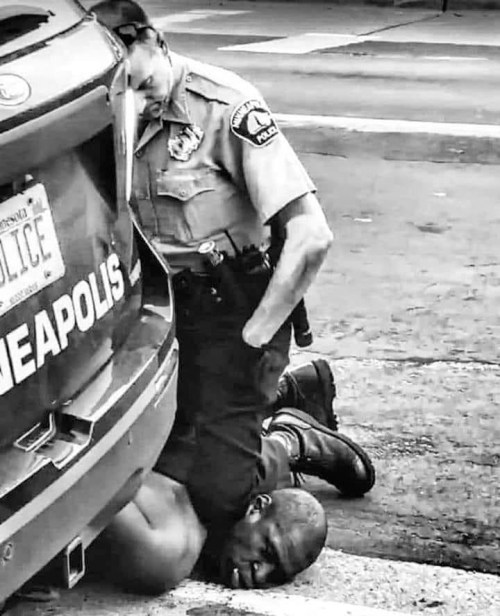
George Floyd and Police. Photographer Unknown
Jesus, Lord, help us to repent.
John 13:35 By this all people will know that you are my disciples, if you have love for one another.”
Luke 10:30 Jesus replied, “A man was going down from Jerusalem to Jericho, and he fell among robbers, who stripped him and beat him and departed, leaving him half dead.
31 Now by chance a priest was going down that road, and when he saw him he passed by on the other side.
32 So likewise a Levite, when he came to the place and saw him, passed by on the other side.
In general, broadly speaking, knowing there are exceptions, but as a basic principle, hasn’t white evangelical America played the role of the priest and Levite in the story of the Good Samaritan? Ever since the very beginning when we pushed the native Americans to the driest, most barren parts of our country with a sigh of “Good riddance,” haven’t good, Christian, church-going white people been ignoring the plight of people of color in our country?
The priest and the Levite did nothing to harm the Samaritan who had been attacked, beaten, robbed, and left for dead by the side of the road. They didn’t throw a stone at him or kick him out of the path. Their sin was that they saw, they witnessed, they understood, and they chose to ignore. They probably said their prayers that night.
Perhaps Trump’s Christian base made an honest error in electing him the first time. But in the wake of all the violent murders, beatings, and oppression by rogue policemen in our country, not just now with the slaying of George Floyd, but the year before that, and the year before that, and the year before that…all the way back to the 1600’s, how can we possibly elect a man for a second term whose mouth spouts hatred, insults, and lies against our fellow human beings with every other tweet? We need to repent on our knees before God, confess our sin of indifference, and elect people at the national, state, and local levels who not only promise to change the culture of policing in America, but people who will actually do it.
And on a personal level, what can white evangelical Christians do? Just for starters, speak out. Call a spade a spade. Don’t tolerate the kind of language we hear from our President on a daily basis. Don’t vote for him. Vote for someone else. Don’t remain silent when you hear your neighbors disparage people of other colors, races, religion, nationality, and cultural mores. Jesus did not appoint us to judge others–he appointed us to love. Write letters to elected officials, including the chief of police in your community when you hear of atrocities. Don’t vote for offenders a second time. Require accountability from policemen.
And what about the aborted unborn? Don’t use them as a scapegoat to excuse our blind eye toward the unjust violence against entire races of people around us. Attend rallies, join a pro-life group, such as 40 Days for Life, buy tickets to movies such as, “Unplanned,” for all your neighbors and your church’s youth group, support your local charities with diapers, baby blankets, clothes, and words of encouragement and love for women without supportive homes for their newborns. Donate. We don’t need a foul-mouthed president in our fight against abortion. Especially when the world he espouses is dangerous for all children and adults not exactly like himself.
Don’t fall for the other excuse that says, “But most policemen are good people who do their jobs well.” That’s a cop-out. If a medical doctor intentionally murdered a patient, would you say, “We can’t discipline him and change the rules because most doctors are good people who do their jobs well?” If you happened to go to a sadist dentist who tricked you into a tooth extraction without medication, would you protect him from all accountability by saying, “Most dentists are great people who do their jobs well?” No, that particular doctor needs to be punished, that particular dentist needs to have his license stripped, and that particular policeman needs to be fired and held accountable in a just court of civil law.
To “love our neighbor” means we need to leave our zones of comfort and actually DO something. We need to stoop, bend, lift, carry, and pay for. Only then will America begin to heal.
Father, forgive ME, for I have sinned. I helped kill George Floyd. Help ME to do better.
Poster for Psalm 103:1–Bless the Lord, O My Soul
Christina Wilson
 One Small Voice